

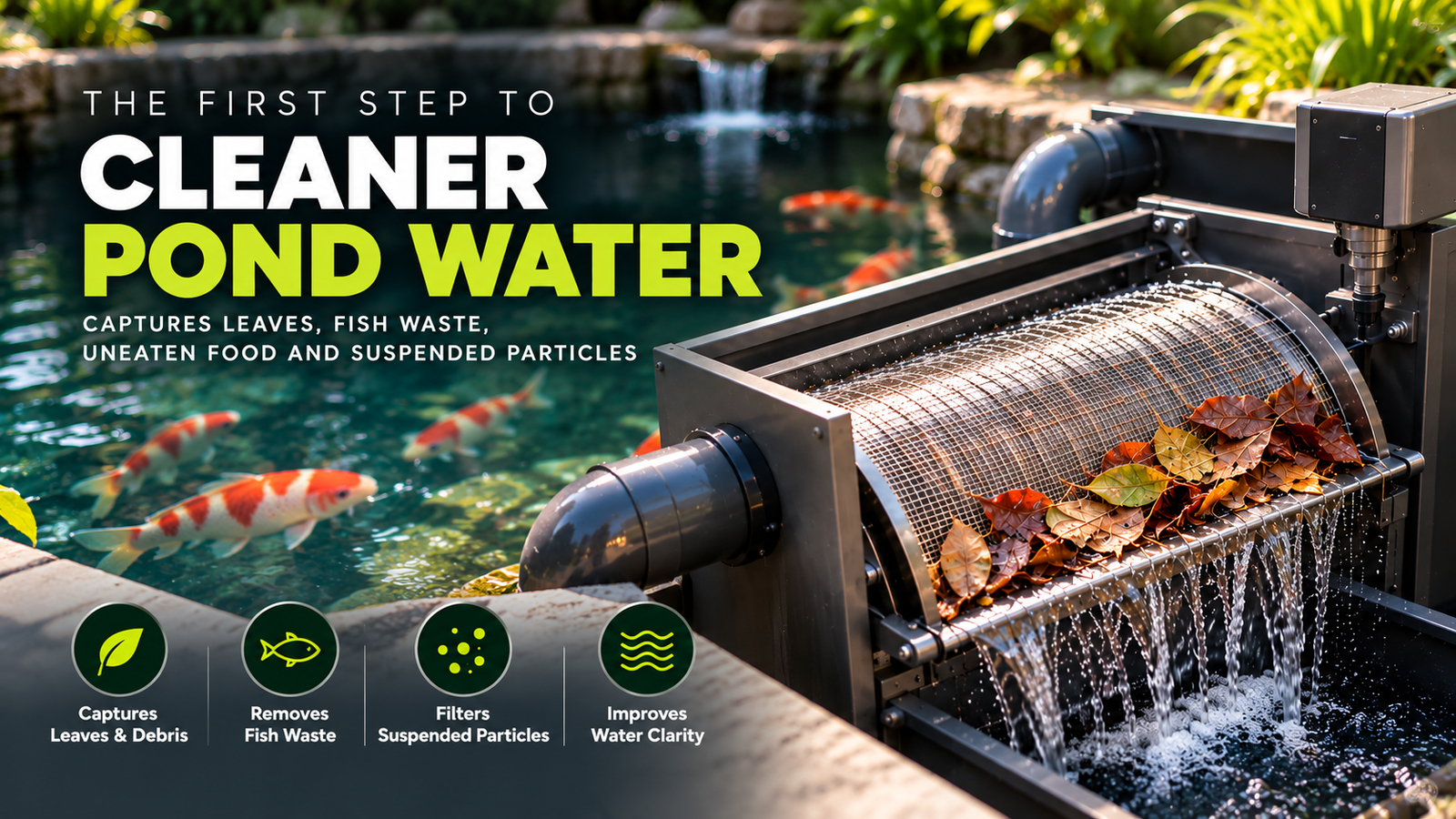
Clear pond water is not only about appearance—it is an important part of maintaining a healthy pond environment for koi and other fish. One of the most important stages of a pond filtration system is pond mechanical filtration.
Mechanical filtration removes physical waste from pond water before it reaches the biological filtration stage. Leaves, uneaten fish food, fish waste, suspended particles and other debris can make pond water cloudy and place additional pressure on the rest of the filtration system.
In this guide, we explain what pond mechanical filtration is, how it works, the different types of mechanical filters, and how to choose the right system for your pond.
What Is Pond Mechanical Filtration?
Pond mechanical filtration is the process of physically removing solid particles and debris from pond water.
Unlike biological filtration, which uses beneficial bacteria to process harmful compounds, mechanical filtration physically captures unwanted particles from the water.
Typical debris removed by mechanical filtration includes:
- Fish waste
- Uneaten fish food
- Leaves and plant debris
- Dirt and dust
- Algae particles
- Suspended solids
- Other visible organic waste
The filtered water can then move through biological filtration and other stages of the pond filtration system.
Why Is Pond Mechanical Filtration Important?
A pond without effective mechanical filtration can quickly develop cloudy water and excessive waste accumulation.
A properly designed pond mechanical filtration system provides several benefits.
1. Removes Solid Waste
Mechanical filters capture larger particles before they circulate throughout the pond. This helps keep the water cleaner and reduces visible debris.
2. Protects Biological Filter Media
When large amounts of solid waste enter the biological filter, the filter media can become clogged. Mechanical filtration removes much of this waste before it reaches the biological stage.
3. Improves Water Clarity
Suspended particles can make pond water look cloudy. Mechanical filtration helps capture these particles and improves overall water clarity.
4. Reduces Maintenance
When solid waste is collected in a dedicated mechanical filter, it can often be removed more easily than when it accumulates throughout the entire filtration system.
5. Supports a Healthier Pond Environment
Cleaner water and effective waste removal contribute to better conditions for koi and other pond fish.
How Does Pond Mechanical Filtration Work?
The basic process is simple.
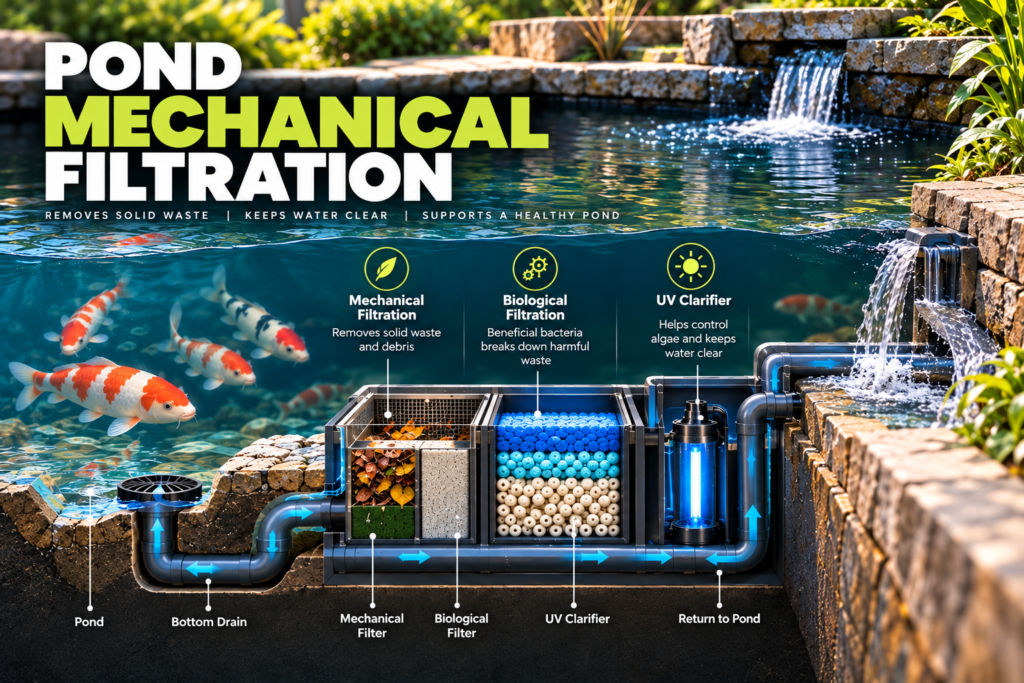
Pond → Pump/Bottom Drain → Mechanical Filter → Biological Filter → UV Clarifier → Pond
Depending on the pond design, the order and equipment can vary.
Water enters the mechanical filtration stage, where physical media or filtration technology captures suspended solids and debris.
The cleaner water then moves to the biological filtration stage, where beneficial bacteria help process dissolved waste compounds.
Types of Pond Mechanical Filtration
There are several types of mechanical filtration systems available for ponds. The right choice depends on pond size, fish population, flow rate and the amount of waste produced.
1. Filter Mats
Filter mats are commonly used in multi-chamber pond filtration systems.
Different densities of filter mats can capture particles of different sizes. They are relatively simple and can be washed or cleaned periodically.
Filter mats are particularly useful as part of a multi-stage filtration system.
2. Filter Brushes
Filter brushes are another traditional mechanical filtration option.
The bristles trap larger particles and suspended debris as water passes through the filtration chamber.
They are commonly used in larger pond filtration systems and can be cleaned when necessary.
3. Sieve Filters
Sieve filters use a fine screen to separate solid waste from water.
Water passes through the screen while larger particles are collected separately. This makes sieve filtration useful for reducing the amount of solid waste entering biological filtration.
4. Drum Filters
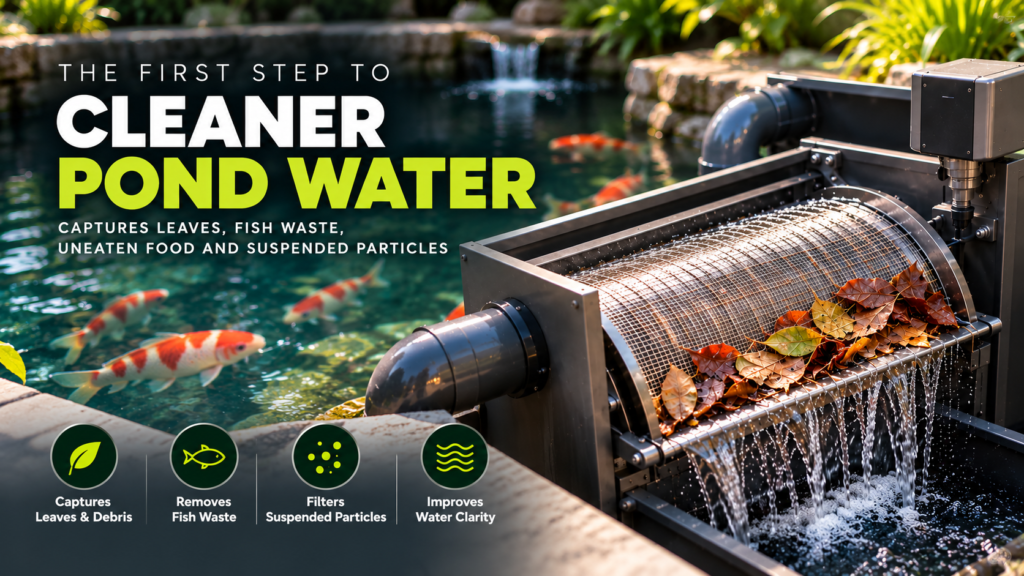
Rotary Drum Filters, commonly called RDF systems, provide automated mechanical filtration.
Water passes through a fine filtration screen inside the drum. As the screen becomes dirty, the system can automatically initiate a cleaning cycle.
This can significantly reduce manual filter cleaning and is particularly useful for larger koi ponds and high-load filtration systems.
5. Settlement Chambers
Settlement chambers allow heavier waste particles to settle out of the water before the water moves into the next filtration stage.
They can be useful in gravity-fed pond filtration systems, especially when combined with other mechanical filtration methods.
Mechanical vs Biological Pond Filtration
Mechanical and biological filtration perform different jobs.
| Mechanical Filtration | Biological Filtration |
|---|---|
| Removes physical particles | Processes dissolved waste |
| Captures fish waste and debris | Uses beneficial bacteria |
| Improves water clarity | Helps control ammonia and nitrite |
| Protects biological media | Supports biological balance |
| Requires physical cleaning | Requires healthy bacterial colonization |
A good pond filtration system generally needs both mechanical and biological filtration rather than relying on only one stage.
Where Should Mechanical Filtration Be Installed?
Mechanical filtration is generally placed before biological filtration.
This allows solid waste to be removed before it reaches the biological filter media.
For example, a pond system may be designed as:
Bottom Drain → Mechanical Filter → Biological Filter → UV Clarifier → Return Pump → Pond
The exact configuration depends on the pond’s construction, plumbing, pump capacity and filtration equipment.
How to Choose Pond Mechanical Filtration
Choosing a mechanical filter should not be based only on the pond’s water volume.
Consider these factors:
Pond Size
Calculate the approximate water volume of the pond first.
A larger pond generally requires a filtration system capable of handling a greater volume of water and waste.
Fish Quantity
Koi produce significantly more waste than lightly stocked ornamental ponds.
A pond with many koi may require a more powerful mechanical filtration system than a pond with fewer fish.
Pump Flow Rate
The filtration system must be compatible with the required water flow.
A pump that moves water too quickly for the filter can reduce filtration effectiveness, while an undersized pump may not provide adequate circulation.
Amount of Debris
Outdoor ponds can collect leaves, dust, insects and other debris. If your pond is surrounded by trees or exposed to significant environmental debris, mechanical filtration becomes particularly important.
Maintenance Requirements
Consider how frequently you are able and willing to clean the filter.
Traditional filter media may require regular manual cleaning, while automated systems such as RDF filters can reduce routine maintenance.
How Often Should Mechanical Pond Filters Be Cleaned?
There is no single cleaning schedule for every pond.
Cleaning frequency depends on:
- Pond size
- Number of fish
- Feeding level
- Filter type
- Amount of debris
- Seasonal conditions
- Water flow
A heavily stocked koi pond may require more frequent mechanical filtration maintenance than a lightly stocked ornamental pond.
The important point is to avoid allowing captured waste to remain in the filter for too long.
Common Pond Mechanical Filtration Mistakes
Using an Undersized Filter
One of the most common problems is choosing a filter based only on pond volume without considering fish load and waste production.
Skipping Mechanical Filtration
Sending heavily contaminated pond water directly into biological media can cause the media to become clogged with solid waste.
Poor Filter Maintenance
Even a high-quality filter will not perform properly if accumulated waste is not removed regularly.
Choosing the Pump Before Designing the Filtration System
The pump and filtration system should be planned together. Flow rate, pipe diameter, filter capacity and pond circulation all need to work together.
Ignoring Bottom Drain Design
A properly designed bottom drain can help transport settled waste toward the filtration system, reducing the amount of debris that remains on the pond floor.
Pond Mechanical Filtration for Koi Ponds
Koi ponds usually require effective mechanical filtration because koi produce a considerable amount of waste.
For a koi pond, a filtration system may combine:
Bottom Drain + Mechanical Filter + Biological Filter + UV Clarifier + Pump
For larger koi ponds, systems such as sieve filters or Rotary Drum Filters can provide more efficient solid-waste separation.
The correct setup should be selected according to the pond volume, koi quantity, pump flow rate and overall pond design.
Mechanical Filtration and UV Clarifiers
Mechanical filtration and UV clarification solve different water-quality problems.
Mechanical filtration removes physical particles from the water.
A UV clarifier uses ultraviolet light to help control suspended algae and microorganisms as water passes through the unit.
For ponds experiencing green water, a properly sized UV clarifier combined with effective filtration can be part of an overall water-quality solution.
How Greenfin Can Help With Pond Filtration
Choosing the correct pond mechanical filtration system can be difficult because every pond has different requirements.
At Greenfin The Pond Studio, pond filtration can be planned according to factors such as:
- Pond dimensions
- Water volume
- Fish quantity
- Pump flow rate
- Pond design
- Mechanical filtration requirements
- Biological filtration requirements
- UV clarification
- Plumbing configuration
Whether you are constructing a new koi pond or upgrading an existing filtration system, selecting the right equipment at the planning stage can make maintenance easier and improve water clarity.
Final Thoughts
Effective pond mechanical filtration is an essential part of maintaining clean and healthy pond water. By removing fish waste, leaves, uneaten food and suspended particles before they reach the biological filter, mechanical filtration helps the entire pond filtration system work more efficiently.
From filter mats and brushes to sieve filters and automated Rotary Drum Filters, there are different solutions for different pond sizes and filtration requirements.
The best filtration setup depends on your individual pond rather than simply choosing the largest available filter.
Need help choosing the right pond filtration system? Share your pond size, fish quantity and pond photos with Greenfin The Pond Studio for a suitable filtration recommendation.
Frequently Asked Questions
What is pond mechanical filtration?
Pond mechanical filtration is the process of physically removing solid waste and suspended particles from pond water before it enters the biological filtration stage.
Is mechanical filtration necessary for a koi pond?
Effective mechanical filtration is especially useful for koi ponds because it helps remove solid waste and protects the biological filtration stage.
What is the difference between mechanical and biological filtration?
Mechanical filtration physically removes particles, while biological filtration uses beneficial bacteria to process dissolved waste compounds.
How often should a pond mechanical filter be cleaned?
Cleaning frequency depends on the pond size, fish load, filter type and amount of debris. Filters should be checked regularly and cleaned when waste accumulates.
Can mechanical filtration remove green pond water?
Mechanical filtration can remove suspended particles, but green water caused by suspended algae generally requires additional treatment such as appropriately sized UV clarification.