

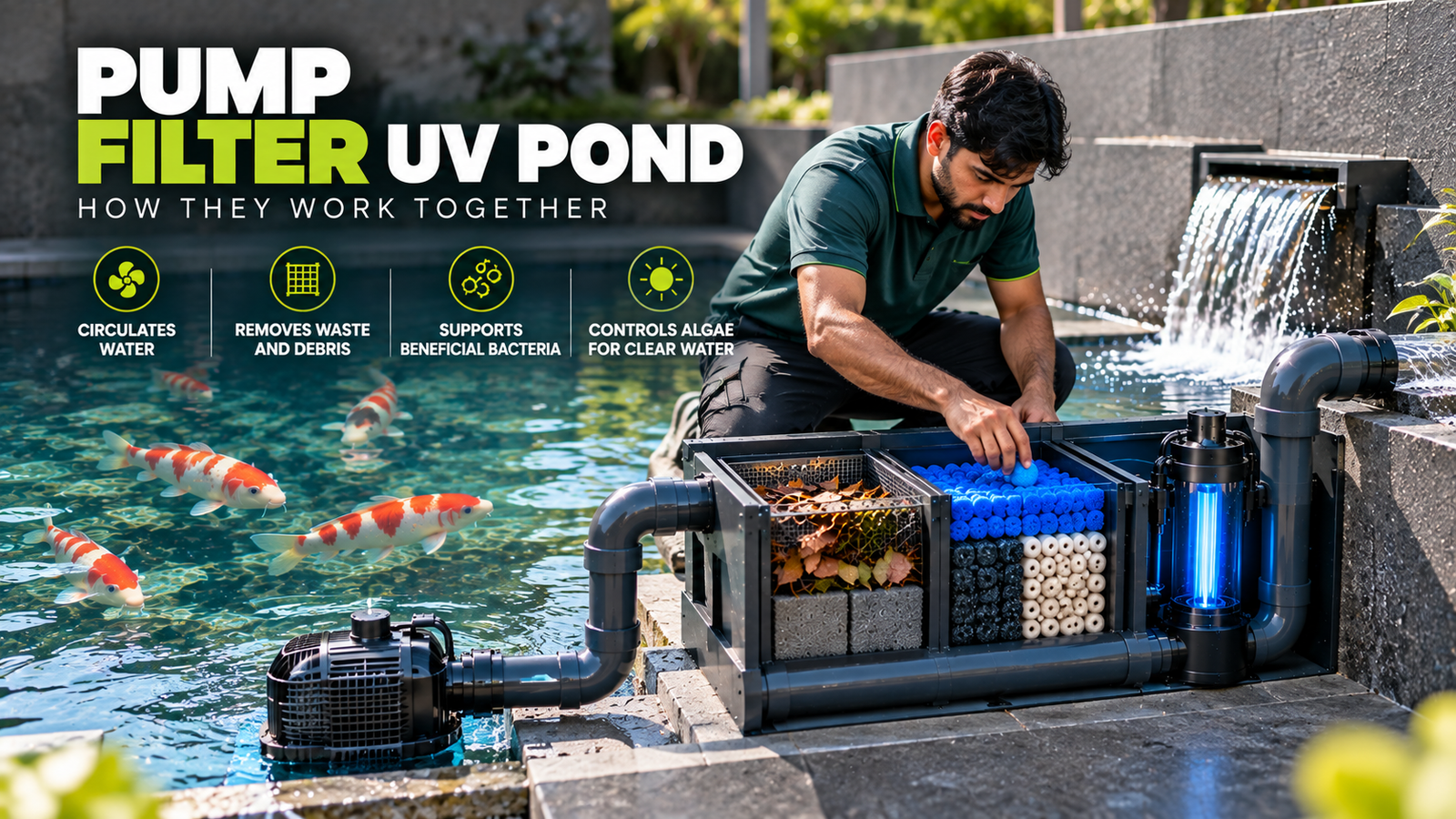
A clear and healthy pond depends on more than just a powerful pump or a good filter. Pump, filter and UV clarifier each perform a different job, and when they are correctly sized and connected, they work together to improve water circulation, remove waste and control suspended algae.
Understanding how these three components work together can help pond owners choose the right filtration system for koi ponds, ornamental ponds and water features.
How Do Pump, Filter and UV Work Together?
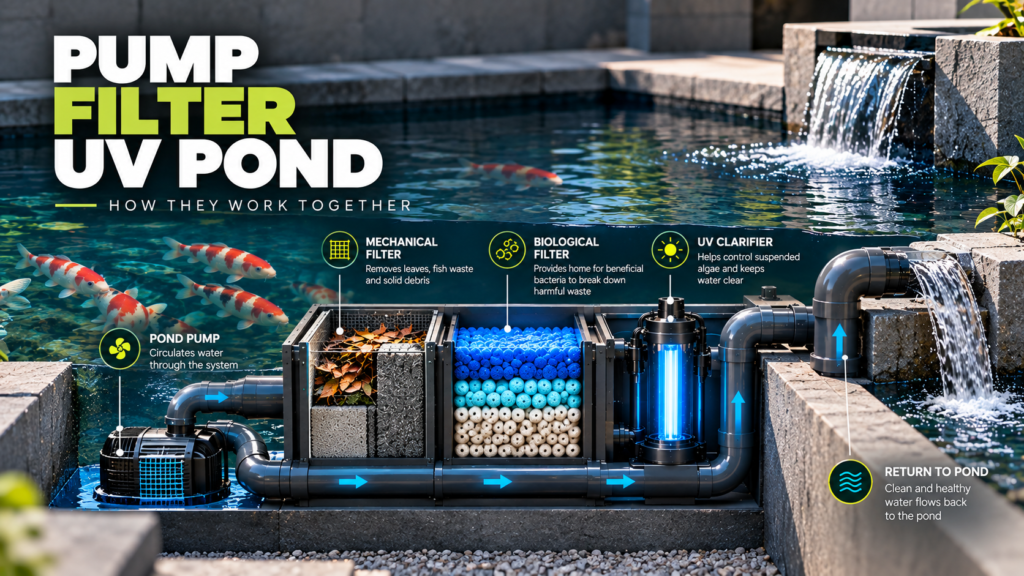
A typical pond filtration system follows this basic water flow:
Pond → Pump → Mechanical Filter → Biological Filter → UV Clarifier → Return to Pond
Depending on the pond design, the exact arrangement may vary. Some systems use gravity-fed filtration, bottom drains or skimmers before the pump.
The important point is that each component has a specific function.
- Pump: Moves and circulates water
- Mechanical filter: Removes solid waste and debris
- Biological filter: Provides a surface for beneficial bacteria
- UV clarifier: Helps control suspended algae and microorganisms
- Return system: Sends treated water back to the pond
1. What Does a Pond Pump Do?
The pond pump is responsible for moving water through the filtration system.
Without adequate water circulation, the filter and UV clarifier cannot work effectively.
The pump moves water from the pond or collection chamber toward the filtration equipment and then returns the treated water to the pond.
Main Functions of a Pond Pump
A properly selected pond pump helps:
- Circulate pond water
- Supply water to the filtration system
- Operate waterfalls and streams
- Supply water to UV clarifiers
- Improve overall water movement
- Return filtered water to the pond
Why Pump Size Matters
Choosing a pump only by its maximum flow rate can be misleading.
The actual flow can be affected by:
- Pipe diameter
- Pipe length
- Vertical lift
- Bends and fittings
- Filter resistance
- UV clarifier resistance
- Waterfall height
Therefore, the required pump should be selected based on the actual system flow requirement, not simply the pump’s maximum rated flow.
2. What Does a Mechanical Pond Filter Do?
The first major filtration stage is usually mechanical filtration.
Pond mechanical filtration physically captures solid particles from the water.
These can include:
- Fish waste
- Uneaten fish food
- Leaves
- Dirt
- Algae particles
- Suspended debris
Mechanical filtration helps prevent large amounts of solid waste from entering the biological filtration stage.
Common mechanical filtration options include:
Filter Mats
Filter mats capture suspended particles as water passes through the media.
Filter Brushes
Brushes trap larger debris and are commonly used in multi-chamber pond filters.
Sieve Filters
Sieve filters separate solid waste from water using a fine screen.
Rotary Drum Filters
A Rotary Drum Filter (RDF) provides highly efficient mechanical filtration and can automatically clean its filtration screen.
For larger koi ponds, an RDF can help reduce manual filter maintenance.
3. What Does a Biological Filter Do?
After mechanical filtration, water can move through biological filtration.
Biological filtration is different from mechanical filtration.
Instead of physically removing waste particles, biological filtration provides surfaces where beneficial bacteria can colonize.
These bacteria help process compounds produced by fish waste.
Common biological filter media include:
- Bio balls
- Ceramic media
- Moving-bed media
- Japanese filter mats
- Other high-surface-area media
A biological filter should generally receive water that has already passed through effective mechanical filtration. This helps reduce the amount of solid waste accumulating inside the biological chamber.
4. What Does a UV Clarifier Do?
A UV clarifier uses ultraviolet light as water passes through the unit.
It is commonly used to help control suspended algae, particularly when pond water develops a green appearance.
A UV clarifier does not replace mechanical or biological filtration.
Instead, it works as another stage in the overall filtration system.
UV Clarifier Benefits
A properly sized UV system can help:
- Control suspended algae
- Improve water clarity
- Reduce certain microorganisms passing through the unit
- Support clearer-looking pond water
The UV unit should be selected according to the pond volume, flow rate and manufacturer’s specifications.
How Pump + Filter + UV Work Together
Think of the system as a water-treatment chain.
Step 1: The Pump Moves the Water
The pump draws or receives water from the pond and sends it toward the filtration system.
Step 2: Mechanical Filtration Removes Solid Waste
The water passes through the mechanical filter, where leaves, fish waste and other physical particles are captured.
Step 3: Biological Filtration Processes Dissolved Waste
The mechanically filtered water enters the biological filter, where beneficial bacteria colonize the media and help process harmful nitrogen compounds.
Step 4: UV Clarification Helps Control Suspended Algae
Water then passes through the UV clarifier, where ultraviolet light helps control suspended algae and microorganisms.
Step 5: Cleaned Water Returns to the Pond
Finally, the treated water is returned to the pond through a return line, waterfall, fountain or other water feature.
The process then repeats continuously.
Pump + Filter + UV: Simple Flow Diagram
POND
↓
PUMP
Moves pond water
↓
MECHANICAL FILTER
Removes leaves, fish waste & debris
↓
BIOLOGICAL FILTER
Supports beneficial bacteria
↓
UV CLARIFIER
Helps control suspended algae
↓
RETURN TO POND
Cleaner, clearer water
↓
POND
The cycle continues.
Why All Three Components Are Important
A common mistake is expecting one piece of equipment to solve every water-quality problem.
For example, a powerful pump can circulate water, but a pump does not filter water.
Similarly, a UV clarifier can help control suspended algae, but UV does not physically remove leaves and fish waste.
A mechanical filter can capture solid waste, but it does not perform the same function as biological filtration or UV clarification.
Each component has a different role.
| Equipment | Main Function |
|---|---|
| Pond Pump | Moves and circulates water |
| Mechanical Filter | Removes solid particles |
| Biological Filter | Supports beneficial bacteria |
| UV Clarifier | Helps control suspended algae |
| Return System | Sends treated water back to pond |
How to Choose the Right Pump for Your Pond
Before selecting a pump, calculate the approximate pond volume.
For a rectangular pond:
Length × Width × Average Depth = Water Volume
For example:
A pond measuring 4 m × 3 m × 1 m contains approximately:
4 × 3 × 1 = 12 m³
Since 1 cubic metre equals 1,000 litres:
12 m³ = 12,000 litres
However, pump selection should not be based only on the pond volume. The desired turnover rate, filtration capacity, pipework and elevation also need to be considered.
How to Choose the Right Filter
The filter should be suitable for both the water volume and fish load.
A pond containing a large number of koi generally produces more waste than a lightly stocked ornamental pond.
Consider:
- Pond volume
- Number and size of fish
- Feeding quantity
- Pump flow
- Mechanical filtration capacity
- Biological media capacity
- Available filter space
- Maintenance requirements
For heavily stocked koi ponds, a combination of efficient mechanical and biological filtration may be required.
How to Choose a UV Clarifier
UV sizing depends on several factors, including:
- Pond volume
- Water flow through the UV
- Amount of sunlight
- Algae load
- Fish stocking
- Manufacturer recommendations
The UV wattage alone does not determine performance. The flow rate through the UV unit is also important.
If water passes through the UV unit too quickly, contact time may be insufficient for the intended treatment.
Common Pump + Filter + UV Mistakes
1. Using an Oversized Pump
An extremely high-flow pump is not automatically better. The filtration equipment must be able to handle the flow.
2. Using an Undersized Pump
Insufficient circulation can reduce filtration performance and create areas of stagnant water.
3. Choosing a Filter Only by Pond Volume
Fish quantity and waste production are also important when selecting filtration.
4. Installing UV Without Proper Flow Planning
The UV clarifier and pump should be matched according to the manufacturer’s recommended flow range.
5. Neglecting Mechanical Filtration
Allowing excessive solid waste to reach biological media can increase maintenance and reduce filtration efficiency.
6. Ignoring Pipe Size
Small pipes and excessive bends can create additional resistance and reduce actual water flow.
Best Filtration Setup for a Koi Pond
A koi pond may use a setup such as:
Bottom Drain / Skimmer
↓
Mechanical Filtration
↓
Biological Filtration
↓
UV Clarifier
↓
Pump / Return System
↓
Pond
For larger koi ponds, more advanced systems such as Rotary Drum Filters, multi-chamber filtration systems and pressurized biological filters may be incorporated depending on the pond design.
Pump + Filter + UV Maintenance
Regular maintenance is essential for reliable filtration performance.
Pump Maintenance
Check:
- Pump intake
- Impeller
- Strainer
- Pipe connections
- Unusual noise or vibration
Filter Maintenance
Remove accumulated solid waste according to the filter type and manufacturer’s instructions.
UV Maintenance
Check the UV lamp and quartz sleeve regularly. UV lamps also have a limited operating life and should be replaced according to the manufacturer’s recommendations.
Can Pump + Filter + UV Keep Pond Water Crystal Clear?
These components can play an important role in maintaining clear pond water, but they are not the only factors involved.
Water clarity can also be affected by:
- Fish stocking
- Feeding
- Sunlight
- Algae growth
- Pond design
- Water quality
- Filtration capacity
- Regular maintenance
- Debris entering the pond
A properly designed filtration system should therefore be considered as a complete system rather than simply buying the biggest pump, filter or UV available.
Final Thoughts
A successful pond filtration system depends on different components working together.
The pump circulates the water, the mechanical filter removes solid waste, the biological filter supports beneficial bacteria, and the UV clarifier helps control suspended algae.
When these components are correctly sized and installed, they can provide effective water circulation and filtration for koi ponds, ornamental ponds and water features.
At Greenfin The Pond Studio, pond filtration can be planned based on your pond dimensions, water volume, fish quantity, pump requirements and filtration needs.
Need help selecting a pump, filter and UV system for your pond? Share your pond size, fish count and pond photos with Greenfin Pond Studio for a suitable filtration recommendation.
Frequently Asked Questions
What is the role of a pump in a pond filtration system?
The pump circulates pond water through the filtration equipment and returns treated water to the pond.
Can a UV clarifier replace a pond filter?
No. A UV clarifier performs a different function from mechanical and biological filtration. It should generally be used as part of a complete filtration system.
What comes first, the filter or UV?
The exact arrangement depends on the system design and manufacturer’s recommendations. In many systems, mechanical and biological filtration are used before UV clarification.
How do I choose the right pond pump?
Consider pond volume, desired circulation, filter flow requirements, pipework, vertical lift and waterfall requirements rather than looking only at the pump’s maximum flow.
Do koi ponds need mechanical and biological filtration?
Koi ponds generally benefit from both mechanical and biological filtration because solid waste and dissolved waste require different filtration processes.