

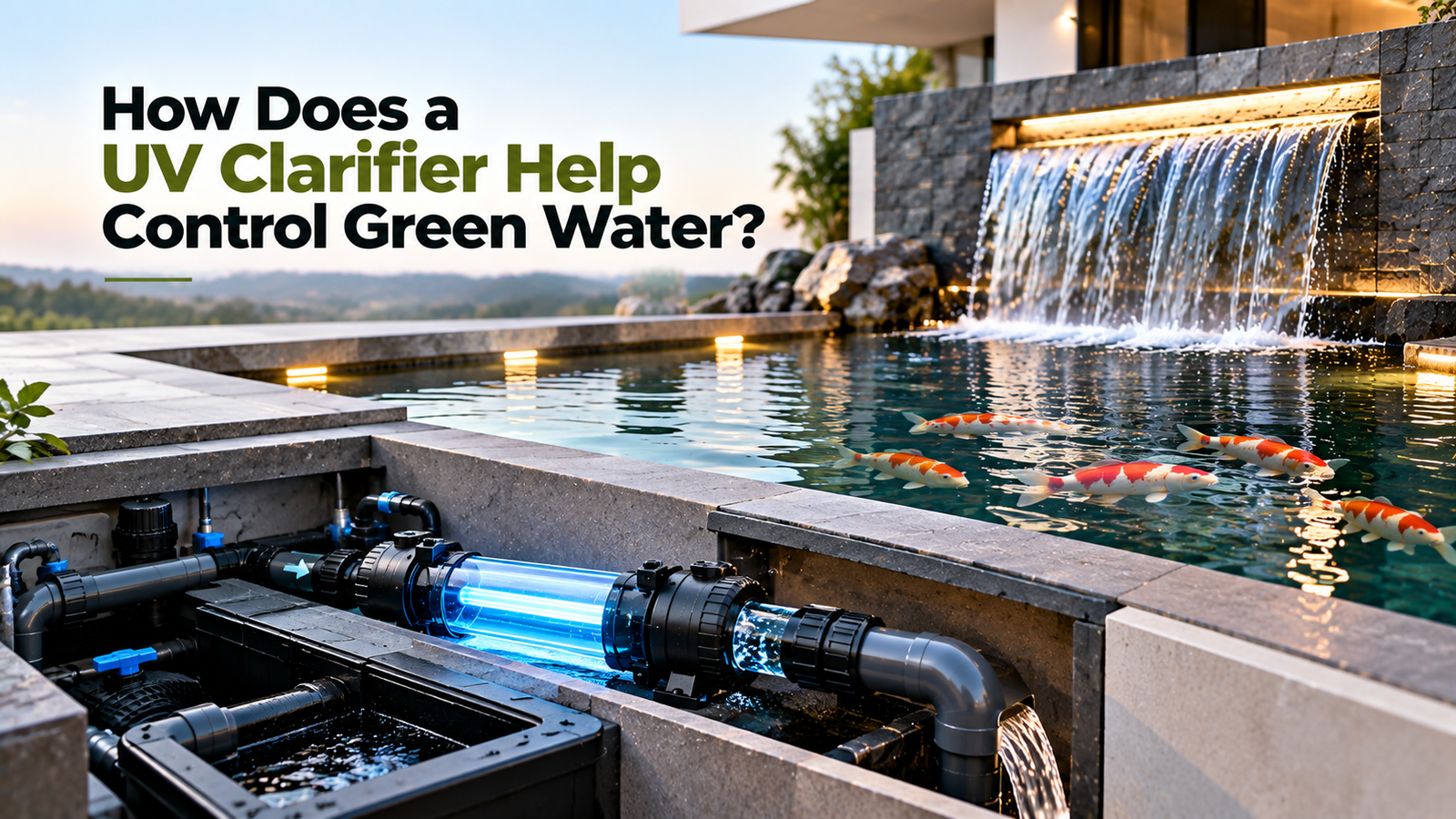
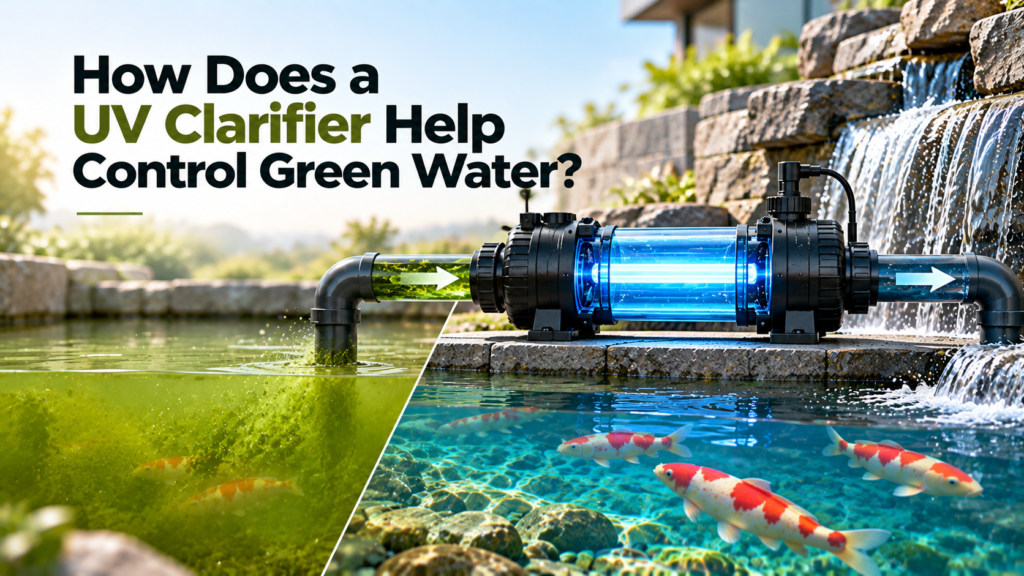
Green pond water is one of the most common problems faced by pond owners, especially during warm and sunny weather. A pond that was once clear can suddenly become green and cloudy, making it difficult to see fish, rocks, and other features beneath the surface.
One of the most effective pieces of equipment used to control suspended algae is a UV clarifier.
But how does a UV clarifier work? Does it actually remove green water? Where should it be installed? And is a UV clarifier enough on its own to maintain clear pond water?
In this guide, we explain how a UV clarifier helps control green water, how it works with a pond filtration system, and what pond owners should consider when choosing one.
What Causes Green Pond Water?
Green pond water is usually caused by microscopic algae suspended throughout the water.
Unlike string algae, which grows on surfaces and forms long strands, suspended algae can make the entire pond look green or cloudy.
Several factors can contribute to green water, including:
- Excess sunlight
- Warm water temperatures
- Excess nutrients
- Fish waste
- Decaying leaves and organic matter
- Overfeeding fish
- Poor filtration
- Insufficient water circulation
A pond with high nutrient levels and plenty of sunlight can provide ideal conditions for algae growth.
This is why controlling green water usually requires more than one solution.
What Is a UV Clarifier?
A UV clarifier is a pond filtration component that uses ultraviolet light to help control suspended algae and certain microorganisms flowing through the unit.
Water is pumped through the UV chamber, where it passes close to a UV-C lamp. The ultraviolet radiation affects microorganisms suspended in the water.
When used correctly as part of a properly designed pond filtration system, a UV clarifier can help reduce the green appearance of pond water.
It is commonly used in:
- Koi ponds
- Garden ponds
- Fish ponds
- Water features
- Large ornamental ponds
- Pond filtration systems
How Does a UV Clarifier Help Control Green Water?
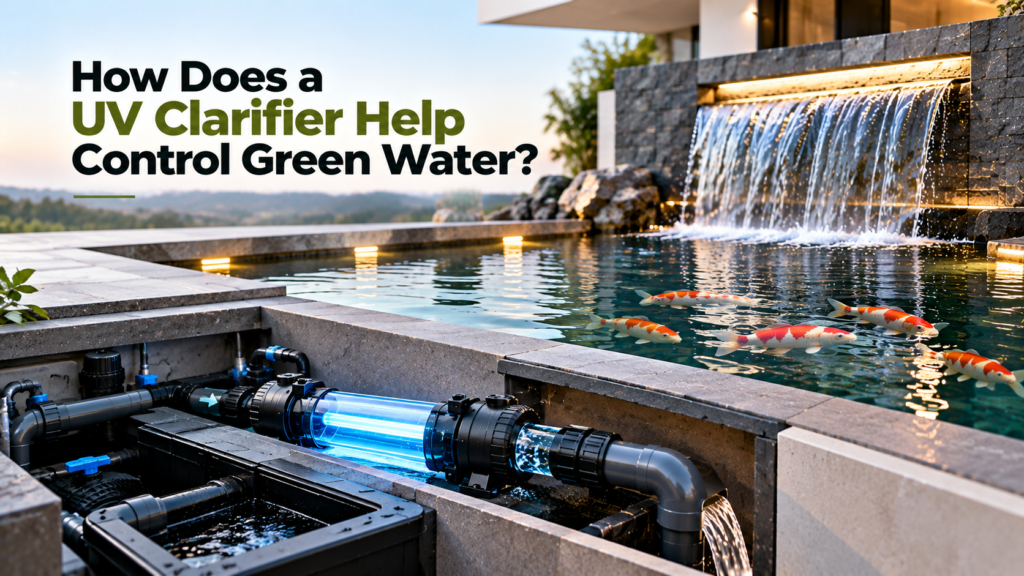
The basic process is simple.
Step 1: Pond Water Enters the System
A pond pump moves water from the pond or filtration chamber into the filtration system.
Step 2: Water Passes Through the UV Chamber
The water flows through the UV clarifier, passing around the UV lamp.
Step 3: UV Light Acts on Suspended Algae
The UV radiation affects the suspended algae as the water passes through the chamber.
Step 4: Water Continues to the Filter
The treated water then continues through the pond filtration system.
As the cycle continues, the amount of suspended algae in the circulating water can be reduced, helping the pond gradually become clearer.
UV Clarifier vs UV Sterilizer
The terms UV clarifier and UV sterilizer are sometimes used interchangeably, but they can refer to different applications.
A UV clarifier is commonly used to control suspended algae that causes green or cloudy-looking water.
A UV sterilizer is generally associated with higher levels of microbial control.
The effectiveness of either setup depends on factors such as:
- UV lamp power
- Water flow rate
- Contact time
- Pond size
- Water clarity
- Installation
- Lamp condition
- Overall filtration
For ordinary green pond water, a correctly sized UV clarifier can be an important part of the filtration system.
Why Does Green Water Become Clear After UV Treatment?
Suspended algae can multiply rapidly when pond conditions are favourable.
When water continuously passes through an appropriately sized UV clarifier, the UV treatment can affect the suspended algae.
The affected algae can then be captured by mechanical filtration as the water continues through the pond’s filtration system.
This is why UV clarification and mechanical filtration work well together.
The UV unit helps address suspended algae, while the filter helps remove particles and waste from the water.
Does a UV Clarifier Remove All Types of Algae?
No.
This is an important point for pond owners.
A UV clarifier is primarily useful for suspended algae in the water column.
It does not directly remove every form of algae growing on pond surfaces.
For example, string algae or blanket weed attached to rocks and pond surfaces may require other control methods.
If the pond has excessive algae growth, it is important to identify the type of algae before deciding on a treatment approach.
UV Clarifier and Pond Filter: Why You Need Both
A common misconception is that installing a UV clarifier alone will solve every pond water problem.
A healthy pond system normally requires multiple stages of water management.
A typical setup may look like:
Pond → Skimmer/Bottom Drain → Mechanical Filtration → UV Clarifier → Biological Filtration → Pump → Waterfall → Pond
The exact arrangement depends on the pond design and equipment being used.
Mechanical Filtration
Mechanical filtration helps remove physical particles such as:
- Leaves
- Dirt
- Fish waste
- Fine debris
- Suspended particles
Biological Filtration
Biological filtration provides surfaces where beneficial bacteria can colonize and help process fish waste.
UV Clarification
UV treatment helps control suspended algae and contributes to clearer-looking water.
Together, these components provide a more complete approach to pond filtration.
How to Choose the Right UV Clarifier
Selecting a UV clarifier should not be based only on the size of the UV lamp.
Consider the following factors.
1. Pond Volume
First, determine the approximate volume of your pond.
For a simple rectangular pond:
Length × Width × Average Depth × 1,000 = Approximate Litres
For irregular ponds, the actual volume will require a more detailed calculation.
2. Water Flow Rate
The flow rate through the UV unit is extremely important.
If water moves through the chamber too quickly, the exposure time may not be sufficient for the intended application.
Always follow the manufacturer’s recommended flow rates.
3. UV Lamp Wattage
UV clarifiers are available in different wattages.
The appropriate wattage depends on factors such as:
- Pond volume
- Algae level
- Water flow
- Pond exposure to sunlight
- Fish stocking
- Manufacturer specifications
A larger pond generally requires a system designed for a greater water volume.
4. Pond Type
A heavily stocked koi pond can have different filtration requirements compared with a small ornamental garden pond.
Consider the complete pond environment before selecting your equipment.
How Long Does It Take for a UV Clarifier to Clear Green Water?
The time required to improve water clarity can vary.
It depends on:
- Severity of the algae problem
- UV clarifier size
- Water flow
- Filtration capacity
- Pond volume
- Sunlight exposure
- Nutrient levels
- Fish stocking
- Maintenance
A UV clarifier does not instantly make green water clear.
The pond water needs to circulate through the system repeatedly, while the filtration system needs to capture the resulting particles.
For this reason, patience and proper filtration are important.
Does a UV Clarifier Kill Beneficial Bacteria?
A UV clarifier is installed within the circulating water system, so its effect depends on how the system is designed and where the unit is installed.
Beneficial bacteria primarily colonize surfaces inside biological filters and on filter media rather than freely floating throughout the pond.
For this reason, proper system design and UV placement are important.
If you are installing a new pond filtration system, consider the relationship between the pump, mechanical filter, UV clarifier, and biological filter rather than treating each component separately.
How Often Should a UV Lamp Be Replaced?
UV lamps gradually lose their effectiveness as they age, even when they still appear to be producing light.
The replacement interval depends on the specific UV unit and manufacturer’s recommendation.
Regular maintenance should include:
- Checking the UV lamp
- Cleaning the quartz sleeve
- Inspecting seals
- Checking water flow
- Removing debris from the system
- Replacing the lamp according to manufacturer guidance
A dirty quartz sleeve can reduce the amount of UV reaching the water.
How to Maintain a UV Clarifier
Regular maintenance helps keep the system working properly.
Clean the Quartz Sleeve
Mineral deposits and dirt can accumulate on the quartz sleeve surrounding the lamp.
Clean it according to the manufacturer’s instructions.
Check the Lamp
Inspect the UV lamp and replace it when recommended.
Check Water Flow
Make sure the pump is delivering water within the recommended flow range.
Inspect Connections
Check hoses, fittings, seals, and electrical connections regularly.
Keep the Filter Clean
A clogged mechanical filter can reduce water flow and affect the performance of the overall system.
Other Ways to Reduce Green Pond Water
A UV clarifier is only one part of green water management.
You should also focus on the underlying pond conditions.
Reduce Excess Feeding
Uneaten food contributes nutrients to the pond and can encourage algae growth.
Feed fish appropriately and remove uneaten food where possible.
Control Organic Waste
Remove fallen leaves, dead plants, and accumulated debris before they break down and add nutrients to the water.
Maintain Good Filtration
A properly designed filtration system helps manage waste and suspended particles.
Provide Adequate Water Movement
Good circulation helps distribute oxygen and move water through the filtration system.
Manage Sunlight
Excessive direct sunlight can encourage algae growth. Where practical, pond design can include suitable shade without excessively covering the pond.
Common Mistakes When Using a UV Clarifier
Choosing a UV Unit Without Checking Pond Volume
Always compare the unit’s specifications with your actual pond requirements.
Ignoring Flow Rate
A UV clarifier needs an appropriate flow rate. More flow is not automatically better.
Not Cleaning the Quartz Sleeve
A dirty sleeve can reduce UV performance.
Forgetting Lamp Replacement
A lamp can continue glowing while its effective UV output has decreased.
Expecting UV to Replace Filtration
UV clarification does not replace mechanical and biological filtration.
Is a UV Clarifier Worth It for a Koi Pond?
For ponds that frequently experience green water caused by suspended algae, a properly sized UV clarifier can be a useful component of the filtration system.
However, it should be considered as part of a complete pond management strategy.
For koi ponds, the filtration system should also account for:
- Fish stocking levels
- Pond volume
- Mechanical filtration
- Biological filtration
- Pump capacity
- Bottom drains
- Skimmers
- Water circulation
- Aeration
A properly designed system can make routine pond maintenance easier and help maintain better water clarity.
Final Thoughts
A UV clarifier can be an effective tool for controlling green pond water caused by suspended algae. By continuously treating circulating water with UV light and working alongside mechanical and biological filtration, it can help improve water clarity.
However, the UV clarifier should not be viewed as a standalone solution. Pond volume, filtration, pump flow, nutrient levels, sunlight, fish stocking, and regular maintenance all influence water quality.
If your pond frequently turns green, start by identifying the cause and then consider a properly sized UV clarifier and complete pond filtration system.
At Greenfin The Pond Studio, you can find pond pumps, UV clarifiers, filtration equipment, skimmers, filter media, and pond solutions for different pond requirements.
Explore pond equipment and filtration solutions at greenfinindia.com.
Frequently Asked Questions
Does a UV clarifier clear green pond water?
A properly sized UV clarifier can help control suspended algae responsible for green-looking pond water. It works best when combined with appropriate mechanical and biological filtration.
Can I use a UV clarifier without a pond filter?
A UV clarifier can treat circulating water, but it does not replace mechanical or biological filtration. A complete filtration system is generally more effective for maintaining pond water quality.
How many watts of UV do I need for my pond?
The required UV capacity depends on pond volume, water flow, pond conditions, and the manufacturer’s specifications. It is important to select a unit based on the complete system rather than wattage alone.
How often should I clean a UV clarifier?
Inspect and clean the quartz sleeve and other components according to the manufacturer’s maintenance instructions. Regular inspection helps maintain effective UV performance.
Will a UV clarifier remove string algae?
UV clarifiers are primarily designed to help control suspended algae in the water. They are not a direct solution for string algae attached to pond surfaces.
Can a UV clarifier be used in a koi pond?
Yes. UV clarification is commonly incorporated into koi pond filtration systems to help control suspended algae and improve water clarity when correctly sized and installed.