

Choosing the right filtration system is one of the most important decisions when building or upgrading a pond. A good filtration system helps remove waste, supports beneficial bacteria, improves water quality, and keeps the pond looking clean.
Two popular options for pond filtration are multi-chamber filtration systems and pressurized pond filters. Both can be effective, but they are designed for different pond sizes, layouts, fish loads, and maintenance requirements.
So, which pond filter should you choose?
The answer depends on your pond volume, fish population, available space, waterfall requirements, maintenance preferences, and overall filtration goals.
In this guide, we compare multi-chamber vs pressurized pond filters to help you understand how each system works and where it is most suitable.
What Is a Multi-Chamber Pond Filter?
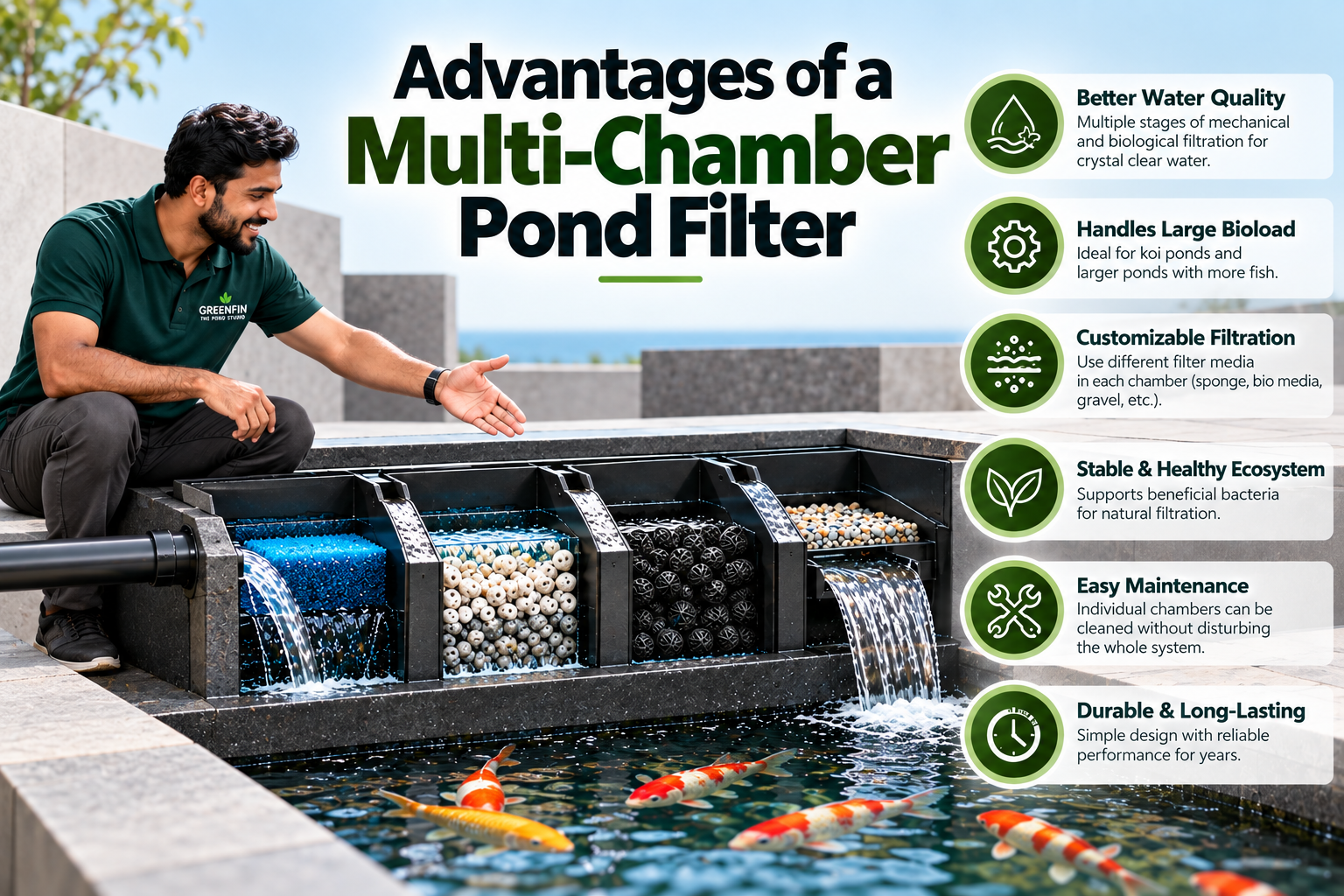
A multi-chamber pond filter is a filtration system divided into several chambers. Water passes through different stages of filtration before returning to the pond.
Each chamber can contain different types of filter media designed for mechanical and biological filtration.
A typical multi-chamber system may include:
- Filter brushes
- Filter mats
- Filter sponge
- Japanese filter media
- Bio balls
- Ceramic biological media
- Moving-bed media
- Other biological filter media
Because the chambers can be customized, multi-chamber filtration systems are commonly used for larger ponds and koi ponds.
How Does a Multi-Chamber Filter Work?
Water from the pond is directed into the first chamber.
Stage 1: Mechanical Filtration
The first stage captures larger particles such as:
- Fish waste
- Leaves
- Uneaten food
- Dirt
- Sludge
- Suspended debris
This reduces the amount of solid waste entering the biological stages.
Stage 2: Fine Mechanical Filtration
The following chamber can contain finer filter media to capture smaller suspended particles.
The exact arrangement depends on the filter design.
Stage 3: Biological Filtration
The biological chambers provide surfaces for beneficial bacteria to colonize.
These bacteria help process nitrogenous waste generated by fish and decomposing organic matter.
Stage 4: Final Filtration or Water Return
The final chamber may contain additional biological media or polishing media before the water is returned to the pond.
The number and arrangement of chambers can be customized according to the pond design.
What Is a Pressurized Pond Filter?
A pressurized pond filter is a closed filtration unit through which water is pumped under pressure.
Unlike many traditional gravity-flow chamber systems, pressurized filters are enclosed and can often be installed in compact spaces.
Many pressurized pond filters combine mechanical and biological filtration in one unit.
Some models also include an integrated UV clarifier, which can help control suspended algae and improve water clarity.
How Does a Pressurized Pond Filter Work?
The pond pump pushes water into the filter.
Inside the filter, water passes through filtration media that capture particles and provide surfaces for beneficial bacteria.
The filtered water then exits the unit and can be directed toward:
- The pond
- A waterfall
- A stream
- A fountain
- Other water features
Because the system operates under pressure, it provides flexibility when the filtered water needs to travel to a higher elevation.
Multi-Chamber vs Pressurized Pond Filter
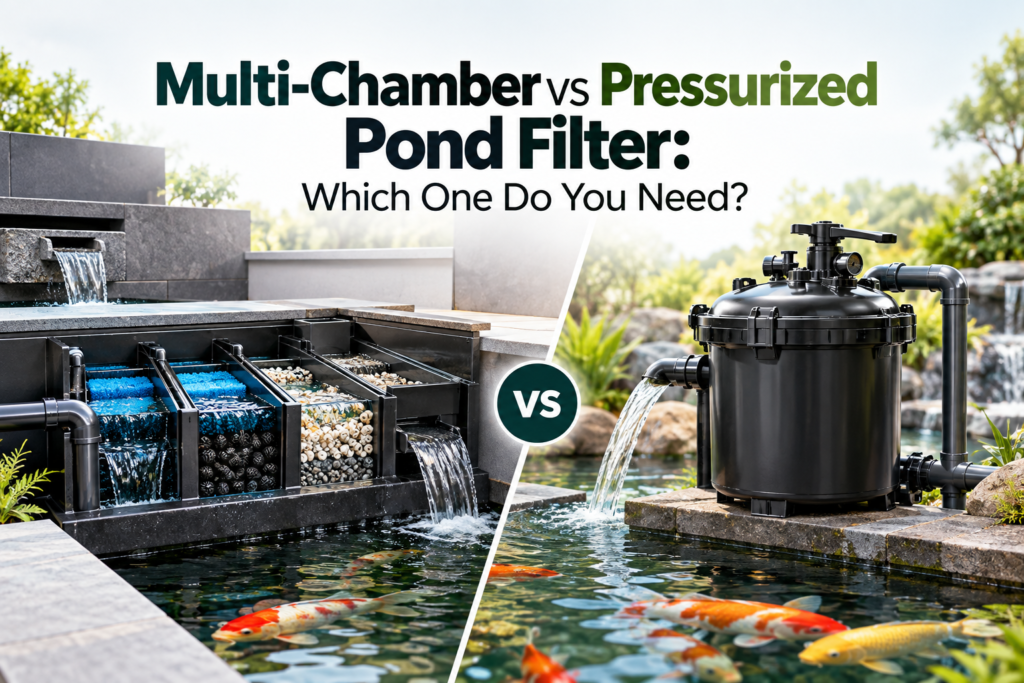
The two systems differ in design, installation, maintenance, capacity, and flexibility.
| Feature | Multi-Chamber Filter | Pressurized Pond Filter |
|---|---|---|
| Design | Multiple open/accessible chambers | Closed pressurized unit |
| Filtration | Mechanical + biological | Mechanical + biological |
| Capacity | Suitable for medium to large systems | Small to medium systems depending on model |
| Customization | High | Limited to the unit design |
| Filter Media | Highly customizable | Manufacturer-specified |
| Space | Requires more installation space | More compact |
| Maintenance | Manual chamber cleaning | Often easier cleaning |
| Installation | Requires planning | Generally simpler |
| Waterfalls | Can be designed for waterfalls | Suitable for pressurized returns |
| UV Integration | Separate UV or custom integration | Some models include UV |
| Expansion | Easier to expand | Limited by unit capacity |
| Large Koi Ponds | Can be designed for high fish loads | Model-dependent |
The actual performance depends on the specific filter model, pump, plumbing, pond volume, fish load, and system design.
Advantages of a Multi-Chamber Pond Filter
1. Highly Customizable
One of the biggest advantages is flexibility.
You can select different filter media for different chambers according to the requirements of the pond.
For example, one chamber can focus on mechanical filtration while subsequent chambers are dedicated to biological filtration.
2. Suitable for Larger Ponds
A properly designed multi-chamber filtration system can handle larger water volumes and higher fish loads.
This makes it a common choice for large koi ponds and professionally designed pond systems.
3. Large Biological Filtration Capacity
Multiple chambers provide significant space for biological media.
This can be useful when maintaining ponds with a high fish population.
4. Easy Access to Filter Media
The chambers are generally accessible, making it possible to inspect, clean, replace, or rearrange filtration media.
5. Flexible System Design
A multi-chamber system can be designed around the pond’s:
- Water volume
- Fish population
- Pump capacity
- Bottom drain
- Skimmer
- Waterfall
- Available space
This makes it useful for customized pond projects.
Advantages of a Pressurized Pond Filter
1. Compact Design
Pressurized filters generally occupy less space than large multi-chamber filtration systems.
This makes them useful when installation space is limited.
2. Easier Installation
Many pressurized systems are designed as complete filtration units, which can simplify installation.
They can be connected to a suitable pond pump and integrated into the pond’s plumbing system.
3. Suitable for Waterfalls
Because water is pumped through the filter under pressure, the outlet can often be routed to a waterfall or elevated return.
This can make pressurized filters convenient for garden ponds and decorative water features.
4. Easier Routine Cleaning
Many pressurized filters include cleaning or backwash mechanisms.
Depending on the model, cleaning can be performed without completely removing the filter media.
5. Some Models Include UV Clarification
Certain pressurized pond filters have built-in UV systems.
This can be useful for pond owners who want filtration and UV clarification in one compact unit.
Which Filter Is Better for a Koi Pond?
There is no single filtration system that is suitable for every koi pond.
The correct choice depends on the pond’s design.
For example, a large koi pond with a high fish population may require substantial mechanical and biological filtration capacity.
A multi-chamber system can be designed with multiple stages and a large quantity of biological media.
For a smaller ornamental pond or garden pond, a pressurized filter may provide a compact filtration solution.
The important point is to size the filtration system according to the actual pond conditions rather than choosing a filter based only on the manufacturer’s maximum pond-volume claim.
Multi-Chamber vs Pressurized Filter for Waterfalls
If your pond includes a waterfall, the filtration system must be capable of supplying the required water flow and overcoming the vertical lift.
A pressurized filter can be convenient for this type of installation because the filtered water can be pumped toward an elevated waterfall.
A multi-chamber system can also be incorporated into a waterfall system, but the plumbing and pump arrangement need to be planned carefully.
The pump should be selected based on actual flow requirements, pipe diameter, pipe length, bends, filter resistance, and waterfall height.
What About Maintenance?
Maintenance is an important factor when selecting a pond filter.
Multi-Chamber Filter Maintenance
Depending on the design, maintenance can include:
- Removing accumulated sludge
- Cleaning mechanical media
- Inspecting biological media
- Checking water flow
- Cleaning chambers
- Inspecting plumbing
The maintenance frequency depends on the pond’s fish load and amount of waste.
Pressurized Filter Maintenance
Maintenance can be simpler for many pressurized systems, especially when they include convenient cleaning or backwash functions.
However, the filter still requires periodic inspection and maintenance.
A pressurized filter should not be considered maintenance-free.
Which Filter Requires More Space?
Space requirements are another important consideration.
A multi-chamber filter generally requires dedicated space because the chambers need to be installed and accessed for maintenance.
A pressurized filter has a more compact footprint and can be easier to integrate into smaller pond installations.
If space is limited, a pressurized filtration system may therefore be more practical.
How to Choose the Right Pond Filter
Before selecting a filter, consider these factors:
1. Pond Volume
Calculate the approximate amount of water in the pond.
2. Fish Population
A pond containing many koi requires more filtration capacity than a lightly stocked ornamental pond.
3. Fish Size
Large koi produce considerably more waste than small fish, so filtration requirements can increase as the fish grow.
4. Pump Flow
The filter must be compatible with the pump and the required flow rate.
5. Available Space
Consider both installation space and access for maintenance.
6. Waterfall or Fountain
If you have a waterfall or fountain, account for the required flow and vertical lift.
7. Maintenance Preference
Consider whether you prefer a customizable filtration system or a more compact system with convenient cleaning.
8. Future Expansion
If you expect your fish population to increase, consider designing the filtration system with additional capacity.
Can You Use a UV Clarifier With Both Systems?
Yes.
A UV clarifier can be used as part of many pond filtration setups.
Its purpose is different from mechanical and biological filtration.
Mechanical filtration removes physical particles.
Biological filtration supports beneficial bacteria.
UV clarification helps control suspended microscopic algae.
For ponds suffering from persistent green water, combining these filtration stages can provide a more comprehensive water-management approach.
Common Mistakes When Choosing a Pond Filter
Choosing a Filter Only by Pond Volume
A manufacturer’s stated pond capacity may not represent the actual capacity for a heavily stocked koi pond.
Always consider fish load and filtration requirements.
Using an Undersized Pump
A pump that does not provide sufficient actual flow can reduce filtration performance.
Ignoring Plumbing
Long pipes, narrow pipes, multiple bends, and excessive elevation can reduce actual water flow.
Not Providing Enough Mechanical Filtration
If large amounts of solid waste reach biological media, the system may require more frequent maintenance.
Ignoring Future Fish Growth
Koi grow over time. A system designed only for today’s fish population may become inadequate later.
Multi-Chamber vs Pressurized Pond Filter: Which Should You Choose?
The right choice depends on your individual pond.
A multi-chamber filtration system may be suitable when you need:
- High filtration capacity
- Large biological media volume
- Custom filtration stages
- A solution for larger koi ponds
- Greater control over filter media
- A system that can be customized around the pond design
A pressurized pond filter may be suitable when you need:
- Compact filtration
- Easier installation
- Convenient maintenance
- A solution for smaller or medium pond systems
- Pressurized water return
- Integrated UV clarification in selected models
Instead of asking which filter is universally better, the more useful question is:
Which filtration system is correctly sized and designed for your pond?
Get the Right Pond Filtration Solution With Greenfin India
Choosing a pond filter is only one part of designing a successful pond filtration system.
Pump capacity, pipe sizing, fish population, pond volume, bottom drains, skimmers, UV clarification, aeration, and water-return design all need to work together.
Greenfin The Pond Studio provides pond equipment and pond solutions including pond pumps, filtration systems, UV clarifiers, aeration equipment, and pond construction services.
If you are planning a new pond or upgrading an existing filtration system, understanding your pond’s water volume and fish load is the best place to start.
Explore pond filtration equipment and pond solutions at Greenfin India.