

Maintaining healthy pond water is essential for keeping koi and other pond fish active, healthy, and stress-free. One of the most important water parameters pond owners should monitor is nitrite (NO₂⁻).
Nitrite can become dangerous when it builds up in pond water. Even when your pond looks clean and the fish appear normal, elevated nitrite levels can cause serious stress and affect fish health.
The good news is that maintaining a properly designed pond filtration system, supporting beneficial bacteria, controlling feeding, and performing appropriate water changes can help keep nitrite under control.
In this guide, we explain what causes high nitrite levels, how to test for nitrite, and how to reduce and prevent nitrite buildup in ponds.
What Is Nitrite in a Pond?
Nitrite is an intermediate compound produced during the nitrogen cycle.
Fish release ammonia through their waste, gills, and decomposing organic matter. Beneficial bacteria convert ammonia into nitrite. Another group of beneficial bacteria then converts nitrite into nitrate.
The basic process is:
Ammonia → Nitrite → Nitrate
A healthy biological filtration system supports this process and helps prevent toxic ammonia and nitrite from accumulating.
Nitrite becomes a concern when the pond produces waste faster than the biological filtration system can process it.
Why Are High Nitrite Levels Dangerous for Pond Fish?
High nitrite levels can interfere with the ability of fish to transport oxygen through their blood. This can cause stress even when the pond water contains sufficient dissolved oxygen.
Fish exposed to elevated nitrite may show symptoms such as:
- Gasping or breathing heavily
- Staying near waterfalls or air stones
- Loss of appetite
- Reduced activity
- Clamped fins
- Stress or unusual swimming behavior
- Increased susceptibility to disease
Koi and heavily stocked ponds can be particularly vulnerable because they produce significant amounts of waste.
This is why regular water testing and effective biological filtration are important parts of pond maintenance.
What Causes High Nitrite Levels in a Pond?
Several factors can contribute to rising nitrite levels.
1. New Pond or New Filter
New ponds and newly installed biological filters may not have enough beneficial bacteria to process fish waste efficiently.
This is commonly known as a new pond cycle.
The biological filter needs time to establish a stable population of nitrifying bacteria.
2. Overstocking Fish
Too many fish produce more waste than the filtration system can process.
If the fish load is too high for the pond and filter capacity, ammonia and nitrite can rise quickly.
3. Overfeeding
Uneaten food decomposes and contributes to the organic waste load.
Feeding fish more than they can consume can therefore increase the workload on the filtration system.
4. Insufficient Biological Filtration
A pond may have a powerful pump but still suffer from poor water quality if its biological filtration capacity is inadequate.
Mechanical filtration removes debris, while biological filtration provides a surface for beneficial bacteria to grow.
5. Filter Cleaning Problems
Cleaning biological filter media too aggressively with untreated tap water can reduce beneficial bacteria.
This can temporarily weaken the biological filtration process.
6. Dead Fish, Leaves and Organic Waste
Decomposing leaves, dead fish, excess sludge and other organic material can increase the overall waste load and contribute to poor water quality.
Regular pond maintenance helps minimize this problem.
How to Test Nitrite Levels in a Pond
The easiest way to identify a nitrite problem is to use a reliable pond water test kit.
Testing is especially important when:
- Starting a new pond
- Adding new fish
- Installing a new filtration system
- After major filter cleaning
- Fish show unusual behavior
- Water quality suddenly changes
For a healthy pond, nitrite should ideally remain undetectable or as close to zero as possible.
Always follow the instructions supplied with your specific test kit because testing methods and interpretation can vary.
How to Reduce Nitrite Levels in a Pond
If your pond has elevated nitrite, take action promptly.
1. Perform a Partial Water Change
A partial water change can help dilute accumulated nitrite.
Avoid making unnecessary massive water changes unless there is a specific reason to do so. Sudden changes in water chemistry can also stress fish.
When adding replacement water, make sure it is properly treated and suitable for pond fish.
2. Improve Biological Filtration
One of the most effective long-term solutions is improving the pond’s biological filtration capacity.
A properly sized filter should provide sufficient biological media for beneficial bacteria.
Common biological filter media include:
- Bio balls
- Japanese filter mats
- Ceramic media
- Moving-bed media
- Other high-surface-area biological media
The correct choice depends on the pond size, fish load and filtration design.
3. Support Beneficial Bacteria
Beneficial nitrifying bacteria convert ammonia into nitrite and then nitrite into nitrate.
When establishing a new pond or after major filtration changes, adding a suitable beneficial bacteria product can help support biological filtration.
However, bacteria products should complement a properly designed filtration system rather than replace it.
4. Reduce Feeding Temporarily
If nitrite levels are elevated, temporarily reducing feeding can help reduce the amount of waste entering the system.
Once water quality stabilizes, feeding can gradually return to a normal schedule.
Avoid overfeeding even after the problem is resolved.
5. Remove Organic Waste
Remove accumulated leaves, sludge, uneaten food and other decomposing material from the pond.
A pond skimmer can help collect floating debris before it sinks and decomposes.
Regular mechanical filtration also reduces the amount of organic material entering the biological filter.
6. Increase Aeration
Good oxygen levels are important for both fish and beneficial bacteria.
Adding an air pump and air stones can improve oxygenation, particularly in heavily stocked koi ponds and during warm weather.
Adequate aeration can also support biological filtration efficiency.
7. Check the Pond Filter Flow
A filtration system needs appropriate water flow to function effectively.
Check for:
- Blocked filter media
- Clogged pipes
- Dirty mechanical media
- Pump restrictions
- Incorrect pump sizing
- Poor water circulation
If water is bypassing the biological media or the filter is undersized, nitrite problems may continue.
Does Salt Help With High Nitrite?
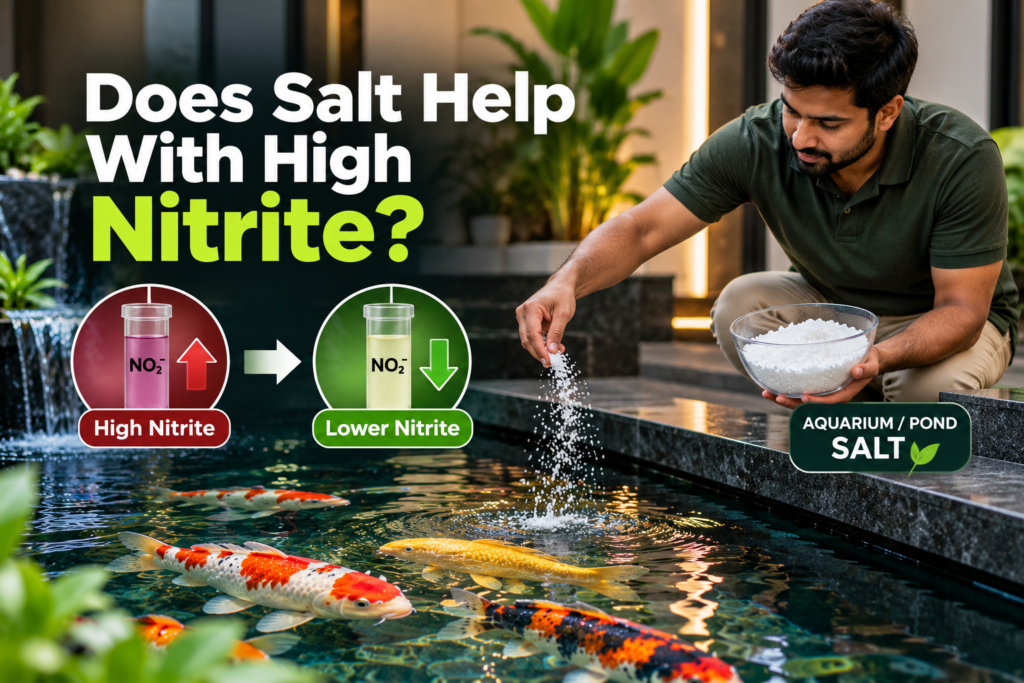
Pond salt is sometimes used as part of nitrite management because chloride ions can reduce the uptake of nitrite through the fish’s gills.
However, salt should not be considered a replacement for proper filtration and water management.
Before adding salt, check the pond’s existing salt concentration and consider the fish, plants and other organisms in the pond.
Use an appropriate test method and dose carefully according to the product instructions.
How to Prevent Nitrite Problems in the Future
Preventing nitrite buildup is much easier than dealing with a severe water-quality problem.
Maintain Proper Filtration
Use a filtration system appropriate for the pond’s water volume and fish load.
A good filtration setup generally includes:
Mechanical filtration + Biological filtration + UV clarification + Proper water circulation
Each component has a different role.
Avoid Overstocking
Always consider the mature size and waste production of fish before adding more fish to the pond.
Overstocking places additional pressure on filtration and water quality.
Feed Responsibly
Feed only what the fish can consume within a reasonable period.
Remove uneaten food rather than allowing it to remain in the pond.
Clean Mechanical Media Regularly
Mechanical filtration media should be cleaned regularly to prevent accumulated waste from breaking down and affecting water quality.
However, biological media should be handled carefully to preserve beneficial bacteria.
Test Pond Water Regularly
Don’t wait until fish become stressed before testing.
Monitor important parameters such as:
- Ammonia
- Nitrite
- Nitrate
- pH
- KH
- Temperature
Regular testing helps identify problems before they become serious.
The Role of a Good Pond Filtration System
A properly designed filtration system is one of the most important investments for a healthy koi pond.
For example, a pond filtration setup may include a pond skimmer, mechanical filter, biological filter, UV clarifier and properly sized pond pump.
The filtration system should be selected according to:
- Pond volume
- Fish quantity
- Fish size
- Feeding level
- Waterfall or fountain requirements
- Desired water clarity
- Available space
How Often Should You Check Nitrite?
The ideal testing frequency depends on the pond and its condition.
For an established, stable pond, regular periodic testing may be sufficient.
Test more frequently when:
- The pond is newly constructed
- New fish have been introduced
- A new filter has been installed
- Fish numbers have increased
- The pond filter has been heavily cleaned
- Fish are showing signs of stress
- Water quality changes suddenly
Keeping a simple record of test results can help you understand changes in your pond over time.
Frequently Asked Questions
What is a safe nitrite level for a koi pond?
Ideally, nitrite should be 0 ppm or as close to zero as possible. Detectable nitrite should be investigated, especially in a heavily stocked pond.
What causes nitrite to suddenly increase?
Common causes include a new or immature biological filter, overfeeding, increased fish stocking, filter disruption, insufficient biological media and excessive organic waste.
Can a UV filter remove nitrite?
No. A UV clarifier primarily helps control suspended microorganisms and algae that pass through the UV chamber. It does not replace biological filtration for converting nitrite.
Does changing water reduce nitrite?
Yes. A properly conducted partial water change can dilute nitrite in the pond. However, the underlying filtration or waste-load problem should also be addressed.
Can too many koi cause high nitrite?
Yes. More fish produce more waste, increasing the demand placed on the biological filtration system.
How long does it take for nitrite to decrease?
The time varies depending on the cause, pond size, filtration capacity, water changes, bacterial activity and fish load. Monitor the pond regularly rather than relying on a fixed timeframe.
Final Thoughts
Maintaining low nitrite levels is an essential part of keeping a healthy koi pond. High nitrite usually indicates that the pond’s biological filtration system is struggling to keep up with the waste being produced.
The best long-term approach is to combine proper filtration, responsible feeding, adequate aeration, regular maintenance and routine water testing.
If you are planning a new koi pond or upgrading an existing filtration system, choosing the right pond pump, biological filter, UV filter and filter media can make a significant difference to long-term water quality.
Related Topics
- How Much Filtration Does a Koi Pond Need?
- How Does a UV Pond Filter Work?
- How to Choose the Right Pond Pump
- Best Pond Filtration Systems for Koi Ponds
- Why Is My Pond Water Green?
- How to Reduce Algae Growth in a Pond