

Keeping pond water clean, clear, and healthy is one of the biggest challenges for koi pond and outdoor pond owners. Even when a pond has a good mechanical and biological filtration system, the water can sometimes turn green because of suspended algae and microorganisms.
This is where a UV pond filter or UV clarifier can be useful.
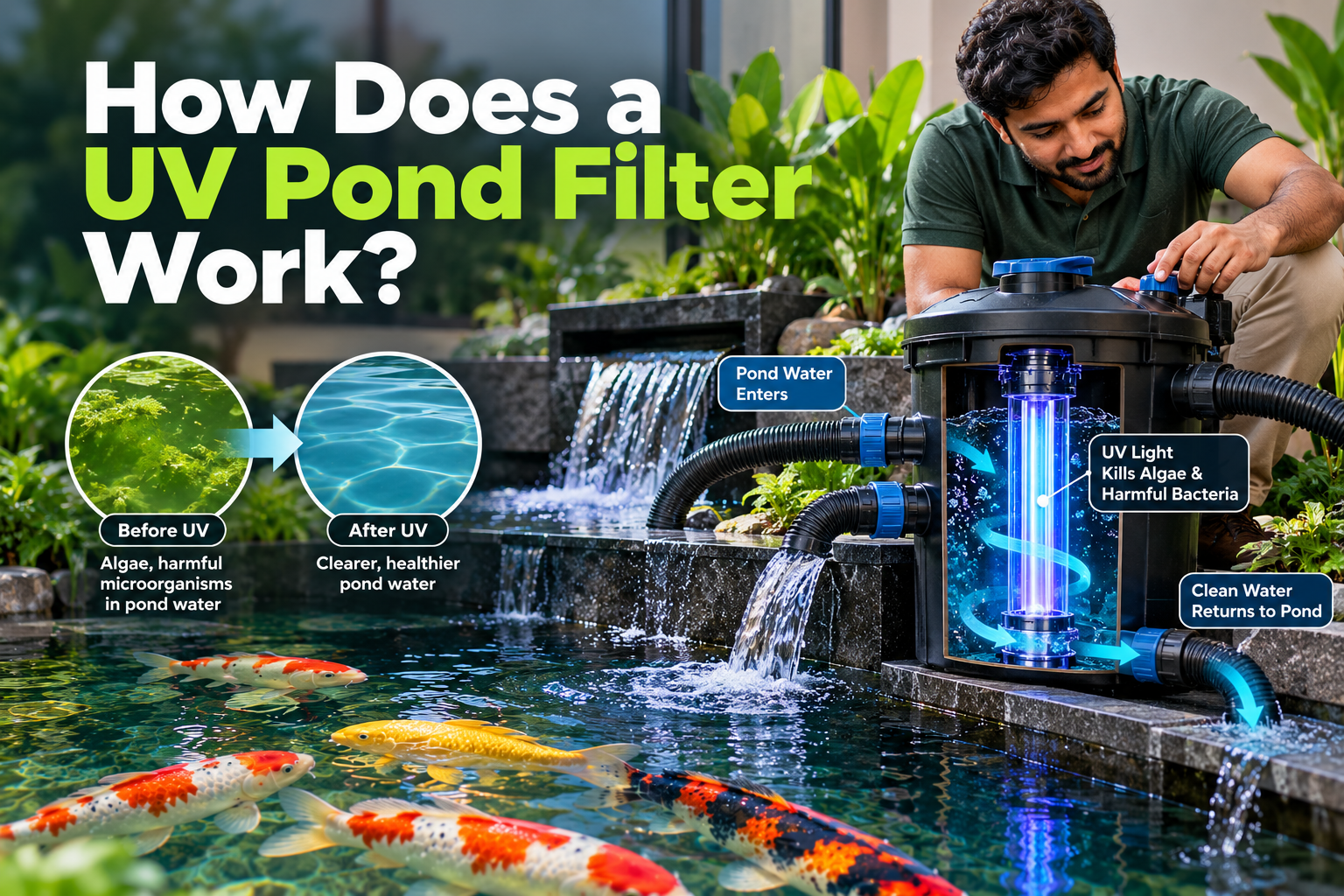
A UV pond filter uses ultraviolet light to treat water as it passes through the UV chamber. The UV light helps control suspended algae and certain microorganisms, making it easier for the pond filtration system to produce clearer water.
In this guide, we explain how a UV pond filter works, what it removes, where it should be installed, how long it takes to clear green water, and how to choose the right UV filter for your pond.
What Is a UV Pond Filter?
A UV pond filter is a pond filtration device that uses ultraviolet-C (UV-C) light to treat water flowing through a specially designed chamber.
Unlike a conventional mechanical filter that physically traps debris, a UV unit works by exposing waterborne organisms to UV-C radiation.
The water flows through the UV chamber while the UV lamp produces ultraviolet light. Suspended microorganisms and algae that pass through the chamber are exposed to the UV light.
A UV system is therefore commonly used as part of a complete pond filtration setup rather than as the only filtration device.
How Does a UV Pond Filter Work?
The working principle is relatively simple.
Step 1: Pond Water Enters the System
Water is drawn from the pond using a properly sized pond pump.
Depending on the pond design, water may first pass through a skimmer, mechanical filter or another pre-filtration stage.
Step 2: Water Passes Through the UV Chamber
The water enters the UV filter and flows around the UV lamp.
The lamp is usually enclosed inside a protective quartz sleeve. This allows UV light to reach the water while protecting the lamp from direct contact with water.
Step 3: UV-C Light Treats Suspended Organisms
The UV-C radiation interacts with microorganisms suspended in the water.
For suspended green-water algae, this can cause the cells to lose their ability to reproduce and remain suspended as healthy colonies.
The exact effectiveness depends on factors such as:
- UV lamp wattage
- Water flow rate
- Contact time
- Water clarity
- Pond size
- Condition and age of the UV lamp
- UV chamber design
Step 4: Treated Water Returns to the Pond
After passing through the UV chamber, the treated water continues through the filtration system and returns to the pond.
The dead or damaged algae can then be captured by mechanical filtration.
This is why a UV unit works best when combined with effective mechanical and biological filtration.
What Does a UV Pond Filter Do?
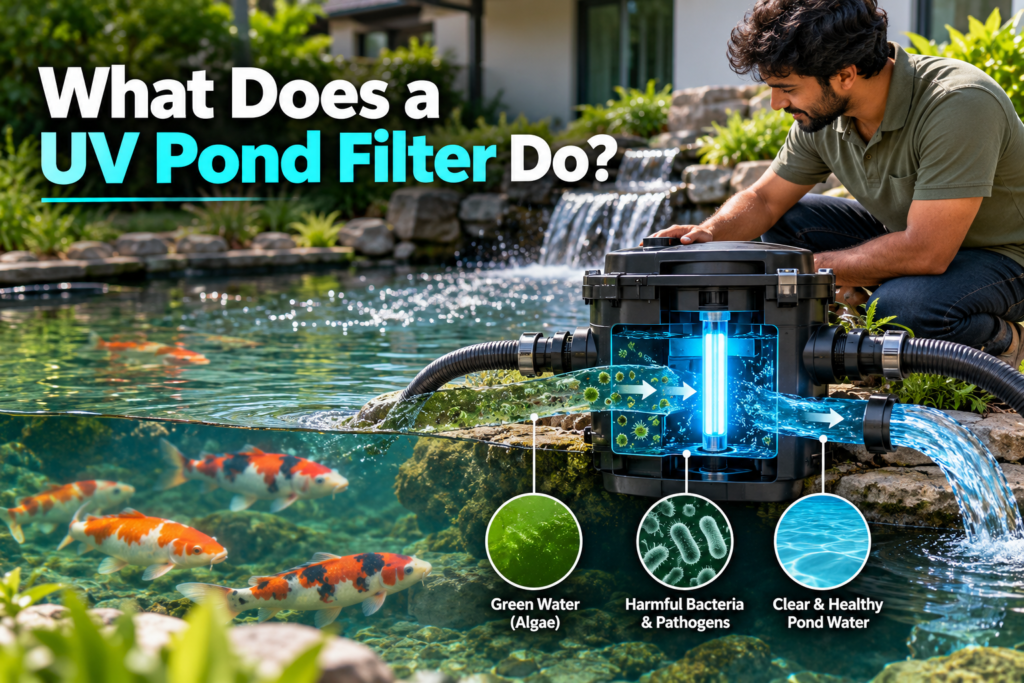
A UV pond filter is mainly used to help control suspended algae and certain microorganisms in the water column.
One of its most popular applications is controlling green pond water.
When suspended algae are reduced, the water can become significantly clearer.
However, a UV filter does not physically remove all types of pond waste.
It should not be expected to replace:
- Mechanical filtration
- Biological filtration
- Regular pond maintenance
- Water circulation
- Proper fish stocking management
Think of UV as an additional treatment stage within a complete filtration system.
Can a UV Pond Filter Remove Green Water?
Yes, a correctly sized and installed UV system can be very effective for controlling green water caused by suspended algae.
Green water occurs when microscopic algae multiply throughout the water column.
Unlike string algae that grows on pond surfaces, suspended algae can make the entire pond look green or cloudy.
UV treatment targets these suspended organisms as the water passes through the UV chamber.
Once the algae are affected, the filtration system needs to capture and remove the resulting particles.
This means UV + mechanical filtration is often more effective than relying on UV alone.
UV Pond Filter vs Normal Pond Filter
A common misconception is that a UV filter performs the same job as a normal pond filter.
They perform different functions.
| Filtration Type | Main Function |
|---|---|
| Mechanical Filter | Removes physical debris and particles |
| Biological Filter | Provides habitat for beneficial bacteria |
| UV Clarifier | Helps control suspended algae and microorganisms |
| Pond Skimmer | Removes floating debris |
| Pond Pump | Circulates water through the system |
A healthy pond filtration system may combine several of these components.
Does a UV Filter Kill Beneficial Bacteria?
A properly installed UV system primarily treats organisms that pass through the UV chamber.
Beneficial bacteria living on biological filter media are not normally exposed to the UV light in the same way.
However, installation and water flow design matter.
For this reason, UV systems are generally installed as one part of a broader filtration system rather than being treated as a replacement for biological filtration.
Where Should You Install a UV Pond Filter?
The exact installation position depends on the filtration design and the manufacturer’s recommendations.
In many pond systems, the UV unit is installed in the circulation line where water can pass through the UV chamber at an appropriate flow rate.
A common arrangement is:
Pond → Pump → Mechanical Filtration → UV → Biological Filtration → Pond
However, the ideal configuration can vary depending on the type of filter being used.
Always follow the manufacturer’s installation instructions.
Why Is Water Flow Rate Important?
One of the most important factors affecting UV performance is water flow rate.
If water moves through the UV chamber too quickly, the exposure time may be insufficient for the intended treatment.
If the flow is too low, the overall pond circulation may become inadequate.
Therefore, don’t choose a UV unit based only on its wattage.
Consider:
- Pond volume
- Pump flow rate
- UV wattage
- Manufacturer’s recommended flow
- Type of pond
- Fish stocking level
- Water clarity
The correct combination of UV power and water flow is essential for effective performance.
How Many Watts of UV Do You Need for a Pond?
There is no single UV wattage that works for every pond.
The required UV capacity depends on the pond’s volume, fish load, sunlight exposure, water flow and the manufacturer’s specifications.
For example, a small ornamental pond may require a much smaller UV unit than a large koi pond.
When selecting a UV pond filter, look at the manufacturer’s recommended pond capacity and flow range rather than choosing solely by wattage.
For heavily stocked koi ponds, it is particularly important to consider the complete filtration system rather than relying on UV alone.
How Long Does a UV Pond Filter Take to Clear Green Water?
The time required to clear green water varies.
Several factors influence the result:
- Severity of the algae bloom
- UV wattage
- Pond volume
- Water flow
- Mechanical filtration
- Sunlight exposure
- Pond stocking level
- Condition of the UV lamp
A properly sized system may noticeably improve water clarity within several days, but heavily affected ponds can take longer.
If the water remains green despite operating the UV system, check whether the unit is correctly sized, the lamp is functioning, the quartz sleeve is clean and the water flow is within the recommended range.
How Often Should You Replace a UV Lamp?
UV lamps gradually lose their effectiveness with use even if the lamp still appears to be producing visible light.
The replacement interval depends on the specific lamp and manufacturer’s recommendation.
Many pond UV lamps are commonly replaced on an annual schedule when used continuously through the season, but you should follow the manufacturer’s stated service life.
A lamp that still turns on is not necessarily producing its original UV-C output.
How to Maintain a UV Pond Filter
Regular maintenance helps keep a UV system working effectively.
Clean the Quartz Sleeve
Mineral deposits and dirt can accumulate on the quartz sleeve surrounding the UV lamp.
A dirty sleeve reduces UV transmission.
Clean it according to the manufacturer’s instructions.
Check the UV Lamp
Inspect the lamp regularly and replace it according to the recommended service interval.
Check Water Flow
Make sure pipes, pumps and filtration chambers are not blocked.
Reduced flow can affect the overall filtration system.
Keep the System Properly Sealed
Electrical and waterproofing components should be maintained according to the manufacturer’s instructions.
Always switch off electrical equipment before carrying out maintenance.
Why Is My UV Pond Filter Not Clearing Green Water?
If your pond remains green after installing a UV system, there may be another problem.
1. UV Unit Is Undersized
The UV capacity may not be appropriate for the pond volume.
2. Flow Rate Is Too High
Water may be moving through the UV chamber too quickly.
3. Dirty Quartz Sleeve
A dirty sleeve can reduce UV transmission.
4. Old UV Lamp
The lamp may have reached the end of its effective service life.
5. Poor Mechanical Filtration
The UV may be affecting the algae, but the filtration system may not be removing the resulting particles effectively.
6. Excessive Sunlight
Strong sunlight can encourage rapid algae growth.
7. High Nutrient Levels
Excess nutrients from fish waste, uneaten food and decomposing organic matter can encourage algae growth.
In these situations, improving the overall pond filtration and maintenance routine is often necessary.
UV Clarifier vs UV Sterilizer
The terms UV clarifier and UV sterilizer are sometimes used interchangeably, but they can refer to different intended levels of treatment.
A UV clarifier is commonly used in ponds to control suspended algae and improve water clarity.
A UV sterilizer generally refers to a system designed around higher levels of UV exposure for broader microorganism control.
Actual performance depends on the lamp, chamber design, flow rate and UV dose.
Therefore, don’t compare units based only on the words “clarifier” or “sterilizer.”
Is a UV Pond Filter Necessary for Every Pond?
Not necessarily.
A well-balanced pond with appropriate biological filtration, good circulation, controlled nutrients and adequate maintenance may remain clear without UV.
However, UV can be particularly useful when:
- The pond regularly develops green water
- The pond receives strong sunlight
- The pond contains koi or a high fish load
- Water clarity is a priority
- Natural methods alone are insufficient
For many ornamental and koi ponds, UV is a useful addition to the overall filtration system.
Benefits of Using a UV Pond Filter
A properly selected UV system can provide several benefits:
- Helps control green pond water
- Improves water clarity
- Helps control suspended algae
- Supports clearer viewing of koi and other fish
- Works continuously as part of the filtration system
- Requires relatively simple routine maintenance
- Can complement mechanical and biological filtration
How to Choose the Right UV Pond Filter
Before purchasing a UV pond filter, consider the following:
Pond Volume
Know your approximate pond volume in litres.
Fish Load
A heavily stocked koi pond generally requires more filtration capacity than a lightly stocked ornamental pond.
UV Wattage
Select the UV capacity based on the manufacturer’s recommended pond size and intended application.
Flow Rate
Check the recommended flow range and make sure your pump and plumbing are compatible.
Filtration System
UV should work together with mechanical and biological filtration.
Replacement Parts
Consider the availability of replacement UV lamps and other service parts.
Final Thoughts
A UV pond filter works by exposing water to UV-C light as it passes through a dedicated chamber. This helps control suspended algae and certain microorganisms, making UV filtration particularly useful for ponds suffering from green water.
However, UV is only one part of a successful pond filtration system.
For consistently clear and healthy pond water, combine mechanical filtration, biological filtration, appropriate UV treatment, proper pond circulation, aeration, responsible feeding and regular maintenance.
If you’re planning a new koi pond or upgrading an existing system, selecting the right combination of pond pump, UV filter, biological filter, skimmer and filter media can make a major difference.
Explore pond filtration equipment and accessories at GreenfinIndia.com and choose the right equipment for your pond setup.
Frequently Asked Questions
1. Does a UV pond filter make pond water clear?
A properly sized UV system can help clear green water caused by suspended algae. Mechanical filtration is still needed to remove particles from the water.
2. Can UV remove algae from a pond?
UV is particularly effective at controlling suspended microscopic algae that cause green water. It is not designed to remove all forms of string or surface algae.
3. Does a UV filter replace a pond filter?
No. UV treatment complements mechanical and biological filtration. It should not be considered a complete replacement for a pond filtration system.
4. How long should a pond UV filter run?
For green-water control, UV systems are often operated continuously while the pond circulation system is running, subject to the manufacturer’s instructions.
5. How often should a pond UV bulb be replaced?
Follow the manufacturer’s recommended replacement interval. UV output decreases over time even when the lamp still appears to be working.
6. What size UV filter do I need?
The correct size depends on pond volume, fish load, water flow, sunlight exposure and the manufacturer’s specifications. Always check the recommended pond capacity and flow range before purchasing.