

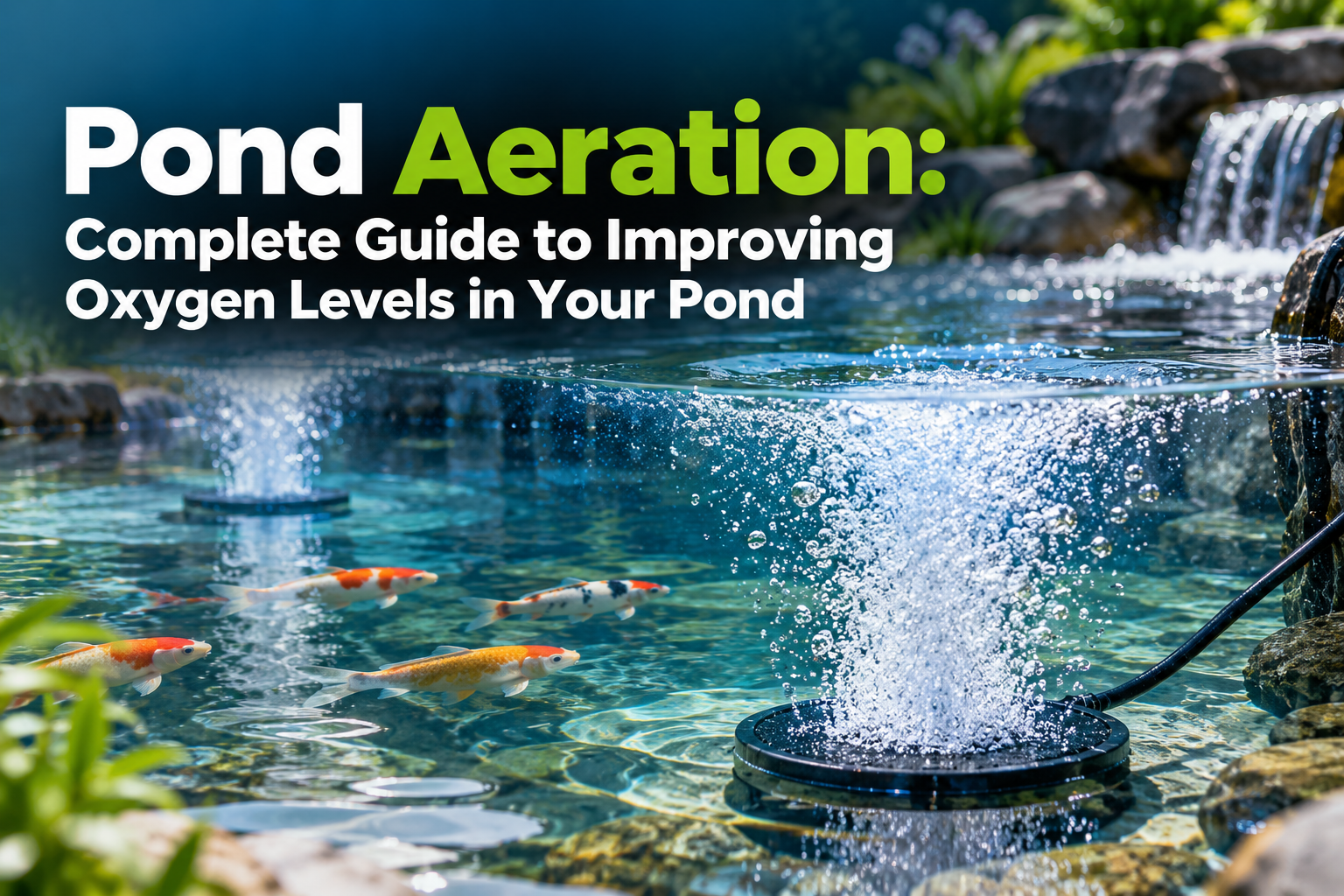
Pond aeration is one of the most important parts of maintaining a healthy and balanced pond. Whether you have a koi pond, ornamental pond, garden pond, or large outdoor fish pond, maintaining sufficient dissolved oxygen helps fish stay healthy and supports beneficial bacteria responsible for biological filtration.
When oxygen levels become too low, fish may become stressed, beneficial bacteria can become less effective, and organic waste can accumulate. A properly designed pond aeration system continuously adds oxygen and improves water circulation.
In this guide, we explain what pond aeration is, why it is important, how pond aerators work, and how to choose the right aeration system for your pond.
What Is Pond Aeration?
Pond aeration is the process of increasing dissolved oxygen in pond water by moving and exposing water to air.
A pond aerator usually consists of an air pump, airline tubing, and one or more air diffusers. The pump pushes air through the diffuser, creating bubbles in the water. As the bubbles rise toward the surface, oxygen is transferred into the water.
Pond aeration can also improve circulation by moving water from deeper areas toward the surface.
Why Is Pond Aeration Important?
Fish and beneficial microorganisms require oxygen to survive and function properly. A pond with insufficient oxygen can develop several water-quality problems.
The main benefits of pond aeration include:
- Increases dissolved oxygen
- Supports healthy fish
- Improves water circulation
- Supports beneficial bacteria
- Helps biological filtration
- Reduces stagnant areas
- Helps break down organic waste
- Can reduce unpleasant pond odors
- Helps maintain better overall water quality
For koi ponds and heavily stocked fish ponds, proper aeration becomes particularly important because fish consume oxygen continuously.
Does a Koi Pond Need Aeration?
Yes, koi ponds can benefit greatly from pond aeration, especially when the pond contains many fish, has limited water movement, or experiences high temperatures.
Koi require oxygen-rich water for healthy growth and normal activity. During warm weather, oxygen levels can become more challenging because warmer water holds less dissolved oxygen.
Aeration is therefore an important part of a complete koi pond filtration and water-management system.
How Does a Pond Aerator Work?
A typical pond aeration system works through three main components:
1. Air Pump
The air pump pushes air through airline tubing. The pump should be selected according to pond size, depth, diffuser requirements, and the amount of aeration needed.
2. Airline Tubing
Airline tubing transports air from the pump to the diffuser located inside the pond.
3. Air Diffuser
The diffuser releases air into the water as small bubbles. Smaller bubbles generally provide more air-water contact, while the rising bubbles also help circulate the water.
Together, these components create continuous water movement and oxygen transfer.
How Much Aeration Does a Pond Need?
The amount of aeration required depends on several factors rather than pond volume alone.
Consider:
- Pond size
- Pond depth
- Number of fish
- Fish species
- Water temperature
- Existing filtration
- Water circulation
- Number of diffusers
- Organic waste load
A lightly stocked ornamental pond may require less aeration than a heavily stocked koi pond.
For this reason, choosing a pond aerator based only on pond volume may not always provide the best result.
Where Should You Place a Pond Aerator?
Diffuser placement is important for effective pond aeration.
For deeper ponds, placing diffusers toward the deeper section can help circulate water through the entire water column.
However, diffuser placement should also consider:
- Pond shape
- Depth variations
- Fish stocking density
- Existing bottom drains
- Water circulation
- Filtration return points
For large or irregularly shaped ponds, multiple diffusers may provide better oxygen distribution than one diffuser.
Pond Aeration vs Waterfall: Which Is Better?
A waterfall and pond aerator can both contribute to oxygenation, but they work differently.
A waterfall primarily increases oxygen exchange by moving water and exposing it to air at the surface.
A pond aerator introduces air directly into the water through diffusers and can provide circulation throughout deeper sections.
For a koi pond, using both proper filtration and aeration can create a more complete water-management system.
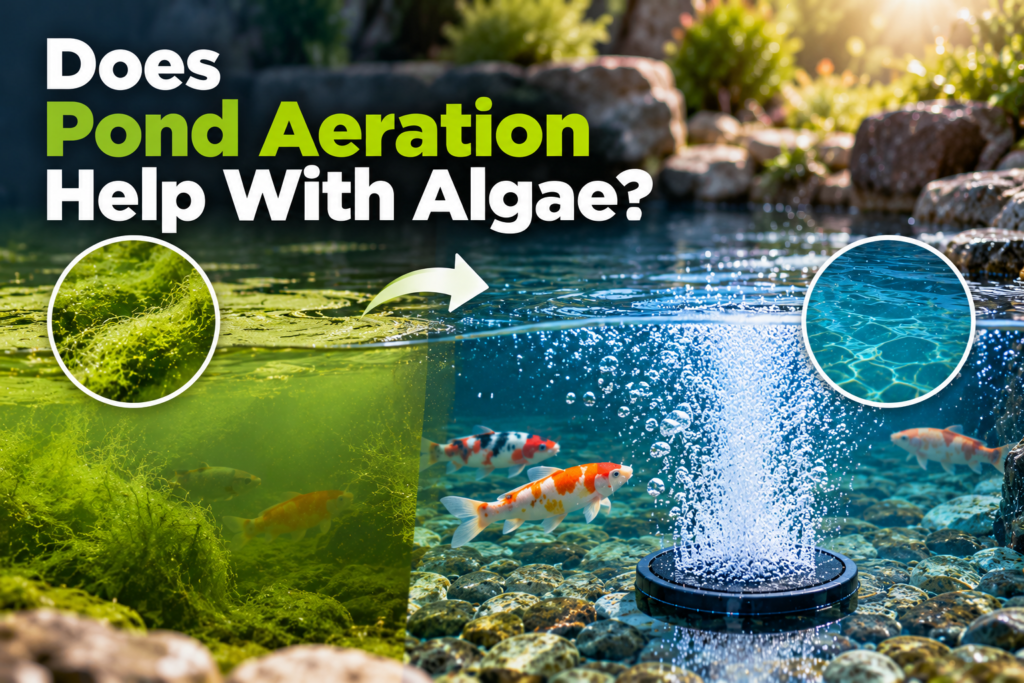
Does Pond Aeration Help With Algae?
Pond aeration can help improve overall pond conditions, but it should not be considered a standalone algae treatment.
Better oxygenation and circulation can support beneficial microorganisms and reduce stagnant areas where organic waste accumulates.
For green water caused by suspended algae, a UV pond clarifier can be a more direct solution. Mechanical and biological filtration can also help remove particles and process waste.
A properly designed pond system may therefore combine:
Pond Pump + Mechanical Filtration + Biological Filtration + UV Clarification + Pond Aeration
Can Pond Aeration Reduce Pond Odor?
Yes, improving oxygen levels can help reduce some pond odors.
Low-oxygen areas can encourage anaerobic decomposition of organic material. This can contribute to unpleasant smells.
Aeration increases oxygen availability and circulation, supporting aerobic biological processes that help break down organic waste more effectively.
However, persistent odor can also indicate excessive sludge, dead organic matter, poor filtration, or other water-quality problems.
Should Pond Aeration Run 24 Hours?
For many ponds, continuous aeration can be beneficial.
Running aeration consistently helps maintain more stable oxygen levels instead of allowing oxygen concentrations to fluctuate significantly.
Nighttime can be particularly important because aquatic plants and algae consume oxygen after photosynthesis stops.
For heavily stocked koi ponds, continuous aeration is often a valuable part of maintaining stable water conditions.
Is Pond Aeration Important During Summer?
Yes. Pond aeration becomes especially important during hot weather.
Warm water naturally holds less dissolved oxygen than cooler water. At the same time, fish may experience increased metabolic activity.
During hot weather, proper aeration can help maintain oxygen availability and improve circulation.
It is also important to avoid excessive feeding during periods when water quality and oxygen levels are under stress.
Is Pond Aeration Important During Rain?
Heavy rain can change pond conditions quickly.
Rainwater can introduce organic material, dust, and other contaminants into the pond. Storm conditions can also disturb the pond surface and alter water parameters.
Maintaining good aeration and circulation can help support stable oxygen levels during changing weather conditions.
After heavy rainfall, checking water clarity, filtration, and fish behavior is also recommended.
What Are the Signs of Low Oxygen in a Pond?
Some common warning signs include:
- Fish gasping at the surface
- Fish gathering near waterfalls or returns
- Reduced fish activity
- Fish appearing stressed
- Unusual pond odors
- Increased organic waste
- Poor biological filtration performance
If fish are repeatedly gasping at the surface, increasing aeration and checking the complete pond system should be treated as a priority.
How to Choose the Right Pond Aerator
When selecting a pond aeration system, consider the following:
Pond Volume
Calculate the approximate volume of your pond before choosing equipment.
Pond Depth
Deep ponds may require an aerator capable of delivering air effectively to deeper diffuser locations.
Fish Stocking
A pond containing many koi requires greater attention to oxygen availability than a lightly stocked ornamental pond.
Pump Air Output
Check the air output of the pump and ensure it is suitable for the diffuser and pond depth.
Number of Diffusers
Large or irregular ponds may benefit from multiple diffusers for better circulation.
Energy Consumption
For systems running continuously, selecting an energy-efficient air pump can help reduce operating costs.
Pond Aeration and Biological Filtration
Pond aeration and biological filtration work closely together.
Beneficial bacteria convert toxic fish waste into less harmful compounds through the biological filtration process. These microorganisms require oxygen to function effectively.
Maintaining good oxygen levels can therefore support the biological filtration system.
This is particularly important in koi ponds with high fish loads and significant amounts of organic waste.
Common Pond Aeration Mistakes
Avoid these common mistakes when installing pond aeration:
Using an Undersized Air Pump
A pump that is too small may not provide sufficient air for the pond.
Using Too Few Diffusers
One diffuser may not distribute oxygen effectively throughout a large pond.
Ignoring Pond Depth
Air pumps and diffusers need to be selected according to operating depth.
Poor Diffuser Placement
Placing diffusers without considering pond circulation can reduce the effectiveness of the system.
Depending Only on Aeration
Aeration does not replace proper filtration, water changes, mechanical waste removal, or UV clarification when required.
Pond Aeration for Different Pond Types
Koi Ponds
Koi ponds generally benefit significantly from strong and consistent aeration because of their fish stocking levels and biological filtration requirements.
Ornamental Ponds
Aeration can improve water movement and help maintain healthier conditions for ornamental fish.
Garden Ponds
A small air pump and diffuser can help prevent stagnant areas and improve oxygen exchange.
Large Outdoor Ponds
Large ponds may require multiple diffusers and a higher-capacity aeration system for effective oxygen distribution.
Frequently Asked Questions About Pond Aeration
What is pond aeration?
Pond aeration is the process of increasing dissolved oxygen in pond water using air pumps, diffusers, waterfalls, fountains, or other water-moving systems.
Does every pond need an aerator?
Not every pond requires a dedicated aerator, but aeration can be highly beneficial for ponds containing fish, especially koi ponds and heavily stocked ponds.
How long should a pond aerator run?
Many pond aeration systems can run continuously to provide stable oxygen levels. The ideal operating schedule depends on the pond design, fish load, temperature, and aeration system.
Does pond aeration help koi?
Yes. Proper aeration helps provide oxygen-rich water for koi and supports beneficial bacteria in the biological filtration system.
Can aeration replace a pond filter?
No. Aeration and filtration perform different functions. Aeration increases oxygen and circulation, while filtration removes particles and processes fish waste.
Can pond aeration clear green water?
Aeration can improve overall pond conditions, but it does not directly remove suspended algae. A suitable UV clarifier and filtration system may be required for persistent green water.
Final Thoughts
Pond aeration is an important part of maintaining healthy pond water, especially in koi ponds and ponds with high fish populations. A properly selected air pump, diffuser, and installation position can improve oxygen levels, water circulation, biological filtration, and overall pond health.
For the best results, pond aeration should be considered as part of a complete pond system that includes appropriate filtration, circulation, waste removal, and water-quality management.
If you are planning a new koi pond or upgrading an existing pond, choosing the right pond aeration system based on pond size, depth, fish population, and filtration setup can make a significant difference.