

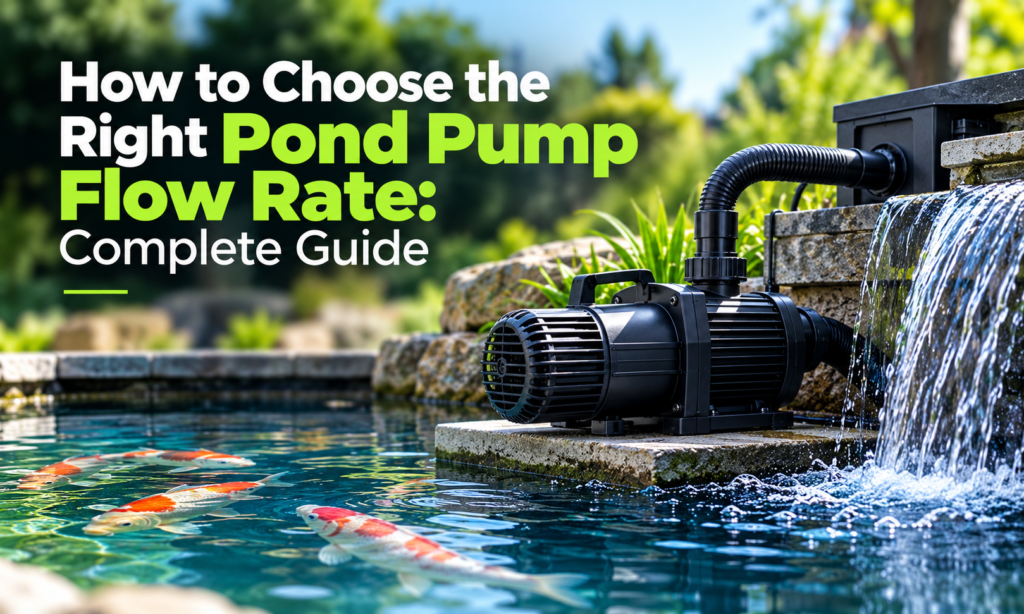
Choosing the correct pond pump flow rate is one of the most important decisions when designing a koi pond, garden pond, waterfall, or fountain. The right pump ensures proper water circulation, supports filtration, improves oxygenation, and keeps the pond environment healthier for fish.
A pump that is too small may not provide enough circulation or filtration. A pump that is unnecessarily large can increase electricity consumption and may create excessive water flow for the pond or filtration system.
In this guide, we explain how to calculate pond pump flow rate, what factors affect pump selection, and how to choose the right pump for your pond.
What Is Pond Pump Flow Rate?
Pond pump flow rate refers to the amount of water a pump can move within a specific period.
It is commonly measured in:
- Litres per hour (LPH)
- Litres per minute (LPM)
- Cubic metres per hour (m³/h)
- Gallons per hour (GPH)
For example, a pump rated at 10,000 LPH is designed to move up to 10,000 litres of water per hour under specified conditions.
However, the advertised pump flow rate is not always the actual flow you will get in your pond.
Why?
Because factors such as head height, pipe length, pipe diameter, bends, filters, UV clarifiers, valves, and other equipment can reduce the actual flow.
Why Is the Correct Pond Pump Flow Rate Important?
The pump is essentially the heart of a pond filtration system.
A properly sized pump helps:
Maintain water circulation
Continuous circulation prevents stagnant areas and distributes oxygen and heat more evenly throughout the pond.
Support filtration
Water needs to pass through the mechanical and biological filtration system at an appropriate rate.
Improve oxygenation
Water movement through waterfalls, returns, fountains, and aeration systems can help increase oxygen exchange.
Keep waterfalls and streams flowing
If you are building a waterfall, the pump must provide enough flow at the required height.
Support healthy koi
Koi produce considerable waste. Good circulation and filtration are important for maintaining suitable water conditions.
How to Calculate Pond Pump Flow Rate
One of the easiest ways to estimate the required pump flow is to consider the pond turnover rate.
Basic formula:
Required Pump Flow = Pond Volume × Desired Turnover Rate
For example:
If your pond contains:
10,000 litres
and you want the pond water to pass through the filtration system approximately once every 1–2 hours, your theoretical circulation target could be around:
5,000–10,000 LPH
But this is only a starting point.
The actual pump selection should also account for head height and system resistance.
What Is Pond Turnover Rate?
Pond turnover rate describes how quickly the pump can circulate the pond’s total water volume.
For example, if you have:
10,000-litre pond + 10,000 LPH actual flow
the theoretical turnover is approximately:
1 turnover per hour
If the actual flow is:
5,000 LPH
the theoretical turnover is:
0.5 turnover per hour, or approximately once every two hours.
The ideal turnover depends on the type of pond, fish load, filtration system, waterfall, and overall design.
Pond Pump Flow Rate Examples
Here are some simple examples to understand the calculation.
| Pond Volume | Example Flow Target |
|---|---|
| 2,000 litres | 2,000–4,000 LPH |
| 5,000 litres | 5,000–10,000 LPH |
| 10,000 litres | 10,000–20,000 LPH |
| 20,000 litres | 20,000–40,000 LPH |
| 30,000 litres | 30,000–60,000 LPH |
These are general starting ranges, not fixed pump specifications. A heavily stocked koi pond or a pond with a high-flow waterfall may require a different design.
The Most Important Factor: Head Height
One of the biggest mistakes people make when selecting a pond pump is looking only at the pump’s maximum LPH rating.
A pump rated at 10,000 LPH does not necessarily deliver 10,000 LPH when lifting water several metres.
The higher the water has to be lifted, the lower the actual flow generally becomes.
This vertical distance is called head height or head pressure.
Example
Imagine a pump must lift water:
2 metres vertically
and then send it through a long pipe to a waterfall.
The actual flow could be considerably lower than the pump’s advertised maximum flow.
Therefore, always check the pump’s flow/head performance curve rather than choosing a pump based only on the maximum LPH number.
How Head Height Affects Pond Pump Performance
Consider these factors:
1. Vertical lift
The distance from the pump to the highest point where water exits.
2. Pipe length
Longer pipe runs create additional resistance.
3. Pipe diameter
Small pipes restrict water flow and increase resistance.
4. Pipe bends
Every elbow, bend, valve, and connector can create additional resistance.
5. Filters
Pond filters can reduce flow depending on their design and condition.
6. UV clarifiers
A UV unit may have recommended flow rates that should be followed for effective treatment.
Therefore, the pump should be selected according to the complete plumbing system, not simply pond volume.
Pond Pump Flow Rate for Waterfalls
Waterfalls require special consideration.
The required pump flow depends on:
- Waterfall width
- Desired water depth
- Waterfall height
- Pipe diameter
- Desired visual effect
A small decorative waterfall may need much less water than a wide, powerful cascade.
For example, a 1-foot-wide waterfall and a 4-foot-wide waterfall will require very different flow rates if you want the same visual water depth.
Important tip:
If your main goal is a strong waterfall, don’t select the pump based only on pond turnover.
Instead, calculate:
Filtration flow requirement + waterfall requirement + system losses
Then select a suitable pump.
Pond Pump Flow Rate for Koi Ponds
Koi ponds generally require reliable circulation and effective filtration because koi can produce a relatively high biological load.
When selecting a pump for a koi pond, consider:
- Pond volume
- Number of koi
- Koi size
- Feeding rate
- Filter capacity
- Bottom drains
- Skimmers
- UV system
- Waterfall
- Return lines
A pond with a small number of fish may have different requirements from a heavily stocked koi pond of the same volume.
This is why pond pump flow rate should always be considered together with filtration capacity.
How to Choose Pump Flow Rate for a Pond Filter
Your filter should be able to handle the intended water flow.
For example, if your filtration system is designed for a certain maximum flow rate, installing an oversized pump without appropriate bypass or flow control can cause problems.
Water may move through the filter too quickly, reducing the effectiveness of certain filtration stages.
Before choosing a pump, check:
Filter manufacturer’s recommended flow range
and compare it with:
Pump’s actual flow at operating head height.
This is particularly important for pressurized filters and UV clarifiers.
Pipe Size Matters
Even a powerful pond pump cannot perform efficiently if the plumbing is undersized.
A small pipe creates greater resistance, which can reduce the actual flow rate.
For larger pond pumps, appropriately sized plumbing can help reduce pressure losses.
General principle:
Higher pump flow → appropriately sized larger plumbing
Instead of forcing a high-volume pump through a very small pipe, design the plumbing system to allow sufficient water movement.
Pump Flow Rate and Energy Efficiency
A larger pump is not always better.
An oversized pump can:
- Consume more electricity
- Increase operating costs
- Create excessive flow
- Put unnecessary pressure on plumbing
- Exceed filter capacity
For a pond that operates continuously, even a small difference in power consumption can become significant over a year.
Therefore, select a pump that provides the required actual flow, rather than simply choosing the biggest pump available.
Variable-Speed Pond Pumps
Variable-speed pumps can be useful when you want greater control over water flow.
Depending on the model, you may be able to adjust the flow for:
- Filtration
- Waterfalls
- Fountains
- Seasonal requirements
- Energy savings
For example, you might use a higher flow rate when operating a large waterfall and reduce the flow when only basic filtration is required.
How to Calculate Pond Water Volume
Before calculating pond pump flow rate, you need to know the approximate water volume.
For a simple rectangular pond:
Formula:
Length × Width × Average Depth × 1,000 = Litres
When measurements are in metres.
Example:
Pond:
4 m × 3 m × 1 m
Volume:
4 × 3 × 1 = 12 m³
Since:
1 m³ = 1,000 litres
The pond contains approximately:
12,000 litres
The actual water volume may be lower depending on the pond shape, rocks, shelves, filter chambers, and operating water level.
Don’t Forget the Sump and Filter Volume
For a complete pond filtration system, water may also be present in:
- Sump
- Filter chambers
- Pipes
- UV chamber
- Bottom drain lines
- Skimmer system
When designing a professional pond system, these components should be considered when estimating total system volume.
Common Pond Pump Selection Mistakes
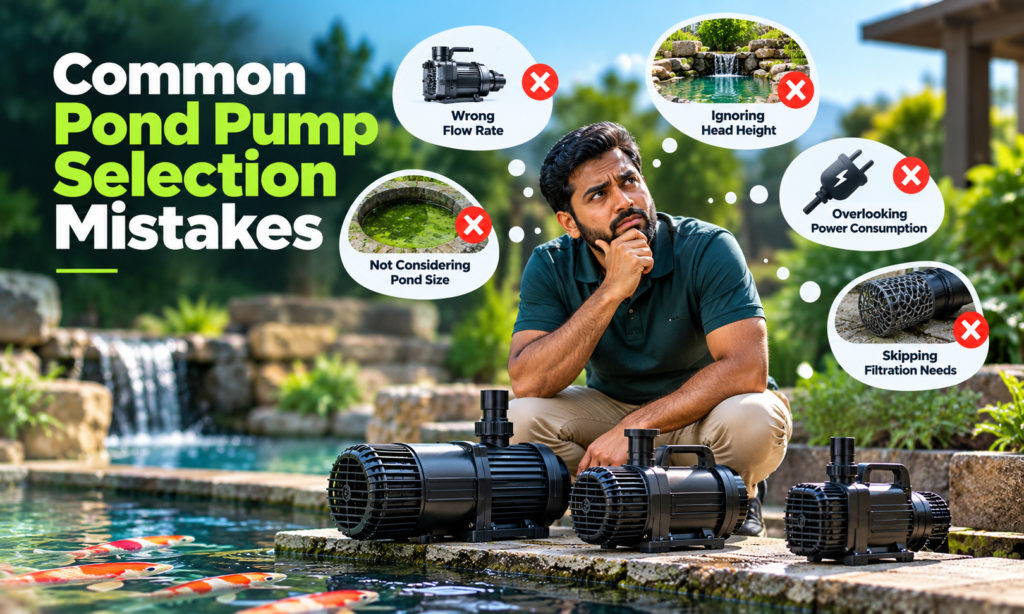
1. Choosing Based Only on LPH
A pump’s maximum LPH doesn’t tell you its actual operating flow.
Always consider head height.
2. Ignoring Pipe Resistance
Long pipes and multiple bends can significantly affect performance.
3. Using Undersized Pipes
Small plumbing can restrict a high-flow pump.
4. Ignoring Filter Capacity
The filter must be capable of handling the pump’s flow.
5. Choosing an Oversized Pump
More flow isn’t automatically better.
6. Not Considering the Waterfall
A pond designed with a waterfall may require considerably more flow than filtration alone.
7. Ignoring Electricity Consumption
Since pond pumps often run continuously, efficiency matters.
Pond Pump Selection Checklist
Before buying a pond pump, check these points:
☑ Pond water volume
☑ Desired turnover rate
☑ Number and size of koi
☑ Required filtration flow
☑ Waterfall height
☑ Waterfall width
☑ Pipe length
☑ Pipe diameter
☑ Number of bends
☑ Filter resistance
☑ UV clarifier requirements
☑ Pump power consumption
☑ Maximum head height
☑ Actual flow at operating head
Frequently Asked Questions
What is a good pond pump flow rate?
There is no single flow rate suitable for every pond. A starting point can be based on pond volume and desired turnover, but the final selection should account for head height, filtration, plumbing, fish load, and waterfall requirements.
How do I calculate pond pump size?
Calculate your pond volume, determine the required turnover and waterfall flow, then select a pump that can provide the required actual flow at the operating head height.
Is a higher LPH pond pump better?
Not necessarily. A pump should be correctly matched to the pond, filter, plumbing, and waterfall. An oversized pump can waste electricity and create excessive flow.
Does pipe size affect pond pump flow?
Yes. Undersized or excessively long plumbing can increase resistance and reduce the actual flow delivered by the pump.
How often should pond water circulate?
The appropriate turnover depends on pond type, fish load, filtration design, and overall system configuration. Koi ponds generally require strong and consistent circulation through an appropriately sized filtration system.
Final Thoughts
Selecting the correct pond pump flow rate is about more than looking at the maximum LPH printed on a pump box.
A properly designed system considers pond volume, turnover rate, head height, pipe diameter, plumbing resistance, filtration capacity, UV requirements, waterfall flow, koi stocking, and energy consumption.
For the best results, choose a pump based on its real-world operating flow at your required head height.
If you’re building a new koi pond or upgrading an existing pond, professional pump and filtration planning can help you achieve better water circulation, efficient filtration, and reliable long-term performance.
Build Your Pond with Greenfin The Pond Studio
Greenfin The Pond Studio provides professional pond construction, pond filtration, plumbing, waterproofing, waterfall and pond infrastructure solutions.
Need help selecting the right pond pump and filtration system for your pond?
Contact Greenfin The Pond Studio
📞 7510171717
🌐 greenfinindia.com