

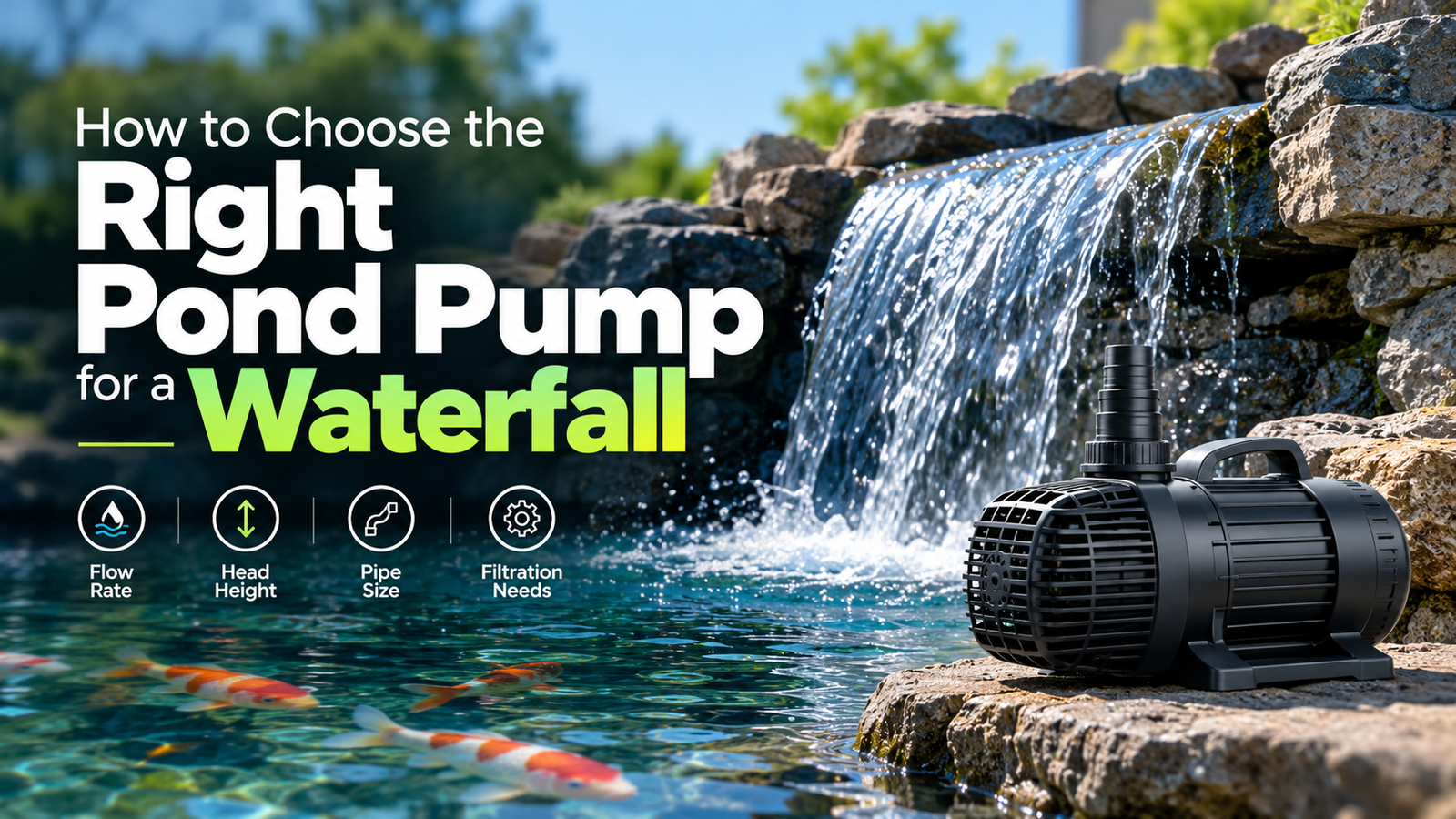
A pond waterfall can transform an ordinary pond into a beautiful, relaxing water feature. But to create a waterfall with the right flow, sound, and appearance, choosing the correct pond pump is essential.
The best pond pump for a waterfall depends on several factors, including the waterfall width, desired flow rate, waterfall height, pipe length, pipe diameter, and total head height.
A pump that is too small may produce a weak trickle, while an oversized pump can create excessive flow, increase electricity consumption, and cause water-management problems.
In this guide, you’ll learn how to choose the right pond pump for a waterfall, how to calculate the required flow rate, and what to consider before buying a pond pump.
What Size Pond Pump Do I Need for a Waterfall?
The required pond pump size depends mainly on the waterfall width and desired water flow.
As a general starting point, a waterfall may require approximately 100–150 litres per hour (LPH) for every inch of waterfall width, depending on the desired appearance and waterfall design.
For example:
- 12-inch waterfall → approximately 1,200–1,800 LPH
- 18-inch waterfall → approximately 1,800–2,700 LPH
- 24-inch waterfall → approximately 2,400–3,600 LPH
- 36-inch waterfall → approximately 3,600–5,400 LPH
These are starting estimates. The actual pump size should also account for head height, pipe friction, bends, fittings, and the type of waterfall feature.
What Is Pond Pump Flow Rate?
Flow rate is the amount of water a pump can move within a specific period.
It is commonly measured in:
- LPH – Litres Per Hour
- LPM – Litres Per Minute
- GPH – Gallons Per Hour
For waterfall applications, LPH is commonly used.
For example, a pump rated at 10,000 LPH theoretically moves up to 10,000 litres of water per hour under specific testing conditions.
However, this does not necessarily mean the pump will deliver 10,000 LPH at your waterfall.
Why?
Because the actual flow decreases as the water has to travel upward and through pipes.
What Is Head Height?
Head height is the vertical distance the pump needs to move water from the pump location to the highest point where the water is discharged.
For example:
If your pump is inside the pond and the waterfall outlet is 1.5 metres above the pump, your system has approximately 1.5 metres of vertical head, before accounting for pipe friction and other losses.
Head height is one of the most important factors when selecting a waterfall pump.
A pump may advertise a high maximum flow rate, but its actual flow can be much lower at the required head height.
Why Does Head Height Matter?
Consider a pump rated at 10,000 LPH.
At low head:
10,000 LPH
At higher head:
7,000 LPH
At even higher head:
4,000 LPH
The actual values depend on the specific pump model and its performance curve.
Therefore, don’t choose a pump based only on the maximum LPH printed on the box.
Always check the pump performance curve or flow rate at your required head height.
How Do I Calculate the Required Pond Pump Flow Rate?
A simple waterfall flow calculation can help you select a suitable pump.
Step 1: Measure the Waterfall Width
Measure the width of the waterfall opening.
For example:
Waterfall width = 60 cm
Step 2: Decide How Strong You Want the Waterfall
A gentle waterfall requires less flow than a powerful cascading waterfall.
For a wider waterfall, you will generally need a higher flow rate to create an even sheet of water.
Step 3: Calculate the Approximate Flow
For example, suppose your waterfall is approximately 60 cm wide and you want a moderate-to-strong flow.
You may require several thousand litres per hour depending on the waterfall design.
Step 4: Account for Head Height
If the waterfall is 1.5 metres above the pump, the pump needs to produce the required flow at 1.5 m head, not at zero head.
Step 5: Account for Pipe Loss
Long pipes, narrow pipes, elbows, valves and other fittings reduce water flow.
Therefore, choosing a pump with some additional capacity can help compensate for these losses.
What Pump Size Do I Need for a 1-Metre Waterfall?
For a waterfall approximately 1 metre wide, the required pump capacity depends on how much water you want flowing across the waterfall.
A small decorative waterfall may require a relatively modest flow rate, while a wide, powerful cascade may require several thousand litres per hour or more.
The height of the waterfall also matters.
A 1-metre-wide waterfall at 50 cm height can require a different pump than a 1-metre-wide waterfall at 2 metres height.
For accurate selection, consider:
Waterfall width + desired flow + head height + pipe diameter + pipe length
What Pump Size Do I Need for a 2-Metre Waterfall?
A 2-metre waterfall requires careful pump selection because the pump must overcome a greater vertical lift.
The higher the waterfall, the greater the required pump head.
For a tall waterfall:
- Choose a pump designed for higher head.
- Check the flow rate at the required head.
- Use appropriately sized pipes.
- Minimize unnecessary bends.
- Avoid undersized plumbing.
A pump with a high LPH rating but insufficient head capability may produce disappointing waterfall flow.
How Does Pipe Size Affect Waterfall Flow?
Pipe diameter has a major impact on pump performance.
A narrow pipe creates greater resistance to water flow, while a larger pipe generally allows water to move more efficiently.
For example, using a very small pipe with a high-capacity pump can significantly restrict the system.
Common Factors That Reduce Flow
- Small-diameter pipes
- Long pipe runs
- Multiple elbows
- Sharp bends
- Valves
- Unnecessary fittings
- Dirty pump intake
- Blocked filters
- Clogged pipes
For larger waterfall systems, properly sized plumbing is essential.
Should I Use a Submersible or External Pond Pump?
Both types can work for waterfalls.
Submersible Pond Pump
A submersible pump sits inside the pond or sump.
Advantages:
- Easy to install
- No separate pump housing required
- Generally simple for small and medium waterfalls
- Suitable for many decorative ponds
External Pond Pump
An external pump is installed outside the pond.
Advantages:
- Suitable for larger systems
- Can provide high flow rates
- Easier access for servicing
- Often preferred for large koi ponds and professional filtration systems
The best option depends on your pond size, waterfall design, filtration system and installation requirements.
Should the Waterfall Pump Also Run the Pond Filter?
It depends on your pond design.
In some systems, one pump can supply both the filtration system and waterfall.
In larger ponds, separate pumps may be better.
For example:
Pump 1 → Filtration system
Pump 2 → Waterfall
This approach allows you to control filtration and waterfall flow independently.
For koi ponds, system design should prioritize reliable filtration and adequate circulation rather than simply maximizing waterfall flow.
How Many Times Should a Pond Pump Circulate the Water?
For a pond filtration system, the desired turnover rate depends on:
- Pond volume
- Fish stocking level
- Filter type
- Biological filtration capacity
- Waterfall design
- Pump head
- Plumbing
A koi pond with a high fish load generally requires more effective filtration and circulation than a lightly stocked decorative pond.
Therefore, don’t select a waterfall pump based only on waterfall requirements if the same pump is also responsible for filtration.
What Happens If the Pond Pump Is Too Small?
An undersized pump can cause:
- Weak waterfall flow
- Uneven water distribution
- Poor circulation
- Reduced filtration performance
- Low oxygen movement
- Poor visual appearance
If your waterfall is designed to produce a strong cascade but the pump cannot deliver enough water at the required head, the waterfall may look more like a small trickle.
What Happens If the Pond Pump Is Too Powerful?
An oversized pump can also create problems.
It may cause:
- Excessive water flow
- Water splashing outside the pond
- Higher electricity consumption
- Overflow problems
- Excessive noise
- Water level fluctuations
- Unnecessary pressure on plumbing
The goal is not simply to buy the biggest pump.
The goal is to choose the right pump for the system.
How Can I Make My Waterfall Flow Stronger?
If your waterfall flow is weaker than expected, check:
- Pump intake for blockage.
- Filter and pre-filter for dirt.
- Pipe diameter.
- Pipe length.
- Number of elbows and bends.
- Waterfall height.
- Pump performance at the current head.
- Valves that may be partially closed.
- Clogged plumbing.
- Water level around the pump.
If everything is clear and the pump still cannot deliver enough water, you may need a higher-capacity pump with suitable head performance.
How to Choose the Best Pond Pump for a Waterfall
Before purchasing a pump, check these specifications:
1. Maximum Flow Rate
Look for the pump’s maximum LPH rating.
2. Maximum Head Height
Make sure the pump can lift water to your waterfall height.
3. Flow at Your Required Head
This is more important than the maximum LPH.
4. Power Consumption
Compare wattage to understand operating costs.
5. Pipe Compatibility
Make sure the pump outlet matches your plumbing requirements.
6. Continuous Operation
For ponds, choose a pump designed for continuous-duty operation when the system requires 24/7 circulation.
7. Reliability
A pond pump may run for long periods, so reliability and availability of spare parts are important.
Pond Waterfall Pump Calculation Example
Suppose you have:
Pond size: 5,000 litres
Waterfall width: 60 cm
Waterfall height: 1 metre
Pipe length: 8 metres
You should not simply choose a pump based on the pond volume.
You need to consider the waterfall flow requirement and the total head.
If your desired waterfall flow is around 5,000 LPH at the waterfall outlet, you may need a pump with a considerably higher maximum flow rating because the pump will lose flow as head height and pipe resistance increase.
Therefore:
Required outlet flow ≠ pump’s maximum advertised flow
This is one of the most common mistakes when choosing pond pumps.
Frequently Asked Questions
What is the best pump for a pond waterfall?
The best pump is one that provides the required flow at the waterfall’s actual head height while being suitable for continuous operation and compatible with your plumbing.
How many LPH do I need for a waterfall?
The required LPH depends on waterfall width, desired flow intensity, waterfall height and plumbing. Wider and more powerful waterfalls generally require higher flow rates.
Does a higher LPH pump always make a better waterfall?
No. A higher LPH rating does not guarantee better waterfall performance. You must consider head height and actual flow at the required operating conditions.
Can I use a pond pump for a waterfall?
Yes. Many pond pumps are designed for waterfalls and other water features. Select one based on flow rate, head height and continuous-duty capability.
Should a pond waterfall pump run continuously?
If the waterfall pump is part of the pond’s circulation or filtration system, continuous operation is commonly preferred. However, the exact operating schedule depends on the pond design and equipment.
Is a submersible pump good for waterfalls?
Yes. Submersible pumps are widely used for small and medium waterfall installations because they are relatively easy to install and maintain.
What is more important: LPH or head height?
Both are important, but you should pay particular attention to the flow rate at the required head height rather than relying only on the maximum LPH rating.
How can I reduce pump electricity consumption?
Use an appropriately sized energy-efficient pump, avoid excessive head height, use correctly sized plumbing, minimize unnecessary bends and keep the pump and intake clean.
Final Thoughts
Choosing the right pond pump for a waterfall requires more than simply looking at the pump’s LPH rating.
You should consider:
Waterfall width + desired flow + head height + pipe diameter + pipe length + fittings + pump efficiency
A correctly sized pump will give you a beautiful, consistent waterfall while maintaining efficient pond circulation.
For larger koi ponds, the pump should also be selected as part of the complete pond filtration and circulation system.
If you’re unsure which pump capacity is suitable for your pond, measure your pond size, waterfall width, waterfall height, pipe length and pipe diameter before selecting your equipment.
Greenfin The Pond Studio provides pond pumps, filtration systems, UV clarifiers, aeration equipment and other pond equipment for different pond and waterfall applications.
Looking for the right pond pump for your waterfall? Explore suitable pond pumps and pond filtration equipment from Greenfin The Pond Studio.
AEO Quick Answer
The right pond pump for a waterfall depends on the waterfall width, desired water flow, vertical height, pipe length and pipe diameter. Always select a pump based on its actual flow rate at the required head height rather than its maximum LPH rating.