

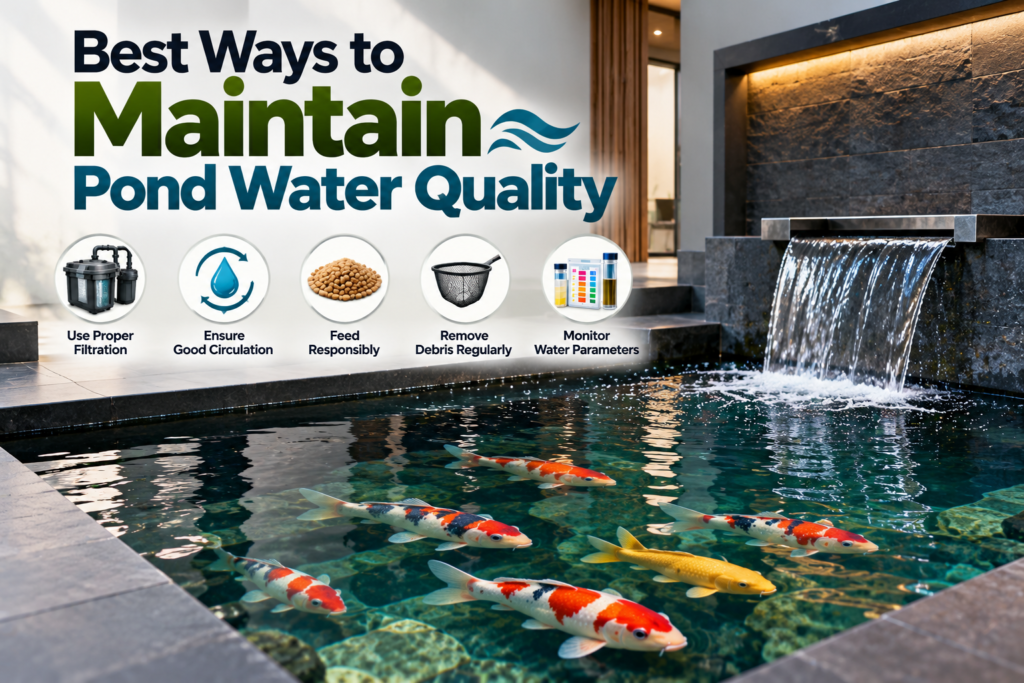
Maintaining good pond water quality is essential for healthy fish, clear water, and a balanced pond ecosystem. Whether you have a small garden pond, a decorative outdoor pond, or a large koi pond, regular maintenance helps prevent algae growth, unpleasant odours, and harmful water conditions.
Poor water quality can affect fish health, reduce oxygen levels, and place unnecessary stress on your pond’s filtration system. The good news is that the right maintenance routine, suitable pond equipment, and proper feeding practices can help you maintain clean and healthy water throughout the year.
In this guide, we will explore the best ways to maintain pond water quality, including filtration, water testing, algae control, aeration, and choosing the right pond equipment.
Why Is Pond Water Quality Important?
Pond water quality directly affects the health of fish, aquatic plants, and beneficial microorganisms. A well-maintained pond supports a stable ecosystem and helps filtration equipment work efficiently.
Here are some important benefits of maintaining good pond water quality:
- Healthy fish: Stable water conditions reduce stress and support normal fish behaviour.
- Better water clarity: Effective filtration helps remove suspended waste and debris.
- Improved oxygen levels: Adequate circulation and aeration support fish and beneficial bacteria.
- Reduced algae problems: Balanced nutrients, suitable filtration, and appropriate sunlight management help control excessive algae.
- Efficient filtration: Regular maintenance prevents debris accumulation and helps maintain consistent water flow.
Clear water does not always mean healthy water. Harmful ammonia and nitrite can be present even when the pond looks clean, so water testing is an important part of pond care.
1. Install the Right Pond Filtration System
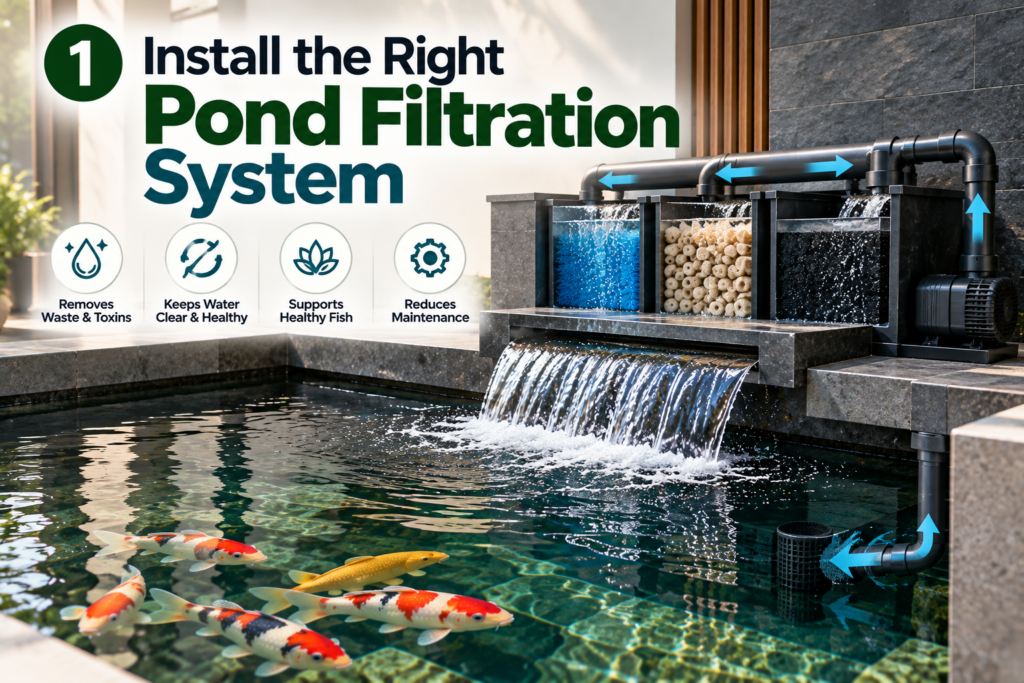
A suitable pond filtration system is one of the most important components of healthy pond water management. It removes waste, processes harmful nitrogen compounds, and helps maintain stable water conditions.
Most effective pond filtration systems combine mechanical and biological filtration.
Mechanical Filtration
Mechanical filtration removes visible and suspended particles, such as fish waste, leaves, and uneaten food.
Common mechanical filtration materials include:
- Filter brushes
- Filter sponges
- Filter mats
- Suitable mechanical filter pads
Mechanical filtration helps prevent debris from accumulating in the pond and reduces the workload on other filtration stages.
Biological Filtration
Biological filtration uses beneficial bacteria to convert toxic ammonia into nitrite and then into nitrate. Ammonia and nitrite should generally remain undetectable in an established, properly functioning pond.
Common biological filter media include ceramic media, plastic bio media, and other materials designed to support beneficial bacteria.
Avoid cleaning all biological filter media aggressively at the same time, because doing so can disrupt the beneficial bacterial population.
Choosing the Right Pond Filter
When selecting a filter, consider:
- Total pond water volume
- Number and size of fish
- Feeding rate
- Pump flow rate
- Filter capacity
- Manufacturer recommendations
Koi ponds with high fish stocking levels usually require more robust filtration than lightly stocked decorative ponds.
Explore suitable pond filtration equipment at Greenfin India.
2. Choose the Correct Pond Pump
A pond pump circulates water through the filtration system and helps prevent stagnant areas. Proper circulation is particularly important in ponds with fish, waterfalls, and multiple filtration chambers.
An undersized pump may not provide enough flow through the filter, while an oversized pump may exceed the filter’s rated capacity or consume unnecessary electricity.
How to Choose a Pond Pump
Before selecting a pump, check:
- The pond’s water volume.
- The required filtration flow rate.
- The height water must be pumped.
- The length and diameter of the pipes.
- The manufacturer’s recommended operating flow.
Remember that a pump’s advertised maximum flow rate may be much higher than the actual flow after accounting for vertical lift and plumbing resistance.
For ponds with waterfalls, choose a pump that delivers the required flow at the waterfall’s operating height while maintaining appropriate circulation through the filtration system.
3. Test Pond Water Regularly
Regular water testing helps identify problems before they become serious. Water may appear clear while still containing harmful compounds.
The most useful pond water parameters to monitor are ammonia, nitrite, nitrate, pH, and temperature. Dissolved oxygen testing is particularly useful in heavily stocked ponds and during hot weather.
| Water parameter | Why it matters |
|---|---|
| Ammonia | Toxic to fish; should generally be undetectable |
| Nitrite | Toxic to fish; should generally be undetectable |
| Nitrate | Indicates accumulated nitrogen waste; manage through maintenance and plant uptake |
| pH | Affects fish health and ammonia toxicity |
| Temperature | Influences oxygen availability, fish metabolism, and biological filtration |
| Dissolved oxygen | Essential for fish and beneficial aerobic bacteria |
How Often Should You Test Pond Water?
For a stable, established pond, testing weekly is a useful starting routine. Test more frequently when introducing fish, establishing a new filter, increasing fish numbers, or investigating fish health problems.
During hot weather or periods of heavy feeding, monitor water conditions more closely.
Follow the instructions supplied with your test kit and interpret results in the context of your pond’s fish species and system design.
4. Maintain Proper Oxygen Levels
Oxygen is essential for fish, beneficial bacteria, and other organisms in the pond ecosystem. Low dissolved oxygen can cause fish to gather near the surface, breathe rapidly, or become unusually inactive.
Warm water holds less dissolved oxygen than cooler water, making oxygen management especially important during hot weather.
Ways to Improve Pond Oxygen Levels
- Install a suitable pond air pump.
- Use air stones or diffusers to distribute air through the water.
- Maintain appropriate water circulation.
- Keep pump intakes and filtration systems free from blockages.
- Avoid excessive fish stocking and overfeeding.
- Monitor oxygen levels during hot weather and after heavy organic waste accumulation.
Waterfalls can contribute to oxygen exchange, but their effectiveness depends on the height, flow, and design of the feature. A waterfall alone may not provide enough oxygen for a heavily stocked koi pond.
Choose aeration equipment according to pond volume, stocking density, water depth, and oxygen demand.
5. Control Algae Growth Naturally and Effectively
Algae are a natural part of many pond ecosystems, but excessive growth can cause green water, string algae, and unpleasant conditions.
Algae commonly grow rapidly when sunlight and available nutrients are abundant.
Practical Ways to Reduce Pond Algae
Reduce excess nutrients: Remove uneaten fish food, decaying leaves, and accumulated organic waste.
Avoid overfeeding: Feed fish only what they can consume within an appropriate period.
Manage sunlight: Where practical, use suitable shading or aquatic plants to reduce excessive direct sunlight.
Maintain filtration: Ensure mechanical and biological filters are operating correctly.
Consider a UV clarifier: A correctly sized UV clarifier can help control suspended single-celled algae responsible for green water.
Remove string algae manually: Remove excessive filamentous algae where practical without disturbing the pond ecosystem unnecessarily.
Can a UV Clarifier Keep Pond Water Clear?
A UV clarifier exposes water passing through the unit to ultraviolet light, helping control susceptible suspended algae. It can be useful when green water is caused by free-floating algae.
However, UV clarifiers do not remove every form of algae, dissolved nutrients, or accumulated fish waste. They should be used alongside appropriate filtration and pond maintenance.
The UV unit’s wattage, flow rate, installation arrangement, and pond capacity should be matched according to the manufacturer’s guidance.
6. Perform Partial Water Changes When Needed
Partial water changes can help reduce accumulated dissolved waste and improve water conditions when performed correctly.
However, replacing too much water at once, or using untreated water, may cause sudden changes in temperature, pH, or water chemistry.
Best Practices for Pond Water Changes
- Test the existing pond water before making significant changes.
- Use a suitable water source.
- Treat tap water for chlorine or chloramine when required.
- Match the replacement water temperature as closely as practical.
- Avoid sudden changes in pH and other important parameters.
- Monitor fish behaviour after the water change.
The appropriate water-change frequency and volume depend on fish stocking, feeding, filtration, water test results, and the quality of the replacement water.
Do not rely on a fixed water-change schedule alone. Use water testing and pond conditions to guide your maintenance routine.
7. Avoid Overfeeding Fish
Uneaten food breaks down in the pond and adds organic waste. Excessive feeding can increase ammonia production, encourage algae growth, and overload the filtration system.
Fish Feeding Tips for Better Water Quality
- Feed an appropriate quantity for the fish species and water temperature.
- Remove uneaten food when practical.
- Avoid feeding more simply because fish appear hungry.
- Adjust feeding practices when fish activity decreases.
- Monitor water quality when increasing feeding quantities.
Koi and goldfish feeding requirements vary with temperature, fish size, and food type. Follow suitable feeding guidance for the fish you keep.
Reducing unnecessary feed waste is one of the simplest ways to support better pond water quality.
8. Remove Leaves, Sludge, and Organic Waste
Leaves, dead plants, fish waste, and uneaten food can accumulate at the bottom of a pond. As this material decomposes, it can contribute to nutrient accumulation and increase the oxygen demand of the pond.
How to Keep the Pond Clean
- Remove floating leaves regularly.
- Clean pump intake screens when necessary.
- Inspect bottom drains and suction points.
- Remove excessive accumulated sludge using suitable methods.
- Clean mechanical filter components according to the manufacturer’s instructions.
Avoid unnecessarily deep or aggressive cleaning that could disturb fish, damage pond surfaces, or remove too much beneficial biological material.
For larger ponds, suitable pond-cleaning equipment can make waste removal easier.
9. Maintain Your Pond During the Rainy Season
Heavy rain can change pond water conditions quickly. Rainwater runoff may introduce soil, fertilisers, leaves, and other contaminants into outdoor ponds.
Sudden rainfall can also change water temperature, dilute water chemistry, and affect pH and alkalinity.
Rainy Season Pond Maintenance Tips
Prevent contaminated runoff: Direct garden runoff away from the pond whenever possible.
Check water levels: Ensure heavy rainfall does not cause overflow that could endanger fish or damage surrounding areas.
Inspect filtration equipment: Remove debris that could obstruct pump intakes and filter inlets.
Test water after heavy rainfall: Check pH and other relevant parameters, especially if runoff enters the pond.
Maintain aeration: Ensure pumps and aeration systems continue to operate reliably.
Inspect electrical equipment safely: Protect outdoor electrical installations from water ingress and use suitable electrical safety protection.
A little preventive maintenance can reduce the risk of sudden water-quality problems during the monsoon season.
10. Use the Right Pond Equipment
Maintaining healthy pond water becomes easier when the equipment is selected according to the pond’s size and requirements.
The following equipment can support a reliable pond maintenance system.
| Equipment | Main purpose |
|---|---|
| Pond pump | Circulates water through the pond and filtration system |
| Mechanical filter | Removes suspended debris and solid waste |
| Biological filter media | Provides a surface for beneficial bacteria |
| UV clarifier | Helps control suspended algae that cause green water |
| Pond air pump | Supplies air for improved oxygenation |
| Pond skimmer | Collects floating leaves and surface debris |
| Pond cleaner | Helps remove accumulated waste and sludge |
Not every pond needs every item. A small ornamental pond and a heavily stocked koi pond have different equipment requirements.
For example, a koi pond generally needs reliable biological filtration and adequate aeration, while a lightly stocked decorative pond may require a simpler system.
Explore pond pumps, filters, UV clarifiers, and other pond equipment through Greenfin The Pond Studio.
11. Create a Regular Pond Maintenance Schedule
Consistency is more effective than waiting until the water becomes cloudy or fish show signs of stress.
Use the following maintenance schedule as a starting point and adjust it to suit your pond.
Daily
- Observe fish behaviour and appetite.
- Check that pumps and aeration equipment are operating.
- Remove obvious floating debris.
- Check for unusual odours or sudden changes in water appearance.
Weekly
- Test ammonia and nitrite, and check other relevant water parameters.
- Inspect the pump intake and mechanical filter.
- Remove accumulated leaves and uneaten food.
- Check water levels and look for plumbing leaks.
Monthly
- Inspect pump and filter performance.
- Review water-quality trends.
- Clean equipment as required by the manufacturer.
- Check UV equipment and replace components when recommended.
Seasonally
- Adjust feeding and maintenance according to temperature.
- Inspect pond plumbing, drains, and electrical protection.
- Review filtration capacity if fish numbers or pond use have changed.
- Prepare the pond for heavy rainfall or other seasonal conditions.
Do not replace or clean every filter component at once if doing so would disrupt biological filtration. Follow the filter manufacturer’s recommendations.
12. Common Pond Water Quality Problems and Solutions
Problem: Green Pond Water
Possible causes: Suspended algae, excessive nutrients, and strong sunlight.
Possible solutions: Review feeding, remove organic waste, maintain filtration, and consider a correctly sized UV clarifier if suspended algae are responsible.
Problem: Cloudy Pond Water
Possible causes: Suspended particles, disturbed sediment, new-filter cycling, or an imbalance in the pond ecosystem.
Possible solutions: Inspect mechanical filtration, check water parameters, and avoid unnecessary disturbances to the pond bottom.
Problem: Fish Gasping at the Surface
Possible causes: Low dissolved oxygen, ammonia or nitrite exposure, or other water-quality problems.
Possible solutions: Increase aeration immediately, check pump and filter operation, and test ammonia, nitrite, pH, and temperature. Seek specialist aquatic advice if fish continue to show distress.
Problem: Unpleasant Pond Odour
Possible causes: Accumulated organic waste, decaying vegetation, stagnant areas, or oxygen-depleted sediment.
Possible solutions: Remove decaying material, improve appropriate circulation and aeration, and investigate the source of the waste.
If fish show sudden distress, do not assume the problem is simply algae or dirty water. Check water quality promptly and address any immediate oxygen or contamination issues.
Frequently Asked Questions
1. How can I maintain pond water quality naturally?
Remove organic waste, avoid overfeeding, maintain suitable filtration, provide adequate aeration, manage excessive sunlight, and monitor water parameters. Aquatic plants may help use nutrients, but they do not replace essential filtration in a heavily stocked fish pond.
2. How often should I clean my pond filter?
Cleaning frequency depends on the filter type, fish stocking, feeding rate, and amount of debris. Inspect mechanical filter components regularly and clean them when needed. Preserve beneficial bacteria in biological media by following the manufacturer’s cleaning instructions.
3. Does a UV clarifier improve pond water quality?
A UV clarifier can help control suspended algae responsible for green water. It does not remove fish waste, ammonia, nitrite, or all types of algae. Combine it with suitable filtration and routine maintenance.
4. What is the ideal pH for a koi pond?
A stable pH is generally more important than making frequent adjustments to reach a particular number. Many koi ponds operate around pH 7.0–8.5, but fish health also depends on alkalinity, temperature, and other water parameters. Avoid sudden pH changes.
5. Why does my pond water become green so quickly?
Rapid green-water growth is often associated with abundant sunlight and nutrients. Review feeding, remove organic waste, maintain filtration, and consider a properly sized UV clarifier when suspended algae are responsible.
6. How do I know if my pond filter is working properly?
Check whether the pump provides the expected flow, mechanical waste is being captured, and ammonia and nitrite remain at appropriate levels. Clear-looking water alone is not enough to confirm that biological filtration is functioning correctly.
7. Can I keep pond water clear without a filter?
Some small, lightly stocked ornamental ponds can operate without conventional filtration if their ecosystem is carefully managed. However, fish ponds, particularly koi ponds, generally benefit from properly sized mechanical and biological filtration.
Conclusion
Maintaining good pond water quality requires a combination of suitable filtration, correct pump selection, adequate oxygenation, regular water testing, responsible fish feeding, and consistent cleaning.
The most important step is to understand your pond’s specific requirements. Pond volume, fish stocking, feeding rate, sunlight exposure, and equipment capacity all influence water quality.
By following a regular maintenance schedule and addressing problems early, you can create a healthier environment for your fish and enjoy clearer water throughout the year.
Looking for reliable pond equipment? Explore pond pumps, filtration systems, UV clarifiers, and other pond maintenance products at Greenfin India to find equipment suited to your pond setup.
SEO Settings
SEO Title: Best Ways to Maintain Pond Water Quality | Greenfin India
Meta Description: Learn the best ways to maintain pond water quality with proper filtration, pond pumps, UV clarifiers, aeration, algae control and regular maintenance.
Focus Keyword: best ways to maintain pond water quality
URL Handle: best-ways-to-maintain-pond-water-quality
Suggested Image Alt Text: Pond filtration system maintaining clear water in an outdoor koi pond
Suggested Internal Links:
- Best Pond Filtration System for Clear Water
- Best Pond Pump for Waterfalls
- Best UV Clarifier for Ponds
- Best Filtration System for Koi Ponds
- How to Choose the Right Pond Pump
Suggested Call to Action: Explore Greenfin India’s pond filtration systems and water-quality equipment to keep your pond clean and healthy.