

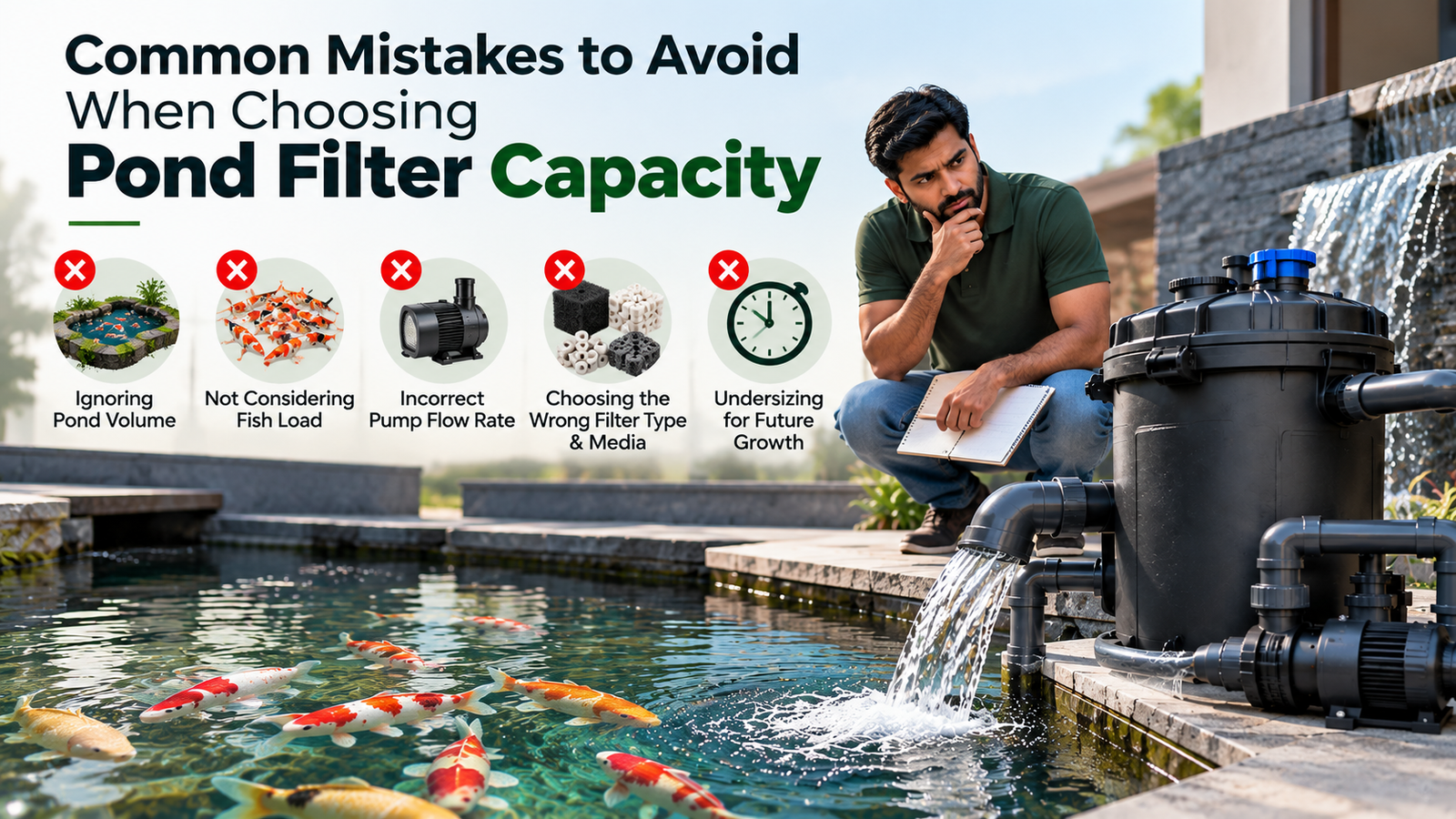
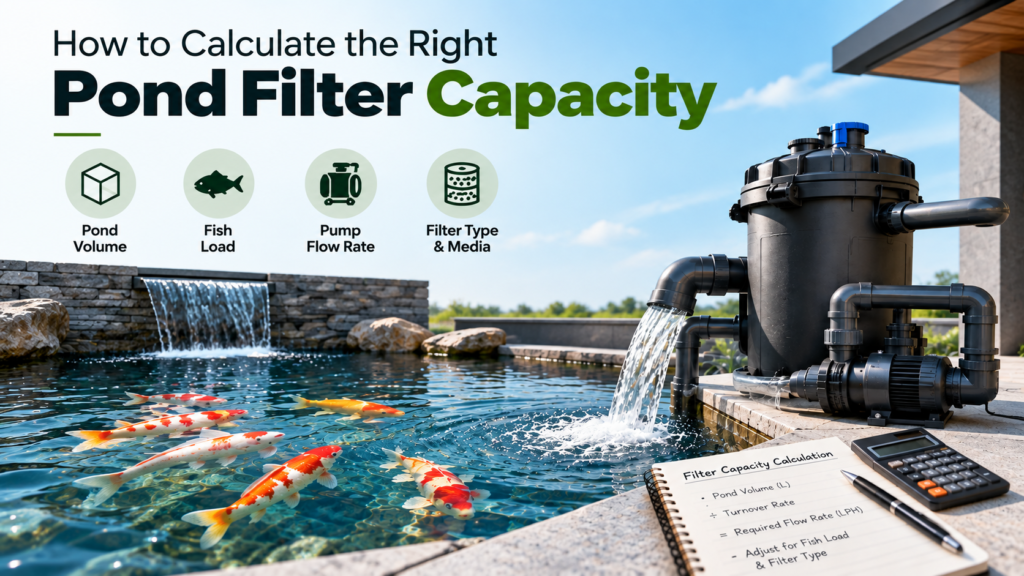
Choosing the right pond filter capacity is essential for maintaining clear water, healthy fish, and a stable pond ecosystem. An undersized filter may struggle to process fish waste and excess nutrients, while an oversized or poorly matched filtration system can increase installation and operating costs unnecessarily.
Whether you are building a new koi pond, upgrading an existing filtration system, or maintaining a garden pond, understanding pond filter capacity calculation helps you select the right equipment for your pond’s water volume, fish population, and circulation requirements.
In this guide, we explain how to calculate pond volume, determine the required pump flow rate, choose a suitable filter, and avoid common filtration mistakes.
Why Is Pond Filter Capacity Important?
A pond filter helps remove suspended debris and supports beneficial bacteria that break down harmful fish waste. These bacteria convert toxic ammonia into nitrite and then into less toxic nitrate through biological filtration.
The correct filter capacity helps you:
- Maintain better pond water quality.
- Reduce the accumulation of fish waste and organic debris.
- Support healthy koi and other pond fish.
- Improve the efficiency of mechanical and biological filtration.
- Reduce unnecessary maintenance and water-quality problems.
The correct capacity depends on more than pond size alone. Fish stocking, feeding levels, sunlight, debris, filter type, and pump performance all influence the filtration requirements.
Step 1: Calculate Your Pond’s Water Volume
Before selecting a filter, calculate how much water your pond holds. This is the starting point for pond filter capacity calculation.
For a rectangular pond
Use this formula:
Pond volume (litres) = Length (m) × Width (m) × Average water depth (m) × 1,000
For example, consider a pond with these dimensions:
- Length: 4 metres
- Width: 3 metres
- Average water depth: 1 metre
Calculation:
4 × 3 × 1 × 1,000 = 12,000 litres
Therefore, the pond holds approximately 12,000 litres of water.
For pond dimensions measured in feet
Use the following formula:
Pond volume (litres) = Length (ft) × Width (ft) × Average depth (ft) × 28.3168
For example, a pond measuring 10 feet long, 6 feet wide, and 3 feet deep has a volume of:
10 × 6 × 3 × 28.3168 = 5,097 litres approximately
Always use the average water depth rather than the maximum construction depth. For irregular or sloping ponds, the actual volume may be lower than the simple rectangular calculation.
Step 2: Determine the Required Pond Water Turnover Rate
Water turnover describes how quickly the pond pump circulates a volume of water equivalent to the pond’s total volume through the filtration system.
The appropriate turnover rate depends on the type of pond and its biological load.
| Pond type | Illustrative turnover target |
|---|---|
| Lightly stocked ornamental pond | Once every 2–3 hours |
| Typical koi pond | Approximately once every 1–2 hours |
| Heavily stocked koi pond | May require more frequent turnover and greater biological capacity |
These are starting points, not universal rules. Follow the filter manufacturer’s specifications and account for fish load, pipework, head height, and the performance of the complete filtration system.
Pump flow rate calculation
Required flow rate (litres/hour) = Pond volume (litres) ÷ Target turnover time (hours)
For a 12,000-litre koi pond targeting one turnover every two hours:
12,000 ÷ 2 = 6,000 litres per hour
This means the system needs an actual filtration flow of approximately 6,000 LPH under operating conditions.
Remember that a pump’s advertised maximum flow rate may be higher than its actual flow after accounting for pipe friction, vertical lift, bends, and filter resistance. Choose the pump based on its expected operating flow, not only its maximum rating.
Step 3: Match the Filter Capacity to Your Pond
After calculating pond volume and flow rate, select a filter designed for your pond’s water volume and biological load.
Filter manufacturers may specify a maximum pond volume, but this rating can vary depending on whether the pond contains koi, goldfish, or very few fish. A filter suitable for a lightly stocked ornamental pond may be insufficient for a heavily stocked koi pond of the same size.
When comparing pond filters, check:
- Recommended pond volume for koi or heavily stocked ponds.
- Maximum and recommended pump flow rates.
- Mechanical filtration performance.
- Biological filter media capacity.
- Cleaning and maintenance requirements.
- Compatibility with UV clarifiers, pumps, and other equipment.
For koi ponds, use the manufacturer’s koi-pond rating wherever available rather than relying on a general garden-pond capacity.
Step 4: Consider Fish Stocking and Feeding Levels
Fish produce waste, and the amount of waste entering the filter increases with fish population, fish size, and feeding quantity.
A pond containing a small number of goldfish may need less biological filtration than a pond of the same volume containing many large koi.
Consider the following factors when selecting a filter:
Light fish stocking
A lightly stocked ornamental pond may work well with a properly sized mechanical and biological filter, supported by suitable circulation.
Moderate fish stocking
A typical koi pond needs dependable solids removal and sufficient biological media to process the waste produced by regular feeding.
Heavy fish stocking
A heavily stocked koi pond may require a larger biological filtration stage, effective pre-filtration, improved aeration, and careful monitoring of ammonia and nitrite.
Do not select a filter based on fish quantity alone. Fish size, feeding rate, temperature, and water-quality results should also guide the final design.
Step 5: Choose the Right Type of Pond Filter
Different filtration systems are suited to different pond sizes and maintenance requirements.
1. Pressurised pond filter
Pressurised filters are compact systems that can be convenient for small and medium garden ponds. Some models include a built-in UV clarifier.
They are useful where installation space is limited, provided the model is rated for the pond’s actual fish load and pump flow.
2. Multi-chamber biological filter
Multi-chamber systems separate filtration stages, allowing mechanical debris removal and biological filtration in different compartments.
They are often suitable for larger koi ponds where sufficient space is available for a properly designed filtration installation.
3. Rotary drum filter
Rotary drum filters automatically remove fine suspended solids from pond water before it reaches the biological filtration stage. They can reduce manual mechanical-filter cleaning and are particularly useful in appropriately designed, heavily stocked koi pond systems.
However, a drum filter does not replace the need for adequate biological media, circulation, and aeration.
4. Biological pond filter
Biological filters provide surfaces for beneficial bacteria to colonise and process nitrogenous waste.
The amount and type of media required depend on the system design, water quality, fish load, and feeding rate. Media volume alone does not guarantee sufficient biological capacity.
Step 6: Check Whether Your Pond Needs a UV Clarifier
A UV clarifier helps control suspended single-celled algae that can cause green pond water. It does not replace mechanical or biological filtration and does not directly remove dissolved fish waste.
When choosing a UV clarifier, consider:
- Pond volume and sunlight exposure.
- Fish stocking and feeding levels.
- Water flow through the UV unit.
- The manufacturer’s recommended UV capacity.
- Lamp condition and maintenance requirements.
Select a UV unit according to the manufacturer’s specifications and intended application. A UV clarifier that is too small or receives water at an unsuitable flow rate may not provide the desired results.
Step 7: Example of Pond Filter Capacity Calculation
Suppose you have a koi pond with the following specifications:
| Parameter | Example value |
|---|---|
| Pond length | 5 metres |
| Pond width | 3 metres |
| Average water depth | 1 metre |
| Calculated pond volume | 15,000 litres |
| Target turnover | Once every 2 hours |
| Required actual flow | 7,500 LPH |
Calculation:
Pond volume = 5 × 3 × 1 × 1,000 = 15,000 litres.
Required flow rate = 15,000 ÷ 2 = 7,500 LPH.
For this example, select a filtration system that can handle the intended fish load and a pump that delivers approximately 7,500 LPH through the complete installed system. The final selection may require a different flow rate depending on the filter manufacturer’s requirements, koi stocking, and system layout.
Do not automatically choose a filter labelled for 15,000 litres unless its rating is appropriate for koi ponds and the expected feeding load.
Common Mistakes to Avoid When Choosing Pond Filter Capacity
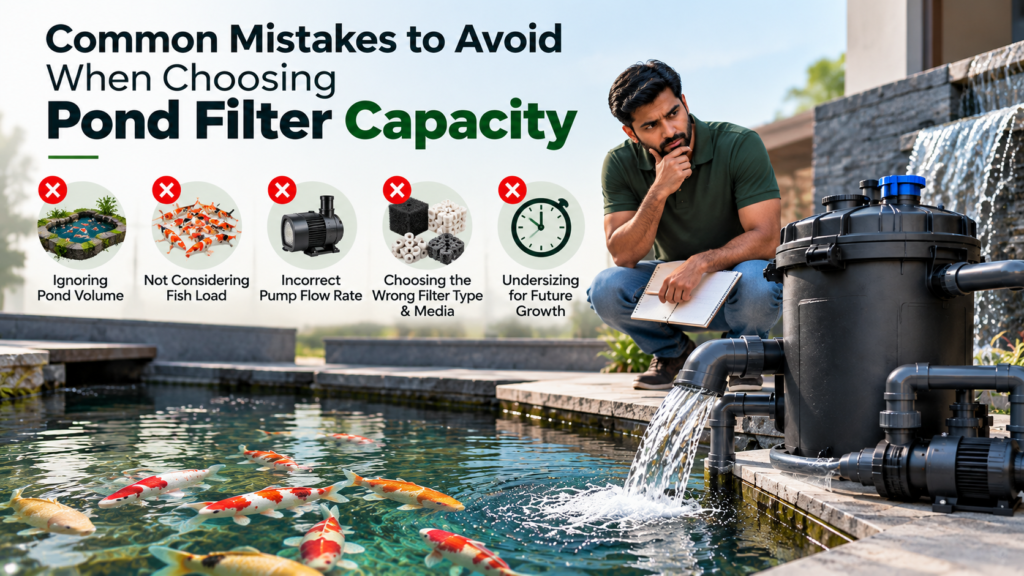
Avoid these common mistakes when designing a pond filtration system:
- Choosing a filter by pond volume alone: Fish load and feeding levels also determine biological filtration requirements.
- Ignoring actual pump flow: Pipework, elevation, and filter resistance reduce the delivered flow rate.
- Using only a UV clarifier: UV treatment cannot replace mechanical and biological filtration.
- Underestimating fish growth: Koi can become large, increasing future waste production.
- Ignoring aeration: Beneficial bacteria and fish need adequate oxygen.
- Neglecting maintenance access: Mechanical filters need cleaning, and biological systems need proper maintenance.
- Overlooking water testing: Regular ammonia, nitrite, and other relevant water-quality checks help verify that the filtration system is performing correctly.
Conclusion
Calculating the right pond filter capacity starts with determining the pond’s actual water volume, estimating an appropriate turnover rate, and selecting a filtration system that can handle the fish population and feeding load.
For koi ponds, pay particular attention to biological filtration, solids removal, aeration, and the pump’s actual operating flow. A well-matched filtration system supports healthier fish, more stable water quality, and easier pond maintenance.
Planning a new pond or upgrading an existing filtration system? Greenfin The Pond Studio can help you explore suitable pond pumps, filtration equipment, and pond construction solutions for your project.
Visit GreenfinIndia.com to explore pond equipment or contact the team to discuss your pond filtration requirements.