

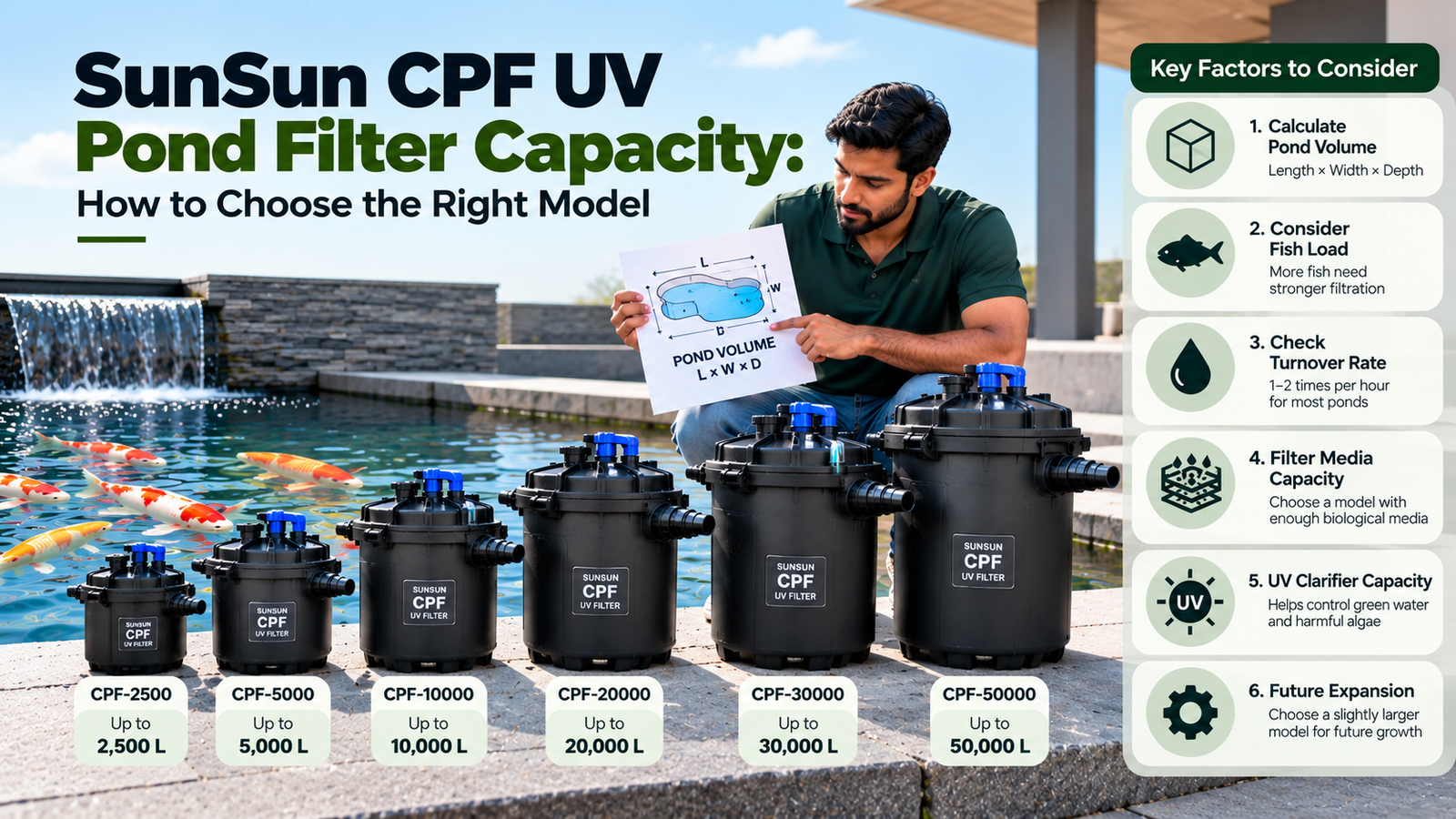
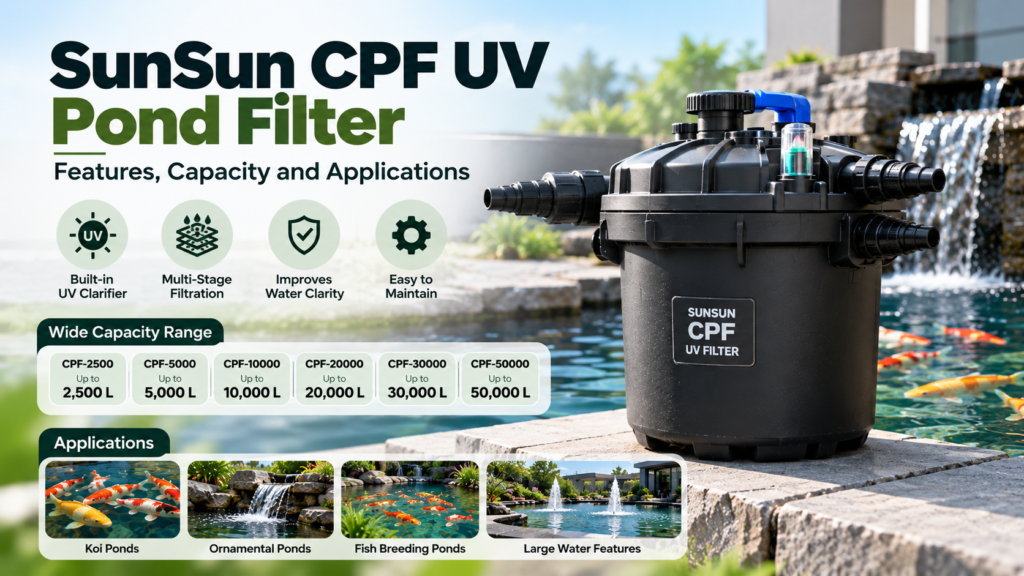
Maintaining clean and healthy pond water is essential for koi fish, goldfish, and other ornamental pond fish. However, fish waste, uneaten food, suspended debris, and algae can gradually affect water quality. Choosing a suitable filtration system helps manage these problems and creates a healthier environment for pond life.
The SunSun CPF UV pond filter is a popular type of pond filtration equipment that combines mechanical filtration, biological filtration, and ultraviolet (UV) water treatment in compatible models. It is designed to help pond owners manage suspended particles, support beneficial bacteria, and control green water caused by free-floating algae.
Whether you are planning a new garden pond, upgrading an existing koi pond, or looking for a convenient filtration solution, understanding the features, capacity, and applications of the SunSun CPF UV pond filter can help you make an informed decision.
In this guide, we explain how the filter works, how to select the right model, and what to consider before installing it.
What Is a SunSun CPF UV Pond Filter?
A SunSun CPF UV pond filter is a pond filtration unit designed to help improve water clarity and support pond water quality. Depending on the model, it may incorporate filter sponges or other mechanical filtration materials, biological filtration surfaces, and a built-in UV clarifier.
The mechanical stage helps trap suspended debris, while the biological stage provides surfaces for beneficial bacteria to colonise. The UV unit exposes flowing water to ultraviolet radiation, helping control free-floating algae responsible for green pond water when the system is correctly sized and operated.
These functions work together to provide a practical filtration solution for suitable ornamental ponds and koi ponds.
However, the CPF range includes different models with different specifications. Always check the exact model’s rated pond volume, UV wattage, recommended flow rate, and installation requirements before purchasing.
Key Features of the SunSun CPF UV Pond Filter
1. Integrated UV Clarification
One of the main attractions of compatible SunSun CPF models is the integrated UV clarification function.
Green pond water often develops when microscopic algae multiply in water exposed to nutrients and sunlight. A UV clarifier treats water passing through the unit and can help reduce these suspended algae.
The result can be clearer-looking pond water when the UV unit is appropriately sized and maintained.
It is important to understand that UV treatment does not remove fish waste, eliminate all algae growing on pond surfaces, or replace biological filtration.
2. Mechanical Filtration
Mechanical filtration helps capture suspended solids such as fish waste, uneaten food, and other debris.
Filter sponges or other designated media trap these particles as water passes through the system. Regular maintenance is necessary because accumulated debris can restrict water flow and reduce filtration performance.
Removing trapped waste also helps prevent organic material from decomposing inside the filter and adding to the pond’s nutrient load.
3. Biological Filtration Support
Biological filtration is essential for ponds containing fish.
Beneficial bacteria colonise suitable surfaces within the filter and help process ammonia produced by fish waste and decomposition. These bacteria convert ammonia into nitrite and then nitrate.
The filter’s biological performance depends on several factors, including media design, oxygen availability, water flow, temperature, fish stocking, and feeding levels.
A new filter requires time to establish its biological community. Do not assume that a newly installed filter can immediately support a fully stocked koi pond.
4. Compact Filtration Design
Depending on the model and installation arrangement, a CPF filter can provide multiple filtration functions in one unit.
This may simplify equipment planning for pond owners who prefer an integrated system rather than separate mechanical, biological, and UV units.
Before installation, check the unit’s dimensions, pipe connections, access requirements, and the manufacturer’s recommended operating position.
5. Convenient Maintenance Features
Certain CPF models include cleaning or backwashing arrangements intended to make maintenance easier.
The precise mechanism differs between models. Follow the manufacturer’s instructions for cleaning the filter media, removing accumulated waste, and maintaining the UV components.
Even when a filter includes convenient cleaning features, periodic inspection remains necessary to ensure that water continues to flow correctly.
SunSun CPF UV Pond Filter Capacity: How to Choose the Right Model
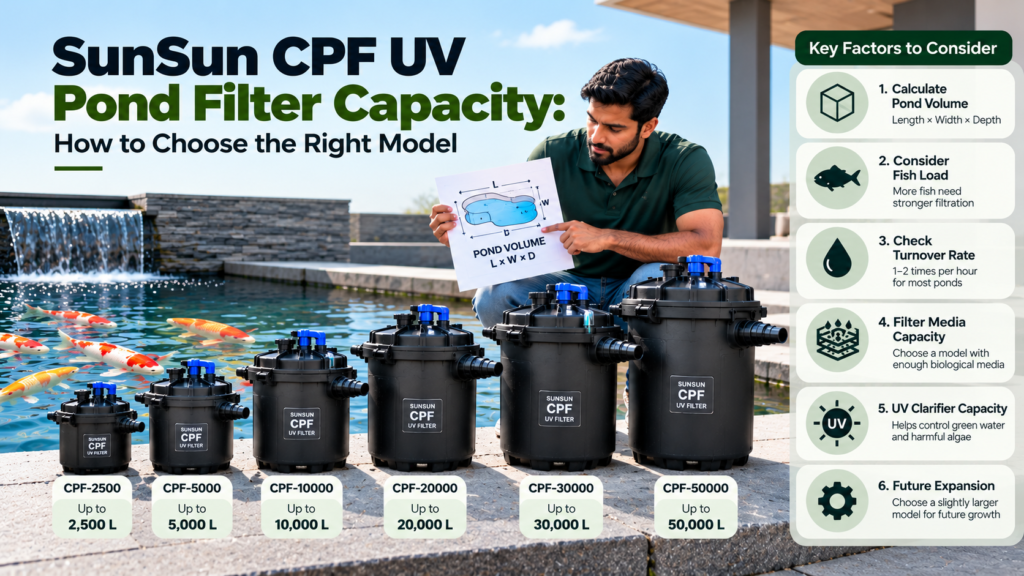
Choosing the correct filter capacity is one of the most important steps when setting up a pond filtration system.
A filter that is too small for the fish population may struggle to maintain water quality. A filter that is not matched to the pump can also perform poorly, even if its advertised pond capacity appears sufficient.
Step 1: Calculate your pond volume
For a rectangular pond, use this formula:
Pond volume in litres = Length × Width × Average depth × 1,000
All dimensions must be measured in metres.
For example, a pond measuring 4 metres long, 3 metres wide, and 1 metre deep has a calculated volume of:
4 × 3 × 1 × 1,000 = 12,000 litres
This is the theoretical volume before accounting for displaced space, sloping sides, or differences between construction depth and actual water depth.
Step 2: Consider the fish population
The required filtration capacity depends on the pond’s biological load, not just its volume.
Consider the following:
- Lightly stocked garden pond: A suitable CPF model may be sufficient when its specifications match the pond’s volume and fish load.
- Moderately stocked koi pond: Check the manufacturer’s recommended koi-pond capacity and ensure that biological filtration is adequate.
- Heavily stocked koi pond: A more substantial filtration arrangement, additional biological media, or a separate pre-filtration stage may be necessary.
Koi generally produce more waste as they grow and consume more food. Plan for the expected adult fish size rather than the number of small fish currently in the pond.
Step 3: Match the pump flow rate
The pump must deliver an appropriate flow through the filter.
Actual flow is affected by pipe diameter, pipe length, bends, vertical lift, and resistance through the filtration equipment.
For example, if a pond has 12,000 litres of water and you are aiming for one theoretical turnover every two hours, the initial flow-rate calculation is:
12,000 ÷ 2 = 6,000 litres per hour
This is a starting estimate, not a universal requirement for every pond. Check the selected CPF model’s permitted flow range and the filtration requirements of the pond.
Do not select a pump solely from its maximum advertised flow rate. Use its expected operating performance after installation.
Step 4: Verify the exact CPF model specifications
Before buying, confirm the following information for the specific model:
- Recommended pond volume, including any separate koi-pond rating.
- UV lamp wattage.
- Recommended pump flow rate.
- Inlet and outlet connection sizes.
- Filter media arrangement.
- Cleaning method and maintenance access.
- Electrical and installation requirements.
Important: SunSun CPF models are not identical. Avoid choosing a model based only on its series name; verify the specifications of the exact product being offered.
Applications of the SunSun CPF UV Pond Filter
1. Ornamental Garden Ponds
Garden ponds may contain goldfish, ornamental fish, or a small number of koi. In these settings, a compatible CPF filter can help capture suspended particles, support biological filtration, and reduce green water.
The final result depends on pond size, sunlight exposure, feeding levels, and the condition of the filtration system.
2. Small and Medium Koi Ponds
Koi ponds need reliable filtration because koi produce considerable waste, particularly when feeding regularly.
A suitable CPF model can be part of a koi pond’s filtration system when its actual capacity and biological performance match the fish load.
For heavily stocked ponds or larger koi installations, additional mechanical pre-filtration and biological filtration may be required.
3. Existing Pond Filtration Upgrades
If your pond water remains green or the current filtration system struggles with debris, reviewing the filter and pump arrangement may help.
A CPF UV filter can be considered when replacing an unsuitable filter or upgrading an existing system. However, persistent water-quality problems should also prompt checks of fish stocking, feeding, circulation, and biological filtration.
4. New Pond Installations
When planning a new pond, selecting the filter early helps determine the pump requirements, plumbing layout, installation position, and maintenance access.
The CPF filter should be considered as part of the complete pond system rather than as an isolated piece of equipment.
For larger ponds, a dedicated filtration chamber or separate mechanical and biological filtration stages may offer more flexibility.
How to Install a SunSun CPF UV Pond Filter
Correct installation is important for reliable operation.
Step 1: Choose a suitable location
Position the filter according to the manufacturer’s instructions, with enough space to access the unit for inspection and cleaning.
Protect electrical connections from water exposure and install the equipment in accordance with the applicable electrical safety requirements.
Step 2: Connect the pond pump
Connect a compatible pump to the filter inlet using suitable pipework and fittings.
Check that the pump’s operating flow falls within the filter manufacturer’s specified range.
Step 3: Check all pipe connections
Inspect the inlet, outlet, seals, and hose connections before starting the system.
Ensure that the outlet returns water safely to the pond and that the plumbing arrangement does not create unnecessary restrictions.
Step 4: Start the filtration system
Follow the manufacturer’s start-up procedure. Check for leaks, unusual noises, restricted flow, or other installation problems.
Confirm that water circulates properly through the filtration unit.
Step 5: Maintain the filter regularly
Inspect the mechanical media and clean it as required. Follow the recommended service interval for the UV lamp and other components.
Avoid using cleaning methods that damage the biological media or unnecessarily remove beneficial bacteria. Always follow the product manual for maintenance and electrical isolation.
Maintenance Tips for Better Filtration Performance
Regular maintenance helps the SunSun CPF UV pond filter operate effectively.
- Check water flow regularly and investigate any sudden reduction.
- Clean mechanical media when debris accumulation restricts flow.
- Inspect hoses, seals, and connections for leaks.
- Replace the UV lamp according to the manufacturer’s maintenance schedule.
- Keep suitable biological media established and oxygenated.
- Avoid overfeeding fish and remove uneaten food where possible.
- Test ammonia and nitrite, particularly after installing a new filter or increasing fish stocking.
- Monitor water clarity and fish behaviour to identify developing problems.
Do not wait for the pond to become visibly dirty before checking the filtration system. Water can appear clear while still containing harmful levels of ammonia or nitrite.
SunSun CPF UV Pond Filter vs Separate Filtration Systems
An integrated CPF unit and a filtration system built from separate components can both be appropriate, depending on the pond’s needs.
An integrated filter may offer a compact arrangement and convenient installation. Separate filtration stages may provide greater flexibility for larger ponds, heavier fish loads, and specialised filtration designs.
When comparing the two approaches, consider the total system cost, maintenance requirements, available space, pump compatibility, and expected fish growth.
The best choice is the system that reliably manages the pond’s solids and biological waste while providing appropriate circulation.
Common Mistakes to Avoid
Choosing a filter based only on maximum pond volume
Advertised capacities may be based on lightly stocked ornamental ponds. Koi ponds often require a more conservative selection.
Using an unsuitable pump
Too little flow can limit filtration, while excessive flow may exceed the manufacturer’s recommended operating range.
Expecting UV treatment to solve every water-quality problem
UV clarification targets susceptible organisms in the water passing through the unit. It does not replace mechanical filtration, biological filtration, or good pond management.
Neglecting biological filter development
Beneficial bacteria need time to establish. Monitor ammonia and nitrite during the filter’s initial operation.
Ignoring routine cleaning
Clogged mechanical media and restricted plumbing can reduce circulation and filtration effectiveness.
Frequently Asked Questions
Is the SunSun CPF UV pond filter suitable for koi ponds?
It can be suitable for koi ponds when the selected model is rated for the pond’s volume and biological load. Check the koi-pond capacity, pump-flow requirements, and available biological filtration before purchasing.
Does the SunSun CPF UV pond filter remove green water?
The integrated UV clarifier in compatible models can help control free-floating algae responsible for green water. Results depend on correct sizing, suitable water flow, lamp condition, and overall pond management.
How often should I clean a SunSun CPF UV pond filter?
Cleaning frequency depends on the fish population, feeding rate, debris load, and filter model. Inspect the unit regularly and clean it according to the manufacturer’s instructions.
Can I use a SunSun CPF UV filter without a pond pump?
A pump is generally needed to move pond water through a CPF filtration unit. Confirm the specific model’s installation requirements and select a compatible pump.
How do I know which CPF model is right for my pond?
Calculate the pond’s actual water volume, assess the fish load, and compare the results with the exact model’s manufacturer specifications. Also consider pump flow, UV capacity, and the need for additional biological filtration.
Conclusion
The SunSun CPF UV pond filter can be a practical filtration option for suitable ornamental ponds and koi ponds. Its combination of mechanical filtration, biological filtration support, and UV clarification in compatible models can help manage suspended debris and green water.
To choose the right model, calculate your pond’s water volume, consider fish stocking and feeding levels, and verify the filter’s rated capacity and pump-flow requirements. Regular cleaning, suitable aeration, and water-quality monitoring remain essential for healthy fish and a stable pond environment.
Looking for pond filtration equipment for your next project? Visit GreenfinIndia.com to explore pond products and filtration solutions, or contact Greenfin The Pond Studio for assistance in planning a suitable pond filtration system.