

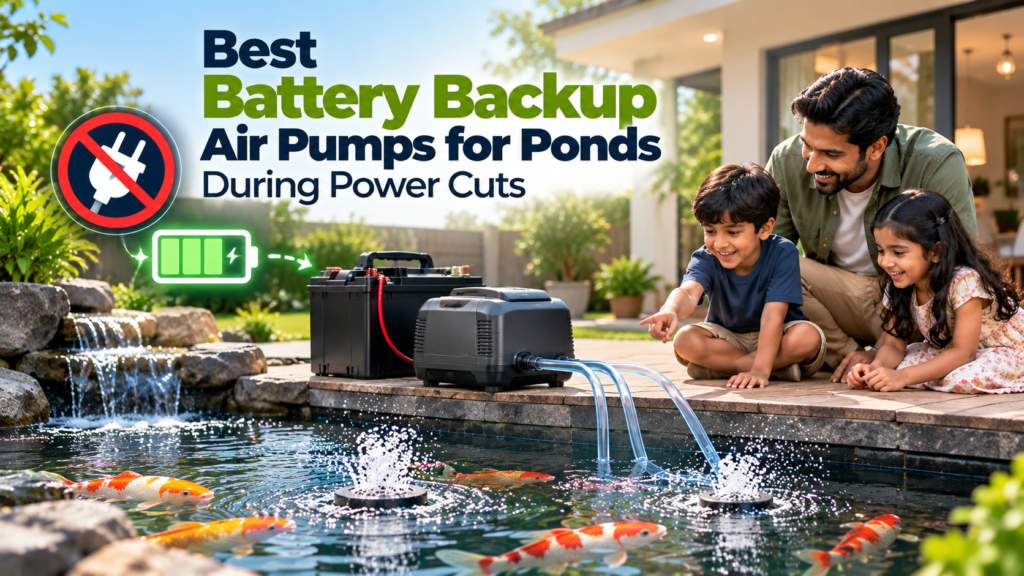
Power cuts can create a serious challenge for koi pond owners, especially when fish depend on mechanical aeration to maintain healthy oxygen levels. During an outage, pond air pumps and other electrical equipment may stop working, reducing water movement and potentially putting fish under stress.
A pond air pump with battery backup helps maintain aeration when the main electricity supply fails. It can be especially useful for koi ponds with high fish populations, deep water, or biological filtration systems that need a continuous oxygen supply.
In this guide, we explain the different types of backup air pumps, how to choose the right capacity, how to estimate battery runtime, and how to prepare your pond for unexpected power failures.
Why Is Battery Backup Aeration Important for Ponds?
Koi fish require dissolved oxygen to breathe, while beneficial bacteria in biological filters also consume oxygen as they break down fish waste. If aeration stops during a power cut, oxygen levels may decline depending on the pond’s temperature, stocking density, depth, and existing circulation.
Battery backup aeration provides an additional source of air when mains electricity is unavailable.
Key benefits include:
- Emergency oxygen supply: Helps maintain aeration while the main power is unavailable.
- Support for koi health: Reduces the risk associated with interrupted aeration.
- Protection during unexpected outages: Provides an additional safety measure during storms, maintenance, and electrical failures.
- Support for biological filtration: Helps supply oxygen to aerated biological filters and surrounding water.
- Greater peace of mind: Gives pond owners more time to restore the main equipment or arrange alternative power.
Battery backup does not replace a properly designed filtration system, and it cannot guarantee safe oxygen levels during every outage. It should form part of a broader emergency plan for koi ponds.
Types of Pond Air Pumps With Battery Backup
Not every air pump provides the same type of backup. Before purchasing, understand how each option works.
1. AC/DC Rechargeable Air Pumps
AC/DC air pumps operate using mains electricity and can switch to an internal rechargeable battery when power fails. Models with automatic switching are particularly convenient because they can continue supplying air without requiring manual intervention.
Advantages:
- Automatic changeover on compatible models.
- Convenient for unexpected power cuts.
- Rechargeable battery included in many designs.
- Suitable for emergency aeration when the output matches the pond’s needs.
Best suited for: Small ponds, emergency aeration, and selected larger applications where the manufacturer’s airflow specifications are sufficient.
Always confirm whether the model automatically switches to battery operation or requires manual activation.
2. Battery-Powered Portable Air Pumps
Portable battery-operated pumps use replaceable batteries or rechargeable battery packs. They can be useful as an emergency backup when the primary aeration system stops working.
Advantages:
- Portable and easy to position.
- Useful during short outages.
- Can operate independently of mains electricity.
- Some rechargeable models include multiple air outlets.
Best suited for: Small ponds, temporary aeration, and emergency support where the pump has sufficient output.
Many portable models are designed primarily for aquariums or fish transport. Do not assume that an aquarium air pump will provide enough airflow for a large koi pond.
3. Main Air Pump Connected to a Backup Power System
For larger ponds, a more powerful primary air pump can be connected to a suitable backup power solution, such as a compatible inverter and battery system.
This approach can support higher aeration requirements, but the backup system must be correctly sized for the pump’s electrical load and desired operating duration.
Advantages:
- Can support larger air pumps.
- Allows selection of a primary pump based on pond requirements.
- Backup duration can be designed around battery capacity.
- May support additional essential equipment if the system is appropriately sized.
Best suited for: Large koi ponds, heavily stocked ponds, and installations requiring longer backup operation.
A qualified electrician should install and protect mains-powered backup systems, particularly around outdoor ponds and wet areas.
How to Choose the Right Battery Backup Air Pump
Selecting the right pump involves more than checking whether it has a rechargeable battery. Consider the following factors before purchasing.
1. Airflow Capacity
Airflow indicates how much air the pump can deliver and is commonly measured in litres per minute (LPM) or cubic feet per minute (CFM).
The required airflow depends on pond volume, water depth, the number and size of koi, diffuser design, and existing aeration.
When comparing products, check:
- Maximum airflow in LPM.
- Airflow available at the operating depth.
- Number of outlets.
- Supported diffuser types.
- Whether airflow changes when the pump switches to battery mode.
For a large koi pond, verify that the backup pump can provide meaningful aeration rather than relying on a small aquarium pump simply because it includes a battery.
2. Battery Backup Duration
Battery runtime determines how long the pump can operate without mains electricity.
Some portable pumps are intended for short emergencies, while larger battery systems may be designed for longer operation. Runtime depends on battery capacity, power consumption, operating mode, battery age, and environmental conditions.
For example, if a backup pump can run for four hours under the manufacturer’s specified conditions, it may not be sufficient for a location that regularly experiences eight-hour outages.
Choose a backup duration based on the longest realistic outage in your area, with an additional safety margin.
3. Pond Size and Fish Population
A small ornamental pond with a few fish usually has different aeration needs from a large koi pond containing many adult fish.
Before choosing a pump, establish:
- Approximate pond water volume.
- Average and maximum depth.
- Number and size of koi.
- Existing waterfall, fountain, or aeration system.
- Whether the biological filter requires separate aeration.
Larger or heavily stocked ponds may require a dedicated backup system rather than a compact rechargeable air pump.
4. Automatic Power Failure Switching
An automatic AC/DC air pump can begin battery operation when the mains supply fails. This is particularly useful if a power cut occurs overnight or when nobody is at the property.
Check the product specifications for automatic switching, charging behaviour, and whether the pump resumes mains operation after power returns.
5. Energy Efficiency
For larger backup systems, energy consumption determines how much battery capacity is required.
Use this formula to estimate energy demand:
Energy required (Wh) = Power consumption (W) × Operating time (hours)
For example, a pump consuming 20 watts for eight hours requires 160 watt-hours of energy before accounting for inverter losses and other system inefficiencies.
When sizing a battery, allow for usable battery capacity, conversion losses, battery condition, and the manufacturer’s discharge recommendations.
6. Outdoor Safety and Durability
Pond aeration equipment must be installed safely around water. Keep the pump, battery connections, and charging equipment protected from rain, flooding, and splashing.
Use equipment rated for its installation environment, follow the manufacturer’s ventilation and mounting instructions, and protect electrical circuits with appropriate safety devices.
Do not place a standard indoor battery system in a location exposed to rain or pond water.
How to Estimate Battery Backup Runtime
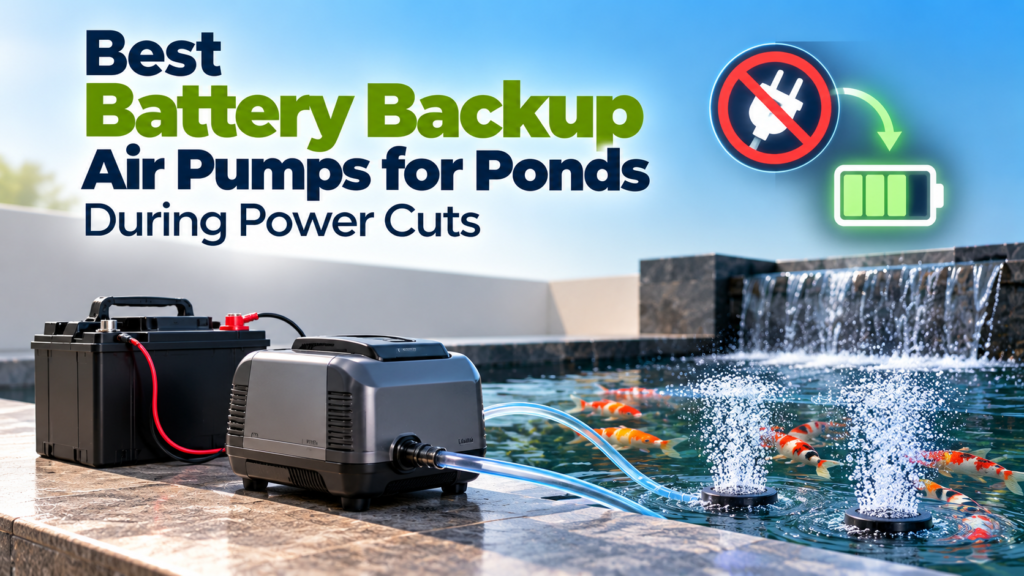
If you are using a dedicated battery and inverter to operate a pond air pump, a basic runtime estimate can help you plan your emergency system.
The following example is illustrative rather than a specification for a particular product.
| Parameter | Example |
|---|---|
| Air pump power consumption | 20 W |
| Desired backup duration | 8 hours |
| Energy needed by pump | 160 Wh |
| Assumed inverter efficiency | 85% |
| Approximate battery energy required | 188 Wh |
The final battery capacity should be higher if you need a reserve for ageing, temperature effects, unexpected longer outages, or additional connected equipment.
For a rechargeable air pump with a built-in battery, use the manufacturer’s stated runtime and check whether it applies to continuous or intermittent operation.
How to Prepare Your Koi Pond for Power Cuts
A backup pump is most useful when it is ready before an outage occurs.
- Keep the battery charged. Follow the manufacturer’s charging and storage recommendations.
- Test automatic switching. Where supported, confirm that the pump changes to battery operation correctly.
- Check every airline. Inspect tubing, connectors, and diffusers for leaks or blockages.
- Position the diffuser correctly. Place it to provide useful circulation without continuously disturbing settled waste.
- Keep a backup plan. For large ponds, consider a secondary pump, compatible battery system, or generator where appropriate.
- Monitor fish behaviour. Watch for gasping at the surface, unusual lethargy, or gathering near water inlets.
- Restore essential equipment promptly. Once electricity returns, check that pumps, filters, and aeration systems have restarted correctly.
If fish show signs of oxygen stress, provide safe emergency aeration immediately and check dissolved oxygen and other water-quality parameters as soon as possible.
Common Mistakes to Avoid
Choosing a Small Aquarium Pump for a Large Pond
A portable air pump may be useful for temporary support but may not provide enough airflow for a heavily stocked koi pond. Always check its actual output and intended application.
Ignoring Battery Runtime
A pump that operates for only a short period may not cover an extended outage. Estimate realistic outage duration before selecting a backup system.
Forgetting to Charge the Battery
A rechargeable pump is not useful if its battery is depleted when electricity fails. Establish a regular inspection and charging routine.
Overlooking Diffuser Resistance
Air stones and tubing can restrict airflow. Check that the backup pump can operate the selected diffuser at the required depth.
Assuming Bubbles Guarantee Adequate Oxygen
Visible bubbles do not necessarily mean dissolved oxygen levels are safe. Monitor water quality and size the backup system for the actual pond conditions.
Frequently Asked Questions
1. What is a pond air pump with battery backup?
It is an aeration pump that can operate from a battery when mains electricity is unavailable. Depending on the model, it may use an internal rechargeable battery or a separate external backup power system.
2. How long can a battery backup air pump run?
Runtime varies by model, battery capacity, airflow setting, and operating conditions. Check the manufacturer’s specifications and distinguish continuous runtime from intermittent runtime.
3. Can a battery air pump protect koi during a long power cut?
It can help maintain aeration, but its effectiveness depends on its airflow, the pond’s oxygen demand, and the length of the outage. Large or heavily stocked ponds may require a higher-capacity backup system.
4. Should a koi pond air pump run during the night?
Yes, aeration is generally important throughout the day and night in stocked koi ponds. Oxygen demand from fish and beneficial bacteria continues after dark, so reliable backup aeration can be especially valuable during overnight outages.
5. Is an AC/DC air pump better than a battery-only pump?
An AC/DC model with automatic switching is convenient for routine use and sudden power cuts. A battery-only pump can be useful for portable emergency aeration. The best option depends on the required airflow, runtime, pond size, and budget.
6. Do I need a backup pump if my pond has a waterfall?
A waterfall provides some aeration, but it stops when its circulation pump loses power. A separate battery-powered air pump or a suitably designed backup power system can help maintain aeration during an outage.
Conclusion
Choosing the right pond air pump with battery backup is an important part of preparing for unexpected power cuts. The right solution depends on pond size, fish population, required airflow, operating depth, and how long you need aeration to continue.
For smaller ponds, a compatible rechargeable AC/DC pump may provide convenient emergency support. For larger koi ponds, consider a properly sized primary air pump connected to a suitable backup power system.
Prepare before the next outage by keeping batteries charged, checking airline connections, testing the backup system, and monitoring water quality.
Explore pond aeration and filtration equipment at GreenfinIndia.com to find products suited to your pond setup.