

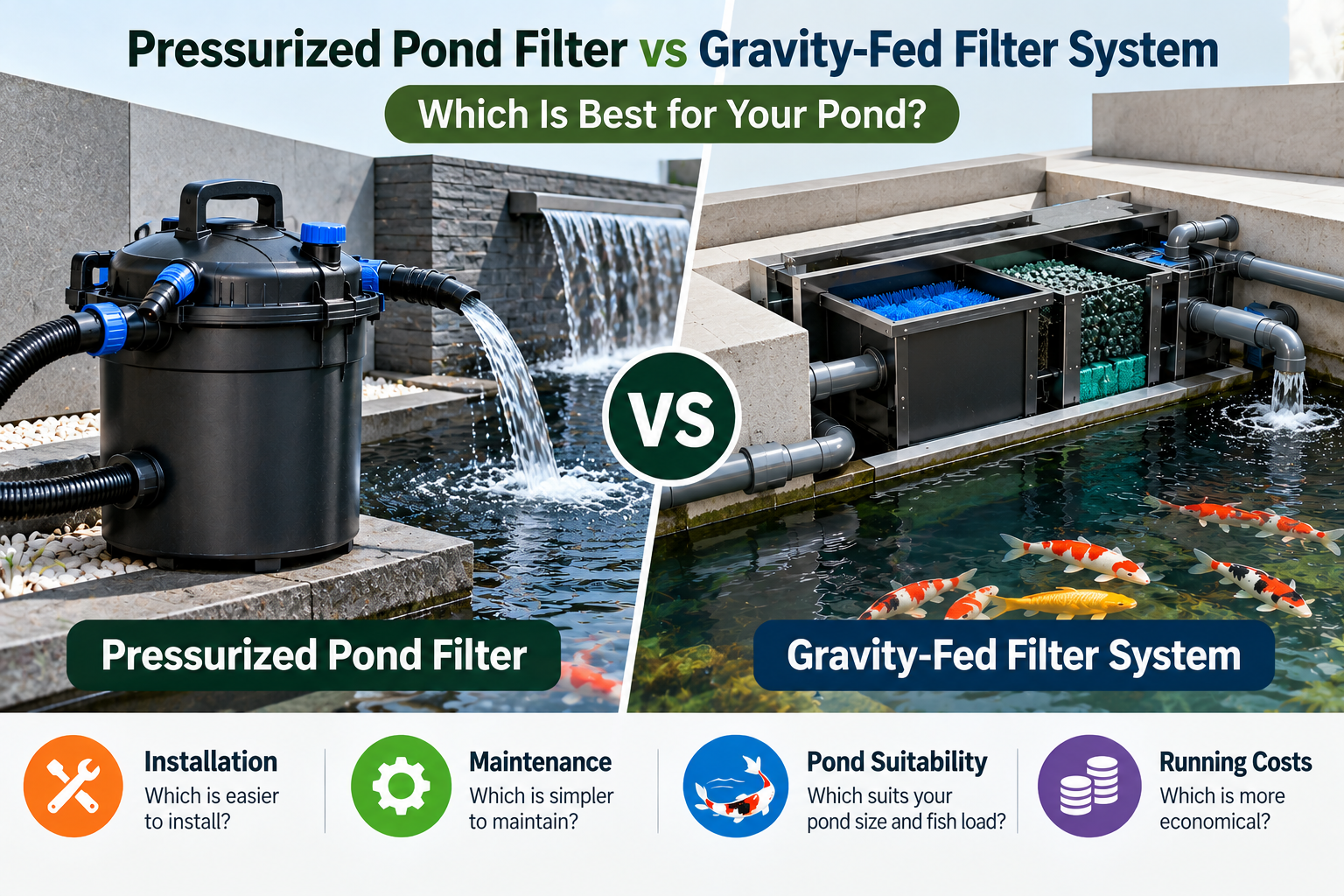
Choosing the right filtration system is essential for maintaining clear pond water, healthy fish, and a balanced aquatic environment. Two popular options are pressurized pond filters and gravity-fed filter systems. Although both can provide mechanical and biological filtration, they differ in installation, maintenance, pond suitability, and running costs.
Understanding the differences between a pressurized pond filter vs gravity-fed filter system can help you choose the right solution for your garden pond, ornamental pond, or koi pond.
In this guide, Greenfin The Pond Studio explains how both systems work, their advantages and disadvantages, and the factors to consider before purchasing or installing a pond filtration system.
What Is a Pressurized Pond Filter?
A pressurized pond filter is a sealed filtration unit that receives water from a pump. Water passes through filtration media inside the unit before returning to the pond through a pipe.
Many pressurized pond filters combine mechanical filtration, biological filtration, and an optional or integrated UV clarifier.
Mechanical filtration traps suspended debris, while biological media provide surfaces for beneficial bacteria that process toxic ammonia and nitrite. A UV clarifier, when included, helps control suspended algae that cause green water.
Advantages of Pressurized Pond Filters
- Compact installation: Suitable for installations with limited space.
- Flexible positioning: Many models can be installed below or above pond water level, subject to manufacturer instructions.
- Waterfall compatibility: Filtered water can be returned to a raised waterfall if the pump provides sufficient flow and pressure.
- Convenient cleaning: Some models feature backwash or cleaning mechanisms.
- Simple setup: Often easier to install in an existing pond than a gravity-fed system requiring bottom drains.
Disadvantages of Pressurized Pond Filters
- Compact models may have limited mechanical and biological media capacity.
- Mechanical media can clog quickly in ponds with heavy fish loads.
- Pump energy consumption may increase when higher pressure is required.
- Regular cleaning is necessary to maintain water flow.
- Larger koi ponds may require additional filtration equipment or a more substantial system.
What Is a Gravity-Fed Pond Filter System?
A gravity-fed pond filter system uses gravity to move water from the pond into a filtration chamber. The filter is generally positioned below the pond’s operating water level, often inside a dedicated filter pit.
Water enters through suitably designed bottom drains or skimmers and passes through mechanical and biological filtration stages. A pump on the clean-water side then returns the filtered water to the pond.
Gravity-fed filtration is commonly considered for larger koi ponds because it can be integrated with bottom drains, high-capacity mechanical filtration, and large biological filter chambers.
Advantages of Gravity-Fed Filter Systems
- High filtration capacity: Large systems can accommodate substantial quantities of filtration media.
- Suitable for koi ponds: Can be designed to manage high fish loads and significant waste production.
- Effective solids removal: Properly designed bottom drains can transport waste to the mechanical filtration stage.
- Flexible configuration: Can incorporate multi-chamber filters, sieve filters, moving-bed media, or rotary drum filters.
- Potential energy efficiency: A well-designed system may require less pumping energy for a given circulation rate, depending on its hydraulic layout.
- Discreet installation: Equipment can be concealed in an appropriately designed filter chamber.
Disadvantages of Gravity-Fed Filter Systems
- Installation requires more planning and technical expertise.
- Bottom drains and larger pipework may need to be installed during pond construction.
- A dedicated filter pit or chamber may be necessary.
- Retrofitting an existing pond can involve additional civil work.
- Maintenance access, drainage, water levels, and overflow protection must be planned carefully.
Pressurized Pond Filter vs Gravity-Fed Filter: Comparison Table
| Feature | Pressurized Pond Filter | Gravity-Fed Filter System |
|---|---|---|
| Installation | Generally straightforward | Requires careful planning |
| Space requirement | Compact | Usually requires a filter chamber |
| Installation cost | Often lower | Often higher |
| Mechanical filtration | Commonly sponge or cartridge based | Can use high-capacity mechanical filtration |
| Biological filtration | Depends on media volume and design | Can accommodate substantial media volume |
| Maintenance | May require frequent backwashing | Depends on the mechanical filter and waste load |
| Waterfall compatibility | Convenient with sufficient pump pressure | Possible with a suitably designed return pump |
| Electricity consumption | Depends on pump head and flow | Depends on pump efficiency and system resistance |
| Small garden ponds | Often suitable | May be unnecessarily complex |
| Large koi ponds | May require supplementary filtration | Often a strong option when properly designed |
| Existing pond upgrades | Usually easier | May require modifications |
Neither system is automatically the best choice for every pond. The correct solution depends on pond volume, fish stocking, feeding rate, water circulation, and maintenance preferences.
1. Installation: Which System Is Easier to Install?
Pressurized Pond Filter Installation
Pressurized filters are often easier to install in existing garden ponds.
A typical setup includes a pond pump, filter inlet and outlet pipes, and a suitable electrical supply. If the filter includes a UV clarifier, follow the manufacturer’s instructions for installation and servicing.
Before installing the unit:
- Calculate the pond’s water volume.
- Determine the required circulation rate.
- Check the pump’s actual flow at the expected operating head.
- Confirm the filter’s recommended capacity for ponds containing fish.
- Provide sufficient space for cleaning and maintenance.
Pressurized filters are useful when the pond has already been constructed and installing a bottom drain would be difficult or expensive.
Gravity-Fed Filter Installation
Gravity-fed filtration requires more detailed planning, especially for a new koi pond.
The pond’s bottom drains, skimmers, pipework, filter chamber, and return pump must operate together. The filter’s operating water level must be coordinated with the pond level, and pipework must be designed to carry the required flow.
Before construction, plan:
- Bottom-drain positions and pipe routes.
- Skimmer connections.
- Filter chamber dimensions and operating water levels.
- Mechanical and biological filtration stages.
- Return-pump placement and flow requirements.
- Waste discharge, drainage, and maintenance access.
For a new koi pond, incorporating these elements during construction can reduce the need for expensive modifications later.
2. Maintenance: Which Filter Is Easier to Clean?
Both systems require regular maintenance. Cleaning frequency depends on fish load, feeding rate, debris, filter capacity, and equipment design.
Pressurized Filter Maintenance
Pressurized filters often need regular cleaning because mechanical media collect suspended particles.
Routine maintenance may include:
- Backwashing or cleaning the filter.
- Monitoring water flow and pressure.
- Inspecting sponges and biological media.
- Cleaning the UV sleeve when required.
- Replacing UV lamps according to manufacturer guidance.
- Inspecting seals, hoses, and pipe connections.
A backwash function can simplify cleaning, but it does not eliminate the need for periodic servicing.
Gravity-Fed Filter Maintenance
Maintenance depends on the filtration configuration. A multi-chamber filter, sieve filter, and automatic drum filter each have different servicing requirements.
Typical maintenance includes:
- Removing accumulated solid waste.
- Cleaning mechanical media when necessary.
- Checking bottom drains and skimmer lines.
- Inspecting the return pump and plumbing.
- Maintaining biological media without unnecessarily destroying beneficial bacteria.
- Servicing automatic cleaning equipment where installed.
A well-designed gravity-fed system can make solid-waste removal easier, especially when mechanical filtration is accessible and properly sized.
Which is better for maintenance? A pressurized filter may be more convenient for a small pond, while a well-designed gravity-fed system can provide easier access to high-capacity filtration. The actual workload depends on the equipment and pond conditions.
3. Pond Suitability: Which System Should You Choose?
Small Garden Ponds
A pressurized pond filter is often a practical choice for a small ornamental pond with a modest fish population.
Its compact design and relatively straightforward installation make it suitable for many existing ponds. Models with integrated UV clarification can also help manage suspended green-water algae.
Always check the manufacturer’s recommended capacity for fish ponds rather than relying only on the maximum advertised pond volume.
Medium-Sized Ponds
Both systems can work well for medium-sized ponds.
Choose a pressurized filter when compact installation and straightforward maintenance are priorities. Consider a gravity-fed or multi-chamber system if the pond has a higher fish load or requires greater mechanical and biological filtration capacity.
Large Koi Ponds
A properly designed gravity-fed filtration system is often a strong choice for large koi ponds.
Koi produce significant waste, especially when kept at high stocking densities or fed heavily. Effective mechanical filtration helps remove solids, while biological filtration supports the bacteria needed to process ammonia and nitrite.
The system should be designed according to pond volume, fish population, feeding rate, and the required circulation rate.
A pressurized filter may still be suitable as supplementary filtration, but a compact standalone unit should not automatically be considered adequate for a heavily stocked koi pond.
Ponds with Waterfalls
Pressurized filters can be convenient when water needs to be returned to a raised waterfall.
Gravity-fed systems can also supply waterfalls, provided the return pump and plumbing are designed for the required flow and elevation.
In both cases, account for waterfall height, pipe length, bends, and other hydraulic resistance when selecting the pump.
4. Running Costs: Which System Is More Economical?
The total cost of pond filtration includes equipment purchase, installation, electricity, cleaning, and replacement parts.
Initial Installation Costs
Pressurized filters generally have lower installation costs because they are compact and may require less civil work.
Gravity-fed systems can cost more initially due to bottom drains, larger pipework, filter chambers, and additional installation labour. For a large koi pond, however, the additional investment may provide greater filtration capacity and easier waste management.
Electricity Consumption
Electricity consumption depends on pump power, operating hours, actual flow, and total dynamic head.
Use this formula to estimate electricity consumption:
Daily energy consumption (kWh) = Pump power (W) × Operating hours ÷ 1,000
For example, a 100 W pump running continuously for 24 hours consumes:
100 × 24 ÷ 1,000 = 2.4 kWh per day
At an illustrative electricity tariff of ₹8 per kWh, this equals ₹19.20 per day or approximately ₹576 over 30 days.
These figures are examples, not a quotation for a particular pump or electricity tariff.
A pressurized filter may require a pump capable of overcoming the filter’s resistance and any waterfall height. A well-designed gravity-fed system may operate efficiently with a suitably selected return pump, but actual energy use depends on the complete system.
Compare the pumps’ power consumption at the required operating flow rather than assuming that one filtration type always consumes less electricity.
Maintenance and Replacement Costs
Consider expenses for:
- Filter media and replacement components.
- UV lamps and sleeves, where applicable.
- Seals, hoses, and fittings.
- Mechanical filter cleaning.
- Pump servicing.
- Automatic cleaning equipment, where installed.
Best value: The most economical system is the one that meets the pond’s filtration requirements reliably while keeping installation, maintenance, and electricity costs manageable.
5. Common Mistakes to Avoid When Choosing a Pond Filter
Avoid these common mistakes when planning pond filtration:
- Choosing a filter based only on pond volume: Fish load and feeding rate significantly affect filtration requirements.
- Ignoring pump head: Maximum advertised flow does not represent actual flow through the installed system.
- Underestimating mechanical filtration: Solid waste should be removed before excessive decomposition.
- Ignoring biological filtration: Beneficial bacteria need suitable media, oxygen, and time to establish.
- Treating UV clarification as complete filtration: UV helps control suspended algae but does not replace mechanical or biological filtration.
- Making maintenance difficult: Provide access to filter lids, valves, pumps, and cleaning points.
- Ignoring electrical safety: Outdoor pond equipment must be installed with appropriate electrical protection.
6. How to Choose the Right Filtration System for Your Pond
Before purchasing a filter, prepare the following information:
- Pond length, width, and average water depth.
- Estimated water volume in litres.
- Number and size of fish.
- Expected feeding rate.
- Availability of bottom drains and skimmers.
- Space available for filtration equipment.
- Waterfall height and required return flow.
- Budget for installation, electricity, and maintenance.
For a small garden pond, a pressurized filter may be the simplest solution. For a large koi pond, a gravity-fed system may provide more flexibility and filtration capacity.
If you are planning a new pond, decide on the filtration system before finalizing the pond’s structural layout. This makes it easier to coordinate drains, plumbing, waterproofing, and filter chamber access.
Frequently Asked Questions
Is a pressurized pond filter better than a gravity-fed filter?
Neither is universally better. Pressurized filters are often suitable for smaller ponds and straightforward installations, while gravity-fed systems can be advantageous for larger koi ponds requiring high-capacity filtration.
Can I use a pressurized filter for a koi pond?
Yes, provided the filter is correctly sized for the pond’s volume and fish load. Heavily stocked koi ponds may need additional mechanical or biological filtration.
Does a gravity-fed pond filter use less electricity?
It can, depending on pump selection, plumbing resistance, required flow, and return height. Actual electricity consumption should be compared using pump performance at the intended operating conditions.
Which pond filter is easier to clean?
Many pressurized filters have convenient backwashing mechanisms. Gravity-fed systems can provide easier access to larger mechanical filtration stages. The result depends on the specific equipment and waste load.
Can I install a gravity-fed filter in an existing pond?
Yes, but installation may require suitable drain connections, a filter chamber below pond water level, and plumbing modifications. A pump-fed system may be simpler when structural changes are impractical.
Do both systems require a UV clarifier?
No. A UV clarifier is useful when suspended algae cause green water, but it is not required for every pond and does not replace biological filtration.
How often should a pond filter be cleaned?
Cleaning frequency depends on the filter design, fish load, feeding rate, and debris entering the pond. Monitor water flow and accumulated waste, and follow the manufacturer’s instructions.
Conclusion
Choosing between a pressurized pond filter and a gravity-fed filter system depends on your pond’s size, fish load, installation conditions, maintenance preferences, and budget.
A pressurized pond filter is often a convenient solution for smaller ornamental ponds and existing installations. A properly designed gravity-fed system can be a strong option for large koi ponds requiring substantial mechanical and biological filtration.
At Greenfin The Pond Studio, you can explore pond pumps, filters, UV clarifiers, and other pond equipment at GreenfinIndia.com.
For a new pond or filtration upgrade, choose a system that matches your pond’s requirements and allows convenient long-term maintenance.
Build a cleaner, healthier pond with the right filtration system.