

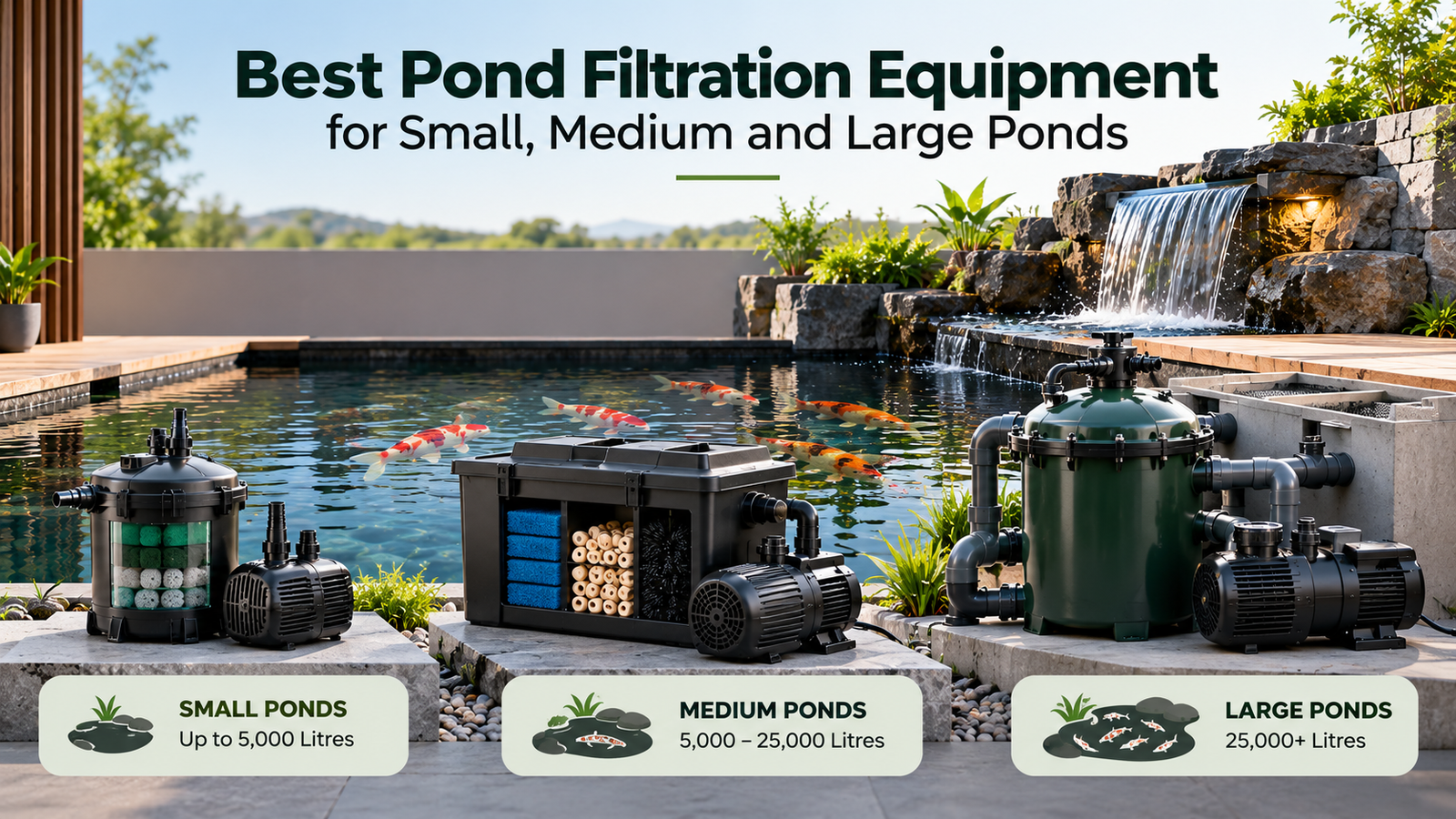
Choosing the best pond filtration equipment is essential for maintaining clean water, healthy fish, and a balanced pond environment. Whether you have a small garden pond, a medium-sized fish pond, or a large koi pond, the right filtration system helps remove fish waste, control suspended debris, and maintain stable water quality.
However, not every pond requires the same filtration setup. Pond volume, fish stocking levels, feeding frequency, sunlight exposure, and maintenance requirements all influence the type of filter you should choose.
In this guide, we compare the best pond filtration equipment for small, medium, and large ponds, explain the differences between filter types, and help you select a suitable system for your pond.
1. Why Is Pond Filtration Important?
Pond water collects fish waste, uneaten food, decaying leaves, and other organic material. As this waste breaks down, it can produce ammonia, which is toxic to fish.
A properly designed pond filtration system helps manage these waste products and maintain better water quality.
The main benefits of pond filtration include:
- Clearer water: Mechanical filtration removes suspended particles and solid debris.
- Biological filtration: Beneficial bacteria convert toxic ammonia into nitrite and then nitrate.
- Improved fish health: Appropriate filtration helps maintain stable water conditions.
- Reduced maintenance: A well-designed system can reduce manual cleaning and waste accumulation.
- Better water circulation: A suitable pump helps move water through the filtration system.
For koi ponds, filtration is particularly important because koi grow large and can produce substantial amounts of waste, especially when fed frequently.
2. Best Pond Filtration Equipment for Small Ponds
Small ponds generally have lower water volumes and may contain a few goldfish, small ornamental fish, or aquatic plants.
For these ponds, a compact filtration system is often sufficient, provided the fish load is low and the equipment is correctly sized.
Recommended equipment
Pressurized pond filter
A pressurized filter combines filtration media inside a sealed unit. Water enters under pressure and returns to the pond through an outlet. Some models include a built-in UV clarifier.
Advantages:
- Compact and easy to conceal.
- Suitable for many small garden ponds.
- Can often supply a small waterfall or fountain.
- Some models include convenient cleaning mechanisms.
Limitations:
- Filter media capacity may be insufficient for heavily stocked koi ponds.
- Mechanical media may require frequent cleaning when debris accumulates.
Integrated pond filter with pump
An integrated unit combines a pump and filter in one compact system. Depending on the model, it may also include a UV clarifier.
This option can be convenient for beginners who want a simple installation without extensive plumbing.
Suitable pond volume
As a preliminary guide, compact systems may suit ponds of approximately 500–2,000 litres with light fish stocking. Always follow the specific model’s capacity rating and adjust for fish load.
For a small pond containing several fish, choose a filter with sufficient biological capacity rather than relying only on the advertised pond-volume rating.
3. Best Pond Filtration Equipment for Medium Ponds
Medium ponds typically have greater water volume, more fish, and higher waste production than small garden ponds.
A more capable filtration system may be required, particularly if the pond contains koi or supports a waterfall.
Recommended equipment
External pump-fed box filter
A box filter contains multiple layers of mechanical and biological media. A pump sends water into the filter, and the treated water generally returns by gravity.
Advantages:
- Provides room for multiple filtration stages.
- Can handle greater waste loads than many compact units.
- Offers relatively straightforward access to filter media.
- Can be integrated with a waterfall when installed correctly.
Limitations:
- Requires sufficient space.
- The filter outlet generally needs to be above the receiving pond’s water level.
- Mechanical media requires regular inspection and cleaning.
Pressurized filter with UV clarifier
This can be a practical option for medium garden ponds with moderate fish stocking.
The pressurized design allows water to return through a pipe, making it easier to conceal the unit or direct water to a suitable water feature.
Choose this option only when its mechanical and biological capacity matches the pond’s actual requirements.
Separate UV clarifier
A standalone UV clarifier can help control suspended green-water algae when correctly sized and operated at the recommended flow rate.
UV clarification does not replace mechanical or biological filtration. It also does not remove all types of algae, such as algae attached to rocks and pond walls.
Suitable pond volume
Medium ponds may fall within approximately 2,000–10,000 litres for planning purposes. These boundaries are not fixed: a lightly stocked ornamental pond and a heavily stocked koi pond of the same volume can require very different systems.
4. Best Pond Filtration Equipment for Large Ponds
Large ponds require more careful filtration planning because they often contain many fish, larger koi, waterfalls, or complex plumbing systems.
In these installations, a combination of mechanical filtration, biological filtration, appropriate pumping, and aeration is often more suitable than a single compact filter.
Recommended equipment
Multi-chamber filtration system
A multi-chamber filter separates different stages of filtration into individual sections.
A typical arrangement may include:
- Settlement or mechanical separation.
- Mechanical filter media for capturing suspended waste.
- Biological media for beneficial bacteria.
- Additional biological or polishing stages, where required.
Advantages:
- Can accommodate larger volumes of filter media.
- Allows mechanical and biological filtration to be managed separately.
- Can be designed around the pond’s fish load and circulation requirements.
- Provides flexibility for future system upgrades.
Limitations:
- Requires more installation space.
- Needs suitable plumbing and drainage.
- May require civil work or a dedicated filtration chamber.
- Must be designed carefully to avoid flow restrictions and maintenance difficulties.
Gravity-fed filtration system
Gravity-fed systems are often considered for larger koi ponds built with bottom drains and suitable plumbing.
Pond water enters the filter by gravity, passes through the filtration stages, and is returned to the pond by a pump.
This arrangement can help transport settled waste toward the filter and reduce the amount of debris that must be handled by the pump.
However, the pond, drains, filter chamber, and water levels must be designed together. It is not simply a matter of placing a gravity-fed filter beside an existing pond.
Rotary drum filter (RDF)
An RDF is a mechanical filter that uses a fine screen to separate solid waste from water. Many systems automatically clean the screen when it becomes clogged.
Advantages:
- Automates much of the mechanical screening process.
- Can reduce manual cleaning of mechanical filter media.
- Can be useful in larger koi ponds with substantial waste production.
Limitations:
- Higher initial investment.
- Requires suitable installation space, plumbing, and waste drainage.
- Still needs biological filtration and regular inspection.
Shower or moving-bed biological filter
These systems provide surfaces for beneficial bacteria and support biological waste processing.
A shower filter passes water over media exposed to air, while a moving-bed filter keeps suitable media moving within an aerated chamber.
The correct choice depends on the pond’s design, required biological capacity, operating conditions, and available space.
Suitable pond volume
Large pond systems are often considered for ponds above approximately 10,000 litres, particularly where koi are heavily stocked. This is only a planning reference; actual filter selection must follow the manufacturer’s specifications and the pond’s expected waste load.
5. Compare Pond Filtration Systems
The following table summarises the main equipment options.
| Filter type | Best suited for | Maintenance | Installation |
|---|---|---|---|
| Integrated pump-filter | Small, lightly stocked ponds | Regular unit cleaning | Simple |
| Pressurized filter | Small to medium garden ponds | Periodic cleaning or backwashing, if supported | Compact plumbing |
| Pump-fed box filter | Medium ponds and some larger systems | Regular mechanical-media cleaning | Requires elevated return |
| Multi-chamber filter | Medium to large fish ponds | Stage-by-stage maintenance | Dedicated space and plumbing |
| Gravity-fed filter | Purpose-designed koi ponds | Depends on filter stages | Requires coordinated pond design |
| Rotary drum filter | Larger, high-waste koi systems | Screen and waste-system checks | More complex |
| Shower or moving-bed biofilter | Systems needing additional biological capacity | Periodic inspection | Requires suitable flow and space |
The maintenance descriptions are general. Always follow the equipment manufacturer’s instructions, particularly for UV servicing and biological media care.
6. How to Choose a Filter Based on Pond Volume and Fish Stocking
Pond volume is the starting point, but it is not the only factor.
A 5,000-litre pond containing a few goldfish may need less filtration than a 5,000-litre pond containing numerous growing koi.
Consider these factors before choosing equipment.
Pond volume
Calculate the pond’s actual water capacity.
For a rectangular pond:
Length × Width × Average Water Depth × 1,000 = Water Volume in Litres
For example:
A pond measuring 3 metres long, 2 metres wide, and 1 metre deep has a theoretical volume of:
3 × 2 × 1 × 1,000 = 6,000 litres.
If the pond has shelves, sloping walls, rocks, or an irregular shape, the actual water volume will be lower than the simple rectangular calculation.
Fish stocking and feeding
More fish and heavier feeding increase waste production and the biological demand placed on the filter.
When selecting a system:
- Consider the expected adult size of the fish.
- Account for the maximum intended stocking level.
- Allow for the feeding rate and seasonal changes.
- Avoid adding many fish at once to a new filter system.
For koi ponds, pay particular attention to the filter’s stated koi capacity or biological loading guidance rather than relying only on a general pond-volume rating.
Sunlight and debris
Ponds exposed to strong sunlight may experience more suspended algae growth. Ponds beneath trees may collect leaves and other organic debris.
Depending on the problem, you may need a suitable UV clarifier, better mechanical filtration, a pond skimmer, or a combination of these.
Future expansion
If you expect your fish to grow or your stocking level to increase, plan the filtration system for the anticipated future load rather than the current one.
7. How to Choose the Right Pond Pump for Your Filter
The pond pump must deliver the required flow through the filtration system without exceeding the filter’s permitted flow rate.
A pump’s advertised maximum flow is usually measured under low-resistance conditions. The actual delivered flow decreases as water moves through pipes, bends, filters, and vertical lifts.
When selecting a pond pump:
- Determine the desired circulation rate for your pond and fish load.
- Check the filtration system’s recommended operating flow.
- Calculate the total head, including vertical lift and plumbing resistance.
- Check the pump’s performance curve at the expected operating head.
- Confirm that the pump and filter are compatible.
As an initial planning reference, some ponds may aim to circulate their water volume roughly once every one to two hours. Heavily stocked koi ponds may require different flow arrangements, and some filtration systems have specific operating-flow requirements.
The final pump selection should satisfy the filter manufacturer’s guidance and the actual hydraulic layout.
8. Why Mechanical, Biological and UV Filtration Work Together
A complete pond filtration system may include several complementary components.
Mechanical filtration
Mechanical filtration captures solid waste, leaves, and suspended particles before they accumulate in the system.
Examples include filter brushes, foam, filter mats, and mechanical screens.
Biological filtration
Biological filtration provides surfaces for beneficial bacteria that process ammonia and nitrite.
Do not clean all biological media aggressively at once. This can disrupt the bacterial population and reduce filtration performance.
UV clarification
A UV clarifier helps control suspended algae responsible for green water when the unit is correctly sized and operated.
It does not replace biological filtration, and it is not a substitute for removing excess waste or managing nutrients.
Aeration
An air pump and diffuser can improve oxygen availability, especially in ponds with many fish or during hot weather.
Waterfalls and fountains may also increase surface agitation, but they should not automatically be considered sufficient aeration for every heavily stocked pond.
9. Pond Filter Installation and Maintenance
Correct installation is just as important as equipment selection.
Installation checklist
- Place the filter where it can be accessed easily for maintenance.
- Use suitable pipe diameters and minimise unnecessary restrictions.
- Install valves and drainage arrangements where needed.
- Provide a safe electrical supply installed by a qualified professional.
- Check for leaks and confirm the correct water flow before adding fish.
- Allow the biological filter to mature and monitor water quality before increasing the fish load.
Routine maintenance
Inspect mechanical media regularly and clean it when waste buildup restricts flow. Where possible, use pond water for rinsing biological media to avoid unnecessary damage to beneficial bacteria.
Check pumps for debris, inspect UV equipment according to the manufacturer’s schedule, and monitor ammonia and nitrite levels.
A filter that looks clean does not necessarily have sufficient biological capacity. Water testing is essential, especially after installation, maintenance, or an increase in fish stocking.
10. Common Mistakes When Choosing Pond Filtration Equipment
Avoid these common mistakes:
Choosing by pond volume alone: Fish load, feeding, sunlight, and debris affect filtration requirements.
Selecting an undersized filter: Insufficient mechanical or biological capacity can lead to poor water quality.
Ignoring pump performance at operating head: The delivered flow may be much lower than the advertised maximum.
Using UV clarification as the only treatment: UV equipment does not replace waste removal and biological filtration.
Cleaning all filter media at once: Excessive cleaning can reduce beneficial bacterial populations.
Ignoring maintenance access: A difficult-to-access filter may be neglected, reducing system performance.
Overstocking the pond: Even a good filtration system has limits. Stocking and feeding must remain appropriate for the entire system.
Conclusion
The best pond filtration equipment depends on pond volume, fish stocking, waste production, installation space, and maintenance preferences.
For small, lightly stocked ponds, a compact pressurized or integrated filter may be sufficient. Medium ponds may benefit from a larger pump-fed box filter or an appropriately sized pressurized system. Large koi ponds often require more comprehensive solutions, such as multi-chamber, gravity-fed, or rotary drum filtration combined with suitable biological filtration.
Before purchasing equipment, calculate your pond volume, assess the expected fish load, and check the pump’s actual operating flow. A properly designed system helps maintain healthier fish, clearer water, and more manageable maintenance.
Need help choosing pond filtration equipment?
Greenfin The Pond Studio provides pond pumps, filters, UV clarifiers, filter media, and pond construction and filtration solutions. Visit GreenfinIndia.com to explore available equipment or enquire about a suitable filtration setup for your pond.
Frequently Asked Questions
1. Which pond filtration system is best for a small pond?
A compact integrated filter or pressurized filter may suit a small pond with light fish stocking. Check the manufacturer’s capacity rating and adjust the selection for fish load and feeding.
2. What is the best filtration system for a koi pond?
A koi pond generally needs effective mechanical and biological filtration. Depending on its size and fish load, suitable options include multi-chamber, gravity-fed, or other high-capacity filtration systems.
3. How do I calculate the filter size for my pond?
Start by calculating the pond’s actual water volume in litres. Then consider fish species, adult fish size, feeding rate, and the manufacturer’s filter capacity guidance. Pond volume alone is not enough to determine the correct filter.
4. Do all pond filters need a UV clarifier?
No. A UV clarifier can help control suspended green-water algae, but it is not required for every pond. Its suitability depends on the pond’s conditions and the owner’s water-clarity goals.
5. How often should a pond filter be cleaned?
Cleaning frequency depends on the filter type, fish load, and debris accumulation. Mechanical media may need frequent cleaning, while biological media generally requires less frequent and gentler maintenance.
6. Can one pump run a pond filter and a waterfall?
Yes, if the pump and plumbing are designed to supply both components at the required flow and pressure. Check the filter’s maximum flow, the waterfall’s needs, and the total hydraulic resistance.
7. Which filter is suitable for a heavily stocked koi pond?
A purpose-designed high-capacity system with effective mechanical separation and biological filtration is often appropriate. The final configuration should be selected based on the pond’s volume, adult fish load, feeding rate, and maintenance requirements.