

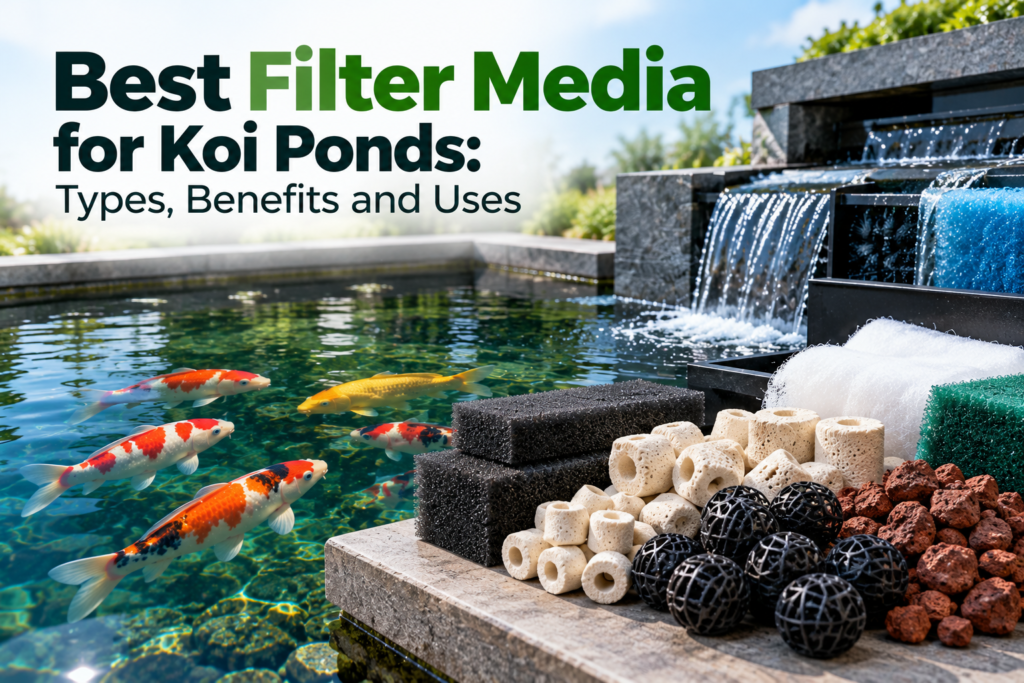
Maintaining clean, healthy water is essential for raising healthy koi fish. Koi produce a significant amount of waste, especially when they are fed regularly or kept in a heavily stocked pond. Without an effective filtration system, waste can accumulate, water quality can deteriorate, and harmful ammonia levels may rise.
Choosing the best filter media for koi ponds is an important step in building an efficient pond filtration system. The right combination of mechanical and biological filter media helps remove solid waste, supports beneficial bacteria, and maintains a stable environment for koi fish.
In this guide, we will explore the different types of koi pond filter media, their benefits, how they work, and how to select the right media for your pond.
Why Is Filter Media Important for Koi Ponds?
Filter media is the material placed inside a pond filter to support mechanical or biological filtration. Different types of media perform different functions, so choosing the right combination is essential for effective filtration.
The two main functions of pond filter media are:
Mechanical filtration: Removes solid particles such as fish waste, uneaten food, leaves, and suspended debris from the water.
Biological filtration: Provides surfaces where beneficial bacteria grow. These bacteria convert toxic ammonia produced by fish waste into nitrite and then into nitrate through the biological process known as nitrification.
A well-designed koi pond filtration system generally needs both types of filtration. Some systems also incorporate additional stages for fine-particle removal or chemical filtration when required.
1. Japanese Mat Filter Media
Japanese mat media is a popular option for biological filtration in multi-chamber koi pond filters. It is made from a durable, porous synthetic material that allows water to pass through while providing surfaces for beneficial bacteria.
Benefits of Japanese Mat Media
- Provides a substantial surface area for bacterial colonisation.
- Allows water to flow through the filter chamber.
- Can support both mechanical particle trapping and biological filtration.
- Is durable and reusable when maintained correctly.
- Is suitable for many traditional multi-chamber pond filtration systems.
Uses of Japanese Mat Media
Japanese mat media is commonly installed in biological filter chambers after larger solid waste has been removed. It is particularly useful in koi ponds where stable biological filtration is important.
To maintain performance, rinse the mat gently when it becomes clogged. If possible, use pond water or appropriately dechlorinated water to avoid unnecessarily damaging beneficial bacteria.
2. Bio Balls
Bio balls are lightweight plastic media designed to provide surfaces for beneficial bacteria. Their open structure allows water to circulate around the media and helps prevent the filter chamber from becoming completely blocked.
Benefits of Bio Balls
- Lightweight and easy to handle.
- Durable and reusable.
- Allow water to move through the media.
- Can be used in many biological filtration systems.
- Are relatively easy to clean when necessary.
Uses of Bio Balls
Bio balls can be used in suitable pond filter chambers, trickle filters, and other systems designed to provide adequate water flow and oxygenation.
Their effectiveness depends on the design of the media, available surface area, oxygen supply, and the amount of waste entering the filter. Ordinary bio balls should not automatically be assumed to provide more biological capacity than every other type of media.
For koi ponds with high fish loads, bio balls may be combined with other media to create a more effective filtration arrangement.
3. Ceramic Rings
Ceramic rings are commonly used in aquarium filters and some pond filtration systems. They provide surfaces where beneficial bacteria can colonise and can be useful in systems with suitable flow and oxygen conditions.
Benefits of Ceramic Rings
- Offer surfaces for beneficial bacterial growth.
- Are available in different shapes and sizes.
- Can be used in selected biological filter chambers.
- May complement other biological media.
Uses of Ceramic Rings
Ceramic rings are generally better suited to filter chambers that can retain them securely while allowing water to pass through. They are often used in smaller filtration systems or as supplementary media.
For large koi ponds, consider the practicality of handling, cleaning, and replacing large quantities of ceramic media. Purpose-designed pond media may be more convenient when high flow rates and substantial waste loads are involved.
4. Moving Bed Filter Media
Moving bed media is specially designed to circulate freely inside a filter chamber with the help of aeration or water movement. Common examples include K1-style and similar floating plastic media.
The movement keeps the media in circulation and helps maintain oxygen availability across its surfaces.
Benefits of Moving Bed Media
- Provides surfaces for beneficial bacteria.
- Supports oxygenated biological filtration.
- Movement helps reduce excessive buildup of solids on the media.
- Can be suitable for heavily stocked koi ponds when correctly designed.
- Can provide consistent biological treatment when properly operated.
Uses of Moving Bed Media
Moving bed media is installed in a chamber designed to keep the media moving. The chamber usually requires suitable aeration, screens to prevent media escape, and enough space for circulation.
It is often used in advanced koi pond filtration systems where biological performance and ease of maintenance are important.
Moving bed media is not intended to replace effective mechanical solids removal. Large debris and suspended solids should be removed before they accumulate in the biological chamber.
5. Plastic Filter Brushes
Filter brushes are widely used as a first-stage mechanical filtration medium in multi-chamber pond filters. Their bristles catch larger particles and help prevent solid waste from travelling into later filter stages.
Benefits of Filter Brushes
- Capture larger suspended particles.
- Help reduce the solids load reaching biological media.
- Are relatively simple to remove and clean.
- Can be reused for long periods with proper maintenance.
Uses of Filter Brushes
Brushes are commonly placed in the first chamber of a multi-chamber koi pond filter, where they intercept leaves, fish waste, and other larger debris.
They should be cleaned regularly according to the amount of waste entering the filter. If brushes become heavily clogged, water flow may decrease and the filtration system may become less effective.
Brushes are primarily mechanical media and should not be treated as a complete substitute for a dedicated biological filter.
6. Filter Sponges and Foam Media
Foam and sponge media are commonly used to capture smaller particles while also providing surfaces for beneficial bacteria. Their performance depends on pore size, thickness, water flow, and the design of the filtration system.
Benefits of Foam Media
- Captures suspended debris.
- Is available in different pore sizes and densities.
- Can provide additional biological filtration.
- Is easy to cut or fit into some filter designs.
- Can improve water clarity when used in an appropriate filtration stage.
Uses of Foam Media
Coarse foam is often used to capture larger particles, while finer foam can help trap smaller debris. However, finer media tends to clog more quickly and may require more frequent cleaning.
For larger koi ponds, make sure the filter has enough surface area and sufficient flow capacity to avoid frequent blockages.
Clean foam media as needed without unnecessarily sterilising the biological filtration system.
7. Lava Rock
Lava rock is a naturally porous material sometimes used in pond filtration systems. Its rough surface can provide places for microorganisms to grow.
Benefits of Lava Rock
- Provides surfaces for microbial colonisation.
- Is widely available in some markets.
- Can be used in selected low-cost filtration arrangements.
Limitations of Lava Rock
Lava rock can trap debris between its pieces, making it difficult to clean thoroughly. Depending on the grade and arrangement, it may also restrict water flow or accumulate sludge.
For a heavily stocked koi pond, purpose-designed filter media is often easier to manage. If lava rock is used, select suitable material and arrange it so that water can circulate and the media can be accessed for maintenance.
8. Activated Carbon
Activated carbon is a chemical filtration medium that adsorbs certain dissolved organic compounds and other substances. It is not a primary biological filter medium for koi ponds.
Benefits of Activated Carbon
- Can help remove certain dissolved organic compounds.
- May help reduce some unwanted odours or discolouration.
- Can be useful after certain treatments when the product instructions recommend carbon.
Uses of Activated Carbon
Activated carbon is generally used for a specific purpose rather than as a permanent replacement for biological filtration. Its usefulness depends on water chemistry, the substance being removed, and the carbon’s capacity.
It does not reliably remove all dissolved pollutants, and ordinary activated carbon is not a solution for every green-water or ammonia problem.
Before using carbon after medication or a pond treatment, check whether the treatment instructions recommend it and whether it is compatible with the intended use.
Comparison of the Best Filter Media for Koi Ponds
The following comparison can help you decide which media is appropriate for each filtration stage.
| Filter media | Main function | Key benefit | Common application |
|---|---|---|---|
| Japanese mat | Biological and some mechanical filtration | Durable, reusable surface | Multi-chamber filters |
| Bio balls | Biological filtration | Lightweight and easy to handle | Biological chambers and trickle filters |
| Ceramic rings | Biological filtration | Provides bacterial surfaces | Selected filter chambers |
| Moving bed media | Biological filtration | Good circulation and oxygen exposure | Moving bed systems |
| Filter brushes | Mechanical filtration | Captures larger waste | First filter chamber |
| Foam and sponges | Mechanical and biological filtration | Captures particles of different sizes | Mechanical or polishing stages |
| Lava rock | Biological support | Porous surface | Selected low-cost systems |
| Activated carbon | Chemical filtration | Adsorbs certain dissolved compounds | Specific treatment applications |
No single media type is the best choice for every koi pond. The ideal combination depends on pond size, fish population, feeding rate, pump flow, filter design, and maintenance requirements.
How to Choose the Best Filter Media for Your Koi Pond
Before buying filter media, consider the following factors.
1. Calculate Your Pond’s Water Volume
Water volume is a starting point for selecting a filtration system.
For a rectangular pond:
Water volume in litres = Length (m) × Width (m) × Average water depth (m) × 1,000
For example, a pond measuring 4 metres long, 3 metres wide, and 1.2 metres deep holds approximately:
4 × 3 × 1.2 × 1,000 = 14,400 litres
This calculation assumes straight sides and a uniform depth. For irregular ponds, use the approximate average depth and shape.
2. Consider the Number and Size of Koi
Koi produce waste through respiration, excretion, and feeding. A pond with many large koi typically requires more effective mechanical and biological filtration than a pond with only a few small fish.
Consider the expected adult fish size rather than choosing equipment only for the fish currently in the pond.
3. Match the Media to the Filter Design
Not every media type works well in every filter chamber.
- Use brushes or suitable mechanical screens to remove larger solids.
- Use mats or other fixed biological media in chambers designed to support them.
- Use moving bed media only in chambers designed to circulate it.
- Use fine foam in a stage that can be cleaned without excessive disruption.
- Use chemical media only when there is a specific reason to do so.
A correctly arranged filter allows water to pass through the media instead of bypassing it.
4. Consider Oxygen and Water Flow
Beneficial bacteria require oxygen to process ammonia and nitrite effectively. Ensure that the filter receives adequate water flow and, where required, additional aeration.
Excessive flow through an unsuitable filter can reduce particle capture, while insufficient flow can cause stagnant areas and poor filtration performance.
5. Plan for Easy Maintenance
Filter media must be maintained to remain effective. Choose a setup that allows you to remove mechanical waste easily and inspect biological media without dismantling the entire filtration system.
A filtration system that is difficult to maintain may gradually lose performance because of clogging or accumulated sludge.
Recommended Filter Media Arrangement for a Koi Pond
A typical multi-stage koi pond filter can be arranged as follows:
Stage 1: Mechanical filtration
Use filter brushes, screens, or another suitable solids-separation method to capture larger waste before it reaches later stages.
Stage 2: Fine mechanical filtration
Use suitable mats or foam to capture smaller particles. The exact arrangement depends on the filter design and how frequently the media can be cleaned.
Stage 3: Biological filtration
Use Japanese mat media, suitable fixed bio media, or another purpose-designed biological medium to support beneficial bacteria.
Stage 4: Additional biological treatment
Where needed, use a moving bed chamber or another appropriately designed biological stage. This is particularly useful in systems with high fish loads, provided the chamber has adequate oxygen and circulation.
Stage 5: Optional polishing or UV treatment
A final polishing stage can capture remaining particles. A correctly sized UV clarifier can help control suspended algae when green water is a problem.
This is an example rather than a mandatory arrangement. Some systems use drum filters, pressurised filters, trickle filters, or integrated equipment that combines several stages in one unit.
How Much Filter Media Does a Koi Pond Need?
The required quantity of filter media cannot be determined by pond volume alone. It also depends on fish stocking, feeding rate, filter design, media characteristics, and the manufacturer’s recommendations.
For example, two ponds with the same water volume may need different amounts of biological media if one contains a few koi and the other contains many large, heavily fed fish.
When calculating the quantity of media:
- Determine the pond’s actual water volume.
- Estimate the expected fish biomass and daily feeding rate.
- Select a filtration system suitable for that waste load.
- Follow the filter manufacturer’s recommended media quantity and chamber dimensions.
- Allow enough space for water circulation, aeration, and cleaning.
Avoid filling every chamber completely with tightly packed media. Restricted water flow can reduce filtration efficiency and make maintenance more difficult.
Common Mistakes to Avoid When Using Pond Filter Media
Overloading the Filter Chamber
Too much media in a chamber can restrict water flow, especially when using foam or tightly packed mats. Follow the filter’s design requirements and ensure water can circulate properly.
Cleaning All Biological Media at Once
Cleaning every biological surface too aggressively can reduce the beneficial bacteria population. Clean mechanical media regularly and maintain biological media carefully, using pond water or appropriately dechlorinated water when rinsing is needed.
Using Only One Type of Filter Media
Mechanical and biological filtration perform different jobs. A filter containing only biological media may become overloaded with solids, while a mechanical-only filter may not adequately process dissolved fish waste.
Ignoring Water Quality Testing
Clear water does not necessarily mean safe water. Test ammonia and nitrite regularly, particularly in new ponds, after filter maintenance, or when increasing the fish population.
Choosing Media Based Only on Price
Low-cost materials may appear economical initially, but poor flow characteristics or difficult maintenance can reduce overall system performance. Compare durability, suitability, cleaning requirements, and the manufacturer’s specifications.
Frequently Asked Questions
1. What is the best filter media for koi ponds?
There is no universal best media. Japanese mat and purpose-designed biological media are common choices for biological filtration, while brushes and screens help remove larger solids. Moving bed media can be effective in properly designed systems with adequate aeration.
2. Is Japanese mat better than bio balls?
Both can support beneficial bacteria. Japanese mat is often used in fixed multi-chamber filters, while bio balls are useful in systems that suit their open structure. The better choice depends on the filter design, flow, available space, and maintenance requirements.
3. Can lava rock be used in a koi pond filter?
Yes, lava rock can support microbial growth in suitable systems. However, it may trap debris and can be difficult to clean. Purpose-designed filter media may be easier to maintain in heavily stocked koi ponds.
4. How often should koi pond filter media be cleaned?
Mechanical media should be cleaned whenever waste buildup restricts flow or reduces performance. Biological media generally requires less frequent and more careful cleaning. Always follow the filter manufacturer’s instructions.
5. Does more filter media always mean better filtration?
No. More media does not automatically provide better results if the chamber has poor circulation, insufficient oxygen, or excessive solids buildup. Proper flow, oxygenation, media quality, and maintenance are equally important.
6. Can filter media remove green pond water?
Ordinary mechanical and biological media may not remove microscopic suspended algae efficiently. A suitable UV clarifier, combined with effective mechanical filtration, can help control green water. Attached algae require different management methods.
7. Do koi ponds need both mechanical and biological filtration?
In most koi ponds, yes. Mechanical filtration removes solid waste, while biological filtration supports bacteria that process ammonia and nitrite. Both are important for maintaining a healthy environment.
Conclusion
Choosing the best filter media for koi ponds is essential for maintaining water quality, protecting fish health, and reducing routine maintenance. Japanese mats, bio balls, moving bed media, brushes, and foam each offer different benefits depending on the filtration system.
For the best results, combine effective solids removal with sufficient biological filtration, maintain adequate oxygen and water circulation, and monitor water quality regularly. Select media according to your pond’s fish population, feeding rate, filter design, and maintenance needs rather than water volume alone.
At Greenfin India, you can explore pond pumps, filtration equipment, UV clarifiers, and other pond-care products to help build a suitable filtration system for your koi pond.
Visit Greenfinindia.com to explore pond equipment and filtration solutions for your next pond project.