

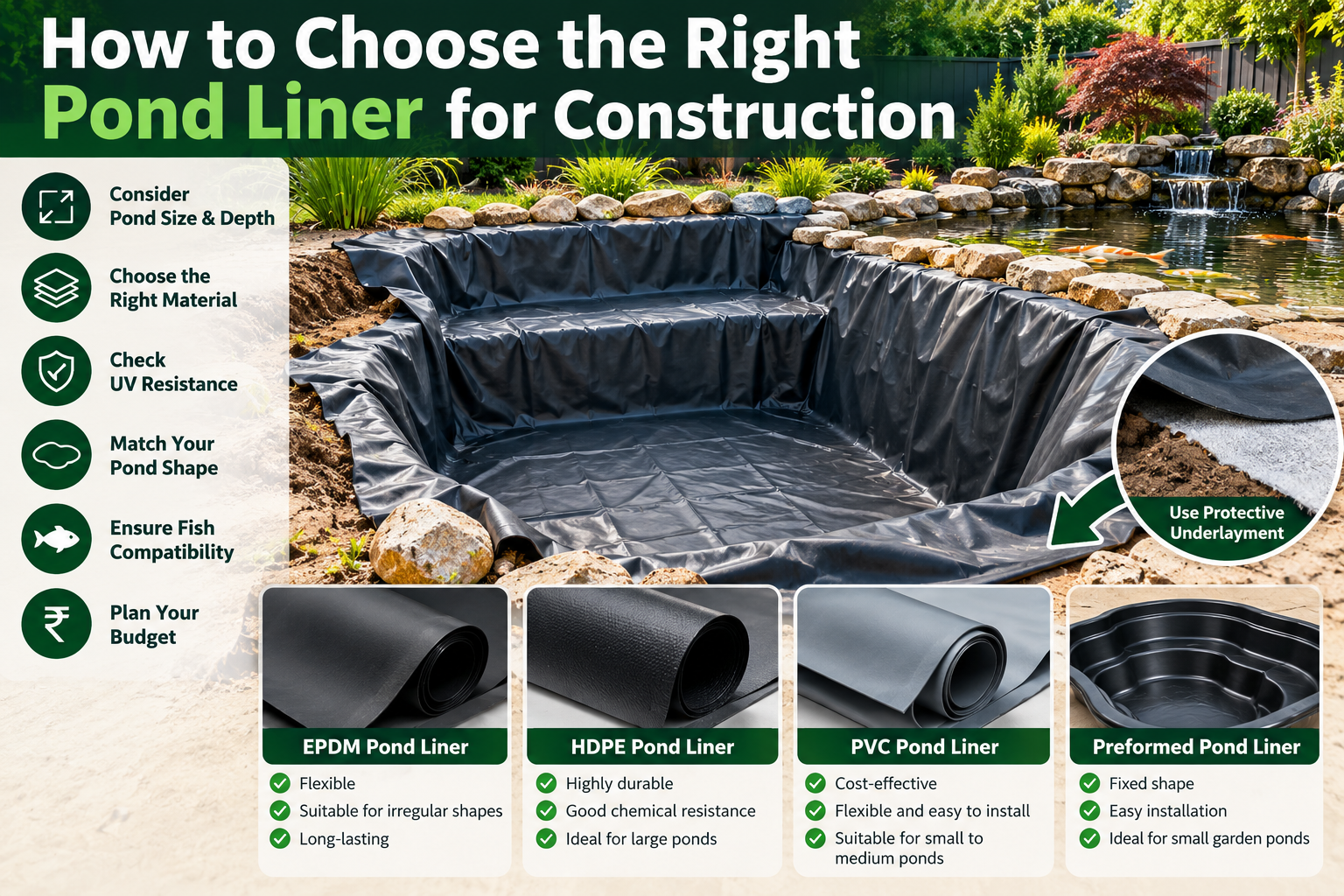
Building a pond requires careful planning, and choosing the right pond liner is one of the most important decisions. A suitable liner helps retain water, protects the pond structure, and creates a reliable foundation for a healthy aquatic environment. Whether you are constructing a garden pond, koi pond, fish pond, or decorative water feature, selecting the right material can improve durability and simplify long-term maintenance.
If you are wondering how to choose the right pond liner, you need to consider several factors, including pond size, depth, material quality, flexibility, UV resistance, and installation requirements. The right choice depends on your pond design, budget, and the type of fish or aquatic life you plan to keep.
In this guide, we explain the different types of pond liners, their advantages, how to calculate the required liner size, and the common mistakes to avoid during pond construction.
What Is a Pond Liner?
A pond liner is a waterproof material installed inside a pond to prevent water from leaking into the surrounding soil. It creates a barrier between the pond water and the ground, helping maintain a stable water level.
Pond liners are commonly used in:
- Koi ponds
- Garden ponds
- Outdoor fish ponds
- Decorative ponds
- Water gardens
- Waterfalls and streams
- Aquaculture ponds
The type of liner required depends on the pond’s size, shape, construction method, and intended use.
For example, a small decorative pond may require a different liner solution from a large koi pond with deep water, heavy filtration equipment, and complex plumbing.
Why Is Choosing the Right Pond Liner Important?
Selecting an appropriate pond liner helps prevent water loss and reduces the risk of expensive repairs.
1. Prevents Water Leakage
A quality pond liner creates a waterproof barrier that helps retain water. Correct installation is equally important because poorly sealed joints, damaged surfaces, and incorrectly fitted pipe connections can cause leaks.
2. Improves Pond Durability
Pond liners must withstand continuous contact with water and potential exposure to sunlight, temperature changes, and ground movement.
Choosing a material suitable for these conditions can improve the service life of your pond.
3. Protects Fish and Aquatic Life
A pond liner intended for aquatic applications helps create a suitable environment for fish and plants.
For koi ponds and other fish ponds, choose a liner specifically suitable for aquatic use and follow the manufacturer’s guidance regarding compatibility and preparation before introducing fish.
4. Supports Different Pond Designs
Flexible liners can accommodate a wide variety of pond shapes, including irregular garden ponds and custom-designed koi ponds.
They can also be adapted around appropriately designed shelves, contours, and other pond features.
5. Reduces Maintenance Costs
A durable liner installed over a properly prepared base can reduce the likelihood of leaks and major repairs.
However, regular inspections and careful maintenance are still necessary to protect the liner from damage.
Types of Pond Liners
Understanding the available materials is an essential part of learning how to choose the right pond liner for construction.
1. EPDM Pond Liner
EPDM is a flexible synthetic rubber material widely used in garden ponds and fish ponds.
Advantages:
- Highly flexible and suitable for irregular pond shapes
- Can accommodate some ground movement
- Available in large sheets
- Suitable for many koi ponds and water gardens when the product is intended for aquatic use
Considerations:
- May cost more initially than some basic liner materials
- Requires protection from sharp stones and other damaging objects
- Repairs must use compatible products and follow the manufacturer’s instructions
EPDM is a popular option for pond owners who want a flexible liner for a custom-shaped pond.
2. HDPE Pond Liner
High-density polyethylene (HDPE) is a durable plastic membrane used in various water-retention and pond applications.
Advantages:
- Good resistance to many chemicals
- Available for large pond projects
- Suitable for certain commercial and agricultural applications
- Can provide durable waterproofing when correctly selected and installed
Considerations:
- Generally less flexible than EPDM
- Installation may require specialist welding equipment
- Complex pond shapes can be more difficult to line
- The product’s thickness, flexibility, and aquatic suitability must be checked
HDPE can be suitable for larger ponds when the liner specification and installation method are appropriate.
3. PVC Pond Liner
PVC pond liners are flexible waterproof membranes used in some garden ponds and water features.
Advantages:
- Often economical
- Flexible and relatively easy to handle
- Available in different sizes and thicknesses
- Can suit certain small and medium-sized ponds
Considerations:
- Durability varies by formulation and product quality
- Some products may be more vulnerable to UV exposure
- Plasticisers and other additives vary between products
- Aquatic suitability and expected service life should be verified
Choose a PVC liner specifically designed for pond use rather than assuming that every waterproof PVC sheet is suitable.
4. Preformed Pond Liners
Preformed pond liners are rigid or semi-rigid pond shells manufactured in a fixed shape.
They are commonly used for smaller garden ponds and decorative water features.
Advantages:
- Predetermined shape and depth
- Relatively straightforward installation
- No need to measure and fold a large flexible liner
- Can be convenient for compact garden projects
Considerations:
- Limited shape and size options
- Less suitable for large or irregular ponds
- Excavation must match the shell accurately
- Ground support must be prepared properly
Preformed liners are a practical option when the pond design is simple and fits an available shell.
How to Choose the Right Pond Liner for Your Pond
Before purchasing a liner, assess your pond’s design and operating requirements.
1. Consider the Pond Size and Depth
Pond dimensions determine the liner size you need.
A larger or deeper pond generally requires a larger liner, and the design must allow sufficient material for the edges and anchoring.
For a rectangular pond, measure the maximum length, width, and depth.
Do not select a liner based only on the pond’s surface dimensions.
2. Choose the Right Liner Thickness
Pond liner thickness is commonly specified in millimetres or mils, depending on the product and market.
A thicker liner is not automatically the best choice for every pond. The appropriate thickness depends on the material, installation method, ground conditions, puncture risks, and manufacturer recommendations.
For example, a pond with a rough sub-base or a large excavation may require a more robust liner specification and protective underlayment.
Always compare product specifications rather than thickness alone.
3. Check UV Resistance
Outdoor pond liners may be exposed to direct sunlight, particularly around the pond edges.
Ultraviolet radiation can degrade materials that are not designed for prolonged outdoor exposure.
Choose a liner with UV resistance appropriate for the intended application, and protect exposed edges according to the manufacturer’s instructions.
4. Consider Your Pond Shape
The pond’s shape affects how easily a liner can be installed.
Flexible liners are generally suitable for irregular ponds, curved edges, and custom-shaped koi ponds.
Preformed liners work best when the excavation can match the shell’s fixed dimensions.
For ponds with complex corners, shelves, or waterfalls, consider how folds, seams, and penetrations will be managed during installation.
5. Check Fish and Aquatic Compatibility
If you are building a koi pond or fish pond, choose a liner designed for aquatic applications.
Check the manufacturer’s information regarding aquatic life, material composition, and any preparation or rinsing requirements.
Avoid assuming that construction membranes, recycled plastic sheets, or general-purpose waterproofing materials are safe for fish.
6. Consider Your Budget
The total pond liner cost includes more than the liner itself.
Your budget should account for:
- Liner material
- Protective underlayment
- Delivery and handling
- Seaming or welding, if required
- Edge anchoring materials
- Drain and pipe penetrations
- Installation labour
- Future repair requirements
Comparing the total installed cost can help you choose a liner that offers suitable durability without exceeding your budget.
How to Calculate the Pond Liner Size
Calculating the required liner size before purchasing helps avoid shortages during installation.
For a simple rectangular pond, a commonly used estimate is:
Liner length = Pond length + (2 × maximum pond depth) + edge allowance
Liner width = Pond width + (2 × maximum pond depth) + edge allowance
The edge allowance provides extra material for securing the liner around the pond perimeter. A margin of approximately 30–60 cm on each side is often used for preliminary planning, but the required allowance depends on the pond design and anchoring method.
Example: Calculating Liner Size for a Koi Pond
Suppose your pond dimensions are:
- Length: 4 metres
- Width: 3 metres
- Maximum depth: 1 metre
- Edge allowance: 0.5 metres on each side
Step 1: Calculate liner length
4 + (2 × 1) + (2 × 0.5) = 7 metres
Step 2: Calculate liner width
3 + (2 × 1) + (2 × 0.5) = 5 metres
Estimated liner size: 7 metres × 5 metres
This is a preliminary estimate for a simple rectangular pond. Extra material may be required for shelves, sloping sides, irregular contours, waterfalls, pipe penetrations, and anchoring details.
For complex ponds, prepare a detailed measurement plan before ordering the liner.
Step-by-Step Guide to Pond Liner Installation
Choosing the correct material is only the first step. Proper installation is essential for reliable waterproofing.
Step 1: Excavate the Pond
Mark the pond outline and excavate the ground to the planned dimensions and depth.
Check that the pond floor and sides match the intended design. Remove loose material that could undermine the liner or its support.
Step 2: Remove Sharp Objects
Inspect the excavated surface and remove stones, roots, sharp debris, and other objects that could puncture the liner.
Pay particular attention to the bottom, corners, and sloping sides.
Step 3: Install Protective Underlayment
A suitable protective geotextile underlayment can help reduce the risk of punctures and abrasion.
Select an underlayment compatible with the liner and site conditions. It should cover the areas that require protection without leaving vulnerable gaps.
Step 4: Position the Pond Liner
Unfold the liner carefully and position it over the prepared surface.
Allow enough material to cover the pond floor and sides, with sufficient excess around the perimeter for anchoring.
Avoid dragging the liner across rough ground or stretching it excessively.
Step 5: Shape the Liner
Adjust the folds so that the liner follows the pond’s contours.
Keep the material as smooth as practical without forcing it into position under tension.
For large liners or complex designs, professional installation may help reduce excessive folds and improve the final finish.
Step 6: Install Drains and Pipe Connections
If the pond includes a bottom drain, skimmer, or other plumbing penetration, use compatible fittings and the liner manufacturer’s approved sealing method.
Incorrectly sealed penetrations are common potential leak points.
Plan the plumbing before filling the pond, and make sure the connections can be inspected during installation.
Step 7: Secure the Pond Edges
Anchor the liner around the pond perimeter using a suitable method.
Keep the liner’s edge above the intended water level so that surrounding soil and surface runoff do not enter the pond unintentionally.
Avoid cutting away excess material until the liner has been positioned, filled, and checked.
Step 8: Fill and Inspect the Pond
Fill the pond gradually and check that the liner settles correctly into the contours.
Inspect the edges, plumbing penetrations, and accessible connections for signs of leakage.
Correct any installation problems before adding fish, completing delicate finishing work, or covering connections that may need access.
Common Pond Liner Installation Mistakes to Avoid
Avoiding these mistakes can help protect your pond investment.
Using an Undersized Liner
A liner that is too small may not cover the sides adequately or provide enough material for anchoring.
Solution: Measure the pond carefully and include sufficient allowances for depth, contours, and edge anchoring.
Ignoring Underlayment
Sharp stones and rough surfaces can damage a liner over time.
Solution: Prepare the base properly and install suitable protective underlayment where required.
Choosing the Wrong Material
Not all waterproof membranes are intended for pond construction or aquatic life.
Solution: Select a product designed for the application and follow its technical specifications.
Poorly Sealing Pipe Penetrations
Incorrect drain or pipe connections can result in water loss.
Solution: Use compatible fittings and approved installation procedures.
Leaving the Liner Exposed to Damage
Unprotected liner edges may be vulnerable to sunlight, accidental punctures, or mechanical damage.
Solution: Finish and protect the edges according to the manufacturer’s recommendations.
Filling the Pond Before Checking the Installation
Water can conceal some installation problems or make repairs more difficult.
Solution: Inspect accessible joints and connections carefully, and test the pond before introducing fish.
Which Pond Liner Is Best for a Koi Pond?
The best liner for a koi pond depends on the pond’s size, shape, construction method, and budget.
Flexible EPDM liners are often suitable for custom-shaped koi ponds because they can accommodate irregular contours.
HDPE may be appropriate for larger projects where the installation design and welding requirements can be managed correctly.
PVC liners can suit certain smaller projects when the product has the necessary durability and aquatic compatibility.
For any material, proper sub-base preparation, puncture protection, secure edges, and reliable plumbing connections are essential.
If your pond is large, deep, or intended to hold valuable koi, consult a pond construction professional before finalising the liner specification.
Pond Liner Maintenance Tips
Regular inspection helps maintain the liner’s condition.
- Inspect exposed edges for damage and deterioration.
- Remove sharp objects from areas where they could contact the liner.
- Check around bottom drains, skimmers, and pipe penetrations.
- Investigate unexplained water-level changes after accounting for evaporation and splash-out.
- Avoid using tools that could puncture or scratch the liner.
- Use compatible repair materials when necessary.
- Keep nearby construction and maintenance work from damaging the waterproofing.
A well-selected liner combined with correct installation and routine inspection can provide reliable service for many years, although its actual lifespan depends on the material, product quality, environmental exposure, and maintenance.
Frequently Asked Questions
1. What is the best material for a pond liner?
EPDM, HDPE, and PVC are common options. The best material depends on pond size, shape, installation requirements, expected exposure, and budget.
2. How thick should a pond liner be?
The appropriate thickness depends on the liner material, pond design, ground conditions, and manufacturer’s recommendations. Compare the complete product specifications rather than choosing by thickness alone.
3. Is a pond liner safe for koi fish?
A liner specifically designed and approved for aquatic applications can be suitable for koi ponds. Check the manufacturer’s compatibility guidance and follow the recommended preparation procedure.
4. How do I calculate the size of a pond liner?
Add twice the maximum pond depth to both the pond length and width, then include an allowance for anchoring and the pond’s contours.
5. Do I need underlayment beneath a pond liner?
Protective underlayment is often recommended because it helps reduce puncture and abrasion risks. The appropriate type depends on the liner material and site conditions.
6. Can I repair a damaged pond liner?
Many liners can be repaired using compatible patches or repair systems. The correct method depends on the material, location, and extent of damage.
7. Can I use a pond liner for a waterfall?
Yes. Suitable flexible liners can be used for waterfalls and streams when installed with proper support, overlap, and water containment.
Conclusion
Understanding how to choose the right pond liner helps you build a pond that retains water reliably and supports long-term maintenance.
Before making a purchase, assess your pond dimensions, material requirements, UV exposure, ground conditions, aquatic compatibility, and total installation cost.
EPDM, HDPE, PVC, and preformed pond liners each have different strengths. Selecting the right option and installing it correctly can reduce the risk of leaks and help protect your pond investment.
Planning a koi pond, garden pond, or outdoor water feature? Explore pond equipment and filtration solutions at GreenfinIndia.com to help create a cleaner, more manageable pond environment.