

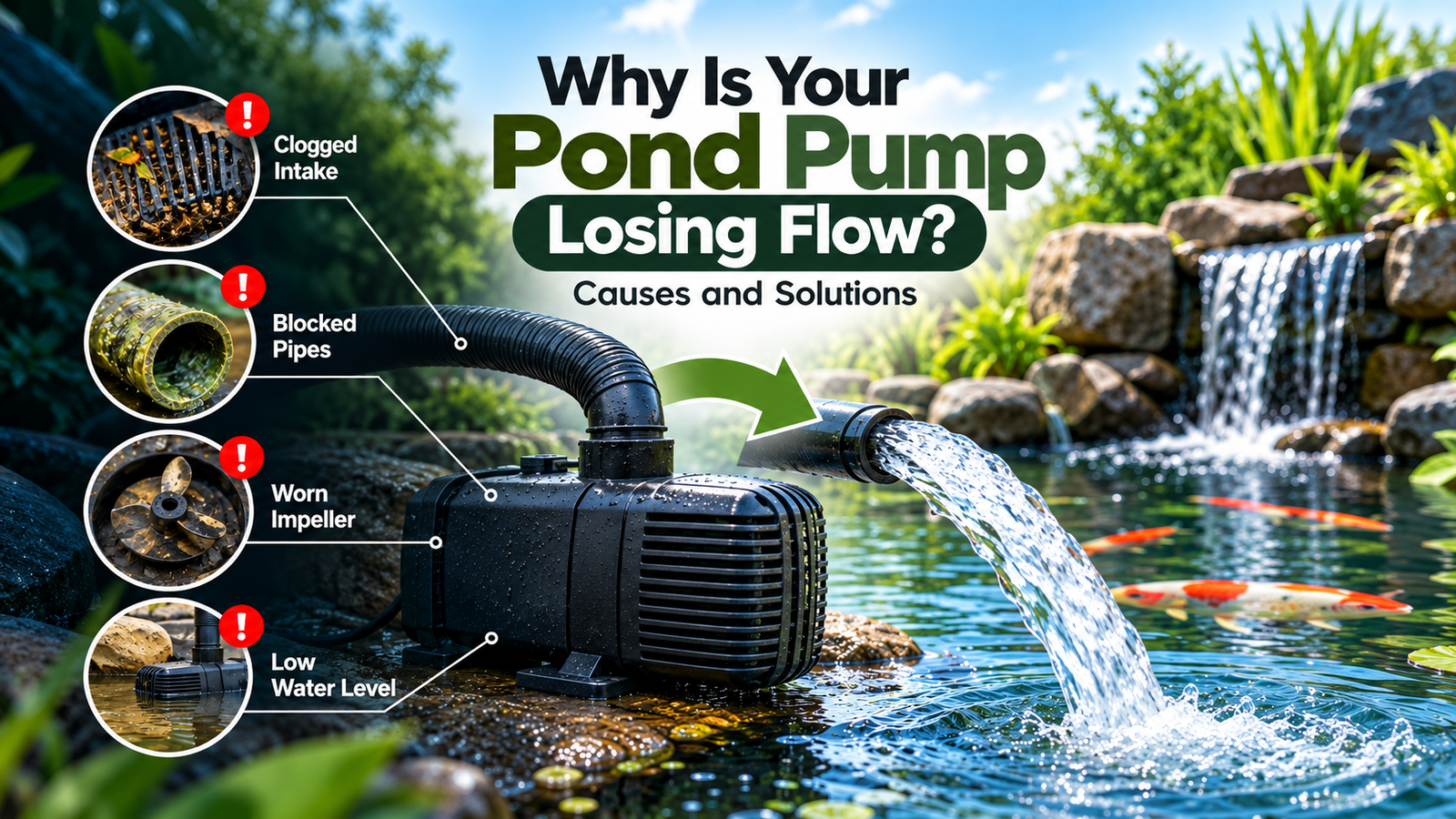
A pond pump is essential for maintaining healthy water circulation, supporting filtration, and powering waterfalls and fountains. However, if your pond pump starts losing flow, you may notice weak water movement, reduced waterfall height, poor filtration performance, or cloudy pond water.
Why is your pond pump losing flow? Common causes include clogged pump intakes, blocked pipes, dirty filter media, excessive head height, trapped air, worn impellers, and incorrect pump sizing. Identifying the problem early can help restore water circulation and prevent unnecessary damage to your equipment.
In this guide, we explain the most common reasons for reduced pond pump flow, how to troubleshoot each problem, and how to maintain your pump for reliable performance.
What Does It Mean When a Pond Pump Loses Flow?
When a pond pump loses flow, it moves less water than expected. For example, a pump rated at 10,000 litres per hour may deliver considerably less water after installation because of pipe resistance, vertical lifting height, dirty filters, or blockages.
The advertised flow rate is generally measured under specified test conditions. Actual performance depends on the pump model, installation arrangement, pipe diameter, total head height, and condition of the filtration system.
Reduced flow can affect several aspects of your pond:
- Poor filtration: Less water passes through the filtration system, potentially reducing its effectiveness.
- Weak waterfalls: Water may trickle rather than flow strongly over the waterfall.
- Reduced circulation: Some areas of the pond may develop stagnant water.
- Lower oxygen availability: Poor circulation can contribute to uneven oxygen distribution, particularly in heavily stocked ponds.
- Increased equipment stress: A blocked or improperly operated pump may overheat or become damaged, depending on its design.
Understanding the cause is the first step towards restoring the correct flow rate.
1. Clogged Pump Intake or Strainer
One of the most common reasons a pond pump loses flow is a blocked intake. Leaves, algae, fish waste, plant roots, and other debris can accumulate around the intake or protective strainer.
When debris restricts the water entering the pump, the pump may continue running but deliver less water.
How to identify the problem
Look for these warning signs:
- Water flow decreases gradually.
- Debris is visible around the pump intake.
- The pump makes unusual noises.
- The waterfall becomes weaker over time.
How to fix it
- Switch off and isolate the pump’s power supply.
- Remove the pump from the water if its installation instructions permit.
- Inspect the intake and protective strainer.
- Remove leaves, algae, and other debris.
- Rinse the strainer using pond water or clean water, following the manufacturer’s instructions.
- Reinstall the pump and check the water flow.
Maintenance tip: Inspect the pump intake regularly, especially during seasons when leaves and algae accumulate quickly.
2. Dirty Pond Filter or Blocked Filter Media
Your pond pump may be working correctly while a dirty filtration system restricts water circulation.
Mechanical filter media capture suspended particles, fish waste, and organic debris. As this material accumulates, water may struggle to pass through the filter.
This is particularly important in koi ponds because koi produce substantial waste relative to many smaller ornamental fish.
Signs of a blocked pond filter
- Water returns to the pond more slowly.
- Water levels differ noticeably across parts of the filter system.
- Mechanical filter media appear heavily clogged.
- The pump’s output decreases after several days or weeks of operation.
How to fix it
- Switch off the pump before servicing the filter.
- Inspect the mechanical filtration stages for accumulated debris.
- Clean the filter according to the manufacturer’s maintenance instructions.
- Rinse reusable biological media gently in removed pond water when cleaning is necessary.
- Avoid unnecessarily cleaning or replacing all biological media at once, as this can disrupt beneficial bacteria.
- Restart the system and check the flow.
If the filter repeatedly becomes blocked, review the filter’s capacity, mechanical filtration arrangement, fish stocking level, and feeding routine.
A correctly sized pond filtration system helps maintain circulation while supporting effective waste removal.
3. Blocked, Narrow, or Incorrectly Sized Pipes
The plumbing connecting your pond pump to the filter, waterfall, or fountain can significantly affect water flow.
A pipe that is too narrow creates greater resistance. Bends, elbows, partially closed valves, accumulated debris, and long pipe runs can also reduce the amount of water delivered.
For example, a pump may have a high rated flow rate but deliver a much smaller volume through a long, narrow pipe feeding a tall waterfall.
How to identify pipe restrictions
Check for:
- Kinked or damaged flexible hoses.
- Algae or debris inside the plumbing.
- Valves that are not fully open.
- Too many tight bends or fittings.
- Pipe diameters smaller than those recommended for the pump.
How to fix it
Inspect the plumbing and remove blockages where accessible. Make sure valves are in the correct position and that hoses are not crushed or bent sharply.
Where necessary, consider using a larger-diameter pipe or simplifying the pipe route.
Always follow the pump manufacturer’s recommendations for pipe diameter and installation.
Important: Increasing the pipe diameter can reduce friction losses, but it will not necessarily solve every flow problem. The pump’s performance curve and total system resistance must also be considered.
4. Excessive Head Height
Head height is one of the most important factors affecting pond pump performance.
It describes the height through which a pump must lift water, together with the hydraulic resistance associated with moving that water through the system.
When water must travel to a high waterfall, an elevated filter, or a fountain, the pump may deliver considerably less water than its advertised maximum flow rate.
Example: A pond waterfall installation
Suppose you install a pond pump rated at 10,000 litres per hour under its specified test conditions.
The pump must lift water to a waterfall 2 metres above the water surface and push it through a long pipe with several bends.
The actual flow rate may be substantially lower than 10,000 litres per hour.
The precise output depends on the pump’s performance curve and the total head of the installation. The rated flow alone cannot establish the actual delivery rate.
How to solve excessive head height
- Check the pump’s performance chart.
- Calculate the vertical lifting height from the pond’s operating water level.
- Account for friction losses in pipes, valves, and fittings.
- Choose a pump that can deliver the required flow at the calculated operating head.
- Use an appropriate pipe diameter to reduce unnecessary resistance.
If you are planning a waterfall, always select your pump according to the required flow at the waterfall’s operating height, rather than relying only on the maximum litres-per-hour rating.
5. Air Trapped Inside the Pump or Plumbing
Some pond pumps, particularly those installed in enclosed or flooded plumbing arrangements, may experience reduced performance when air becomes trapped in the pump or pipework.
Air can interfere with water movement and, in some installations, prevent the pump from operating correctly.
However, the symptoms depend on the pump design. Not every pond pump requires manual priming, and some submersible pumps are designed to operate fully underwater.
Common signs
- The pump runs but produces little or no water.
- Flow starts and stops intermittently.
- The system produces unusual gurgling noises.
- Water delivery improves after trapped air is released.
How to fix it
- Switch off the pump.
- Check the manufacturer’s instructions for priming or air-release procedures.
- Inspect pipe connections for air leaks where applicable.
- Ensure the pump is installed in the correct position.
- Confirm that the pump has the required water supply.
- Restart the system according to the manufacturer’s instructions.
Never allow a pump to run dry unless it is specifically designed for dry operation.
6. A Worn or Damaged Impeller
The impeller is a rotating component that moves water through the pump. If it becomes clogged, worn, cracked, or damaged, the pump may lose its ability to deliver the expected flow.
Fine debris, sand, small stones, and accumulated organic matter can interfere with the impeller’s movement.
Warning signs
- Reduced flow despite a clean intake.
- Unusual grinding, rattling, or vibration.
- Repeated blockages around the impeller.
- The pump operates but fails to produce its normal output.
How to fix it
Switch off and isolate the pump before inspecting it.
Follow the manufacturer’s disassembly instructions to access the impeller. Remove debris carefully and inspect the impeller and associated components for damage.
Replace damaged parts with compatible components recommended by the manufacturer.
If the pump continues to lose flow after cleaning, a qualified technician may need to inspect the motor, bearings, impeller, or other internal components.
7. Low Pond Water Level
If the pond water level drops below the pump’s required operating level, the pump may draw in air or fail to receive sufficient water.
This can happen because of evaporation, leaks, splashing around waterfalls, or inadequate water replacement.
The risk depends on whether the pump is submerged, externally installed, or connected to a dedicated pump chamber.
How to identify the problem
- The pump intake is partly exposed.
- Water flow changes when the pond level changes.
- The pump intermittently draws in air.
- The pump chamber has an unusually low water level.
How to fix it
Check the pond’s operating water level and restore it to the recommended range.
Inspect the pond and plumbing for leaks. Make sure the pump intake remains submerged where required.
For external pumps, check that the water supply and priming conditions meet the manufacturer’s specifications.
Do not continue operating a pump that is running dry or overheating.
8. Incorrect Pump Selection for the Pond
Sometimes, the pump is not faulty at all. The problem is that it was never suitable for the installation.
A pump designed for a small ornamental pond may not provide enough flow for a large koi pond, a tall waterfall, or a filtration system with significant hydraulic resistance.
How to choose the correct pond pump
Consider these factors before purchasing a replacement:
1. Pond water volume
Calculate the approximate volume of water in the pond.
For a rectangular pond:
Pond volume in litres = Length (m) × Width (m) × Average water depth (m) × 1,000
For example, a pond measuring 4 m long, 3 m wide, and 1 m deep has a theoretical volume of:
4 × 3 × 1 × 1,000 = 12,000 litres.
Actual water volume will be lower if the pond contains sloping sides, shelves, or other structures that displace water.
2. Required circulation rate
The desired circulation rate depends on fish stocking, feeding, filtration design, pond temperature, and other factors.
A heavily stocked koi pond generally requires more carefully planned filtration and circulation than a lightly stocked ornamental pond.
3. Total head height
Calculate the vertical lift and consider pipe friction and other system resistance.
4. Filter requirements
Check the recommended flow range of your mechanical and biological filtration equipment.
5. Pump performance curve
Select a pump capable of providing the required flow at the actual operating head.
Choosing the right pump from the beginning can help prevent weak waterfalls, inadequate circulation, and unnecessary energy consumption.
9. Electrical Problems or Pump Motor Failure
If your pump suddenly loses flow, electrical or mechanical problems may be responsible.
A failing motor, damaged cable, faulty connection, or internal component failure can affect pump performance.
Do not assume every reduction in flow is caused by a blockage.
What should you check?
Look for sudden changes in performance, repeated shutdowns, unusual heat, or abnormal noise.
If the pump repeatedly trips an electrical protective device or shows signs of electrical damage, stop using it.
Do not open electrical components or inspect wiring while the equipment is connected to power. Electrical equipment used near water requires appropriate protection and installation.
Have a qualified technician inspect the pump if cleaning the intake and filter does not restore normal operation.
10. Poor Pump Maintenance
Regular maintenance helps prevent many common pond pump problems.
A pump that operates continuously in a pond collects debris and experiences wear over time. Without inspection, small restrictions can gradually become significant flow problems.
Pond pump maintenance checklist
Use the following checklist to keep your equipment operating reliably:
- Inspect the intake and strainer regularly.
- Remove leaves and accumulated debris.
- Check hoses, pipe connections, and valves.
- Clean mechanical filter media when necessary.
- Inspect the impeller according to the manufacturer’s maintenance schedule.
- Check the pond water level.
- Monitor waterfall flow and filter return flow.
- Investigate unusual noise, vibration, or overheating.
- Replace worn components with compatible parts.
- Follow the manufacturer’s instructions for cleaning and servicing.
The inspection frequency depends on pond conditions. Ponds with many fish, heavy feeding, or substantial leaf debris may require more frequent checks.
How to Troubleshoot a Pond Pump Losing Flow
If your pond pump is losing flow, use this step-by-step troubleshooting process.
| Problem | Possible Cause | Recommended Action |
|---|---|---|
| Weak water output | Blocked intake | Clean the intake and strainer |
| Flow decreases gradually | Dirty filter | Inspect and clean mechanical media |
| Weak waterfall | Excessive head height | Check the pump performance curve and pipework |
| Pump runs but delivers no water | Blockage, air, or insufficient water supply | Switch off and inspect the system |
| Flow starts and stops | Intermittent blockage, air ingress, or water supply problem | Inspect the intake and plumbing |
| Grinding or rattling noise | Debris or damaged impeller | Isolate the pump and inspect it |
| Low flow after installation | Incorrect pump selection or restrictive plumbing | Recalculate the required flow and head |
| Sudden loss of performance | Mechanical or electrical fault | Stop operation if unsafe and seek technical assistance |
Safety reminder: Always isolate the electrical supply before removing, cleaning, or inspecting a pond pump. Never handle electrical equipment with wet hands or work on live equipment near water.
Frequently Asked Questions
1. Why is my pond pump running but not pumping water?
A pond pump may run without delivering water because its intake is blocked, the plumbing is obstructed, the water supply is insufficient, or air is trapped in a system that requires priming. A damaged impeller can also prevent normal water delivery.
Switch off the pump before inspecting it, and follow the manufacturer’s troubleshooting instructions.
2. How do I increase the flow rate of my pond pump?
Start by cleaning the intake and filter, checking the pipes for blockages, and ensuring that valves are correctly positioned.
If the flow remains low, review the pipe diameter, total head height, and pump performance curve. You may need a more suitable pump if the existing unit cannot provide the required flow at the operating head.
3. Can a dirty pond filter reduce pump flow?
Yes. A clogged mechanical filter can restrict water movement and reduce the flow through the filtration system.
Clean the filter according to the manufacturer’s instructions and avoid unnecessarily disturbing biological filter media.
4. Does pipe size affect pond pump performance?
Yes. Narrow pipes, long pipe runs, and restrictive fittings can increase friction losses and reduce the delivered flow rate.
Choose a pipe diameter suitable for the pump’s flow rate and installation requirements.
5. How often should I clean my pond pump?
Inspect the pump intake regularly and clean it whenever debris begins to restrict water movement.
The frequency of deeper maintenance depends on pond conditions, fish stocking, debris levels, and the manufacturer’s recommendations.
6. Why has my pond waterfall become weak?
A weak waterfall can result from a clogged pump intake, dirty filter, restricted pipe, excessive lifting height, or an incorrectly sized pump.
Check the simplest causes first before replacing the pump.
7. Should I replace my pond pump if the flow rate decreases?
Not necessarily. Cleaning the intake, servicing the filter, and clearing pipe restrictions may restore the original flow.
If the pump remains weak after these checks, inspect the impeller and other components. Consider replacement if the pump is damaged or cannot meet the system’s flow requirements.
Conclusion
A pond pump losing flow does not always mean that the pump has failed. Blocked intakes, dirty filters, restrictive pipes, excessive head height, trapped air, and worn impellers are all possible causes.
Start with a careful inspection of the intake, filter, plumbing, and water level. If these checks do not restore normal performance, examine the pump’s operating conditions and mechanical components.
For koi ponds, maintaining appropriate water circulation and effective filtration is essential for supporting fish health and overall pond water quality.
Choosing a pump that matches your pond volume, filtration requirements, and waterfall height can also prevent many flow-related problems.
Looking for the right pond pump or filtration system? Explore the pond equipment available at GreenfinIndia.com to find products suited to your pond setup. If you are planning a new koi pond or upgrading an existing filtration system, choose your equipment based on the pond’s actual requirements rather than the pump’s maximum advertised flow rate.