

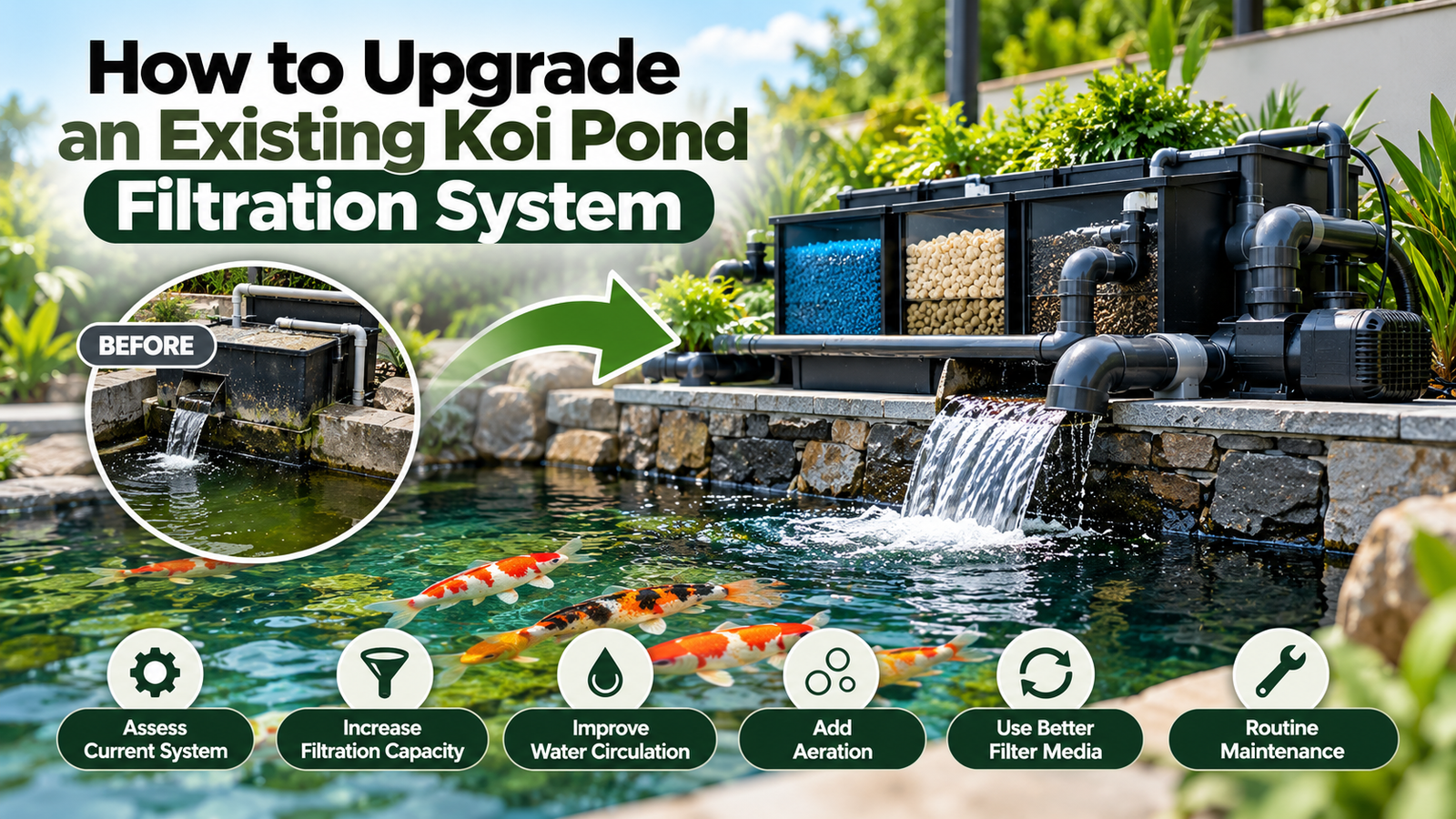
A well-designed filtration system is essential for maintaining clear water, supporting beneficial bacteria, and keeping koi fish healthy. However, as koi grow, fish populations increase, and feeding levels rise, an existing pond filtration system may struggle to handle the additional waste. You may notice cloudy water, excessive algae, clogged filters, or reduced water circulation.
A koi pond filtration upgrade can help address these problems by improving mechanical filtration, increasing biological filtration capacity, optimizing water circulation, and adding suitable equipment where necessary.
Whether you have a small backyard koi pond or a large outdoor pond, upgrading your filtration system can improve water quality and make routine maintenance easier.
In this guide, we explain how to evaluate your existing filtration system, identify the right improvements, choose suitable equipment, and maintain your upgraded setup.
Why Should You Upgrade Your Koi Pond Filtration System?
A pond filtration system should be designed around the pond’s actual requirements, including water volume, fish stocking, feeding levels, and the amount of waste produced.
An older filtration system may have been adequate when the pond was first constructed but may no longer meet its current needs.
Here are some common reasons to consider a filtration upgrade.
1. Increasing Koi Population
As the number of koi increases, the amount of fish waste also increases. A filtration system designed for a few small fish may become inadequate when the pond contains many larger koi.
Increasing biological and mechanical filtration capacity may help the system manage the additional load.
2. Persistent Cloudy or Green Water
Cloudy water can result from suspended particles, bacterial blooms, or other water-quality problems. Green water is commonly associated with suspended algae.
If these problems persist, review the filtration system, nutrient inputs, circulation, sunlight exposure, and maintenance routine.
Mechanical filtration can remove suspended solids, while appropriately sized biological filtration helps process toxic ammonia and nitrite. A UV clarifier can help control suspended green-water algae when correctly selected and installed.
3. Frequent Filter Cleaning
If your filter becomes blocked frequently, it may not have sufficient mechanical waste-handling capacity for the pond.
Upgrading the mechanical filtration stage or improving the way waste reaches the filter can reduce blockages and make maintenance more manageable.
4. Poor Water Circulation
Insufficient circulation can leave debris in certain areas of the pond and reduce the amount of water passing through the filtration system.
A suitable pump, correctly sized pipework, and an effective pond layout help maintain appropriate circulation.
5. Increased Feeding Levels
Koi produce more waste when they consume more food. If your fish are growing and feeding more heavily, your existing filtration system may need additional capacity.
Avoid increasing feeding beyond what the fish and filtration system can safely support.
Step 1: Evaluate Your Existing Koi Pond Filtration System
Before purchasing new equipment, assess your existing pond and identify the actual problem.
Replacing the entire system may be unnecessary if a blocked pipe, undersized pump, or poorly maintained filter is responsible for the reduced performance.
Measure the Pond Water Volume
Start by calculating the approximate water volume.
For a rectangular pond:
Pond volume in litres = Length (m) × Width (m) × Average water depth (m) × 1,000
For example, consider a pond with the following dimensions:
- Length: 4 metres
- Width: 3 metres
- Average water depth: 1.2 metres
Calculation:
4 × 3 × 1.2 × 1,000 = 14,400 litres
The actual water volume may be lower if the pond has shelves, sloping sides, rocks, or other structures that displace water.
Accurate volume estimates help when selecting pumps, filters, UV clarifiers, and other pond equipment.
Check Your Fish Stocking Level
The required filtration capacity depends on more than pond volume.
Consider the number and size of koi, feeding frequency, waste production, and the amount of uneaten food entering the water.
A heavily stocked pond with large koi generally requires more filtration capacity than a lightly stocked pond of the same volume.
Inspect Your Current Filter
Check the filter for:
- Excessive solid waste accumulation.
- Blocked mechanical filter media.
- Insufficient biological filter media.
- Damaged components or water bypassing the media.
- Uneven water distribution through the filter.
- Frequent maintenance requirements.
Also check whether water is flowing through the intended filtration stages rather than bypassing them.
Test Your Pond Water
Before deciding which equipment to upgrade, test the water for ammonia, nitrite, nitrate, pH, and other parameters relevant to your pond.
Ammonia and nitrite should ideally remain undetectable with reliable testing methods. Persistent detectable levels indicate that water quality and filtration performance require attention.
If ammonia or nitrite is detected, take prompt steps to protect the fish, including reducing or temporarily stopping feeding as appropriate, increasing aeration, and performing a suitably conditioned partial water change.
Do not rely on clear-looking water alone to determine whether the pond is healthy.
Step 2: Upgrade the Mechanical Filtration System
Mechanical filtration removes solid waste before it accumulates in the pond or enters biological filter media.
It can capture fish waste, uneaten food, leaves, and other suspended particles.
When the mechanical filtration stage is inadequate, debris may accumulate quickly, increasing maintenance requirements and potentially restricting water flow.
Signs You Need Better Mechanical Filtration
- Filter media clog rapidly.
- Large quantities of waste accumulate in the filter.
- Water remains cloudy because of suspended particles.
- The pump’s flow decreases as the filter becomes dirty.
- Cleaning the filter becomes a frequent task.
Mechanical Filtration Upgrade Options
1. Larger mechanical pond filter
A larger filter may provide additional space for waste collection and filtration media.
Choose a model based on its actual filtration capacity and the manufacturer’s recommended pond and stocking conditions.
2. Improved pre-filtration
A dedicated mechanical pre-filter can remove larger solids before water enters the biological filtration stage.
This can help protect biological media from excessive waste accumulation.
3. Rotary drum filter
A rotary drum filter uses a fine screen to separate solids from the water. Automated cleaning removes collected waste from the screen.
Drum filters can be useful for larger koi ponds with substantial waste production, although installation costs, plumbing requirements, cleaning arrangements, and maintenance should be considered.
4. Better waste removal
In suitable pond designs, bottom drains and strategically positioned suction points can help transport settled waste towards the filtration system.
The effectiveness depends on pond geometry, water circulation, pipework, and installation design.
Step 3: Increase Biological Filtration Capacity
Biological filtration is one of the most important parts of a koi pond filtration upgrade.
Beneficial microorganisms colonize suitable filter media and convert toxic ammonia into nitrite and then into nitrate through the biological nitrogen cycle.
Ammonia and nitrite can harm fish, so the biological filter must have sufficient capacity to process the waste generated by the pond.
When Should You Upgrade Biological Filtration?
Consider additional biological filtration if:
- Ammonia or nitrite remains detectable.
- Fish stocking or feeding has increased significantly.
- The existing filter has limited space for biological media.
- Water quality deteriorates during periods of heavy feeding.
- The filtration system struggles to recover after routine maintenance.
However, detectable ammonia or nitrite can also result from inadequate circulation, low oxygen, a recently disturbed biofilter, or other problems. Test and investigate the system before assuming that adding media alone will solve the issue.
Types of Biological Filter Media
1. Japanese filter mat
Japanese filter mat provides a surface for beneficial microorganisms while also trapping some suspended particles.
It is commonly used in multi-chamber pond filtration systems.
2. Moving bed filter media
Moving bed media circulate in an aerated filter chamber, providing protected surfaces for beneficial microorganisms.
The chamber must be designed with suitable aeration, media quantity, water flow, and media-retention screens.
3. Bio-balls
Bio-balls provide surfaces for microbial growth and can be useful in appropriately designed filtration systems.
Their effectiveness depends on the design, oxygen supply, contact with water, and the amount of media used.
4. Ceramic biological media
Ceramic media can support microbial colonization and are used in some pond filtration systems.
They should be selected according to the filter’s flow characteristics and maintenance requirements.
5. Other specialist biological media
Other engineered media may offer different surface characteristics and flow properties. Follow the manufacturer’s recommendations when selecting and installing them.
How to Upgrade Biological Filtration Safely
Avoid replacing all existing biological media at once.
Established filter media contain beneficial microorganisms that help process fish waste. Removing all of them simultaneously can disrupt biological filtration and cause ammonia or nitrite levels to rise.
A safer approach is to add compatible new media, allow it to mature, and monitor water quality before removing established media.
Maintain sufficient oxygen and water flow through the biological filter.
Step 4: Upgrade the Pond Pump if Necessary
The pump moves water through the filtration system and supports circulation throughout the pond.
An undersized pump may fail to deliver the required flow through the filter. An excessively powerful pump can also cause problems if it exceeds the filter’s recommended flow rate.
How to Choose the Right Pump for an Upgrade
Consider the following factors:
- Actual pond water volume.
- Desired circulation rate.
- Filter manufacturer’s recommended flow range.
- Vertical lifting height.
- Pipe diameter and length.
- Resistance from bends, valves, and fittings.
- Energy consumption and continuous operating requirements.
Do not select a pump based solely on its maximum advertised litres-per-hour rating.
The pump should deliver the required flow at the installation’s actual operating head.
Check Your Existing Pipework
Before buying a new pump, inspect the plumbing for blockages, narrow pipes, closed valves, and unnecessary bends.
Sometimes, improving the pipework can restore sufficient flow without replacing the pump.
Important: Ensure the pump, plumbing, and filtration system are compatible before increasing the pump’s output.
Step 5: Consider Adding a UV Clarifier
A UV clarifier can help control green pond water caused by suspended algae.
Water passes through a unit containing a UV lamp, exposing susceptible microorganisms to ultraviolet radiation.
UV clarification does not replace mechanical or biological filtration. It is an additional treatment that addresses a different problem.
When Is a UV Clarifier Useful?
Consider adding or upgrading a UV clarifier when:
- The pond regularly develops suspended green-water algae.
- Adequate mechanical and biological filtration is already in place.
- Sunlight and nutrient levels contribute to recurring algae problems.
- The existing UV unit is incorrectly sized or no longer operating effectively.
How to Choose the Right UV Clarifier
Consider the pond volume, fish stocking level, algae-control requirements, water flow through the unit, and the manufacturer’s recommended capacity.
Lamp condition, quartz sleeve cleanliness, exposure time, and the actual water flow all affect performance.
A UV clarifier will not remove every form of algae. String algae attached to pond surfaces, for example, requires a different management approach.
For best results, combine appropriate UV treatment with effective filtration, good circulation, sensible feeding, and routine pond maintenance.
Step 6: Improve Water Circulation and Waste Collection
An effective filtration upgrade should consider how waste moves through the pond, not just how much filter media is installed.
Even a large filter may perform poorly if debris remains trapped in dead zones or fails to reach the filtration system.
Improve Pond Circulation
Review the position and direction of pump outlets, returns, and other water inlets.
Depending on the pond layout, strategically positioned returns can help move waste towards bottom drains or collection points.
Avoid creating excessively strong currents in areas where fish need to rest.
Consider a Bottom Drain
A bottom drain can help remove settled waste from suitable pond designs.
If your existing pond lacks a bottom drain, adding one may require significant plumbing and construction work. It is not always necessary or practical for every pond.
Before undertaking modifications, evaluate the pond structure, pipe routing, filtration layout, and expected benefits.
Remove Accumulated Sludge
Accumulated organic debris can contribute to poor water quality and increased oxygen demand.
Remove excessive sludge carefully and avoid disturbing the pond substrate unnecessarily, particularly where this could release large quantities of waste into the water.
Step 7: Choose the Right Filtration Upgrade for Your Pond
Different ponds require different filtration arrangements.
The following table provides a starting point for choosing an appropriate upgrade.
| Pond Problem | Potential Upgrade | Main Benefit |
|---|---|---|
| Filter blocks frequently | Larger mechanical filter or pre-filter | Improves solid-waste handling |
| Ammonia or nitrite remains detectable | Additional mature biological capacity and system checks | Improves waste processing when biofiltration is limiting |
| Water remains green | Suitable UV clarifier and nutrient management | Helps control suspended algae |
| Poor water circulation | Correctly sized pump and improved plumbing | Improves water movement |
| Large quantities of settled waste | Suitable bottom drain or waste-collection improvements | Helps transport waste to filtration |
| Large, heavily stocked koi pond | Expanded mechanical and biological filtration | Increases treatment capacity |
| Excessive filter maintenance | Improved mechanical separation and waste removal | Can simplify routine cleaning |
Option 1: Upgrade to a Box Filter
A pond box filter may be suitable for smaller or moderately stocked ponds, depending on its capacity and design.
Some models combine mechanical and biological filtration stages.
Check the manufacturer’s recommended pond size, fish stocking conditions, media arrangement, and operating flow before purchasing.
Option 2: Install a Pressurized Pond Filter
Pressurized filters can be useful where a compact installation is preferred and the filter needs to supply water to a waterfall or elevated return.
Check the model’s operating pressure, pump requirements, maintenance arrangements, and suitability for koi ponds.
Option 3: Upgrade to a Multi-Chamber Filtration System
Multi-chamber filters provide separate stages for mechanical and biological filtration.
They can be configured to support waste separation, biological treatment, and easier maintenance.
The chamber volume, media type, flow distribution, and waste-removal arrangement must be designed to match the pond’s needs.
Option 4: Consider a Rotary Drum Filter with Biological Filtration
For larger or heavily stocked koi ponds, a rotary drum filter combined with suitable biological filtration may provide a more advanced solution.
The mechanical stage removes solids, while the biological stage processes dissolved fish waste through microbial activity.
These systems typically require careful planning, appropriate installation, and a higher initial investment.
Step 8: Upgrade Your Filtration System Without Harming Your Koi
A filtration upgrade should improve water quality without causing sudden changes that place fish under stress.
Beneficial bacteria need time to colonize new media, so a newly installed filter may not provide full biological capacity immediately.
Follow These Precautions
1. Maintain adequate aeration
Biological filtration consumes oxygen. Ensure that the pond and filter have adequate oxygenation, especially when stocking levels are high or water temperatures are elevated.
2. Avoid replacing all biological media at once
Retain established biological media wherever possible while new media mature.
3. Monitor ammonia and nitrite
Test water frequently during the transition. Increase monitoring if fish stocking, feeding, or filtration capacity changes significantly.
4. Avoid excessive feeding during the transition
Adjust feeding according to water quality and fish condition. If ammonia or nitrite is detected, reduce or temporarily stop feeding as appropriate while addressing the cause.
5. Maintain stable water conditions
Use properly conditioned replacement water and avoid sudden changes in temperature, pH, or other important water parameters.
6. Check the new system regularly
Inspect water flow, pipe connections, filter operation, and waste removal after installation.
A successful upgrade is not simply about installing more equipment. It is about allowing the entire system to operate safely and effectively.
Step-by-Step Koi Pond Filtration Upgrade Checklist
Use this checklist before starting your project.
- Calculate the pond’s approximate water volume.
- Record the number and size of koi.
- Assess the current pump and filtration system.
- Test ammonia, nitrite, pH, and other relevant water parameters.
- Identify whether the main problem is mechanical filtration, biological capacity, water circulation, or algae.
- Inspect pipework, valves, and pump performance.
- Select compatible filtration equipment.
- Plan the installation and waste-removal arrangements.
- Preserve established biological media during the upgrade.
- Maintain adequate aeration and monitor water quality.
- Check the upgraded system’s flow and filtration performance.
- Establish a routine maintenance schedule.
Following these steps can help you avoid unnecessary equipment purchases and identify the improvements that are most likely to benefit your pond.
Frequently Asked Questions
1. When should I upgrade my koi pond filtration system?
Consider an upgrade when the existing system cannot maintain appropriate water quality, struggles with increased fish stocking or feeding, becomes blocked frequently, or fails to provide adequate circulation despite proper maintenance.
Test the water and inspect the system before deciding which components need replacement.
2. Can I add more filter media to my existing pond filter?
Yes, if the filter has sufficient space and the added media are compatible with its design.
However, adding media does not automatically increase filtration capacity if water flow, oxygen supply, or waste removal is inadequate.
3. Is a bigger pond pump always better?
No. A larger pump may increase energy consumption and could exceed the recommended flow rate of your filter.
Choose a pump based on its actual operating flow, head height, plumbing resistance, and filtration requirements.
4. Does a UV clarifier improve biological filtration?
No. A UV clarifier primarily helps control susceptible suspended microorganisms, including algae responsible for green pond water.
Biological filtration relies on beneficial microorganisms growing on filter media to process ammonia and nitrite.
Both systems can be useful, but they perform different functions.
5. How long does it take for new biological filter media to mature?
The process can take several weeks or longer, depending on temperature, oxygen availability, water quality, ammonia supply, and other conditions.
Monitor ammonia and nitrite rather than assuming the filter is fully mature after a fixed number of days.
6. What is the best filtration system for a large koi pond?
The best system depends on pond volume, stocking density, feeding rate, available space, maintenance preferences, and budget.
Larger koi ponds may benefit from dedicated mechanical pre-filtration combined with appropriately sized biological filtration and a suitable pump.
A site-specific assessment is recommended for heavily stocked ponds.
7. Can I upgrade my pond filtration system without draining the pond?
Many filtration upgrades can be completed without draining the entire pond.
However, the installation method depends on the existing plumbing, filter location, and whether new bottom drains or other structural modifications are required.
Avoid unnecessary draining because sudden environmental changes can stress koi.
8. How do I know if my new filtration system is working properly?
Check that water flows through the intended filtration stages, waste is removed effectively, and the system operates within the manufacturer’s recommended flow range.
Monitor ammonia and nitrite regularly. Clear water is encouraging, but it does not by itself prove that the filtration system is biologically effective.
Conclusion
Upgrading an existing koi pond filtration system can improve water quality, increase waste-handling capacity, and make pond maintenance more manageable.
Start by assessing your pond volume, fish stocking level, feeding routine, water quality, and current equipment. Then identify whether the main limitation is mechanical filtration, biological filtration, pump performance, UV treatment, or waste collection.
A well-planned koi pond filtration upgrade should address the actual cause of the problem rather than simply adding more equipment.
For smaller ponds, improving an existing filter or adding suitable biological media may be sufficient. Larger or heavily stocked koi ponds may benefit from a more advanced arrangement that combines mechanical pre-filtration, biological filtration, and correctly sized pumping equipment.
Looking for pond filtration equipment? Explore the available pond pumps, filters, UV clarifiers, and filtration accessories at GreenfinIndia.com to find products suited to your pond’s requirements.
If you are planning a major upgrade or constructing a new koi pond, a properly designed filtration system can help support healthy fish, reliable circulation, and easier long-term maintenance.