

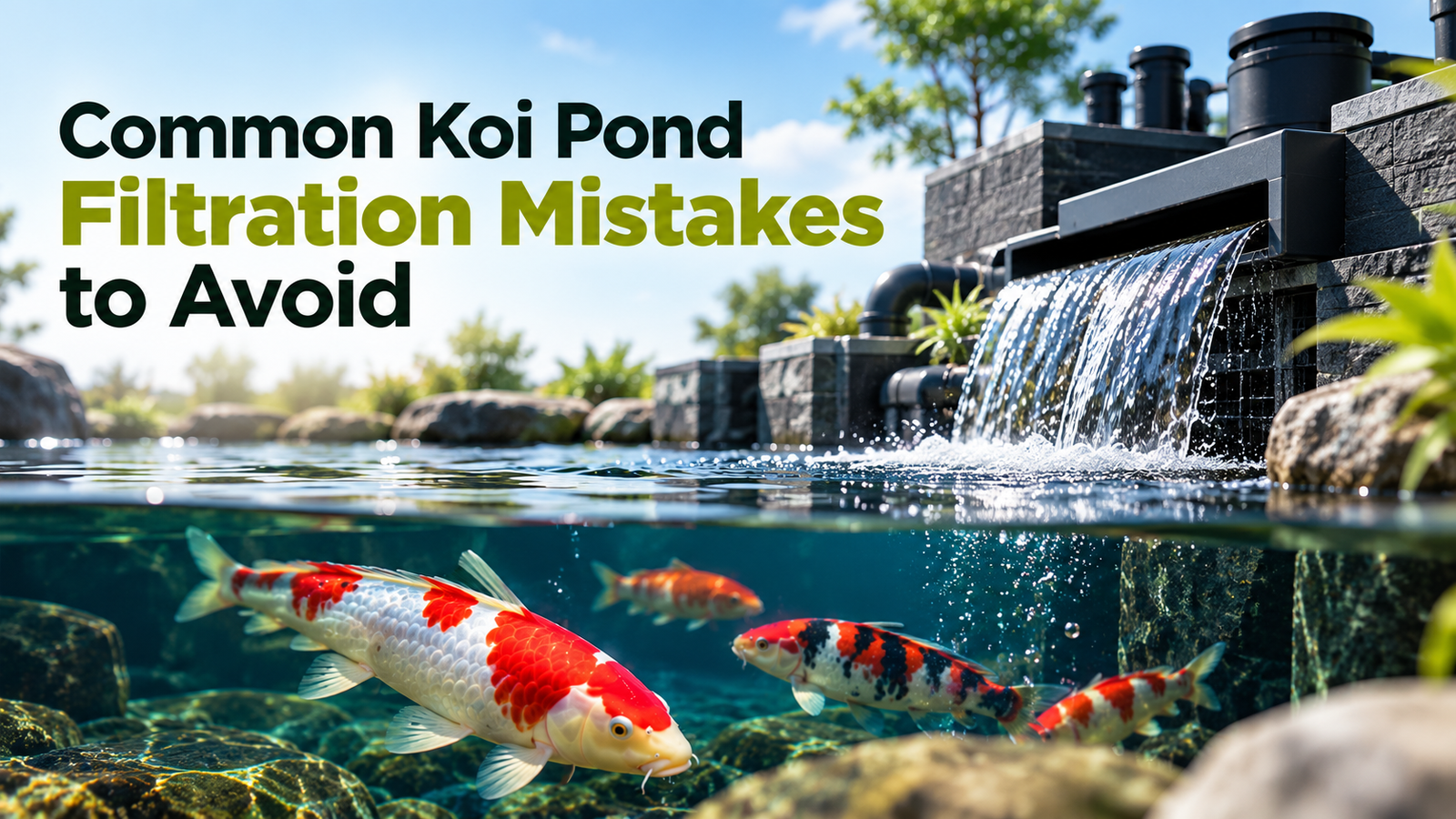
Koi fish are beautiful ornamental fish that require clean, healthy and well-maintained water to thrive. Maintaining good water quality is one of the most important responsibilities of every koi pond owner. A properly designed koi pond filtration system helps remove fish waste, uneaten food, harmful substances and suspended particles while supporting beneficial bacteria.
However, even with good filtration equipment, many pond owners experience cloudy water, algae growth, unpleasant smells and unhealthy fish. These problems often occur because of incorrect equipment selection, poor filtration design or improper maintenance.
Whether you have a small garden pond or a large koi pond, understanding common filtration mistakes can help you maintain crystal-clear water and a healthy environment for your fish.
In this guide, we will explore the most common koi pond filtration mistakes and explain how to avoid them.
1. Choosing the Wrong Pond Filter Size
One of the most common mistakes is selecting a pond filter based only on the manufacturer’s maximum advertised pond capacity.
Every koi pond has different filtration requirements depending on:
- Total pond water volume.
- Number and size of koi fish.
- Daily feeding quantity.
- Fish waste production.
- Pond circulation rate.
- Type of filtration media used.
For example, a filter advertised for a 20,000-litre ornamental pond may not be sufficient for a heavily stocked koi pond of the same volume.
How to avoid this mistake:
Choose a filter according to your actual fish load and feeding habits, not just pond volume. For heavily stocked koi ponds, consider a larger filtration system with sufficient mechanical and biological filtration capacity.
2. Using Only Mechanical Filtration
Mechanical filtration and biological filtration perform different functions.
Mechanical filtration removes physical waste, such as:
- Fish waste.
- Uneaten fish food.
- Leaves and debris.
- Suspended particles.
However, mechanical filtration alone cannot effectively process toxic ammonia produced by fish waste.
Biological filtration uses beneficial bacteria to convert ammonia into nitrite and then nitrate through the nitrogen cycle.
How to avoid this mistake:
Use a combination of mechanical and biological filtration.
Suitable biological media include:
- Bio balls.
- Ceramic rings.
- Moving bed media.
- Japanese filter mats.
- Porous biological media.
A properly designed filtration system should provide enough surface area for beneficial bacteria to grow.
3. Installing an Undersized Pond Pump
A pond pump plays a major role in maintaining effective filtration. It circulates pond water through the filtration system and helps distribute oxygen throughout the pond.
Using an undersized pump can result in:
- Poor water circulation.
- Dead spots in the pond.
- Reduced filtration efficiency.
- Waste accumulation at the pond bottom.
- Inadequate water movement.
How to avoid this mistake:
Calculate the pond’s water volume and choose a pump that provides an appropriate turnover rate for your fish load and filtration design.
For example, a 10,000-litre koi pond might require a system designed to circulate approximately 5,000–10,000 litres per hour, depending on stocking density and filtration requirements.
Always account for head height, pipe diameter, bends and filter resistance because actual pump flow will be lower than its advertised maximum flow.
4. Ignoring Biological Filter Maintenance
Biological filtration depends on beneficial bacteria that live on the surfaces of filter media. These bacteria are essential for maintaining a healthy nitrogen cycle.
One common mistake is cleaning biological media too aggressively or replacing all the media at once.
This can destroy a significant portion of the beneficial bacterial colony, potentially causing ammonia and nitrite levels to rise.
How to avoid this mistake:
- Clean biological media gently when necessary.
- Use removed pond water or appropriately dechlorinated water for cleaning.
- Avoid washing media with untreated tap water containing chlorine or chloramine.
- Do not replace all biological media simultaneously.
- Maintain adequate oxygen and water flow through the media.
Regular monitoring of ammonia and nitrite levels helps ensure that biological filtration is working correctly.
5. Not Removing Solid Waste Before Biological Filtration
Sending large amounts of solid waste directly into biological filter chambers is another common mistake.
Fish waste, uneaten food and organic debris can accumulate inside biological media. Over time, this reduces water flow and creates areas where oxygen levels may become low.
This can reduce filtration performance and increase maintenance requirements.
How to avoid this mistake:
Install an effective mechanical filtration stage before the biological filter.
Common mechanical filtration options include:
- Settlement chambers.
- Filter brushes.
- Japanese filter mats.
- Sieve filters.
- Rotary drum filters.
A rotary drum filter is particularly useful for larger koi ponds because it automatically removes suspended solid waste through a mechanical screening and cleaning process.
6. Using an Incorrect UV Clarifier
Green pond water caused by suspended single-celled algae is a common problem in outdoor koi ponds.
A UV clarifier helps control this type of green water by exposing passing microorganisms to ultraviolet light.
However, installing an undersized UV clarifier or using an unsuitable flow rate can reduce its effectiveness.
How to avoid this mistake:
Consider these factors when choosing a UV clarifier:
- Total pond water volume.
- Sunlight exposure.
- Fish stocking density.
- UV wattage.
- Water flow rate through the UV unit.
- Manufacturer’s recommended operating conditions.
Remember that UV clarifiers help control suspended algae but do not replace mechanical or biological filtration.
7. Overfeeding Koi Fish
Overfeeding is not just a fish-care problem; it also increases the workload of your pond filtration system.
Uneaten food breaks down and releases organic waste into the water. This increases the demand on mechanical and biological filtration.
Excessive feeding can contribute to:
- Higher ammonia production.
- Increased sludge accumulation.
- Poor water quality.
- Reduced oxygen levels.
- Increased algae growth.
How to avoid this mistake:
Feed koi fish in controlled quantities that they can consume within a few minutes. Adjust feeding according to water temperature, fish activity and seasonal conditions.
Avoid leaving uneaten food in the pond.
8. Poor Pond Plumbing and Water Circulation
Even an excellent filtration system may perform poorly if the pond plumbing is incorrectly designed.
Poor plumbing can create stagnant areas where fish waste and debris accumulate.
Common plumbing mistakes include:
- Incorrect pipe diameter.
- Too many sharp pipe bends.
- Poorly positioned water inlets and outlets.
- Missing bottom drains.
- Inadequate pump placement.
- Insufficient water return circulation.
How to avoid this mistake:
Plan the pond plumbing before construction. Use suitable pipe diameters, properly positioned bottom drains and skimmers, and strategically placed water returns.
For larger koi ponds, professional plumbing design can significantly improve filtration performance and simplify maintenance.
9. Neglecting Regular Filter Cleaning
Many pond owners install filtration equipment but forget that regular maintenance is necessary.
Mechanical filter media collect solid waste over time. If not cleaned, accumulated debris can restrict water flow and reduce filtration efficiency.
How to avoid this mistake:
Create a regular maintenance schedule:
| Filter Component | Maintenance |
|---|---|
| Mechanical filter brushes | Inspect and clean regularly |
| Filter sponges | Clean when clogged |
| Settlement chamber | Remove accumulated sludge |
| Biological media | Gentle cleaning when necessary |
| UV clarifier | Clean quartz sleeve and inspect lamp |
| Pond pump | Inspect intake and impeller |
Maintenance frequency depends on fish load, feeding quantity and the amount of waste produced.
10. Ignoring Water Quality Testing
Clear pond water does not always mean healthy pond water.
Some of the most dangerous water-quality problems are invisible. Ammonia and nitrite can be harmful to koi fish even when the water looks crystal clear.
Important water parameters to monitor include:
| Water Parameter | What to Monitor |
|---|---|
| Ammonia (NH3/NH4+) | Should be undetectable |
| Nitrite (NO2-) | Should be undetectable |
| Nitrate (NO3-) | Keep at a suitably low level |
| pH | Stable and appropriate for koi |
| Dissolved Oxygen | Maintain adequate oxygen levels |
| KH | Sufficient buffering capacity |
How to avoid this mistake:
Test pond water regularly, particularly when introducing new fish, increasing feeding quantities or starting a new filtration system.
If ammonia or nitrite is detected, investigate the cause and take appropriate corrective action. Do not rely on water clarity alone.
11. Installing Too Much Filter Media Without Proper Water Flow
Adding more filter media does not automatically improve filtration.
If filter chambers are overcrowded, water may bypass the media or flow unevenly. This reduces the effectiveness of both mechanical and biological filtration.
How to avoid this mistake:
- Arrange filter media according to their purpose.
- Maintain sufficient space between media where required.
- Ensure uniform water distribution.
- Avoid blocking water outlets.
- Follow the recommended flow rate of the filtration system.
A properly designed filter with good water flow is often more effective than an overcrowded filter chamber.
12. Not Providing Enough Oxygen to the Biological Filter
Beneficial bacteria require oxygen to perform biological filtration efficiently.
Insufficient oxygen in the filter chamber can reduce bacterial activity and affect the conversion of ammonia and nitrite.
This is particularly important in heavily stocked koi ponds and moving bed filtration systems.
How to avoid this mistake:
- Install an appropriately sized air pump.
- Use air stones or diffusers where necessary.
- Ensure moving bed media receive sufficient aeration and movement.
- Maintain adequate dissolved oxygen levels in the main pond.
- Check aeration equipment regularly.
Proper oxygen supply supports both fish health and biological filtration.
Recommended Koi Pond Filtration System Setup
A well-planned koi pond filtration system should combine different filtration stages to maintain good water quality.
A typical filtration arrangement includes:
- Koi Pond: Water containing fish waste, uneaten food and organic debris.
- Mechanical Filtration: Brushes, sieve filters or drum filters remove solid waste.
- Biological Filtration: Bio balls, ceramic media and moving bed media support beneficial bacteria.
- UV Clarification: Helps control suspended green-water algae.
- Water Return: Filtered water returns to the pond through suitable outlets.
The actual plumbing arrangement depends on whether the filtration system is gravity-fed or pump-fed.
Frequently Asked Questions (FAQs)
1. What is the most common koi pond filtration mistake?
Choosing an undersized filter is one of the most common mistakes. A filtration system must be selected according to pond volume, fish stocking density and feeding requirements.
2. How often should I clean my koi pond filter?
Mechanical filters should be inspected frequently and cleaned whenever waste accumulation restricts water flow. Biological media should only be cleaned when necessary and gently to preserve beneficial bacteria.
3. Why is my koi pond water cloudy even with a filter?
Cloudy water can result from suspended particles, insufficient mechanical filtration, immature biological filtration, algae or disturbed pond sediment. Identifying the cause is important before changing equipment.
4. Is a UV filter necessary for a koi pond?
A UV clarifier is useful for controlling suspended algae that cause green water. However, it is not a replacement for mechanical and biological filtration.
5. How many times should a koi pond filter circulate water?
The appropriate turnover rate depends on fish stocking density, pond design and filtration capacity. Many koi pond systems aim for approximately one complete circulation every one to two hours, with adjustments based on actual flow and filtration performance.
6. Can I use tap water to clean biological filter media?
Untreated tap water may contain chlorine or chloramine that can damage beneficial bacteria. Use removed pond water or appropriately dechlorinated water instead.
7. Why does my pond filter keep getting clogged?
Frequent clogging can result from excessive fish waste, overfeeding, insufficient mechanical pre-filtration or inadequate filter capacity. Regular cleaning and improved solid-waste removal can help solve the problem.
Conclusion
Maintaining a healthy koi pond requires more than installing a powerful pump or a large filter. Proper equipment selection, effective mechanical and biological filtration, good plumbing, sufficient oxygen and regular water testing all contribute to a successful filtration system.
Avoiding these common koi pond filtration mistakes can help reduce maintenance problems, improve water quality and create a healthier environment for your koi fish.
At Greenfin The Pond Studio, we provide pond filtration products, equipment and pond construction solutions to help pond owners build and maintain healthy, beautiful koi ponds.
Explore pond filtration products at greenfinindia.com.