

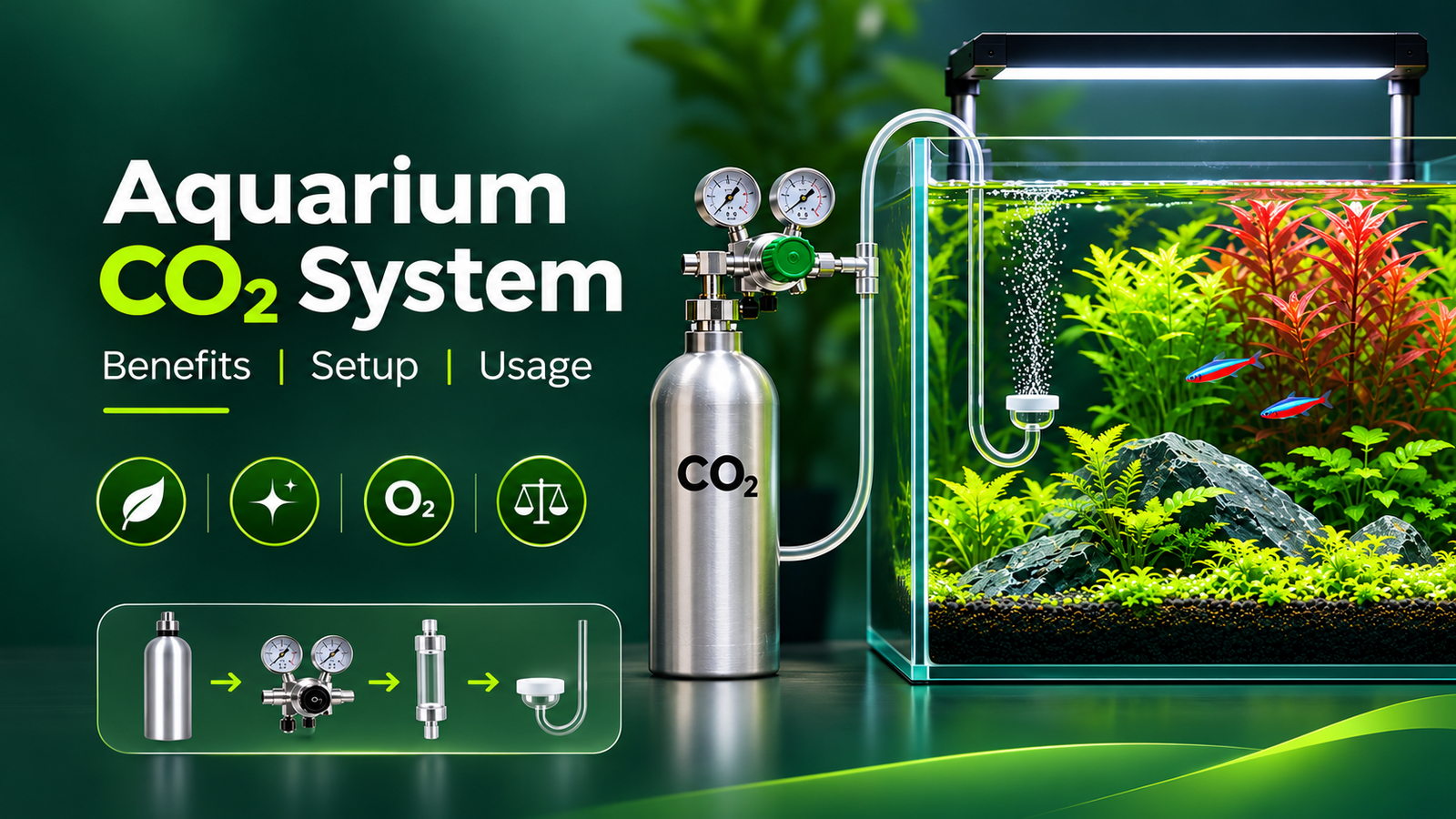

A beautiful planted aquarium is more than just a glass tank filled with water and aquatic plants. Healthy aquatic plants require the right balance of lighting, nutrients, water circulation and carbon dioxide (CO2). Among these essential elements, CO2 plays a major role in supporting plant growth and maintaining a healthy planted aquarium.
An Aquarium CO2 System helps supply additional carbon dioxide to aquarium plants, allowing them to grow faster, develop stronger leaves and maintain vibrant colours. It is particularly useful for high-tech planted aquariums, aquascapes and tanks containing demanding aquatic plant species.
Whether you are setting up your first planted aquarium or improving an existing aquascape, understanding how an aquarium CO2 system works can help you achieve better results.
In this guide, we will explain the benefits, components, installation process and proper usage of an aquarium CO2 system.
1. What Is an Aquarium CO2 System?
An aquarium CO2 system is equipment designed to introduce controlled amounts of carbon dioxide into aquarium water.
Aquatic plants use carbon dioxide during photosynthesis to produce energy and grow. In natural water environments, plants obtain CO2 from various sources, including fish respiration, organic decomposition and atmospheric exchange.
However, in densely planted aquariums with strong lighting, naturally available CO2 may not be sufficient to support optimal plant growth.
An aquarium CO2 system provides an additional and controlled supply of carbon dioxide, helping plants maintain healthy growth.
It is commonly used in:
- High-tech planted aquariums.
- Nature-style aquascapes.
- Dutch-style planted tanks.
- Aquariums with carpeting plants.
- Tanks containing demanding aquatic plant species.
2. Why Is CO2 Important for Aquarium Plants?
Carbon dioxide is one of the essential ingredients required for photosynthesis.
During photosynthesis, aquatic plants use light energy to convert carbon dioxide and water into carbohydrates, which support their growth.
Without sufficient carbon dioxide, plants may experience slower growth even when lighting and nutrients are available.
Here are some important benefits of CO2 supplementation.
Faster Plant Growth
Additional CO2 can improve the growth rate of many aquatic plants. Plants can develop new leaves, stems and roots more efficiently when carbon availability is sufficient.
Healthy and Vibrant Plant Colours
Proper CO2 availability supports healthy plant development. Red aquatic plants, in particular, can develop stronger coloration when CO2, lighting and nutrients are balanced.
Better Carpet Plant Growth
Carpeting plants such as Monte Carlo and Dwarf Hairgrass can benefit from additional CO2.
With appropriate lighting, nutrients and maintenance, these plants can spread more effectively across the aquarium substrate.
Improved Aquascaping Results
CO2 supplementation makes it easier to maintain demanding aquatic plant species in professionally designed aquascapes.
It helps aquascapers achieve dense plant growth, detailed layouts and attractive underwater landscapes.
Better Plant Competition Against Algae
Healthy, actively growing aquatic plants can compete with algae for available nutrients and resources.
However, CO2 alone does not prevent algae. Proper lighting duration, nutrient management, water circulation and regular maintenance are also important.
3. Main Components of an Aquarium CO2 System
Before installing an aquarium CO2 system, it is important to understand its main components.
1. CO2 Cylinder
The CO2 cylinder stores carbon dioxide under pressure. It is the primary source of CO2 for the aquarium.
Common options include refillable cylinders in different capacities.
Choose a cylinder based on aquarium size, CO2 consumption and how frequently you want to refill it.
2. CO2 Regulator
The regulator controls the pressure of CO2 released from the cylinder.
A quality regulator helps maintain stable pressure and provides controlled CO2 delivery.
Some advanced regulators include dual-stage pressure control and integrated solenoid valves.
3. Solenoid Valve
A solenoid valve is an electrically operated component that controls CO2 flow.
It can be connected to a timer so that CO2 supply automatically switches on and off.
Generally, CO2 is supplied during the lighting period and switched off before the aquarium lights turn off.
4. Bubble Counter
A bubble counter helps monitor the rate at which CO2 enters the aquarium.
It allows users to observe the number of bubbles released per second.
However, bubble count is only a rough reference. Actual CO2 concentration depends on several factors, including equipment, aquarium circulation and diffuser efficiency.
5. CO2 Diffuser
A CO2 diffuser releases carbon dioxide into aquarium water as small bubbles.
Smaller bubbles generally provide more surface area for gas exchange and can improve CO2 dissolution.
Different types of diffusers are available depending on aquarium size and installation requirements.
6. CO2 Tubing
CO2-resistant tubing connects the regulator to the diffuser.
Using suitable tubing helps prevent leakage and ensures consistent CO2 delivery.
7. Drop Checker
A drop checker is a monitoring device used to estimate aquarium CO2 availability.
It contains a reference solution and changes colour depending on the CO2 concentration.
Common colour indications include:
- Blue: Lower CO2 availability.
- Green: Approximately suitable CO2 level.
- Yellow: Potentially excessive CO2 level.
A drop checker responds slowly, so it should not be used as the only safety indicator.
4. How to Set Up an Aquarium CO2 System
Setting up a CO2 system correctly is essential for stable plant growth and fish safety.
Follow these steps when installing your aquarium CO2 equipment.
Step 1: Select the Right CO2 Cylinder
Choose a suitable cylinder according to your aquarium size and expected CO2 consumption.
For example, a small planted aquarium may require a smaller cylinder, while a large aquascape may benefit from a higher-capacity cylinder.
Always use a cylinder and regulator designed for compressed CO2.
Step 2: Install the CO2 Regulator
Attach the regulator securely to the CO2 cylinder.
Check that the connection is compatible and properly sealed.
Open the cylinder valve slowly and follow the regulator manufacturer’s instructions.
Never force incompatible fittings or connections.
Step 3: Connect the CO2 Tubing
Connect the CO2 tubing between the regulator outlet and the bubble counter.
Continue the connection from the bubble counter to the diffuser.
Ensure all connections are secure.
Step 4: Install the CO2 Diffuser
Place the diffuser inside the aquarium, preferably in an area with good water circulation.
This helps distribute dissolved CO2 throughout the aquarium rather than concentrating it in one location.
Step 5: Adjust the CO2 Flow
Start with a low CO2 flow rate and gradually adjust it while monitoring plant and fish behaviour.
There is no universal bubble-per-second setting because aquarium dimensions, water movement, diffuser type and plant density vary.
Step 6: Install a Drop Checker
Place the drop checker inside the aquarium where it can be easily observed.
Allow sufficient time for the indicator to respond before making further adjustments.
Step 7: Monitor Fish and Plants
Observe fish behaviour regularly after introducing CO2.
If fish gasp at the surface, breathe rapidly or show unusual behaviour, immediately stop CO2 injection and increase aeration and surface agitation.
5. When Should You Turn ON and OFF Aquarium CO2?
Timing is important when operating an aquarium CO2 system.
Aquatic plants consume CO2 during photosynthesis, which takes place when sufficient light is available.
A common approach is:
- Turn ON CO2 approximately 1–2 hours before the aquarium lights switch on.
- Maintain CO2 supply during the lighting period.
- Turn OFF CO2 approximately 1 hour before the lights switch off.
This helps establish adequate CO2 availability when photosynthesis begins.
A timer-controlled solenoid valve makes this process easier and more consistent.
Avoid injecting CO2 continuously throughout the night in a typical planted aquarium, as plants also consume oxygen through respiration when lights are off.
6. How Much CO2 Does a Planted Aquarium Need?
The correct CO2 level depends on the aquarium’s plant requirements, fish population, lighting and circulation.
A commonly used target in high-tech planted aquariums is approximately 20–30 ppm of dissolved CO2.
However, this is not a universal requirement. Some aquariums grow plants successfully with lower concentrations.
Excessive CO2 can stress fish and other aquatic animals.
To manage CO2 properly:
- Start with a conservative injection rate.
- Monitor fish behaviour.
- Use a drop checker as a supplementary indicator.
- Consider measuring pH and KH together to estimate CO2 concentration.
- Maintain adequate water circulation.
- Ensure sufficient oxygen exchange, particularly at night.
Important: Never increase CO2 injection simply to achieve a particular bubble count. Fish safety should always be the priority.
7. Common Mistakes When Using an Aquarium CO2 System
Many planted aquarium beginners experience problems because of incorrect CO2 setup or poor maintenance.
Here are some common mistakes to avoid.
Excessive CO2 Injection
Too much CO2 can reduce available oxygen and cause serious stress to fish.
Always increase injection gradually and monitor livestock.
Poor Water Circulation
Even when CO2 is supplied correctly, poor circulation can create areas with insufficient CO2 distribution.
Position your diffuser where aquarium flow can distribute dissolved CO2 effectively.
Incorrect Lighting and CO2 Balance
Strong lighting combined with insufficient CO2 can encourage algae growth.
Maintain a balanced relationship between lighting intensity, CO2 availability and nutrients.
Ignoring Equipment Maintenance
A clogged diffuser can reduce CO2 distribution.
Clean the diffuser regularly according to the manufacturer’s instructions and inspect tubing and connections for leaks.
Running CO2 During the Entire Night
Continuous CO2 injection at night is generally unnecessary for planted aquariums and can increase the risk of excessive CO2 accumulation.
Use a timer-controlled solenoid valve to manage injection periods.
8. Is an Aquarium CO2 System Necessary for Every Planted Aquarium?
No. Not every planted aquarium requires additional CO2 injection.
The requirement depends mainly on plant species, lighting conditions and the type of aquascape.
| Aquarium Type | CO2 Requirement |
|---|---|
| Low-tech planted aquarium | Usually not necessary |
| Beginner planted aquarium | Optional |
| High-tech planted aquarium | Highly beneficial |
| Dutch-style aquascape | Recommended |
| Carpet plant aquarium | Often beneficial |
| Artificial plant aquarium | Not required |
Easy-growing aquatic plants such as Anubias, Java Fern and some Cryptocoryne species can grow successfully without additional CO2 under suitable conditions.
However, demanding carpeting plants and many fast-growing stem plants generally benefit from CO2 supplementation.
9. How to Maintain an Aquarium CO2 System
Regular maintenance helps maintain stable performance and prevents unexpected problems.
Follow these maintenance practices:
- Check CO2 cylinder pressure regularly.
- Inspect regulator connections for leakage.
- Clean the diffuser when bubble distribution becomes uneven.
- Check tubing for cracks or damage.
- Monitor the solenoid valve and timer operation.
- Observe fish behaviour after changing CO2 settings.
- Refill the CO2 cylinder before it becomes empty.
Always keep CO2 cylinders secured upright in a well-ventilated area, away from excessive heat.
10. Choosing the Best Aquarium CO2 System
Choosing the right aquarium CO2 system depends on your aquarium size, plant selection and aquascaping goals.
Before purchasing, consider the following factors:
Aquarium Size: Select a suitable cylinder capacity and regulator for your aquarium.
Regulator Quality: Look for stable pressure control and reliable construction.
Solenoid Valve: An automatic solenoid valve makes CO2 scheduling easier.
Diffuser Quality: Choose a diffuser that provides effective CO2 distribution for your aquarium.
Monitoring Equipment: A drop checker can help you monitor CO2 availability.
Ease of Maintenance: Select equipment that is easy to install, clean and operate.
Investing in a reliable CO2 setup can make maintaining a demanding planted aquarium easier.
Frequently Asked Questions (FAQs)
1. What is an aquarium CO2 system used for?
An aquarium CO2 system supplies additional carbon dioxide to aquatic plants, supporting photosynthesis, healthy growth and improved plant development.
2. Is CO2 necessary for aquarium plants?
No. Many easy-growing aquatic plants can survive without additional CO2. However, demanding plants and high-tech aquascapes benefit from CO2 supplementation.
3. How many hours should CO2 run in an aquarium?
A common approach is to inject CO2 for approximately 7–9 hours, coordinated with the aquarium lighting schedule. The exact duration depends on the aquarium setup.
4. Can too much CO2 kill aquarium fish?
Yes. Excessive CO2 can cause breathing difficulties, stress and potentially fish deaths. Always monitor fish behaviour and maintain appropriate gas exchange.
5. Should I turn off CO2 at night?
Yes. In most planted aquariums, CO2 injection should be stopped before the lights turn off.
6. Does CO2 help aquarium carpet plants grow?
Yes. Additional CO2 can significantly support carpeting plant growth when combined with suitable lighting, nutrients and substrate.
7. Can I use CO2 in a fish-only aquarium?
It is generally unnecessary in a fish-only aquarium because there are no demanding aquatic plants that require additional CO2. Excessive injection can put fish at risk.
8. What is the ideal CO2 level for a planted aquarium?
Approximately 20–30 ppm is commonly targeted in high-tech planted aquariums, but the appropriate level varies. Always prioritize fish safety over a numerical target.
Conclusion
An Aquarium CO2 System is an important piece of equipment for aquascapers who want to maintain healthy, dense and attractive aquatic plants.
By selecting suitable equipment, installing it correctly and maintaining a balanced relationship between CO2, lighting and nutrients, you can create a beautiful planted aquarium.
Whether you are building a beginner planted tank or an advanced aquascape, understanding CO2 injection will help you make better decisions and achieve more consistent plant growth.
Explore Greenfin Aqua and Greenfin The Pond Studio for quality aquarium equipment, planted aquarium supplies and aquascaping essentials.