

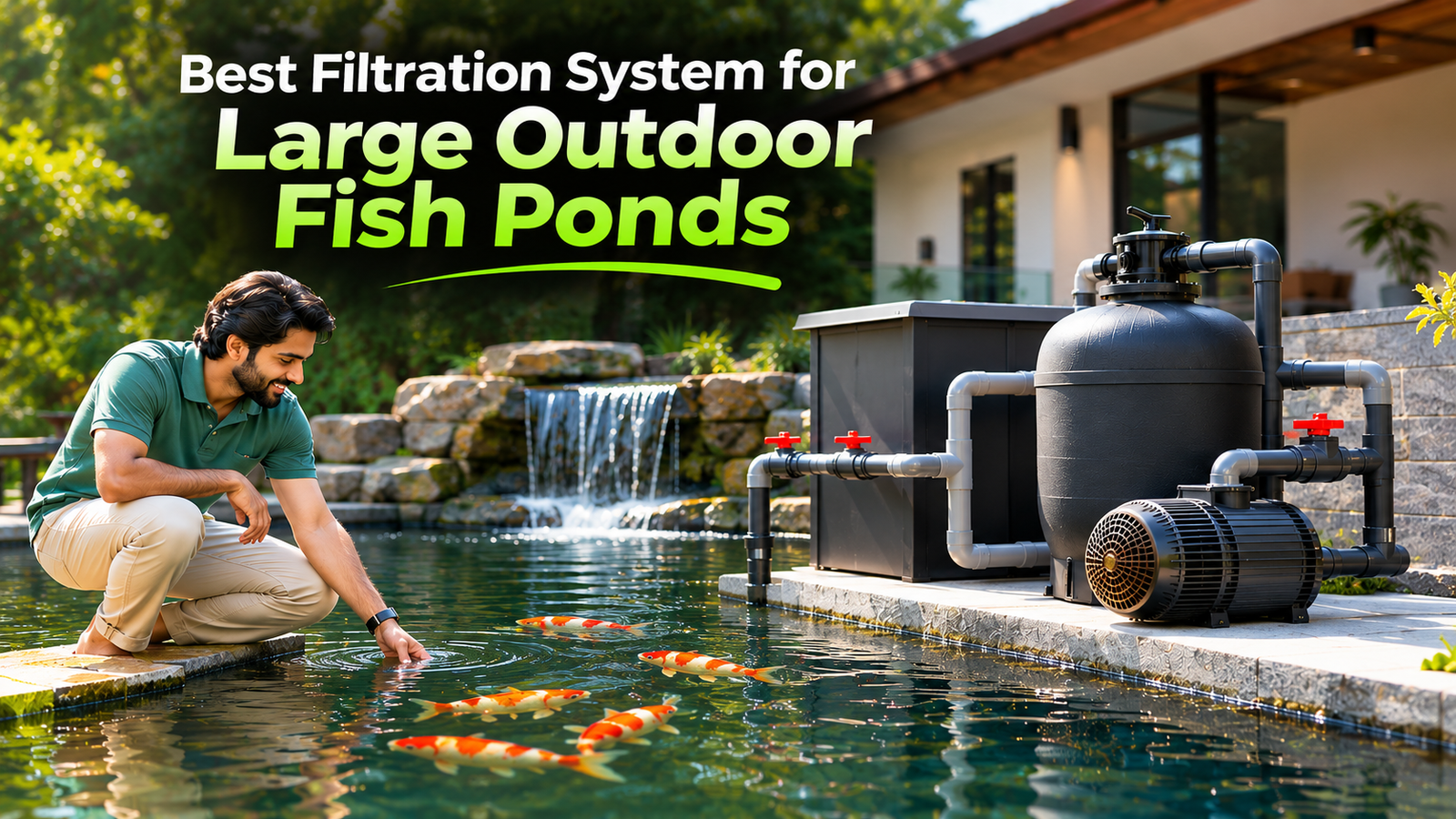
A large outdoor fish pond adds beauty and life to any garden or outdoor space. Whether you maintain a koi pond, ornamental fish pond or a natural garden pond, maintaining clean and healthy water is essential for fish health. However, keeping a large pond clean can be challenging without the right filtration system.
Fish waste, uneaten food, decaying leaves, algae and other organic materials continuously affect pond water quality. Without proper filtration, harmful substances such as ammonia and nitrite can accumulate, making the water unhealthy for fish.
In this guide, we will explore different pond filtration systems, their benefits, essential components and how to select the right setup for your pond.
Why Does a Large Outdoor Fish Pond Need a Filtration System?
Unlike small indoor aquariums, outdoor ponds are exposed to changing weather conditions, sunlight, dust, leaves and other environmental factors.
A large pond with several fish produces a considerable amount of waste. Without effective filtration, this waste can affect water quality and increase maintenance requirements.
A proper pond filtration system helps:
- Remove suspended dirt and solid fish waste.
- Break down harmful ammonia and nitrite.
- Reduce organic waste accumulation.
- Improve water clarity.
- Support healthy fish growth.
- Reduce unwanted algae growth when combined with proper UV treatment and nutrient management.
- Maintain a stable aquatic environment.
For koi ponds and heavily stocked outdoor fish ponds, an efficient filtration system is particularly important.
Types of Filtration Systems for Large Outdoor Fish Ponds
Selecting the right filtration method depends on pond size, fish population, feeding levels and maintenance requirements.
1. Mechanical Filtration System
<AsyncImage query=”large pond mechanical filtration filter brushes Japanese mat filter media” aspectRatio=”16:9″ width=”100%”/>
Mechanical filtration removes visible particles and suspended waste from pond water before they break down.
It typically uses filter brushes, filter pads, sponges and other mechanical media to trap dirt and debris.
Benefits:
- Removes solid waste and suspended particles.
- Prevents excessive dirt accumulation inside the filtration system.
- Helps protect biological filter media from clogging.
- Improves overall water clarity.
Mechanical filtration is an important first stage in most large pond filtration systems.
2. Biological Filtration System
<AsyncImage query=”koi pond biological filtration chamber moving bed K1 filter media” aspectRatio=”16:9″ width=”100%”/>
Biological filtration is one of the most important stages of a koi pond filtration system.
It uses beneficial bacteria to convert harmful ammonia produced by fish waste into nitrite and then into less harmful nitrate through the nitrogen cycle.
Common biological filter media includes:
- Bio balls
- Ceramic rings
- Japanese filter mats
- Moving bed media
- Porous biological media
Benefits:
- Supports beneficial bacterial colonies.
- Helps control ammonia and nitrite.
- Maintains healthier water conditions.
- Supports higher fish stocking levels when correctly sized and maintained.
A large outdoor fish pond should have sufficient biological filtration capacity based on its fish load and feeding requirements.
3. UV Clarification System
<AsyncImage query=”pond UV clarifier ultraviolet sterilizer installed outdoor koi pond filtration” aspectRatio=”16:9″ width=”100%”/>
Green water is a common problem in outdoor ponds. It is usually caused by suspended single-celled algae that multiply when sunlight and nutrients are available.
A UV clarifier passes pond water through a chamber containing an ultraviolet lamp. UV exposure helps control suspended green-water algae.
Benefits:
- Helps control green pond water.
- Improves water transparency.
- Reduces suspended algae.
- Makes it easier to maintain a clear-looking pond.
Choose a UV clarifier based on pond volume, water flow rate, sunlight exposure and the manufacturer’s recommendations.
Remember that UV clarification does not replace mechanical or biological filtration.
4. Drum Filter System
<AsyncImage query=”professional koi pond rotary drum filter filtration system stainless steel” aspectRatio=”16:9″ width=”100%”/>
A rotary drum filter (RDF) is an advanced mechanical filtration solution commonly used in large koi ponds and professional pond installations.
It uses a fine mesh screen to separate solid waste from the water. As the screen becomes dirty, an automatic cleaning mechanism washes away accumulated debris.
Benefits:
- Automatic mechanical waste removal.
- Reduces manual filter cleaning.
- Removes fine solid particles.
- Helps protect biological filtration stages.
- Suitable for demanding large pond applications when correctly sized.
Drum filters are particularly useful for large koi ponds with high fish populations and heavy feeding requirements.
Best Filtration System Combinations for Large Outdoor Fish Ponds
For large outdoor ponds, combining different filtration technologies often produces better results than relying on a single filter.
Here are three commonly used configurations.
Option 1: Multi-Chamber Filtration System
<AsyncImage query=”large concrete koi pond multi chamber filtration system filter brushes Japanese mat bio media” aspectRatio=”16:9″ width=”100%”/>
A multi-chamber filtration system uses separate compartments for different filtration stages.
A typical arrangement includes:
- First chamber – Mechanical filtration using brushes.
- Second chamber – Fine mechanical filtration using mats or pads.
- Third chamber – Biological filtration using bio media.
- Fourth chamber – Additional biological filtration or polishing.
- Return chamber – Pump and water return arrangement, depending on the design.
Best for: Large koi ponds, outdoor fish ponds and custom-built pond filtration installations.
Option 2: Pressurised Bio-Filter System
<AsyncImage query=”large outdoor pond pressurized biological filter with backwash valve UV pond filter” aspectRatio=”16:9″ width=”100%”/>
A pressurised pond filter is a compact filtration solution that combines mechanical and biological filtration in a sealed unit. Some models also include integrated UV clarification.
Benefits:
- Compact installation.
- Easy integration with pond plumbing.
- Convenient cleaning in models with backwash functions.
- Suitable for selected medium and large pond applications depending on model capacity.
Best for: Ponds where space is limited and a compact filtration arrangement is preferred.
Option 3: Rotary Drum Filter (RDF) System
<AsyncImage query=”large professional koi pond rotary drum filter moving bed biological filtration system installation” aspectRatio=”16:9″ width=”100%”/>
For professional koi ponds and high-stock-density fish ponds, a rotary drum filter combined with biological filtration can be an excellent solution.
A typical arrangement:
- Bottom drain and skimmer collection.
- Rotary drum mechanical filtration.
- Moving bed biological filtration.
- Additional biological filtration if required.
- Pump and UV clarification stage.
- Return water to the pond.
Best for: Large koi ponds, premium pond installations and ponds with high fish loads.
How to Choose the Right Pond Filter for Your Pond Size
Before purchasing a filtration system, calculate the pond’s water volume and understand its fish load.
Use the following formula:
Pond Volume (Litres) = Length × Width × Average Water Depth × 1,000
All dimensions should be in metres.
For example:
A pond measuring 6 metres long, 4 metres wide and 1.5 metres deep:
6 × 4 × 1.5 × 1,000 = 36,000 litres.
This pond holds approximately 36,000 litres of water.
However, pond volume alone does not determine filter capacity. You should also consider:
- Number and size of fish.
- Daily fish feeding quantity.
- Amount of sunlight received.
- Presence of aquatic plants.
- Pond depth and shape.
- Pump flow rate.
- Plumbing and pipe diameter.
- Filter manufacturer’s recommended capacity.
A heavily stocked koi pond may require a significantly more powerful filtration system than a lightly stocked ornamental pond of the same volume.
How to Choose the Right Pond Pump for Filtration
A pond pump is responsible for circulating water through the filtration system.
When selecting a pond pump, consider:
1. Flow Rate: Check the recommended water circulation rate for your filter and pond.
2. Head Height: Understand how much water the pump needs to lift. Actual flow decreases as head height and plumbing resistance increase.
3. Pipe Diameter: Use appropriately sized plumbing to minimise friction losses.
4. Energy Consumption: Compare wattage and operating efficiency because pond pumps often run continuously.
5. Continuous Operation: Choose a pump suitable for long operating hours and outdoor pond conditions.
Always consider the actual delivered flow through the installed filtration system rather than relying only on the pump’s maximum advertised flow rate.
Common Pond Filtration Mistakes to Avoid
Even a powerful filtration system may not perform properly if it is incorrectly installed or maintained.
Avoid these common mistakes:
- Choosing a filter based only on pond water volume.
- Ignoring fish stocking levels.
- Using an undersized pond pump.
- Installing insufficient biological filter media.
- Allowing mechanical filter media to become clogged.
- Cleaning biological media with chlorinated tap water.
- Ignoring regular water quality testing.
- Using UV clarification as a replacement for biological filtration.
- Switching off the filtration system for extended periods.
Regular maintenance and monitoring are essential for long-term filtration performance.
How to Maintain a Large Outdoor Pond Filtration System
A well-maintained filtration system provides more consistent water quality and reduces the risk of sudden problems.
Follow these maintenance practices:
- Inspect the pump and plumbing regularly.
- Remove accumulated dirt from mechanical filter media.
- Clean biological media carefully without destroying beneficial bacterial colonies.
- Check UV lamps and replace them according to manufacturer recommendations.
- Monitor ammonia, nitrite, nitrate and pH levels.
- Check water flow through the filter.
- Remove leaves and organic debris from the pond.
- Maintain suitable aeration for fish and biological filtration.
Avoid cleaning all biological media at once, as this can reduce beneficial bacteria populations.
Final Thoughts
Choosing the best filtration system for large outdoor fish ponds is essential for maintaining clean water, healthy fish and a beautiful outdoor pond environment.
For many large koi ponds, a multi-chamber filtration system provides a flexible solution. Pressurised filters are useful where compact installation is important, while rotary drum filters combined with biological filtration are suitable for more demanding pond applications.
The ideal setup depends on your pond volume, fish population, feeding levels and maintenance requirements.
At Greenfin The Pond Studio, we provide pond equipment and pond construction solutions, including pond pumps, UV clarifiers, filtration systems and pond infrastructure services.
Explore our pond products and find the right equipment for your pond.
Website: https://greenfinindia.com
Greenfin The Pond Studio – Complete Pond Solutions.
Frequently Asked Questions (FAQs)
1. What is the best filtration system for a large koi pond?
A combination of mechanical and biological filtration is essential. For demanding large koi ponds, a rotary drum filter combined with moving bed biological filtration can provide an effective solution.
2. How often should a large pond filter run?
Most fish pond filtration systems should operate continuously, 24 hours a day, to maintain stable water circulation and biological filtration.
3. Is a UV filter necessary for an outdoor fish pond?
A UV clarifier is useful for controlling suspended green-water algae, especially in outdoor ponds exposed to sunlight. However, it does not replace mechanical and biological filtration.
4. How much filter media is required for a large pond?
The required amount depends on the type of media, surface area, fish stocking level and daily feeding quantity. Follow the filter manufacturer’s specifications and design requirements.
5. Can one filter handle a 50,000-litre koi pond?
Yes, if it is correctly designed and rated for the pond’s fish load and feeding rate. In some installations, multiple filtration stages or larger systems may be necessary.
6. What is better: a multi-chamber filter or a drum filter?
A multi-chamber filter is flexible and often more affordable to build and maintain. A drum filter provides automated mechanical waste removal and is particularly useful for larger, heavily stocked koi ponds.
7. Does a pond filter remove green water?
Mechanical and biological filters alone may not remove suspended single-celled algae effectively. A properly sized UV clarifier can help control this type of green water.