

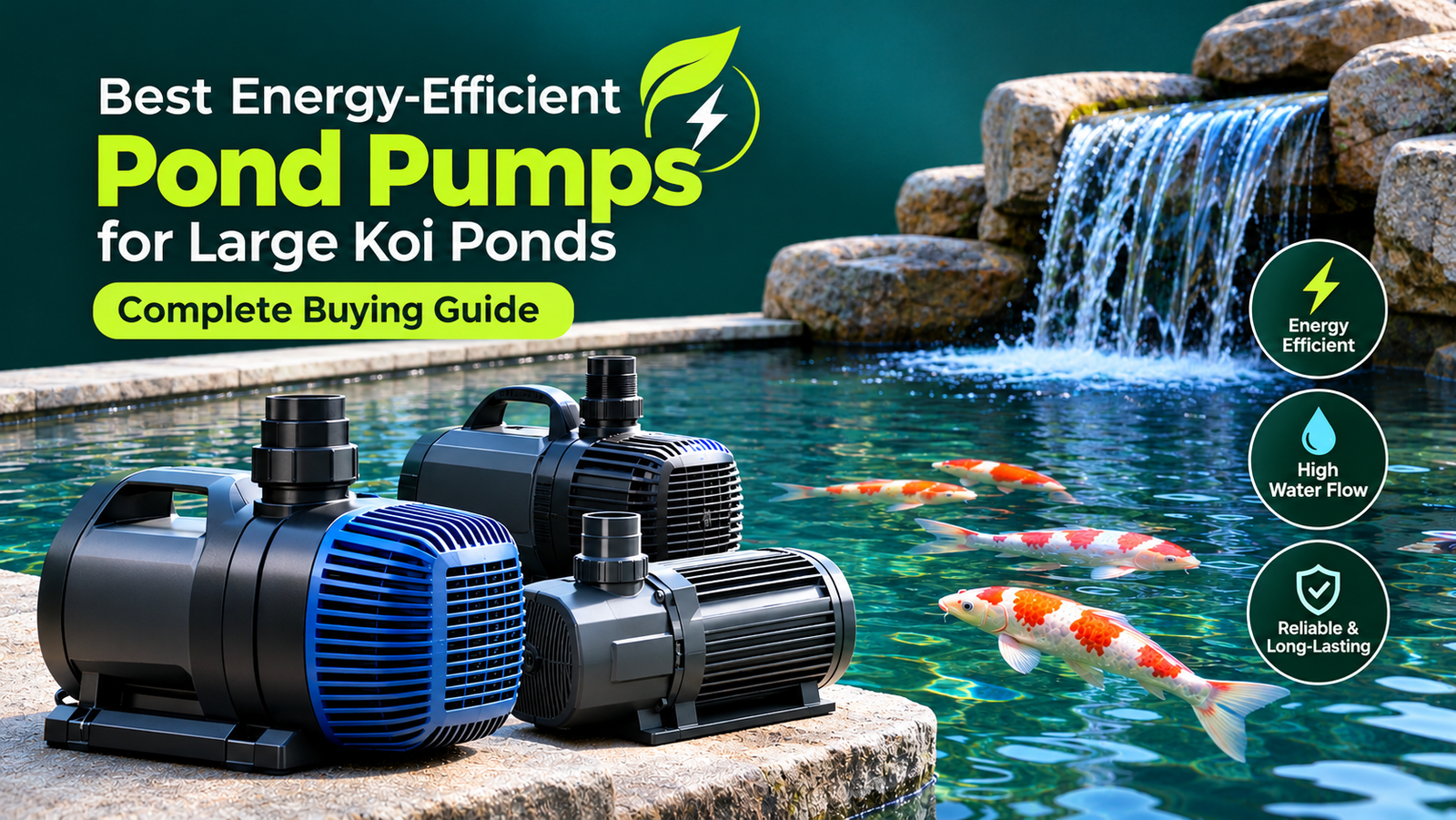
Large koi ponds require powerful and reliable water circulation to maintain clean, healthy and oxygen-rich water. Choosing the right pond pump is essential for maintaining effective filtration, supporting fish health and operating waterfalls or fountains. However, running a high-capacity pump continuously can increase electricity consumption.
An energy-efficient pond pump helps reduce operating costs while delivering the water flow required for proper pond circulation and filtration.
In this guide, we will explore how to choose the best energy-efficient pond pumps for large koi ponds, important features to consider, pump capacity requirements and tips for reducing electricity consumption.
Why Do Large Koi Ponds Need Energy-Efficient Pond Pumps?
Large koi ponds contain a significant volume of water and usually support multiple fish. Maintaining water quality requires continuous circulation through mechanical and biological filtration systems.
A suitable energy-efficient pond pump offers several advantages:
- Lower electricity consumption: Reduces monthly electricity expenses.
- Continuous water circulation: Helps distribute oxygen and prevent stagnant areas.
- Better filtration performance: Moves pond water through filtration systems effectively.
- Improved fish health: Supports stable water conditions for koi fish.
- Long-term savings: Reduces operating expenses when the pump runs continuously.
- Waterfall and fountain operation: Supports decorative water features when correctly sized.
Selecting a pump based only on its maximum flow rate is not recommended. You should also consider its power consumption, pumping height and filtration requirements.
1. Important Features to Look for in an Energy-Efficient Pond Pump
Before purchasing a pond pump, understand the specifications that determine its performance and electricity usage.
A. Power Consumption (Watts)
Power consumption indicates how much electrical energy a pump uses during operation.
For example:
- 100W pump: Uses 0.1 kWh per hour.
- 200W pump: Uses 0.2 kWh per hour.
- 300W pump: Uses 0.3 kWh per hour.
A pump with lower wattage may consume less electricity, but it must still deliver sufficient water flow for your pond.
B. Flow Rate (Litres Per Hour)
Flow rate measures how much water a pump can move in one hour.
It is generally expressed in LPH (litres per hour).
Large koi ponds require pumps capable of maintaining adequate circulation through the filtration system.
The required flow rate depends on:
- Total pond water volume.
- Number and size of koi fish.
- Filtration system capacity.
- Waterfall and fountain requirements.
- Pipe diameter and plumbing arrangement.
C. Maximum Head Height
Head height refers to the vertical distance a pump can move water.
For example, if your pond filtration system is located above the pond water level, the pump must overcome the height difference.
Remember that the actual flow rate decreases as pumping height increases.
Always check the pump’s flow-versus-head performance chart before purchasing.
D. Adjustable Flow Rate
Variable-speed or frequency-controlled pumps allow users to adjust water flow according to pond requirements.
This feature can help optimise electricity consumption when the pump does not need to operate at maximum capacity.
E. Continuous Operation Capability
Koi pond filtration systems generally require continuous circulation.
Choose a pump specifically designed for long operating hours and continuous pond applications.
2. Types of Energy-Efficient Pond Pumps for Large Koi Ponds
Different pond pumps are suitable for different applications. Understanding their differences helps you choose the right equipment.
A. Variable Frequency Pond Pumps
Variable frequency pumps allow users to adjust motor speed and water flow.
Their main advantage is the ability to match pump output with actual pond requirements instead of operating continuously at full speed.
Benefits:
- Adjustable water circulation.
- Potential electricity savings.
- Flexible flow control.
- Suitable for filtration and waterfall applications, depending on the model.
These pumps are particularly useful for large koi ponds where water flow requirements may change.
B. High-Efficiency Submersible Pond Pumps
Submersible pumps operate underwater and are commonly used in garden ponds, koi ponds and filtration systems.
Benefits:
- Easy installation.
- Compact design.
- Direct water pumping.
- Suitable for different pond applications.
Choose a model with adequate flow capacity and a suitable power rating.
C. External Pond Pumps
External pumps are installed outside the pond and connected through suitable plumbing.
They are commonly used in large pond installations where higher flow rates or specialised filtration arrangements are required.
Benefits:
- Convenient maintenance access.
- Flexible installation arrangements.
- Suitable for larger filtration systems.
- Can support complex pond plumbing configurations.
The installation should include appropriate priming, suction plumbing and protection against dry running.
3. How to Calculate the Right Pond Pump Capacity
Selecting the correct pump capacity is one of the most important steps when designing a large koi pond filtration system.
A commonly used starting point is to circulate the entire pond volume approximately once every 1–2 hours. However, heavily stocked koi ponds may require higher circulation depending on the filtration design and biological load.
Example:
Consider a koi pond with the following dimensions:
- Length: 20 feet
- Width: 12 feet
- Depth: 5 feet
Water volume calculation:
20 × 12 × 5 = 1,200 cubic feet.
1,200 × 28.316 = approximately 33,979 litres.
For a circulation target of once every two hours:
33,979 ÷ 2 = approximately 16,990 LPH.
Therefore, you can start evaluating pumps capable of delivering approximately 17,000 LPH at the actual operating head.
Important: This is the required delivered flow rate, not necessarily the pump’s advertised maximum flow rate. Account for pipe friction, fittings, filters and elevation when selecting the pump.
4. Best SunSun Pond Pumps to Consider for Large Koi Ponds
SunSun offers different pond pump models for water circulation, filtration and decorative water features.
When choosing a pump, compare the model specifications with your actual pond requirements.
SunSun JTP Series Pond Pumps
The SunSun JTP series is worth considering for pond water circulation and filtration applications.
Potential applications include:
- Koi pond filtration.
- Water circulation.
- Pond water features.
- General pond pumping.
Choose the appropriate model based on its flow rate, power consumption and head performance.
SunSun CLP Frequency Variation Pond Pump
The SunSun CLP frequency variation pump is a product category worth considering when adjustable water circulation is important.
Key considerations include:
- Adjustable pumping performance.
- Flow requirements for filtration.
- Operating power consumption.
- Installation compatibility.
- Pumping head requirements.
Check the exact model specifications before purchasing to determine its suitability for your pond.
SunSun JDP Series Pond Pumps
SunSun JDP series pumps can also be considered when comparing pond circulation equipment.
Evaluate the available models based on:
- Maximum flow rate.
- Power consumption.
- Maximum head.
- Continuous operation suitability.
- Plumbing compatibility.
Buying tip: Do not select a pump only because it has the highest advertised LPH. A correctly sized pump with suitable operating efficiency can be a better long-term investment.
5. How to Reduce Electricity Consumption in a Large Koi Pond
Even an energy-efficient pond pump can consume unnecessary electricity if the filtration system and plumbing are poorly designed.
Here are some practical ways to improve efficiency.
1. Choose the Correct Pump Size
Avoid installing an oversized pump when your filtration system does not require that much water flow.
Select a pump based on actual operating requirements.
2. Use Proper Pipe Diameter
Undersized pipes increase water resistance and reduce pump performance.
Use appropriately sized plumbing to minimise friction losses.
3. Clean Pump Intake and Filters Regularly
Blocked pump intakes and clogged filter media can restrict water flow.
Regular cleaning helps maintain consistent circulation.
4. Avoid Unnecessary Pumping Height
Install the filtration system and plumbing efficiently to minimise excessive vertical lifting.
5. Consider Variable-Speed Technology
If your pump supports adjustable operation, use the appropriate speed for your filtration requirements.
Do not reduce the flow below the minimum required by your filtration system.
6. Maintain Proper Filtration Design
A properly designed mechanical and biological filtration system reduces unnecessary restrictions and helps the pump operate effectively.
6. How Much Electricity Does a Pond Pump Consume?
Electricity consumption depends on the pump’s wattage and daily operating hours.
The following table assumes continuous operation for 24 hours per day and 30 days per month.
| Pump Power | Daily Consumption | Monthly Consumption |
|---|---|---|
| 100W | 2.4 kWh | 72 kWh |
| 150W | 3.6 kWh | 108 kWh |
| 200W | 4.8 kWh | 144 kWh |
| 300W | 7.2 kWh | 216 kWh |
| 500W | 12 kWh | 360 kWh |
Electricity cost example:
If your electricity tariff is ₹8 per unit:
A 200W pond pump consumes 144 units per month.
144 × ₹8 = ₹1,152 per month.
This calculation assumes the pump operates continuously at its rated power. Actual consumption may vary depending on operating conditions and adjustable speed settings.
7. Common Mistakes to Avoid When Buying a Pond Pump
Avoid these mistakes when selecting a pump for your koi pond.
- Choosing a pump based only on advertised maximum LPH.
- Ignoring the maximum head requirement.
- Selecting an undersized pump for a large filtration system.
- Using narrow pipes that restrict water flow.
- Ignoring electricity consumption.
- Purchasing a pump without checking continuous-operation suitability.
- Failing to consider waterfall and fountain requirements.
- Neglecting regular pump maintenance.
The right pump should balance water circulation, filtration performance, energy consumption and long-term reliability.
8. Frequently Asked Questions (FAQs)
1. Which pond pump is best for a large koi pond?
The best pond pump depends on pond volume, fish stocking, filtration capacity and required flow rate. Variable-frequency pumps are worth considering when adjustable flow and energy optimisation are priorities.
2. How many hours should a koi pond pump run?
A koi pond filtration pump generally needs to operate 24 hours a day to maintain continuous water circulation and biological filtration.
3. Are variable-speed pond pumps more energy-efficient?
They can be more energy-efficient when operated at reduced speeds to meet actual water circulation requirements. Savings depend on the motor, pump design and operating conditions.
4. What LPH pump is required for a 30,000-litre koi pond?
As an initial estimate, a circulation target of once every two hours would require approximately 15,000 LPH of actual delivered flow. The final pump selection should consider filtration requirements and total head.
5. Does a bigger pond pump consume more electricity?
Generally, higher-power pumps consume more electricity when operated at their rated power. However, actual consumption depends on motor efficiency and operating conditions.
6. Can I use one pump for both pond filtration and a waterfall?
Yes, if the pump provides sufficient flow at the required operating head and the plumbing is properly designed. In some large koi ponds, separate pumps are preferable for filtration and decorative water features.
7. How can I calculate monthly pond pump electricity costs?
Use this formula:
Monthly Electricity Consumption = (Pump Watts ÷ 1,000) × Operating Hours Per Day × 30
Multiply the monthly units by your electricity tariff to calculate the estimated cost.
Conclusion
Choosing the right energy-efficient pond pump is essential for maintaining a healthy and clean environment in large koi ponds. A suitable pump provides continuous water circulation, supports effective filtration and helps control electricity expenses.
Before purchasing, compare flow rate, wattage, maximum head, adjustable speed features and continuous-operation suitability.
For large koi ponds, SunSun JTP series pumps and SunSun CLP frequency variation pumps are options worth exploring based on your installation requirements.
At Greenfin The Pond Studio, explore pond pumps, filtration equipment and accessories to build an efficient pond filtration system.
Explore pond equipment: https://greenfinindia.com/