

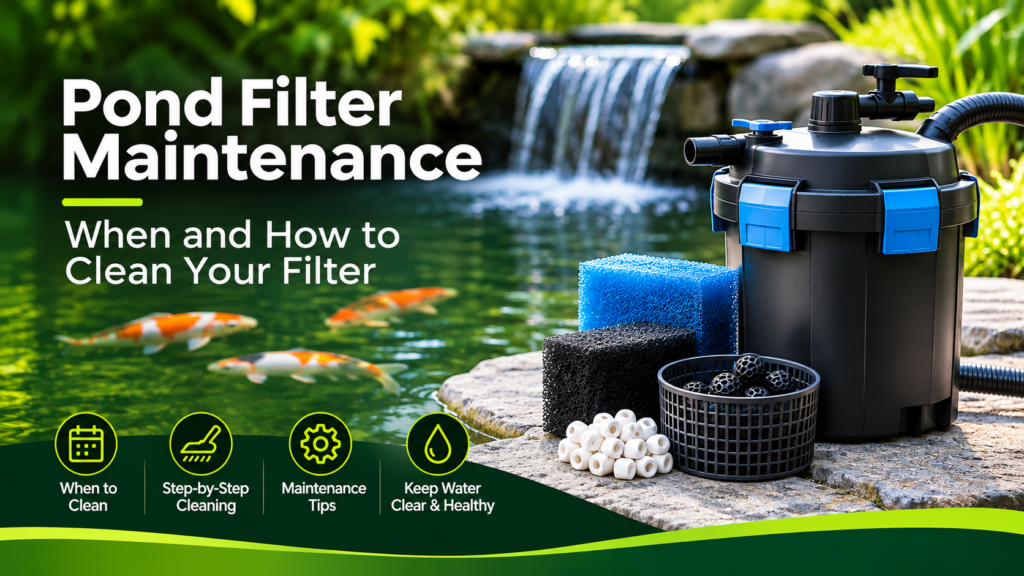
A clean and efficient pond filtration system is essential for maintaining healthy fish and crystal-clear pond water. Whether you have a small garden pond or a large outdoor koi pond, regular pond filter maintenance helps remove accumulated waste, support beneficial bacteria, and maintain stable water quality.
Over time, pond filters collect fish waste, uneaten food, leaves, algae, and other organic debris. Without proper maintenance, these materials can restrict water flow, reduce filtration efficiency, and contribute to poor water quality.
In this guide, we explain when to clean your pond filter, how to clean different filtration systems, and the best practices for maintaining a healthy pond environment.
Why Is Pond Filter Maintenance Important?
A pond filter continuously processes water to remove unwanted particles and support biological filtration. However, accumulated waste can reduce its performance.
Regular pond filter maintenance offers several benefits:
- Improved water clarity: Removes suspended dirt and organic particles.
- Better water circulation: Prevents blockages that restrict water flow.
- Healthy fish environment: Helps maintain stable water quality.
- Efficient biological filtration: Protects beneficial bacteria responsible for processing ammonia and nitrite.
- Longer equipment lifespan: Reduces unnecessary strain on pumps and filtration components.
- Reduced maintenance problems: Prevents excessive sludge accumulation and filter clogging.
A properly maintained filtration system helps create a balanced aquatic environment for koi, goldfish, and other ornamental pond fish.
When Should You Clean Your Pond Filter?
The ideal cleaning frequency depends on pond size, fish population, feeding habits, filter type, and the amount of debris entering the pond.
There is no single maintenance schedule suitable for every pond.
Recommended Pond Filter Maintenance Schedule
| Filter component | Suggested inspection or maintenance |
|---|---|
| Mechanical filter sponge | Inspect weekly; clean when clogged |
| Filter brushes | Inspect every 1–2 weeks |
| Biological filter media | Inspect periodically; clean gently only when necessary |
| Pressurized pond filter | Check weekly; backwash according to pressure or flow |
| UV clarifier | Inspect regularly; clean quartz sleeve when fouled |
| Pond pump pre-filter | Inspect weekly or more often if debris is heavy |
| Multi-chamber filter | Inspect weekly; drain accumulated sludge as needed |
These are starting points. Ponds with heavy koi stocking or frequent feeding may require more frequent mechanical cleaning.
Signs Your Pond Filter Needs Cleaning
Understanding the warning signs of a dirty filter can help prevent serious pond water quality problems.
1. Reduced Water Flow
A noticeable reduction in water circulation is one of the most common signs of a clogged filter.
Accumulated debris can restrict water movement through mechanical filter media, reducing filtration performance.
2. Cloudy or Dirty Pond Water
If your pond water becomes cloudy despite continuous filtration, your mechanical filter may be overloaded or require cleaning.
Cloudiness can also result from algae, bacterial blooms, or other water-quality issues, so filter cleaning may not always be the complete solution.
3. Excessive Sludge Accumulation
Fish waste, uneaten food, and organic debris can settle inside filtration chambers.
Removing accumulated sludge helps prevent blockages and excessive decomposition.
4. Unpleasant Water Odour
A strong unpleasant smell may indicate decomposing organic waste or oxygen-poor conditions.
Inspect the filtration system, remove accumulated debris, and test water quality to identify the cause.
5. Increased Ammonia or Nitrite Levels
Elevated ammonia or nitrite can indicate that biological filtration is insufficient or disrupted.
However, these readings can also result from overfeeding, excessive fish stocking, or an immature biological filter.
Test water parameters before making major changes to the filtration system.
How to Clean a Pond Filter: Step-by-Step Guide
Correct pond filter maintenance involves cleaning mechanical components without unnecessarily damaging the beneficial bacteria living inside biological filter media.
Step 1: Turn Off the Pond Equipment
Before opening the filtration system, disconnect the electrical supply to the pump and any associated UV equipment.
Follow the manufacturer’s instructions for releasing pressure and opening the filter safely.
Step 2: Remove Accumulated Debris
Open the mechanical filtration section and remove collected leaves, fish waste, sludge, and other debris.
For multi-chamber systems, drain sludge through the designated waste outlets.
Step 3: Clean Mechanical Filter Media
Mechanical media, such as filter sponges, brushes, and filter pads, capture suspended particles.
Rinse or backwash these components until accumulated waste is removed and normal water flow can be restored.
Avoid harsh detergents or household cleaning chemicals.
Step 4: Protect Biological Filter Media
Biological filtration media provides a surface for beneficial bacteria that convert toxic ammonia into nitrite and then into nitrate.
Avoid washing biological media with chlorinated tap water.
If cleaning is necessary, gently rinse the media using pond water or appropriately dechlorinated water.
Do not scrub biological media aggressively or replace all mature biological media at the same time.
Step 5: Inspect the Pond Pump
Check the pump intake, impeller chamber, and pre-filter for accumulated debris.
Remove obstructions according to the manufacturer’s maintenance instructions.
A properly functioning pond pump is essential for maintaining water circulation through the filtration system.
Step 6: Inspect the UV Clarifier
If your pond filtration system includes a UV clarifier, inspect the quartz sleeve for mineral deposits and dirt.
Clean it carefully according to the manufacturer’s instructions.
Always disconnect electrical power before servicing UV equipment, and never look directly at an operating UV-C lamp.
Step 7: Restart the Filtration System
After cleaning, reassemble the filtration system and confirm that all seals, connections, and valves are correctly positioned.
Restart the equipment and inspect for leaks, unusual noises, and restricted water flow.
Monitor the pond’s ammonia and nitrite levels after any significant filter maintenance.
How to Maintain Different Types of Pond Filters
Different filtration systems require different cleaning methods.
1. Pressurized Pond Filter Maintenance
Pressurized pond filters are commonly used in garden ponds and ornamental fish ponds.
Many models include a backwashing mechanism that allows accumulated debris to be discharged without removing the filter media.
Maintenance tips:
- Check water flow regularly.
- Use the backwash function when required.
- Inspect filter sponges for excessive clogging.
- Check seals and hose connections.
- Maintain the integrated UV clarifier if fitted.
Pressurized filters are convenient for pond owners looking for compact filtration equipment.
2. Multi-Chamber Pond Filter Maintenance
Multi-chamber filtration systems separate mechanical and biological filtration into different compartments.
Mechanical chambers collect larger particles, while biological chambers support beneficial bacteria.
Maintenance tips:
- Remove sludge from settlement chambers.
- Clean mechanical filter brushes and pads.
- Maintain adequate water flow through biological chambers.
- Avoid unnecessarily disturbing mature biological media.
- Inspect chamber drains and connecting pipes.
Multi-chamber filtration systems are particularly useful for larger koi ponds requiring substantial mechanical and biological filtration capacity.
3. Rotary Drum Filter Maintenance
Rotary drum filters use a rotating screen and automatic cleaning mechanism to remove suspended waste from pond water.
These systems can significantly reduce manual mechanical filter cleaning.
However, routine inspections are still necessary.
Check the drum screen, spray nozzles, waste discharge, water-level sensors, and cleaning mechanism according to the manufacturer’s recommendations.
Common Pond Filter Cleaning Mistakes to Avoid
Improper pond filter maintenance can reduce filtration efficiency and disrupt beneficial bacteria.
Cleaning All Filter Media at Once
Thoroughly cleaning or replacing every biological filter component simultaneously may remove a significant portion of the established bacterial population.
Clean biological media only when necessary, and preserve mature media whenever possible.
Using Chlorinated Tap Water
Untreated tap water containing chlorine or chloramine can damage beneficial bacteria.
Use pond water or appropriately dechlorinated water for cleaning biological media.
Overcleaning Biological Media
Biological media does not need to look perfectly clean.
Its primary function is to support beneficial microorganisms, not simply to trap visible dirt.
Ignoring the Pond Pump
Even a clean filter cannot perform efficiently if the pump intake or impeller is obstructed.
Include the pump in your regular maintenance routine.
Overfeeding Pond Fish
Excessive feeding increases fish waste and uneaten food, placing additional pressure on the filtration system.
Feed appropriate quantities and remove uneaten food when necessary.
How to Reduce Pond Filter Maintenance
Although regular maintenance is necessary, the right pond design and equipment can significantly reduce cleaning requirements.
Choose the Correct Filter Capacity
Select a filtration system based on pond volume, fish stocking density, feeding levels, and expected waste production.
Koi ponds generally require more substantial filtration than lightly stocked ornamental ponds.
Install a Pond Skimmer
A pond skimmer collects floating leaves and surface debris before they sink and decompose.
This reduces the amount of organic waste reaching the main filtration system.
Use a Bottom Drain
A properly designed bottom drain helps transport settled waste toward mechanical filtration.
Bottom drains are especially useful in dedicated koi ponds.
Maintain Adequate Water Circulation
Correct pump sizing helps ensure that pond water moves efficiently through the filtration system.
Avoid selecting a pump based only on its maximum advertised flow rate. Consider actual flow after pipe friction, elevation, and filter resistance.
Use Appropriate Filter Media
Combining effective mechanical and biological media can improve filtration performance.
Mechanical media removes suspended particles, while biological media supports the nitrogen cycle.
How Often Should You Replace Pond Filter Media?
Not all pond filter media requires regular replacement.
Mechanical filter media: Replace sponges or pads when they become damaged, deteriorated, or cannot maintain adequate flow after cleaning.
Biological filter media: Durable ceramic, plastic, and other biological media can often remain in service for years. Replace only when damaged or when recommended by the manufacturer.
UV lamps: UV-C lamp replacement intervals depend on the lamp model and manufacturer specifications. Some lamps require replacement even when they still visibly illuminate because their UV output declines over time.
Always follow the maintenance recommendations for your specific filtration equipment.
Choosing the Right Pond Filtration Equipment
An efficient filtration system combines appropriate pump capacity, mechanical waste removal, and biological treatment.
For koi ponds and outdoor garden ponds, equipment selection should consider:
- Total pond water volume
- Number and size of fish
- Daily feeding quantity
- Required water circulation
- Available filter installation space
- Ease of cleaning and maintenance
- Energy consumption
At Greenfin The Pond Studio, we offer pond filtration equipment, pond pumps, UV clarifiers, and accessories for different pond applications.
Explore our range of pond filtration solutions at Greenfinindia.com.
Frequently Asked Questions About Pond Filter Maintenance
1. How often should I clean my pond filter?
Inspect mechanical filtration weekly and clean when debris accumulation restricts water flow. Biological media should be cleaned only when necessary.
2. Can I clean my pond filter with tap water?
Mechanical components may be cleaned according to the manufacturer’s instructions, but biological filter media should preferably be rinsed with pond water or dechlorinated water to protect beneficial bacteria.
3. Should I turn off my pond filter at night?
No. Pond filtration should generally operate continuously to maintain water circulation, oxygen delivery, and biological filtration.
4. Why is my pond water still green after cleaning the filter?
Green pond water is often caused by suspended algae. Cleaning the mechanical filter alone may not solve the problem. Check nutrient levels, sunlight exposure, UV clarifier operation, and overall filtration performance.
5. Can excessive filter cleaning harm koi fish?
Yes. Aggressive cleaning can disrupt beneficial bacteria and lead to ammonia or nitrite accumulation, which can harm fish.
6. How do I know if my pond filter is working properly?
Check water circulation, mechanical waste removal, ammonia and nitrite readings, and the overall condition of the fish. Clear water alone does not guarantee safe water quality.
Conclusion
Regular pond filter maintenance is essential for keeping koi ponds and garden ponds clean, healthy, and efficient.
The key is to clean mechanical filtration components when necessary while protecting the beneficial bacteria responsible for biological filtration.
By inspecting your filter regularly, removing accumulated waste, maintaining the pond pump, and monitoring water quality, you can improve filtration performance and reduce common pond maintenance problems.
For pond filters, pumps, UV clarifiers, and other pond maintenance equipment, visit www.greenfinindia.com