

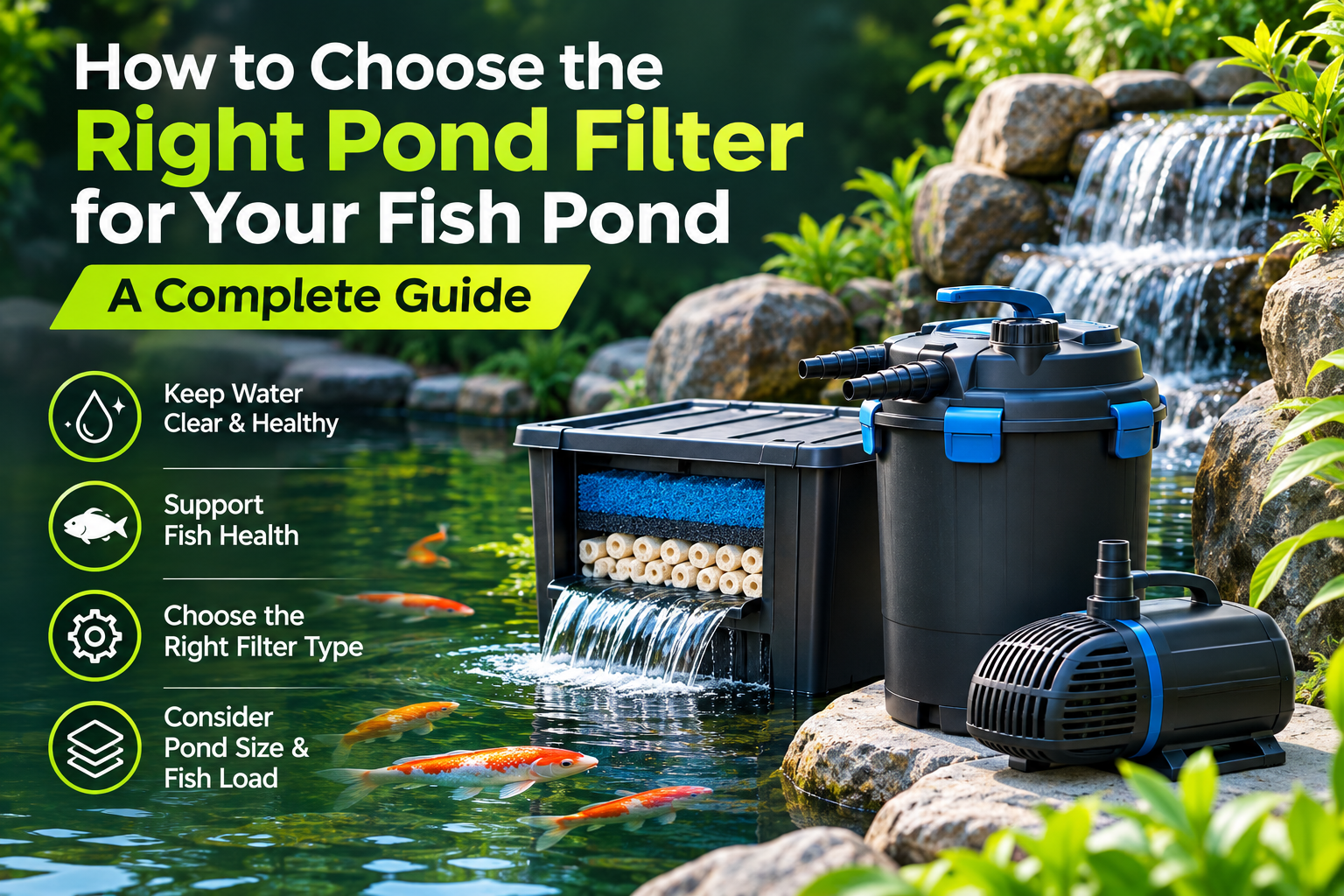
Choosing the right pond filter is one of the most important steps in maintaining a healthy fish pond. Whether you have a small garden pond, a decorative water feature, or a large koi pond, an efficient filtration system helps maintain clear water, control waste, and create a healthy environment for fish.
Fish produce waste continuously, and uneaten food, leaves, algae, and other organic materials can accumulate in pond water. Without proper filtration, harmful substances such as ammonia and nitrite can increase, affecting fish health and water quality.
However, not every pond requires the same filtration system. Pond size, water volume, fish population, feeding habits, and pump capacity all influence the type of filter you should choose.
In this guide, we will explain the different types of pond filters, how they work, and how to select the right filtration system for your pond.
1. Why Does Your Fish Pond Need a Filter?
A pond filtration system helps maintain water quality by removing solid waste and supporting beneficial bacteria that break down harmful substances.
Here are the main benefits of installing a proper pond filter:
- Removes fish waste and suspended debris.
- Supports beneficial bacteria growth.
- Helps control ammonia and nitrite levels.
- Improves water clarity.
- Reduces organic waste accumulation.
- Creates a healthier environment for koi and other pond fish.
- Helps maintain stable water conditions.
A filtration system is particularly important for koi ponds because koi produce considerable amounts of waste and require good water quality.
2. Understand the Different Types of Pond Filters
Before choosing a pond filter, it is important to understand the different filtration systems available.
Each filter has its own advantages depending on pond size, fish population, maintenance requirements, and installation space.
A. Biological Pond Filter
Biological filtration is one of the most important parts of a fish pond filtration system.
It uses beneficial bacteria to convert toxic ammonia into nitrite and then nitrate through the nitrogen cycle.
Common biological filter media include:
- Bio balls
- Ceramic rings
- Japanese filter mats
- Moving bed media
- Sintered glass media
- Porous biological media
Best for: Koi ponds, ornamental fish ponds, and ponds with higher fish populations.
B. Mechanical Pond Filter
Mechanical filtration removes physical waste and suspended particles from pond water.
It helps prevent solid waste from accumulating inside the pond and reduces the load on biological filter media.
Common mechanical filter materials include:
- Filter brushes
- Filter sponges
- Filter mats
- Filter pads
- Filter socks
Best for: Ponds with fish waste, leaves, and other suspended debris.
C. Pressurized Pond Filter
A pressurized pond filter is a compact filtration system that operates using water pressure from a pond pump.
Water enters the filter, passes through mechanical and biological filtration media, and returns to the pond.
Many pressurized filters also include integrated UV clarifiers.
Advantages:
- Compact and space-saving design.
- Easy installation.
- Suitable for smaller and medium-sized ponds, depending on model capacity.
- Convenient cleaning systems on selected models.
- Can be installed with flexible plumbing arrangements.
Best for: Garden ponds, ornamental ponds, and smaller koi ponds when correctly sized.
D. Multi-Chamber Pond Filter
A multi-chamber filtration system uses separate chambers for different stages of filtration.
Each chamber can contain specific filter media to improve mechanical and biological filtration.
A typical multi-chamber system includes:
- Mechanical filtration chamber.
- Biological filtration chamber.
- Additional biological filtration chamber.
- Final polishing chamber.
Advantages:
- Large media capacity.
- Flexible filtration arrangements.
- Suitable for larger ponds.
- Easy to customize according to pond requirements.
- Can support high biological filtration capacity.
Best for: Medium to large koi ponds and ponds with higher fish populations.
E. Rotary Drum Filter (RDF)
A Rotary Drum Filter is an advanced mechanical filtration system designed to remove fine solid waste from pond water automatically.
Water passes through a fine filtration screen inside a rotating drum. When the screen becomes clogged, an automatic cleaning system washes away accumulated waste.
Advantages:
- Automatic mechanical waste removal.
- Reduces manual cleaning.
- Helps protect biological filter chambers.
- Suitable for heavily stocked koi ponds.
- Supports advanced filtration system designs.
Best for: Large koi ponds, professional fish ponds, and high-performance filtration systems.
3. Choose a Filter According to Your Pond Water Volume
Pond water volume is one of the most important factors when selecting a pond filter.
A filter that is too small may not handle the amount of waste produced by fish. An oversized or more advanced system may increase installation costs, but it can provide additional filtration capacity.
First, calculate your pond water volume.
Rectangular pond formula:
\[ L \times W \times D \times 1000 \]
When all dimensions are in metres, the result is in litres.
For example:
- Length: 4 metres
- Width: 3 metres
- Depth: 1 metre
Water volume:
\[ 4 \times 3 \times 1 \times 1000 = 12,000\text{ litres} \]
Your pond has a theoretical water capacity of 12,000 litres.
For irregular ponds, use the average depth and appropriate volume estimates.
General Pond Filter Selection Guide
| Pond Water Volume | Suggested Filter Type |
|---|---|
| Up to 2,000 litres | Compact biological or pressurized filter |
| 2,000–5,000 litres | Pressurized pond filter |
| 5,000–10,000 litres | Larger pressurized or multi-chamber filter |
| 10,000–20,000 litres | Multi-chamber filtration system |
| 20,000–50,000 litres | Large multi-chamber or advanced filtration system |
| Above 50,000 litres | Custom-designed filtration or RDF system |
These are preliminary guidelines, not fixed filter capacity ratings. Final selection must consider fish stocking, feeding levels, actual filter specifications, and pump flow.
4. Consider the Number of Fish in Your Pond
Pond volume alone is not enough to determine the correct filter size.
A pond containing 20 small goldfish will have different filtration requirements compared with a pond containing 20 large koi.
Koi produce significant waste, particularly when they are fed regularly with high-protein fish food.
When selecting a pond filter, consider:
- Number of fish.
- Average and maximum adult fish size.
- Daily feeding quantity.
- Fish species.
- Pond water volume.
- Existing filtration and aeration.
For heavily stocked koi ponds, choose a filtration system with higher mechanical and biological filtration capacity.
5. Choose the Right Pond Pump for Your Filter
A pond filter cannot perform effectively without a properly selected pump.
The pond pump moves water through the filtration system, allowing mechanical and biological filtration to take place.
When selecting a pump, consider the following:
Pump Flow Rate
The pump should deliver the required flow rate for the selected filter.
For example, a 10,000-litre pond may require a different flow rate depending on fish stocking, filter design, and the manufacturer’s recommended turnover rate.
Head Height
Head height refers to the vertical distance and resistance the pump must overcome to move water through the plumbing system.
A pump’s actual flow decreases as head height and plumbing resistance increase.
Pipe Diameter
Using an undersized pipe can restrict water flow and reduce pump performance.
Always select the pipe diameter according to the pump outlet and recommended flow requirements.
Continuous Operation
For most fish ponds, the filtration pump should operate continuously to maintain water circulation and biological filtration.
6. Understand the Importance of UV Pond Filters
UV clarifiers are commonly used in outdoor fish ponds to help control green water caused by suspended algae.
They use ultraviolet light to treat water passing through the UV chamber.
Benefits of UV clarification include:
- Helps control suspended green-water algae.
- Improves water clarity.
- Reduces certain free-floating microorganisms.
- Supports the overall pond water-treatment system.
However, UV clarifiers do not replace mechanical or biological filtration.
When choosing a UV filter, consider:
- Pond water volume.
- Fish population.
- UV wattage.
- Recommended flow rate.
- Exposure time inside the UV chamber.
- Manufacturer’s pond capacity rating.
For heavily stocked koi ponds, select a UV system based on actual operating conditions rather than pond volume alone.
7. Select the Right Filter Media
Filter media plays an important role in determining filtration performance.
Different media perform different filtration functions.
| Filter Media | Main Function |
|---|---|
| Filter brushes | Mechanical waste collection |
| Filter sponge | Mechanical and some biological filtration |
| Japanese mat | Mechanical and biological filtration |
| Bio balls | Biological filtration |
| Ceramic rings | Biological filtration |
| Moving bed media | Biological filtration |
| Filter floss | Fine mechanical filtration |
For better results, arrange filter media according to the filter’s water flow direction and manufacturer’s recommendations.
A good filtration system should provide enough mechanical filtration to remove solid waste before water reaches the biological media.
8. Consider Filter Maintenance and Cleaning
Regular filter maintenance is necessary to keep your pond filtration system operating efficiently.
A poorly maintained filter can become clogged, reduce water flow, and affect water quality.
Follow these maintenance practices:
- Check filter water flow regularly.
- Remove accumulated solid waste.
- Clean mechanical filter media when necessary.
- Avoid cleaning all biological media at once.
- Rinse biological media using pond water or appropriately dechlorinated water.
- Inspect pump impellers and plumbing connections.
- Check UV lamps according to manufacturer replacement recommendations.
The cleaning frequency depends on fish population, feeding quantity, filter capacity, and pond conditions.
9. Common Mistakes to Avoid When Choosing a Pond Filter
Many pond owners experience water quality problems because of incorrect filtration selection.
Avoid these common mistakes:
1. Choosing a filter based only on pond volume
A heavily stocked koi pond requires more filtration than a lightly stocked ornamental pond of the same size.
2. Using an undersized pond pump
Insufficient water flow can reduce filtration performance.
3. Ignoring biological filtration
Mechanical filtration alone cannot provide complete biological waste treatment.
4. Selecting an undersized UV clarifier
An incorrectly sized UV unit may not effectively control green water.
5. Overloading the pond with fish
Increasing fish numbers without upgrading filtration can create water quality problems.
6. Neglecting regular filter cleaning
Accumulated waste can restrict water flow and affect filtration efficiency.
10. Which Pond Filter Is Best for Your Fish Pond?
Here is a simple comparison to help you choose the right filtration system.
| Filter Type | Main Advantage | Suitable Application |
|---|---|---|
| Pressurized Filter | Compact and convenient | Small and medium ponds |
| Multi-Chamber Filter | Large media capacity | Medium and large koi ponds |
| Biological Filter | Beneficial bacteria support | All fish ponds |
| UV Pond Filter | Suspended algae control | Green-water management |
| Rotary Drum Filter | Automatic mechanical filtration | Large and advanced koi ponds |
For small ornamental ponds, a properly sized pressurized filter can be a convenient option.
For medium and large koi ponds, a multi-chamber filtration system provides greater flexibility and biological media capacity.
For advanced koi pond installations, a Rotary Drum Filter combined with biological filtration can provide an effective filtration arrangement.
11. Example: Choosing a Filter for a 10,000-Litre Koi Pond
Let’s consider a practical example.
Pond specifications:
| Parameter | Details |
|---|---|
| Pond length | 4 metres |
| Pond width | 2.5 metres |
| Pond depth | 1 metre |
| Water volume | 10,000 litres |
| Fish type | Koi |
| Installation | Outdoor |
For this pond, the filtration system should be selected based on koi stocking and feeding levels.
Recommended filtration arrangement:
- Mechanical filtration to remove solid fish waste.
- Biological filtration using suitable biological media.
- Properly sized pond pump for the required flow.
- UV clarifier for suspended green-water algae control.
- Adequate aeration to maintain dissolved oxygen.
For a heavily stocked koi pond, consider a multi-chamber filtration system or a suitable drum filter combined with biological filtration.
The final filter model and pump capacity should be confirmed using the manufacturer’s specifications and actual operating flow requirements.
12. Final Checklist Before Buying a Pond Filter
Before purchasing a pond filtration system, check the following:
- Calculate the total pond water volume.
- Determine the number and size of fish.
- Estimate daily fish feeding requirements.
- Select suitable mechanical filtration.
- Ensure sufficient biological filter media capacity.
- Choose the correct pond pump.
- Check the required pipe connections.
- Select an appropriate UV clarifier if needed.
- Consider filter cleaning and maintenance requirements.
- Check the manufacturer’s recommended pond capacity.
Conclusion
Choosing the right pond filter is essential for maintaining clean, clear, and healthy pond water. The ideal filtration system depends on pond size, fish population, feeding habits, pump flow rate, and maintenance requirements.
Small ornamental ponds may work well with pressurized pond filters, while larger koi ponds often benefit from multi-chamber filtration systems or advanced Rotary Drum Filter systems.
Remember that a good pond filtration system should combine mechanical filtration, biological filtration, and proper water circulation. With the right equipment and regular maintenance, you can create a healthy environment for your fish.
At Greenfin The Pond Studio, we offer pond pumps, UV clarifiers, pond filters, filtration media, and complete pond filtration solutions to help maintain healthy fish ponds.
Explore our pond filtration products and solutions at GreenfinIndia.com.
For pond filtration assistance and product enquiries, contact our team.