

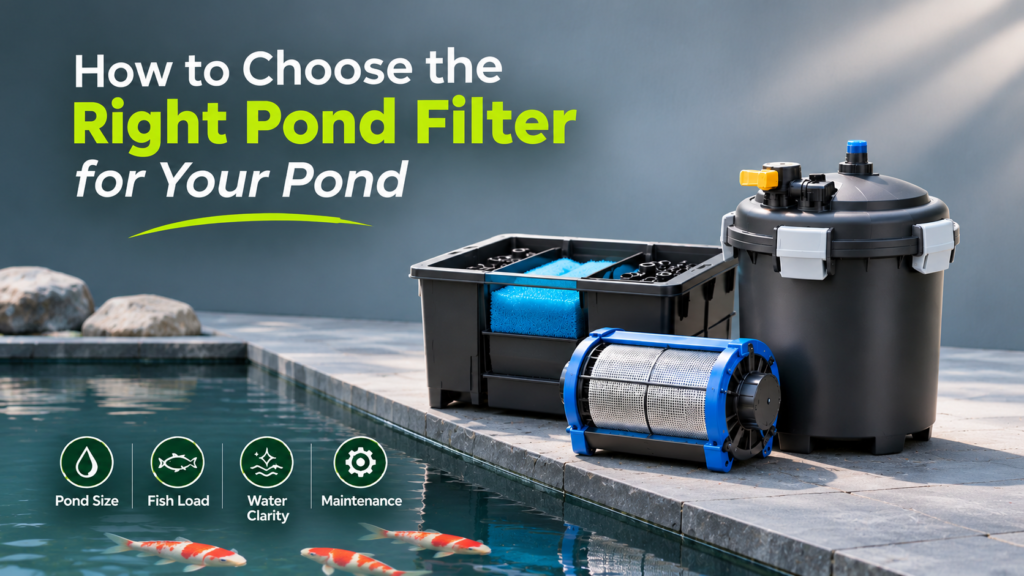
A healthy pond requires more than clean-looking water. Proper filtration is essential for maintaining water quality, supporting beneficial bacteria, removing fish waste, and creating a healthy environment for koi and other pond fish.
Choosing the right pond filter can be confusing because there are different types of filtration systems available, including mechanical filters, biological filters, pressurized filters, and multi-chamber filtration systems.
The best pond filter depends on several factors, such as pond water volume, fish stocking levels, feeding habits, pump capacity, and the amount of maintenance required.
In this guide, we will explain how to choose the right pond filter for your pond, understand different filtration systems, and select suitable equipment for long-term pond maintenance.
1. Why Is a Pond Filter Important?
A pond filter helps maintain clean and healthy water by removing waste materials and supporting beneficial bacteria.
Fish continuously produce waste, and uneaten fish food, leaves, and other organic materials can accumulate in the pond. Without proper filtration, these materials can affect water quality and increase harmful ammonia levels.
A good pond filtration system provides several benefits:
- Removes suspended dirt and debris from pond water.
- Helps reduce harmful ammonia and nitrite levels through biological filtration.
- Supports beneficial bacteria growth.
- Improves water clarity.
- Reduces organic waste accumulation.
- Creates a healthier environment for koi and other pond fish.
- Supports better overall pond water management.
Remember that a pond filter does not replace regular water testing, water changes, or proper pond maintenance.
2. Understand the Different Types of Pond Filtration
Before selecting a pond filter, it is important to understand the three main types of filtration.
A. Mechanical Filtration
Mechanical filtration removes physical waste materials from pond water.
It captures particles such as:
- Fish waste
- Uneaten fish food
- Leaves
- Dust and dirt
- Suspended organic debris
Common mechanical filter materials include:
- Filter sponges
- Filter brushes
- Filter pads
- Filter mats
- Filter socks
Mechanical filtration is generally the first stage of a pond filtration system.
Regular cleaning is necessary because accumulated debris can restrict water flow.
B. Biological Filtration
Biological filtration uses beneficial bacteria to convert toxic fish waste into less harmful substances.
Fish produce ammonia through their waste and respiration. Beneficial bacteria help convert:
- Ammonia into nitrite.
- Nitrite into nitrate.
Nitrate is generally less toxic to fish, although it can accumulate and should be managed through water changes and appropriate pond maintenance.
Popular biological filter media include:
- Bio balls
- Ceramic rings
- Japanese filter mats
- Moving bed media
- Bio rings
- Porous biological media
Biological filtration is especially important for koi ponds because koi produce considerable waste, particularly when stocking and feeding levels are high.
C. Chemical Filtration
Chemical filtration uses specific materials to remove certain dissolved substances or impurities from water.
Common chemical filtration media include:
- Activated carbon
- Zeolite
- Phosphate-removal media
These materials have different functions and should be selected according to the actual water quality problem.
Chemical filtration is usually an additional filtration stage rather than a replacement for mechanical and biological filtration.
3. Different Types of Pond Filters Available
There are several pond filter designs available. Each type is suitable for different pond sizes and installation requirements.
A. Pressurized Pond Filter
A pressurized pond filter is a closed filtration unit that operates under pressure from a pond pump.
Water enters the filter, passes through the filtration media, and returns to the pond through the outlet.
Advantages:
- Compact design.
- Easy installation.
- Suitable for small and medium-sized ponds, depending on model capacity.
- Can be installed discreetly.
- Some models include UV clarifiers.
- Certain models feature convenient backwashing systems.
Best suited for:
Garden ponds, decorative ponds, and smaller koi ponds when correctly sized.
B. Multi-Chamber Pond Filter
A multi-chamber pond filter contains multiple sections, with each chamber designed for a different filtration stage.
A typical setup may include:
- First chamber: Mechanical filtration.
- Second chamber: Fine mechanical filtration.
- Third chamber: Biological filtration.
- Fourth chamber: Additional biological filtration or polishing.
Advantages:
- Large filtration media capacity.
- Flexible filtration arrangement.
- Suitable for larger koi ponds.
- Easy to customize different filtration stages.
- Supports high biological filtration capacity.
Best suited for:
Medium to large koi ponds, heavily stocked ponds, and custom pond filtration installations.
C. Gravity-Fed Pond Filter
A gravity-fed filtration system uses gravity to move water from the pond’s bottom drain or skimmer into the filter.
After filtration, a pump returns the cleaned water to the pond.
Advantages:
- Suitable for professionally designed koi ponds.
- Can handle large water volumes.
- Allows effective collection of bottom waste.
- Can be integrated with advanced filtration equipment.
Best suited for:
Large koi ponds and professionally constructed pond systems.
D. Drum Filter System
A rotary drum filter is an advanced mechanical filtration system that automatically removes fine suspended particles from pond water.
Water passes through a fine filter screen, and accumulated debris is removed through an automatic cleaning mechanism.
Advantages:
- Automatic mechanical cleaning.
- Reduces manual filter cleaning.
- Effective removal of suspended particles.
- Suitable for advanced koi pond filtration.
Best suited for:
Large koi ponds, high-performance filtration systems, and commercial pond installations.
4. How to Calculate the Correct Pond Filter Capacity
One of the most important steps when selecting a pond filter is calculating the pond’s total water volume.
The filter should be selected according to the actual pond volume, fish stocking, feeding rate, and manufacturer’s filtration recommendations.
Pond Water Volume Calculation
For rectangular ponds:
Length × Width × Average Water Depth × 1,000 = Water Volume in Litres
For example:
Pond dimensions:
- Length: 10 feet
- Width: 6 feet
- Depth: 3 feet
Calculation:
10 × 6 × 3 × 28.316 = 5,097 litres approximately.
Example pond calculation
5,097 L
Approximate water volume for a 10 × 6 × 3 feet pond.
Once you know the pond volume, compare it with the filter manufacturer’s recommended pond capacity.
Important: A filter’s advertised maximum capacity may be based on lightly stocked ponds. For koi ponds with heavy stocking and feeding, choose a filtration system with sufficient additional capacity.
5. Choose a Pond Filter Based on Fish Stocking
The number and type of fish in your pond directly affect filtration requirements.
Small Fish Pond
For a small decorative pond with a limited number of fish, a suitable pressurized pond filter may be sufficient.
Consider:
- Pond water volume.
- Number of fish.
- Pump flow rate.
- Mechanical and biological filtration capacity.
Medium Koi Pond
Medium-sized koi ponds generally require stronger mechanical and biological filtration.
A pressurized filter or multi-chamber filtration system may be suitable depending on fish stocking and feeding levels.
Large Koi Pond
Large koi ponds with high fish stocking require advanced filtration systems.
Consider:
- Multi-chamber filtration.
- Gravity-fed filtration.
- Rotary drum filtration.
- High-capacity biological filter media.
- Bottom drain and skimmer arrangements.
For heavily stocked koi ponds, proper filtration design is more important than simply selecting a filter based on pond volume.
6. How to Choose the Right Pond Pump for Your Filter
A pond filter and pond pump must work together.
Even a high-capacity pond filter cannot perform properly if the pump does not provide sufficient water flow.
Consider the following factors:
1. Pump Flow Rate
Check the recommended flow rate of the pond filter. Excessive flow can reduce filtration effectiveness or exceed the filter’s rated capacity.
2. Pumping Height
If the pump supplies water to an elevated filter or waterfall, consider the required pumping height.
3. Pipe Diameter
Use suitable pipe sizes to minimize unnecessary flow restrictions.
4. Filter Compatibility
Check whether the filter requires a pump-fed or gravity-fed arrangement.
5. Continuous Operation
Choose a pond pump designed for the intended operating conditions and follow the manufacturer’s installation guidelines.
7. Why Is UV Clarification Important in Pond Filtration?
Green pond water is a common problem in outdoor ponds.
It is usually caused by suspended microscopic algae that multiply under suitable sunlight and nutrient conditions.
A UV clarifier uses ultraviolet light to help control suspended green-water algae as pond water passes through the unit.
Benefits of UV Pond Clarifiers
- Helps control green pond water.
- Improves water clarity.
- Works alongside mechanical and biological filtration.
- Reduces suspended algae when correctly sized and installed.
Important: UV clarifiers do not remove fish waste or replace biological filtration. A complete pond filtration system should include suitable mechanical and biological filtration.
8. Best Filter Media for Pond Filtration
Selecting suitable filter media is essential for efficient filtration.
Different media perform different functions.
| Filter Media | Main Function |
|---|---|
| Filter Sponge | Mechanical filtration |
| Filter Brush | Captures larger debris |
| Japanese Mat | Mechanical and biological support |
| Bio Balls | Biological filtration |
| Ceramic Rings | Biological filtration |
| Moving Bed Media | Biological filtration |
| Activated Carbon | Adsorbs certain dissolved impurities |
| Zeolite | Can help adsorb ammonia under suitable conditions |
For koi ponds, a combination of mechanical and biological media is generally recommended.
Regularly remove accumulated waste from mechanical media while avoiding unnecessary disruption of established biological media.
9. Common Mistakes to Avoid When Choosing a Pond Filter
Many pond owners experience filtration problems because of incorrect equipment selection.
Here are some common mistakes to avoid:
- Choosing a filter based only on advertised pond capacity.
- Ignoring fish stocking levels.
- Using insufficient biological filter media.
- Selecting an unsuitable pump flow rate.
- Ignoring pond bottom waste collection.
- Not cleaning mechanical filter media regularly.
- Expecting a UV clarifier to remove all pond waste.
- Installing a filter without considering maintenance access.
- Using undersized pipes that restrict water flow.
- Neglecting regular water quality testing.
10. How Often Should You Clean a Pond Filter?
Filter cleaning frequency depends on pond conditions, fish stocking, feeding levels, and the type of filter installed.
Mechanical filter media: Inspect frequently and clean when accumulated waste restricts water flow.
Biological filter media: Clean carefully and only when necessary, preferably using pond water to avoid damaging beneficial bacteria.
Pressurized filters: Follow the manufacturer’s backwashing and cleaning instructions.
Drum filters: Inspect the automatic cleaning system and waste discharge regularly.
Avoid cleaning all biological media thoroughly at the same time because this can reduce beneficial bacterial populations.
Frequently Asked Questions (FAQs)
1. Which pond filter is best for koi fish?
A properly sized multi-chamber filtration system is a popular choice for koi ponds. Pressurized filters may also work for smaller or lightly stocked koi ponds.
2. Can I use a pressurized filter for a large koi pond?
Yes, provided the filter is specifically rated for the pond’s actual fish load and operating conditions. Multiple filtration units or a larger filtration system may be necessary.
3. Is biological filtration necessary for a fish pond?
Yes. Biological filtration supports beneficial bacteria that convert toxic ammonia and nitrite into less harmful substances.
4. Does a UV filter clean pond water?
A UV clarifier helps control suspended algae responsible for green water. It does not replace mechanical or biological filtration.
5. How many hours should a pond filter run?
Most fish pond filtration systems are designed to operate continuously, 24 hours a day, to maintain stable water quality and biological filtration.
6. What is the best filter media for koi ponds?
A combination of Japanese filter mats, biological media, and suitable mechanical filter materials can provide effective filtration. The best combination depends on the filtration system design.
7. Can I run a pond without a filter?
A natural pond with very low fish stocking may function without a conventional filter if it has a balanced ecosystem. However, koi ponds and heavily stocked fish ponds generally require proper mechanical and biological filtration.
Conclusion
Choosing the right pond filter is essential for maintaining healthy water conditions and supporting fish health.
Before purchasing a filtration system, calculate your pond water volume, consider fish stocking levels, understand the different filtration types, and select a compatible pond pump.
For small and medium ponds, pressurized pond filters can offer convenient filtration. For larger koi ponds, multi-chamber and drum filtration systems can provide greater filtration capacity and flexibility.
At Greenfin The Pond Studio, we provide pond filtration equipment, pond pumps, UV clarifiers, filter media, and pond construction solutions to help pond owners maintain clear and healthy ponds.
Explore our pond filtration products at Greenfinindia.com