

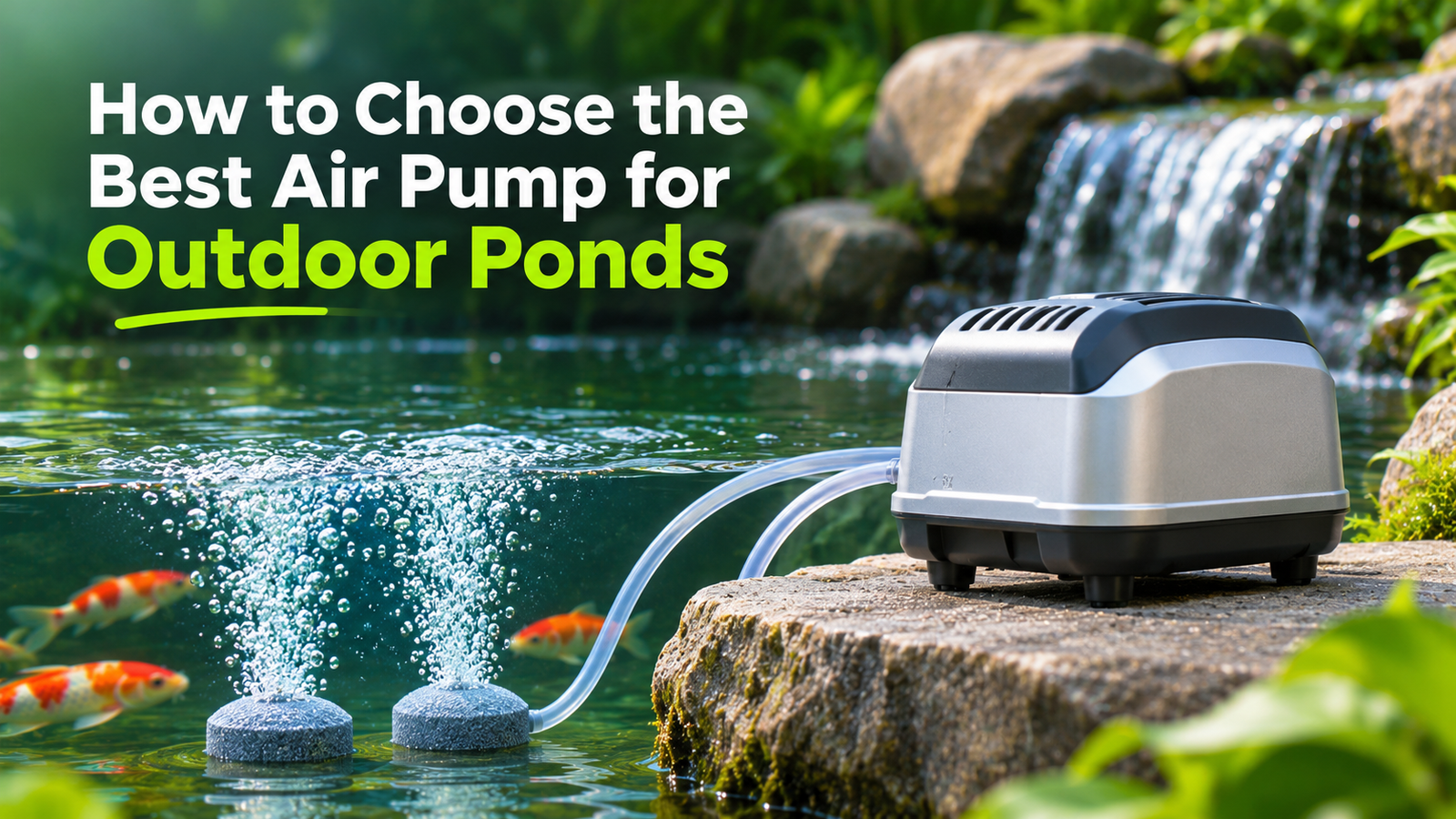
Outdoor ponds need more than clean water and proper filtration to maintain a healthy environment for fish. Adequate oxygen is equally important for fish health, beneficial bacteria and overall pond water quality. One of the most effective ways to improve oxygen circulation is by installing a suitable pond air pump.
Choosing the best air pump for outdoor ponds depends on several factors, including pond size, water depth, fish population, air pump capacity and the number of air stones required. Selecting the wrong pump may result in insufficient aeration, poor oxygen circulation or unnecessary electricity consumption.
In this guide, we will explain how to choose the right pond air pump, what features to consider and how to install and maintain an effective pond aeration system.
1. Why Is an Air Pump Important for Outdoor Ponds?
An air pump supplies air to the pond through air tubing and air stones or diffusers. These components release bubbles into the water, helping improve oxygen transfer and water circulation.
Here are some important benefits of using a pond air pump:
Improves Dissolved Oxygen Levels
Fish need dissolved oxygen to breathe and remain healthy. An air pump helps increase oxygen exchange between the water and the atmosphere, particularly when used with suitable diffusers.
Supports Beneficial Bacteria
Beneficial bacteria in biological filtration systems require oxygen to break down harmful fish waste, ammonia and nitrite. Proper aeration supports healthy biological filtration.
Reduces Stagnant Water
Air diffusers help create water movement, reducing stagnant areas and improving circulation throughout the pond.
Supports Healthy Koi Fish
Koi ponds often have high fish stocking levels. Adequate aeration helps maintain a healthier environment, especially during hot weather and periods of increased fish activity.
Helps During Hot Weather
Warm water holds less dissolved oxygen than cold water. Additional aeration can help compensate for increased oxygen demand during summer.
2. Understand Your Pond Size Before Choosing an Air Pump
The first step in selecting an air pump is calculating your pond’s water volume.
A small ornamental pond does not require the same air pump capacity as a large koi pond with hundreds of fish.
Use this formula to calculate pond volume:
Pond Volume = Length × Width × Average Water Depth
For rectangular ponds, calculate the volume in cubic metres and multiply by 1,000 to convert it into litres.
For example:
- Length: 3 metres
- Width: 2 metres
- Average depth: 1 metre
Water volume = 3 × 2 × 1 = 6 cubic metres.
Total water volume = 6,000 litres.
Once you know your pond volume, consider the fish population, filtration requirements and water depth before selecting an air pump.
Remember that pond volume alone does not determine the correct pump capacity. A heavily stocked koi pond generally needs more aeration than a lightly stocked ornamental pond of the same size.
3. Check the Air Pump Capacity (LPM)
Air pump capacity is usually measured in litres per minute (LPM). It indicates how much air the pump can deliver under specified operating conditions.
For example:
- 10 LPM: Suitable for certain small aeration applications.
- 20 LPM: Can support multiple small diffusers depending on depth and resistance.
- 40 LPM: Useful for larger aeration setups.
- 60 LPM and above: Can support more demanding pond aeration systems, depending on the operating pressure.
These are illustrative capacity categories, not fixed pond-size recommendations. Actual performance depends on water depth, diffuser type, tubing length and operating pressure.
When selecting an air pump, check its rated airflow and performance at the required pressure rather than relying only on the maximum advertised LPM.
4. Consider the Depth of Your Outdoor Pond
Water depth plays an important role in air pump selection.
As the air stone is placed deeper underwater, the pump needs to overcome greater water pressure to release bubbles.
For deeper ponds, choose an air pump that can deliver sufficient airflow at the required operating pressure.
Consider these points:
- Check the maximum operating pressure of the air pump.
- Select suitable air stones or diffusers.
- Avoid excessively long or narrow air tubing.
- Ensure the pump is designed for continuous operation if it will run throughout the day.
A pump with a high advertised airflow may not perform as expected at greater depths.
5. Choose the Right Number of Air Stones
Air stones and diffusers distribute air into the pond through small bubbles. They help create better oxygen exchange and circulation.
The number of air stones depends on:
- Pond water volume.
- Pond shape and depth.
- Fish stocking density.
- Air pump capacity.
- Required oxygen distribution.
For a large pond, multiple air stones positioned in different areas can provide more uniform aeration than a single diffuser.
Use a suitable air manifold to distribute airflow between multiple outlets. Individual control valves can help balance the airflow.
6. Types of Air Pumps for Outdoor Ponds
Different air pumps are available for pond aeration. Selecting the right type depends on the size and requirements of your pond.
Diaphragm Air Pumps
Diaphragm air pumps use a flexible diaphragm to move air through the outlet.
Benefits:
- Suitable for continuous aeration applications.
- Available in different airflow capacities.
- Can support multiple air outlets.
- Useful for many ornamental and koi pond setups.
Electromagnetic Air Pumps
Electromagnetic air pumps use electromagnetic movement to operate the pumping mechanism.
Benefits:
- Available in different airflow capacities.
- Useful for continuous aeration when designed for that purpose.
- Can supply multiple diffusers through a manifold.
High-Capacity Pond Air Pumps
High-capacity air pumps are designed for larger ponds and more demanding aeration requirements.
Benefits:
- Higher airflow capacity.
- Suitable for multiple air stones.
- Useful for heavily stocked koi ponds.
- Can support biological filter aeration.
Always compare airflow, operating pressure, power consumption and manufacturer’s operating recommendations before purchasing.
7. Important Features to Check Before Buying a Pond Air Pump
Before purchasing an air pump, check these important specifications.
| Feature | Why It Matters |
|---|---|
| Airflow (LPM) | Determines air delivery capacity |
| Operating pressure | Important for deeper ponds |
| Power consumption (W) | Helps estimate electricity costs |
| Number of outlets | Determines diffuser connections |
| Noise level | Important for residential ponds |
| Continuous operation rating | Helps determine suitability for 24-hour use |
| Weather protection | Important for outdoor installation |
| Spare parts availability | Helps with long-term maintenance |
For outdoor installations, protect the electrical connections from rain and water splashes. Keep the pump in a dry, ventilated location and follow the manufacturer’s installation instructions.
8. How to Install an Air Pump in an Outdoor Pond
Installing a pond air pump correctly helps achieve consistent aeration.
Follow these steps:
Step 1: Select a Suitable Location
Place the air pump in a dry, shaded and well-ventilated location near the pond. Avoid placing it where water can enter the pump.
Step 2: Connect the Air Tubing
Connect suitable air tubing to the pump outlet. Use an air manifold if multiple diffusers are required.
Step 3: Install Air Stones
Position air stones or diffusers in suitable areas of the pond. For larger ponds, distribute them to improve oxygen circulation.
Step 4: Check Airflow
Switch on the pump and check whether all diffusers are releasing air consistently. Adjust the valves if necessary.
Step 5: Check Electrical Safety
Use suitable outdoor electrical protection, proper earthing and an appropriate residual-current protection device. Keep plugs and electrical connections away from water.
Step 6: Monitor Pond Conditions
Observe fish behaviour and monitor dissolved oxygen levels, especially during hot weather and early morning hours.
9. Common Mistakes to Avoid When Choosing a Pond Air Pump
Avoid these common mistakes when purchasing an air pump:
- Choosing a pump based only on pond volume.
- Ignoring the depth of the pond.
- Using too many air stones for the available pump capacity.
- Purchasing a pump without checking operating pressure.
- Installing the pump in an area exposed to rain.
- Ignoring electricity consumption.
- Not cleaning blocked air stones.
- Depending entirely on aeration without maintaining proper biological filtration.
A correctly sized air pump should support the pond’s overall filtration and aeration requirements.
10. How to Maintain Your Outdoor Pond Air Pump
Regular maintenance helps maintain consistent airflow and extend equipment life.
Follow these maintenance practices:
- Clean air stones periodically to remove dirt and mineral deposits.
- Inspect air tubing for cracks, leaks and blockages.
- Check the air pump’s intake filter, if fitted.
- Keep the pump in a clean and ventilated location.
- Inspect the diaphragm and other serviceable components according to the manufacturer’s instructions.
- Check airflow from every diffuser regularly.
If you notice reduced bubbling or unusual noise, inspect the tubing, diffuser and pump before assuming the pump has failed.
11. Best Air Pump Setup for Koi Ponds
Koi ponds generally require reliable aeration because koi fish consume oxygen and produce significant amounts of waste.
An effective setup may include:
- A suitable high-capacity air pump.
- Multiple air stones or pond diffusers.
- Air tubing and a distribution manifold.
- A properly designed biological filtration system.
- Regular dissolved oxygen monitoring.
For heavily stocked koi ponds, consider providing backup aeration using an independent air pump or battery-supported system. This is especially useful during power interruptions.
The ideal setup depends on pond volume, fish stocking density, water depth and filtration design.
12. Frequently Asked Questions (FAQs)
1. Should an outdoor pond air pump run 24 hours a day?
For most koi ponds, continuous aeration is beneficial. It supports fish respiration and aerobic biological filtration. Choose a pump designed for continuous operation.
2. How many air stones do I need for my pond?
The number depends on pond size, depth, fish population, diffuser capacity and available airflow. Large ponds may require multiple diffusers for even oxygen distribution.
3. Is a bigger air pump always better?
No. An oversized pump may consume unnecessary electricity and create excessive water movement. Select a pump based on the actual aeration requirement and operating pressure.
4. Can an air pump replace a pond filter?
No. An air pump improves aeration but does not replace mechanical or biological filtration. Both systems perform different functions.
5. Is an air pump necessary for koi ponds?
Aeration is highly recommended for koi ponds, particularly those with high stocking densities. It helps maintain oxygen availability for fish and beneficial bacteria.
6. Where should I place air stones in a koi pond?
Position diffusers strategically to distribute oxygen throughout the pond. Avoid placing them where they interfere with bottom drains or create excessive disturbance for fish.
7. Does an air pump help reduce algae?
An air pump does not directly remove algae. However, improved circulation and a healthy filtration system can contribute to better pond management.
Conclusion
Choosing the best air pump for outdoor ponds is essential for maintaining healthy fish, supporting beneficial bacteria and improving overall pond conditions.
Before purchasing, calculate your pond volume, consider water depth, check the required airflow in LPM and select suitable air stones. For koi ponds, reliable continuous aeration and backup arrangements are especially important.
At Greenfin The Pond Studio, we understand the importance of proper pond aeration and filtration. Explore suitable pond air pumps, air stones and pond equipment at Greenfinindia.com to build a healthier and better-maintained outdoor pond.
Create a healthier pond with the right aeration system!