

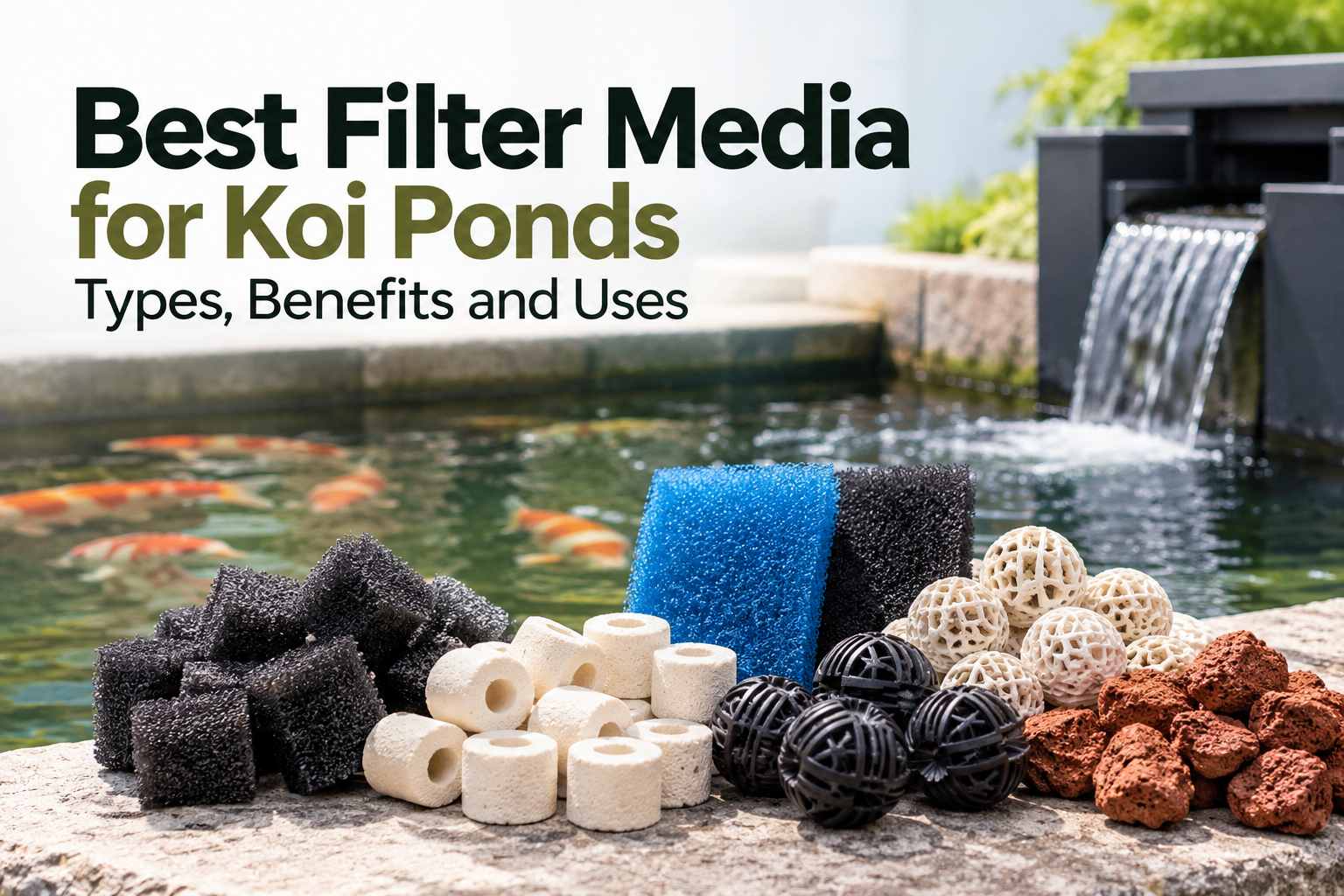
Maintaining clean and healthy water is essential for keeping koi fish active, colourful, and healthy. A properly designed pond filtration system removes fish waste, uneaten food, suspended particles, and harmful nitrogen compounds that can accumulate in pond water. Choosing the best filter media for koi pond filtration is an important step in creating a reliable and effective filtration system.
Different filter media perform different functions. Some capture solid waste, while others provide a surface for beneficial bacteria that convert toxic ammonia into nitrite and then nitrate. Certain media can also help improve water clarity when used in the correct filtration arrangement.
But which pond filter media should you choose? Should you use Japanese filter mats, bio balls, ceramic media, moving-bed media, or a combination of different types?
In this guide, we will explore the most popular koi pond filter media, their benefits, their uses, and how to choose the right combination for your pond.
Why Is Filter Media Important for Koi Ponds?
Koi fish produce waste continuously, and uneaten food adds to the organic load in pond water. Without effective filtration, waste can accumulate and ammonia levels may rise, creating dangerous conditions for fish.
Pond filter media helps filtration systems manage these problems through mechanical and biological filtration.
1. Mechanical Filtration
Mechanical filter media captures physical particles such as fish waste, uneaten food, leaves, and suspended debris.
Examples include filter sponges, Japanese filter mats, filter brushes, and suitable mechanical screens.
Mechanical filtration helps prevent solid waste from accumulating in biological filter chambers. Captured debris must be removed regularly to prevent excessive clogging and decomposition.
2. Biological Filtration
Biological filter media provides a surface for beneficial microorganisms that process nitrogenous waste.
These microorganisms help convert ammonia into nitrite and then nitrate through the biological filtration process. Ammonia and nitrite are toxic to fish, so an established biological filter is essential for a healthy koi pond.
Examples include moving-bed media, ceramic media, bio balls, and other purpose-designed biological filter media.
3. Chemical Filtration
Chemical filtration uses materials that adsorb or remove specific dissolved substances from water.
Examples include activated carbon and certain specialised adsorbent media. These materials are not necessary in every koi pond and should be selected for a specific purpose.
For most koi ponds, effective mechanical filtration and biological filtration are the main priorities.
Best Filter Media for Koi Pond Filtration
The best media depends on your pond size, koi population, feeding rate, filter design, and maintenance routine. The following options are commonly used in pond filtration systems.
1. Japanese Filter Mat
Japanese filter mat is a popular option for koi pond filtration. It consists of a structured mat material that allows water to pass through while providing a surface for debris capture and beneficial bacterial growth.
Benefits of Japanese Filter Mat
- Provides mechanical filtration by trapping suspended particles.
- Offers surface area for beneficial bacteria.
- Can be used in multi-chamber pond filters.
- Supports a simple, modular filter layout.
- Can be cleaned and reused when properly maintained.
Best Uses
Japanese filter mats are suitable for mechanical and biological filtration chambers in koi ponds. They are particularly useful in multi-chamber filtration systems where water passes through several stages.
For best results, place the mats where they can be accessed easily for cleaning. If used as mechanical media, remove accumulated sludge before it blocks water flow.
2. Moving-Bed Bio Filter Media
Moving-bed media is designed for biological filtration in systems where water and air keep the media moving inside a chamber.
The movement helps expose the media to circulating water and oxygen, supporting the development of beneficial bacterial communities.
Benefits of Moving-Bed Media
- Provides surfaces for biological filtration.
- Works well in aerated moving-bed chambers.
- Allows water and oxygen to circulate around the media.
- Can support consistent biological performance when correctly designed.
- Often requires less frequent manual cleaning than media used for heavy mechanical waste collection.
Best Uses
Moving-bed media is particularly useful in dedicated biological chambers of koi pond filtration systems.
A moving-bed chamber requires suitable aeration, water flow, and a retaining screen to prevent media from escaping. The chamber should also be designed to keep the media moving properly.
Moving-bed media is not a substitute for mechanical filtration. Large solids should generally be removed before water reaches the biological chamber.
3. Bio Balls
Bio balls are lightweight plastic filter media designed to provide surfaces for beneficial bacteria. They are available in different shapes and sizes, depending on the manufacturer and intended application.
Benefits of Bio Balls
- Lightweight and durable.
- Can be used in suitable biological filter chambers.
- Allow water to flow around their surfaces.
- Easy to handle and install.
- Can be used in some trickle filters and other oxygen-rich filtration arrangements.
Best Uses
Bio balls can be useful in biological filtration chambers, trickle filters, and other compatible pond filter systems.
Their performance depends on the available surface area, water distribution, oxygen supply, and overall filter design. Not all bio balls have the same surface characteristics, so compare the manufacturer’s specifications before choosing a product.
4. Ceramic Filter Media
Ceramic filter media is made from porous ceramic material designed to provide surfaces for beneficial bacteria.
Different products have different pore structures, shapes, and surface areas. Ceramic media should be chosen according to the manufacturer’s recommended application and the pond filter’s design.
Benefits of Ceramic Media
- Provides surfaces for beneficial bacterial colonisation.
- Can be used in suitable biological filtration chambers.
- Available in different shapes and sizes.
- Can support biological filtration in compact filter systems.
- Often reusable when handled and maintained correctly.
Best Uses
Ceramic media is useful in suitable biological filter chambers, particularly where the media can be protected from excessive solids accumulation.
Some ceramic products are designed primarily for aquariums or small filters, while others may be appropriate for larger systems. Check the product’s intended use and ensure that the quantity and filter design are suitable for your pond.
5. Filter Brushes
Filter brushes are commonly used as mechanical filter media in pond filtration systems.
Their bristles catch suspended solids and larger particles as water passes through them. They can also provide some surface area for bacterial growth, but their primary role is often mechanical waste capture.
Benefits of Filter Brushes
- Capture larger suspended particles.
- Help separate solids before water reaches biological media.
- Are relatively easy to remove for cleaning.
- Can be reused after maintenance.
- Work well in suitable settlement and mechanical filtration chambers.
Best Uses
Filter brushes are particularly useful in the first stage of a multi-chamber koi pond filter.
They can help reduce the amount of solid waste reaching downstream media. Regular cleaning is important because heavily clogged brushes can restrict water flow and allow trapped organic waste to decompose.
6. Filter Sponge and Foam
Filter sponge and foam media are commonly used for mechanical filtration and can also support biological filtration.
They are available in different pore sizes and densities. Coarse foam generally allows water to pass through more easily, while finer foam captures smaller particles but can clog more quickly.
Benefits of Sponge and Foam Media
- Captures suspended particles.
- Offers surface area for beneficial bacteria.
- Available in different densities.
- Easy to cut or fit into compatible filter chambers.
- Can be reused when cleaned appropriately.
Best Uses
Coarse foam is often suitable for the initial mechanical filtration stage, while finer foam may be used for additional particle removal.
Avoid choosing extremely fine foam without considering the pond’s waste load and available maintenance time. If it becomes clogged, water may bypass the media or the filter’s flow rate may decrease.
7. Lava Rock
Lava rock is a porous natural material sometimes used as biological filter media in pond systems.
Its rough, irregular structure provides surfaces that can support microbial growth. However, the quality, porosity, size, and suitability of lava rock vary considerably.
Benefits of Lava Rock
- Provides surfaces for microbial colonisation.
- Can be relatively inexpensive where suitable material is available.
- May be used in certain large biological filtration chambers.
- Can support biological filtration when water flows through the media appropriately.
Best Uses
Lava rock may be suitable for certain pond filtration arrangements, but it is not always the most convenient choice for koi ponds.
Some types can trap sludge, create difficult-to-clean areas, or restrict water flow when packed too tightly. Use clean, suitable material and design the chamber to minimise solids accumulation.
For heavily stocked koi ponds, purpose-designed filter media may be easier to maintain and manage.
8. Activated Carbon
Activated carbon is a chemical filtration medium that adsorbs certain dissolved organic compounds and other substances from water.
It is different from conventional biological filter media and should not be used as the main method of biological filtration.
Benefits of Activated Carbon
- Can adsorb certain dissolved organic compounds.
- May help remove some causes of colour or odour.
- Can be useful for specific water-treatment requirements.
- Provides targeted chemical filtration when appropriately selected.
Best Uses
Activated carbon is generally an optional component rather than a standard requirement for every koi pond.
Its effectiveness depends on the water chemistry, carbon quality, contact time, and substances being removed. It does not reliably remove every dissolved contaminant, and exhausted carbon must be replaced according to the product’s instructions.
Do not use it as a substitute for mechanical filtration, biological filtration, or appropriate treatment of a specific water-quality problem.
Comparison of Different Koi Pond Filter Media
| Filter media | Main function | Key benefit | Maintenance consideration |
|---|---|---|---|
| Japanese filter mat | Mechanical and biological | Versatile chamber media | Clean when clogged |
| Moving-bed media | Biological | Suitable for aerated moving-bed systems | Maintain aeration and circulation |
| Bio balls | Biological | Lightweight and durable | Prevent excessive solids buildup |
| Ceramic media | Biological | Provides bacterial colonisation surfaces | Protect from heavy sludge accumulation |
| Filter brushes | Mechanical | Captures larger particles | Remove trapped solids regularly |
| Sponge and foam | Mechanical and biological | Different pore sizes for different filtration stages | Fine foam can clog quickly |
| Lava rock | Biological | Porous natural material | Can trap sludge and restrict flow |
| Activated carbon | Chemical | Adsorbs certain dissolved substances | Replace when exhausted |
No single media type is best for every pond. The most effective combination depends on the filtration system and the amount and type of waste entering it.
Which Filter Media Is Best for a Koi Pond?
For many koi ponds, a combination of mechanical and biological filter media is a practical starting point.
The following arrangements illustrate how different media can be used.
Option 1: Multi-Chamber Pond Filter
A multi-chamber filter separates filtration into different stages.
A typical arrangement may include:
- First chamber: Filter brushes or other suitable mechanical media to capture larger solids.
- Second chamber: Japanese filter mats or coarse foam for additional mechanical filtration.
- Third chamber: Biological media such as ceramic media or other suitable stationary media.
- Final chamber: Additional biological media or a suitable polishing stage, depending on the system design.
The exact arrangement depends on the filter layout, water flow, and maintenance requirements.
Option 2: Moving-Bed Biological Filter
A moving-bed system uses aerated biological media in a dedicated chamber.
A typical arrangement includes:
- Mechanical pre-filtration to remove larger solids.
- A moving-bed chamber containing compatible floating biological media.
- An air pump and diffuser to keep the media moving.
- A retaining screen to keep the media inside the chamber.
- A suitable return system to circulate water back to the pond.
This arrangement can provide effective biological filtration when the chamber is correctly sized and maintained.
Option 3: Pressurised Pond Filter
A pressurised pond filter is a compact filtration unit that can be useful for certain small and medium pond applications.
Depending on the model, it may contain sponge media, biological media, or a combination of filtration materials.
Before selecting a pressurised filter, check its rated pond capacity, maximum recommended fish load, flow requirements, and cleaning mechanism. Manufacturer ratings may assume particular stocking and feeding conditions.
A pond with many koi may require a more substantial filtration system than a product’s general pond-size rating suggests.
How Much Filter Media Does a Koi Pond Need?
There is no universal quantity of filter media that suits every koi pond. The correct amount depends on the pond’s water volume, number and size of koi, feeding rate, media specifications, and filter configuration.
A larger pond with many koi generally produces more waste than a lightly stocked pond of the same volume.
Factors to Consider
1. Pond water volume
Calculate the actual operating water volume rather than relying only on the pond’s external dimensions. Allow for the water level, shelves, rocks, and other structures that displace water.
2. Fish stocking and feeding
Koi produce waste according to their size, feeding rate, and metabolism. A heavily stocked pond usually needs greater filtration capacity.
3. Media surface area
Different products offer different effective surface areas. Compare manufacturer specifications rather than assuming that equal volumes of two media types provide equal biological capacity.
4. Mechanical pre-filtration
Removing solids before they reach biological media helps prevent clogging and supports more stable filtration performance.
5. Oxygen and water flow
Beneficial bacteria require oxygen and appropriate water movement. Biological media cannot perform effectively if the chamber has poor circulation or insufficient oxygen.
For the most reliable result, size the entire filtration system according to the pond’s fish load and expected waste production.
How to Maintain Koi Pond Filter Media
Even the best filter media requires appropriate maintenance. Poor cleaning practices can damage beneficial bacterial colonies, reduce water flow, and allow waste to accumulate.
1. Inspect Mechanical Media Regularly
Check filter brushes, mats, and foam for trapped sludge and debris. Clean them when necessary, especially if the water flow decreases or waste begins to accumulate.
2. Avoid Overcleaning Biological Media
Biological media supports beneficial bacteria. Do not unnecessarily sterilise it or replace all established biological media at once.
If cleaning is required, follow the manufacturer’s recommendations and use a method appropriate for the media type.
3. Avoid Chlorinated Water for Biological Media
Untreated tap water containing chlorine or chloramine can damage beneficial bacteria. When practical, use removed pond water for gentle cleaning of established biological media, or follow a suitable water-treatment procedure.
4. Maintain Adequate Oxygen
Biological filtration depends on oxygen availability. Keep aeration and water circulation functioning properly, especially during warm weather or periods of heavy fish activity.
5. Remove Accumulated Sludge
Do not allow large amounts of trapped organic waste to accumulate in filter chambers. Remove sludge and debris before they interfere with water flow or decompose excessively.
6. Monitor Water Quality
Test pond water regularly for ammonia, nitrite, pH, and other relevant parameters. Nitrate monitoring can also help assess the overall nitrogen load.
Ammonia and nitrite should remain at undetectable levels on appropriate tests. If either is detected, investigate the cause and take prompt corrective action.
7. Protect Biological Filtration During Maintenance
Avoid cleaning every biological chamber at the same time unless the system design and circumstances specifically require it. Preserve established bacterial colonies wherever possible.
Common Mistakes When Choosing Koi Pond Filter Media
Choosing the wrong filter media can increase maintenance and reduce filtration performance.
Avoid these common mistakes:
- Using only biological media: Without suitable mechanical pre-filtration, solid waste may clog the biological chamber.
- Selecting media based only on price: Cheap media may be difficult to clean or unsuitable for the intended filter.
- Overpacking the filter chamber: Restricted water movement can reduce filtration efficiency.
- Ignoring the fish load: Filter capacity must account for the number and size of koi and how much they are fed.
- Mixing incompatible media: Some media are designed for stationary chambers, while moving-bed media require a different arrangement.
- Neglecting maintenance: Even good filter media performs poorly when blocked by sludge.
- Replacing all biological media at once: This can remove much of the established bacterial population and destabilise water quality.
- Expecting filter media alone to solve green water: Suspended algae may require separate management through appropriate UV treatment, nutrient control, and pond maintenance.
Frequently Asked Questions About Koi Pond Filter Media
1. What is the best filter media for a koi pond?
There is no single best media for every pond. Japanese filter mats, filter brushes, moving-bed media, ceramic media, and bio balls can all be useful in appropriate filtration systems. A combination of mechanical and biological filtration is often the best starting point.
2. Is Japanese mat good for koi pond filtration?
Yes. Japanese filter mats are widely used in multi-chamber pond filters because they can provide mechanical filtration and surfaces for beneficial bacteria. They should be cleaned when waste buildup restricts water flow.
3. Are bio balls better than ceramic media?
Neither is automatically better. Their performance depends on the product’s surface characteristics, filter design, water flow, oxygen supply, and maintenance. Choose media that suits the specific filtration chamber.
4. Can I use lava rock in a koi pond filter?
Lava rock can support biological filtration, but some varieties trap sludge or restrict water flow. Consider maintenance access, material suitability, and the advantages of purpose-designed filter media before choosing it.
5. How often should koi pond filter media be cleaned?
Mechanical media should be inspected regularly and cleaned when debris accumulates or flow decreases. Biological media generally needs gentler and less frequent cleaning, depending on the filter design and the manufacturer’s instructions.
6. Does more filter media always mean better filtration?
No. Additional media will not necessarily improve performance if the filter lacks sufficient oxygen, water flow, or mechanical pre-filtration. Correct sizing and good system design are more important than simply adding more material.
7. Is activated carbon necessary for koi ponds?
Usually not as a standard requirement. Activated carbon is useful for specific chemical filtration purposes, but effective mechanical filtration, biological filtration, and regular maintenance are the main priorities for most koi ponds.
8. Can I mix different types of pond filter media?
Yes, provided that each media type is placed in a suitable chamber and the system allows proper water flow and maintenance. Separating mechanical and biological stages often makes the filter easier to manage.
Conclusion
Choosing the best filter media for koi pond filtration is an important part of maintaining clean water and healthy koi. Japanese filter mats, filter brushes, moving-bed media, bio balls, ceramic media, and sponge filters each offer different benefits.
For many koi ponds, a well-designed combination of mechanical and biological media provides more reliable results than relying on a single material. Mechanical media captures solid waste, while biological media supports beneficial bacteria that process ammonia and nitrite.
The right choice depends on your pond’s volume, fish population, feeding rate, filtration layout, and maintenance routine. Select compatible media, maintain adequate oxygen and water flow, and monitor water quality regularly.
At Greenfin The Pond Studio, we understand the importance of choosing suitable filtration equipment for different pond requirements. Whether you are building a new koi pond or upgrading an existing filtration system, choosing the right filter media can make routine maintenance easier and help support a healthier pond environment.
Explore pond filtration equipment and pond solutions at GreenfinIndia.com to find options suitable for your project.