

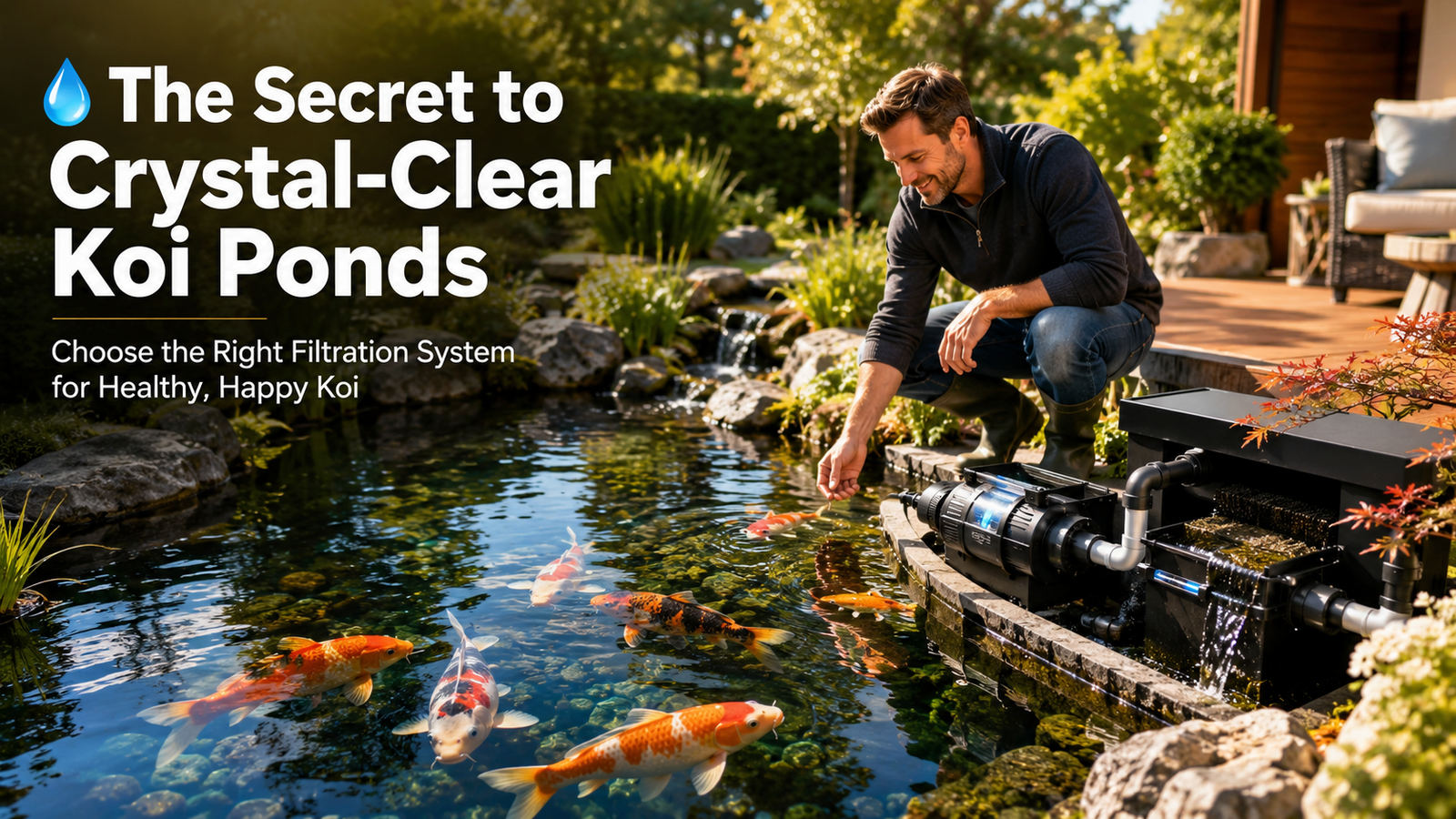
What Is the Best Filtration System for Koi Ponds? The Complete Buyer’s Guide (2026)
Koi ponds are more than decorative water features—they’re living ecosystems that require careful maintenance to keep fish healthy and water crystal clear. One of the most common questions asked by pond owners is, what is the best filtration system for koi ponds? The answer depends on your pond size, fish population, and maintenance preferences, but every successful koi pond relies on an efficient combination of mechanical, biological, and UV filtration.
Koi are beautiful fish, but they also produce a significant amount of waste. Without proper filtration, uneaten food, fish waste, leaves, and other debris quickly accumulate, leading to poor water quality, harmful ammonia spikes, excessive algae growth, and unhealthy fish. Investing in the right koi pond filtration system not only keeps your pond looking pristine but also creates a stable environment where koi can thrive.
In this guide, you’ll learn how koi pond filtration works, the essential components of a complete filtration system, the different types of filters available, and how to choose the best solution for your pond. Whether you’re building a new koi pond or upgrading an existing one, this guide will help you make an informed decision.
Why Do Koi Ponds Need a High-Quality Filtration System?
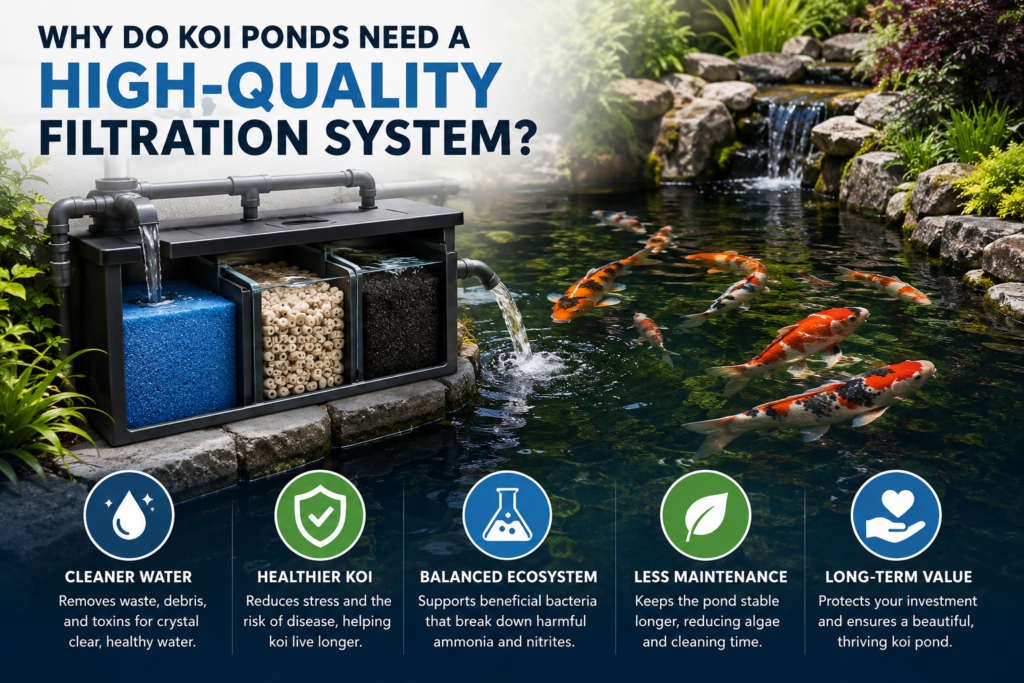
A koi pond is a closed aquatic environment. Unlike natural lakes or rivers, waste doesn’t simply wash away. Everything that enters the pond—from fish waste to decaying leaves—must be managed through an effective filtration system.
Why Koi Produce More Waste Than Ornamental Fish
Koi are large, active fish with healthy appetites. They consume substantial amounts of food daily and produce much more waste than smaller ornamental fish. As koi grow, their waste production increases, placing greater demand on the pond’s filtration system.
Without adequate filtration, organic waste accumulates quickly, causing water quality to decline and increasing maintenance requirements.
How Poor Filtration Affects Koi Health
Insufficient filtration can lead to several serious problems, including:
- High ammonia and nitrite levels
- Reduced oxygen availability
- Cloudy or green water
- Excessive algae growth
- Increased risk of bacterial and parasitic diseases
- Stress and weakened immune systems
- Slower growth and dull coloration
Poor water quality is one of the leading causes of illness in koi ponds. Maintaining consistent filtration is essential for keeping your fish healthy throughout the year.
Benefits of Proper Pond Filtration
Choosing the best filtration system for koi ponds offers numerous long-term advantages:
- Crystal-clear water with improved visibility
- Efficient removal of fish waste and debris
- Stable biological balance
- Lower ammonia and nitrite levels
- Healthier, more active koi
- Reduced algae growth
- Less frequent pond cleaning
- Lower maintenance costs over time
A properly designed pond filtration system also extends the lifespan of pumps and other pond equipment by reducing the amount of debris circulating through the system.
What Makes the Best Filtration System for Koi Ponds?
The best filtration system for koi ponds combines three essential filtration stages that work together to maintain excellent water quality.
Mechanical Filtration
Mechanical filtration is the first line of defense. It physically removes solid waste before it begins to decompose.
Common debris removed includes:
- Fish waste
- Uneaten food
- Leaves
- Twigs
- Dust
- Algae particles
- Organic debris
Popular mechanical filter media include:
- Filter brushes
- Filter mats
- Foam sponges
- Sieve filters
- Drum filters
Removing waste early prevents harmful ammonia from building up and reduces the workload on biological filtration.
Benefits of Mechanical Filtration
- Cleaner water
- Reduced sludge buildup
- Improved water flow
- Longer lifespan for biological media
- Easier pond maintenance
Biological Filtration
Biological filtration is the heart of every koi pond filtration system.
Unlike mechanical filters that trap debris, biological filters use beneficial bacteria to break down harmful waste compounds.
These bacteria convert:
- Ammonia → Nitrite
- Nitrite → Nitrate
This natural process, known as the nitrogen cycle, is essential for maintaining safe water conditions.
Common biological filter media include:
- Ceramic rings
- Bio balls
- Moving bed media
- Lava rock
- Japanese filter mats
- Porous bio blocks
The more surface area available, the larger the bacterial colony that can develop, improving the filter’s efficiency.
Benefits of Biological Filtration
- Removes toxic ammonia
- Stabilizes water quality
- Supports healthy koi growth
- Reduces fish stress
- Creates a balanced ecosystem
Without biological filtration, even crystal-clear water can contain dangerous levels of invisible toxins.
UV Clarification
Many pond owners mistake green water for dirty water. In reality, green water is caused by microscopic free-floating algae.
A UV clarifier uses ultraviolet light to destroy these algae cells as water passes through the unit.
Benefits include:
- Crystal-clear water
- Reduced algae blooms
- Improved water appearance
- Better viewing of koi
- Lower maintenance requirements
It’s important to note that UV clarifiers are not a replacement for mechanical or biological filtration. Instead, they complement the overall filtration system by improving water clarity.
How the Three Filtration Stages Work Together
| Filtration Stage | Primary Purpose | Removes |
|---|---|---|
| Mechanical Filtration | Captures solid waste | Leaves, fish waste, uneaten food, debris |
| Biological Filtration | Converts harmful toxins | Ammonia and nitrite |
| UV Clarifier | Controls green water | Free-floating algae |
Combining all three stages creates a complete koi pond filtration system capable of maintaining excellent water quality throughout the year.
Types of Koi Pond Filtration Systems
There is no one-size-fits-all solution. The best filtration system for koi ponds depends on pond size, fish stocking levels, budget, and maintenance preferences.
Let’s explore the most common filtration systems used by koi keepers.
Gravity-Fed Filtration Systems
Gravity-fed systems are widely regarded as one of the most effective filtration options for medium to large koi ponds.
Water flows naturally from the pond into the filtration chambers before being pumped back into the pond.
Advantages
- Excellent biological filtration capacity
- Handles large volumes of water
- Highly efficient for heavily stocked ponds
- Low operating pressure
- Ideal for professional koi ponds
Disadvantages
- Requires more installation planning
- Higher initial cost
- Needs dedicated filter pit or space
Best For
- Large koi ponds
- Serious koi hobbyists
- High fish populations
Pressurized Pond Filters
Pressurized filters are compact, easy to install, and suitable for smaller ponds.
Water is forced through the filter under pressure, allowing flexibility in placement.
Advantages
- Easy installation
- Compact design
- Suitable for waterfalls
- Minimal space required
- Beginner-friendly
Disadvantages
- Smaller filtration capacity
- Requires more frequent cleaning
- Less suitable for heavily stocked ponds
Best For
- Small to medium koi ponds
- Home garden ponds
- Beginner pond owners
Drum Filter Systems
Drum filters are considered one of the most advanced mechanical filtration solutions available today.
These systems automatically remove solid waste using a rotating drum and self-cleaning mechanism, significantly reducing manual maintenance.
Advantages
- Automatic cleaning
- Exceptional mechanical filtration
- Handles heavy fish loads
- Reduces maintenance time
- Excellent water clarity
Disadvantages
- Premium price
- Requires electricity and plumbing
- Best paired with a separate biological filter
Best For
- Large koi ponds
- Premium pond installations
- High-value koi collections
Multi-Chamber Filters
Multi-chamber filtration systems divide the filtration process into separate compartments, allowing mechanical, biological, and sometimes chemical filtration to occur in sequence.
Advantages
- Comprehensive filtration
- Large biological media capacity
- Flexible media arrangement
- Reliable long-term performance
Disadvantages
- Requires more installation space
- Manual cleaning is necessary
- Initial setup can be more complex
Best For
- Medium to large koi ponds
- Pond owners seeking a balanced filtration solution
Bead Filters
Bead filters use thousands of floating plastic beads that trap debris while also providing a surface for beneficial bacteria to colonize.
These filters combine mechanical and biological filtration in a compact unit.
Advantages
- Space-saving design
- Effective dual-stage filtration
- Suitable for pressurized systems
- Produces clear water
Disadvantages
- Requires regular backwashing
- Less effective if oversized fish loads are present
- Can become clogged without proper maintenance
Best For
- Medium-sized koi ponds
- Homeowners with limited installation space
- Pond keepers looking for an all-in-one filtration option
By understanding the strengths and limitations of each system, you can narrow down the best filtration system for your koi pond based on your specific needs. In the next section, we’ll explore how to choose the right filtration setup according to pond size, fish population, pump flow rate, and maintenance requirements.
How to Choose the Best Filtration System for Your Koi Pond
Selecting the best filtration system for koi ponds isn’t simply about purchasing the biggest filter available. The right system should match your pond’s volume, fish population, and future growth. A properly sized filtration system ensures stable water quality, reduces maintenance, and provides a healthier environment for your koi.
Consider Your Pond Size
Pond volume is the most important factor when selecting a filtration system.
A larger pond requires higher water circulation and greater biological filtration capacity. Always calculate your pond’s total water volume before choosing a filter and pump.
General recommendation:
- Small ponds (up to 1,000 L)
- Medium ponds (1,000–5,000 L)
- Large ponds (5,000–15,000 L)
- Extra-large ponds (15,000+ L)
As a rule of thumb, choose a filtration system rated for 20–30% more water than your actual pond volume. This provides a safety margin as koi grow larger.
Number of Koi
The more koi you keep, the more waste your filtration system must process.
A lightly stocked pond may function well with a smaller biological filter, while heavily stocked ponds require high-capacity filtration with extensive bio-media.
Avoid overcrowding, as it increases ammonia levels and places unnecessary strain on your filter.
Fish Feeding Habits
Koi are often fed multiple times a day during warmer months.
Frequent feeding increases:
- Fish waste
- Uneaten food
- Organic debris
- Ammonia production
If your koi receive regular, high-protein diets, consider upgrading to a larger filtration system than the minimum recommendation.
Pump Flow Rate
A pond filter performs best when paired with the correct pump.
Ideally, your pond’s entire water volume should circulate through the filtration system once every 1–2 hours.
For example:
- 5,000-liter pond → Pump flow of approximately 3,000–5,000 L/h (depending on head height and filter specifications).
- Larger ponds may require multiple pumps or high-capacity circulation systems.
Always check the manufacturer’s recommended flow rate for your chosen filter.
Filter Media Quality
High-quality filter media provides more surface area for beneficial bacteria to grow.
Popular biological media include:
- Ceramic rings
- Moving bed media
- Bio balls
- Japanese filter mats
- Sintered glass media
Investing in quality media improves filtration efficiency and long-term water stability.
Ease of Maintenance
Choose a system that fits your maintenance routine.
Features that simplify maintenance include:
- Drain valves
- Easy-access chambers
- Self-cleaning drum filters
- Backwash systems
- Removable filter trays
A filtration system that is easy to clean is more likely to be maintained regularly, resulting in healthier koi and clearer water.
Energy Efficiency
Because koi pond filtration operates continuously, energy efficiency is an important consideration.
Look for:
- Energy-efficient pond pumps
- Low-wattage UV clarifiers
- Durable filter materials
- Reliable long-term performance
Although premium equipment may have a higher upfront cost, it often reduces electricity consumption and maintenance expenses over time.
Koi Pond Filtration Checklist
Before buying a filtration system, ask yourself:
- ✔ What is my pond’s total volume?
- ✔ How many koi do I keep?
- ✔ Will I add more koi in the future?
- ✔ What pump flow rate do I need?
- ✔ Does the filter include biological media?
- ✔ Is UV clarification included or compatible?
- ✔ Is maintenance simple and convenient?
Recommended Filtration Setup by Pond Size
| Pond Size | Recommended Pump | Recommended Filter | UV Clarifier |
|---|---|---|---|
| Up to 1,000 L | Small pond pump | Pressurized filter | Optional |
| 1,000–5,000 L | Medium-flow pump | Multi-stage filter | Recommended |
| 5,000–15,000 L | High-flow pump | Gravity-fed filter | Essential |
| 15,000+ L | Commercial pump | Drum filter + Biological filter | Essential |
Common Filtration Mistakes to Avoid
Even the best filtration system for koi ponds cannot perform well if it’s installed or maintained incorrectly.
Choosing a Filter That’s Too Small
Undersized filters struggle to process waste, leading to poor water quality.
Always select a filter rated above your pond’s actual capacity.
Cleaning Biological Media with Tap Water
Tap water contains chlorine that kills beneficial bacteria.
Instead, rinse biological media using pond water during maintenance.
Skipping UV Maintenance
UV bulbs gradually lose effectiveness even if they still produce light.
Replace UV bulbs according to the manufacturer’s recommendations, typically every 12 months.
Overfeeding Koi
Excess food increases waste and encourages algae growth.
Feed only what your koi can consume within a few minutes.
Ignoring Water Testing
Regularly monitor:
- Ammonia
- Nitrite
- Nitrate
- pH
- KH (carbonate hardness)
Routine testing helps detect problems before they affect fish health.
Turning Off the Filter
Beneficial bacteria require a continuous supply of oxygen-rich water.
Turning off the filter for extended periods can kill bacterial colonies and disrupt the nitrogen cycle.
Whenever possible, run your filtration system 24 hours a day, 7 days a week.
Best Maintenance Tips for a Koi Pond Filtration System
Routine maintenance keeps your filtration system operating at peak performance.
Weekly Maintenance
- Remove leaves and debris
- Check pump operation
- Inspect water clarity
- Test water parameters
- Clean skimmer baskets
Monthly Maintenance
- Clean mechanical filter media
- Flush filter chambers
- Inspect plumbing connections
- Check UV operation
- Inspect pump impeller
Seasonal Maintenance
Spring
- Deep-clean the filtration system
- Restart UV clarifier
- Inspect all equipment
Summer
- Increase monitoring during heavy feeding
- Remove excess algae
- Maintain good water circulation
Autumn
- Install pond netting if needed
- Remove falling leaves promptly
- Reduce feeding as temperatures drop
Winter
- Continue water circulation where appropriate
- Protect exposed pipework from freezing (if applicable)
- Minimize unnecessary disturbance to dormant koi
Annual Maintenance
- Replace UV bulb
- Inspect seals and O-rings
- Replace worn filter media if required
- Service the pond pump
- Check electrical components
Koi Pond Maintenance Schedule
| Task | Frequency |
|---|---|
| Remove debris | Weekly |
| Test water quality | Weekly |
| Clean mechanical filter | Monthly |
| Inspect pump | Monthly |
| Replace UV bulb | Every 12 months |
| Deep-clean filtration system | Annually |
Frequently Asked Questions
What is the best filtration system for koi ponds?
The best filtration system for koi ponds combines mechanical filtration, biological filtration, and a UV clarifier. Together, these components remove debris, convert harmful ammonia into less toxic compounds, and control green water algae, creating a healthy environment for koi.
How often should I clean a koi pond filter?
Mechanical filter media should generally be cleaned every few weeks, depending on fish load and debris levels. Biological media should only be cleaned when necessary using pond water to preserve beneficial bacteria.
Can a pond have too much filtration?
No. Oversizing your filtration system is usually beneficial. Larger filters provide greater biological capacity, improve water quality, and reduce maintenance.
Do koi ponds need UV filters?
While not mandatory, UV clarifiers are highly recommended because they control green water algae and improve water clarity without harming fish or beneficial bacteria inside the biological filter.
What size filter do I need for my koi pond?
Choose a filter rated for at least 20–30% more than your pond’s total volume. This allows for future koi growth and increased biological demand.
How long does pond filter media last?
Mechanical media may need periodic replacement depending on wear, while high-quality biological media can last for many years if maintained properly.
Should a koi pond filter run 24/7?
Yes. A koi pond filtration system should operate continuously to maintain oxygen flow, support beneficial bacteria, and keep water quality stable.
Conclusion
If you’re wondering what is the best filtration system for koi ponds, the answer is a complete filtration setup that combines mechanical filtration, biological filtration, and UV clarification. Each stage plays a critical role in removing waste, maintaining healthy water parameters, and keeping your pond clear throughout the year.
When selecting a filtration system, consider your pond’s size, the number of koi, pump flow rate, and long-term maintenance requirements. Choosing equipment that’s slightly oversized provides better performance and accommodates future fish growth.
Regular maintenance is just as important as choosing the right equipment. Cleaning mechanical filters, monitoring water quality, replacing UV bulbs, and servicing pumps will help ensure your filtration system performs efficiently for years to come.
With the right combination of quality filtration and consistent care, your koi pond can remain a beautiful, balanced ecosystem where your fish thrive in clean, healthy water.
If you’re planning to upgrade your pond, explore a range of high-quality pond filters, pumps, UV clarifiers, and filtration accessories to build a reliable system tailored to your koi pond’s needs.