

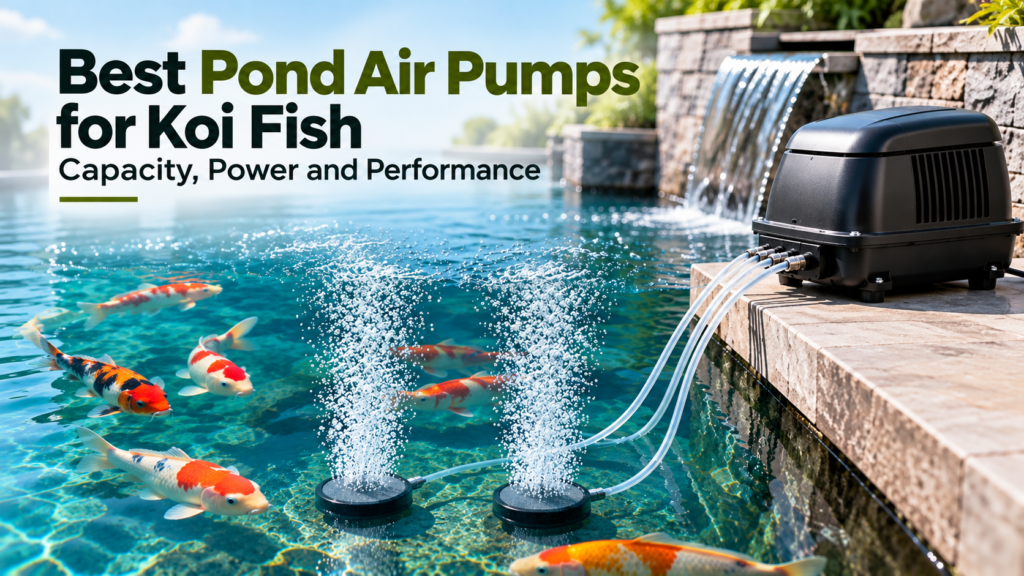
Koi fish need clean, well-oxygenated water to stay active and healthy. While a pond filter removes waste and a pond pump circulates water, a dedicated air pump helps improve oxygen exchange and water movement. Choosing the best pond air pump for koi depends on pond volume, water depth, fish population, airflow requirements, and electricity consumption.
Whether you maintain a small backyard koi pond or a large pond with many fish, selecting the right aeration system can help support fish health and biological filtration. In this guide, we explain how pond air pumps work, how to choose the right capacity, which features matter most, and how to maintain your equipment.
Why Do Koi Ponds Need an Air Pump?
Koi consume dissolved oxygen from the water. Beneficial bacteria in biological filters also require oxygen to break down fish waste and other organic matter. When oxygen levels fall, fish may become stressed, particularly during hot weather or when the pond contains many fish.
A pond air pump draws air from the surrounding environment and sends it through airline tubing to an air stone or diffuser submerged in the pond. The diffuser releases bubbles that disturb the water surface and support gas exchange.
The main benefits of pond aeration include:
- Improved oxygen exchange: Surface movement helps transfer oxygen from the air into the water.
- Support for koi health: Adequate dissolved oxygen helps koi breathe and remain active.
- Better biological filtration: Beneficial bacteria need oxygen to process fish waste.
- Water circulation: Rising bubbles can help move water through different pond areas.
- Reduced stagnant zones: Correctly positioned diffusers can improve circulation in areas with limited water movement.
A waterfall or fountain can also contribute to aeration, but it may not provide sufficient oxygenation throughout a heavily stocked or deep koi pond. A dedicated air pump offers additional aeration, especially when paired with suitable diffusers.
How to Choose the Best Pond Air Pump for Koi
Before purchasing an air pump, evaluate your pond’s size, depth, fish population, and filtration system. A pump that works well in a small ornamental pond may not provide sufficient airflow for a large koi pond.
1. Pond Water Volume
Pond volume is a useful starting point when choosing an air pump. Larger ponds generally require more total airflow, especially when they contain many koi.
Calculate the pond’s approximate water volume before selecting equipment.
For a rectangular pond:
Water volume in litres = Length × Width × Average water depth (in metres) × 1,000
For example, a pond measuring 4 m long, 3 m wide, and 1 m deep contains approximately 12,000 litres of water when filled to those dimensions.
For irregular ponds, calculate the approximate average depth and adjust for shelves, sloping sides, and displacement.
Remember that pond volume alone does not determine the required air pump capacity. Fish stocking, water temperature, filtration demand, and pond depth also influence aeration requirements.
2. Airflow Capacity
Airflow is one of the most important specifications when comparing pond air pumps. It is commonly measured in litres per minute (LPM) or cubic feet per minute (CFM).
A pump with a higher airflow rating can generally supply more diffusers, provided it can maintain adequate output at the installation depth.
When comparing products, check:
- Maximum airflow in LPM or CFM.
- Airflow available at the intended operating depth.
- Number of air outlets.
- Compatibility with the selected diffusers.
- Manufacturer recommendations for pond applications.
Do not select a pump using its maximum advertised airflow alone. Actual output can decrease as water depth and back pressure increase.
3. Pond Depth and Operating Pressure
Water depth affects how hard an air pump must work to push air through a submerged diffuser. Deeper ponds create greater back pressure, which can reduce the delivered airflow of some pumps.
For deeper koi ponds, choose a pump rated to operate at the required pressure. Confirm the manufacturer’s airflow specifications at the intended depth rather than relying only on the free-air rating.
A pump with insufficient pressure may produce weak bubbles even if its advertised airflow appears adequate.
4. Number and Size of Koi
A pond with a few small koi has different oxygen requirements from a pond containing many large, actively growing fish.
Consider a higher aeration capacity when:
- The pond is heavily stocked.
- Koi are large or growing rapidly.
- Water temperatures are high.
- The biological filter has a high processing demand.
- The pond contains areas with poor circulation.
Aeration should be selected as part of the complete pond system, alongside filtration, circulation, and sensible fish stocking.
Types of Pond Air Pumps
Different air pump designs suit different pond sizes and operating conditions.
Linear Diaphragm Air Pumps
Linear diaphragm pumps use vibrating diaphragms to move air. They are often suitable for residential koi ponds where quiet operation and energy efficiency are important.
Advantages:
- Generally quiet operation.
- Relatively low power consumption for their output.
- Suitable for continuous operation when correctly sized.
- Some models have replaceable diaphragms for maintenance.
Best suited for: Small and medium koi ponds, subject to the pump’s airflow and pressure ratings.
Electromagnetic Air Pumps
Electromagnetic air pumps use an electromagnetic mechanism to drive an air-moving diaphragm. Many compact aquarium and pond aerators use this design.
Advantages:
- Compact construction.
- Straightforward installation.
- Useful for distributing air to small diffusers.
- Often economical for smaller installations.
Best suited for: Small ponds and modest aeration requirements, provided the pump is rated for the application.
Piston-Type Air Pumps
Piston pumps use a piston mechanism to deliver air. Certain designs can handle higher operating pressures and larger airflow requirements than compact aerators.
Advantages:
- Potentially suitable for demanding applications.
- Available in higher-capacity designs.
- Can support deep-water aeration when correctly specified.
Best suited for: Larger or deeper ponds requiring greater pressure or airflow, depending on the specific model.
Always compare the manufacturer’s pressure, airflow, noise, and maintenance specifications before choosing a pump type.
How Much Airflow Does a Koi Pond Need?
There is no single airflow rating that is suitable for every koi pond. The required capacity depends on the pond’s water volume, depth, stocking density, water temperature, diffuser design, and existing circulation.
Use the following table as a starting point for planning, not as a guaranteed pump-sizing specification.
| Pond size | Aeration planning |
|---|---|
| Small ornamental pond | Compact pump with suitable airflow and diffuser coverage |
| Medium koi pond | Higher-capacity pump with multiple diffuser options where needed |
| Large koi pond | Calculate total airflow and distribute it across appropriate diffuser locations |
| Deep or heavily stocked pond | Verify delivered airflow under operating pressure and consider professional sizing |
For a reliable selection, first determine the pond’s water volume, then assess fish load and depth. Compare the resulting requirements with the manufacturer’s performance chart.
For heavily stocked koi ponds, it is particularly important to monitor dissolved oxygen rather than assuming that a particular pump rating guarantees safe oxygen levels.
Important Features to Check Before Buying
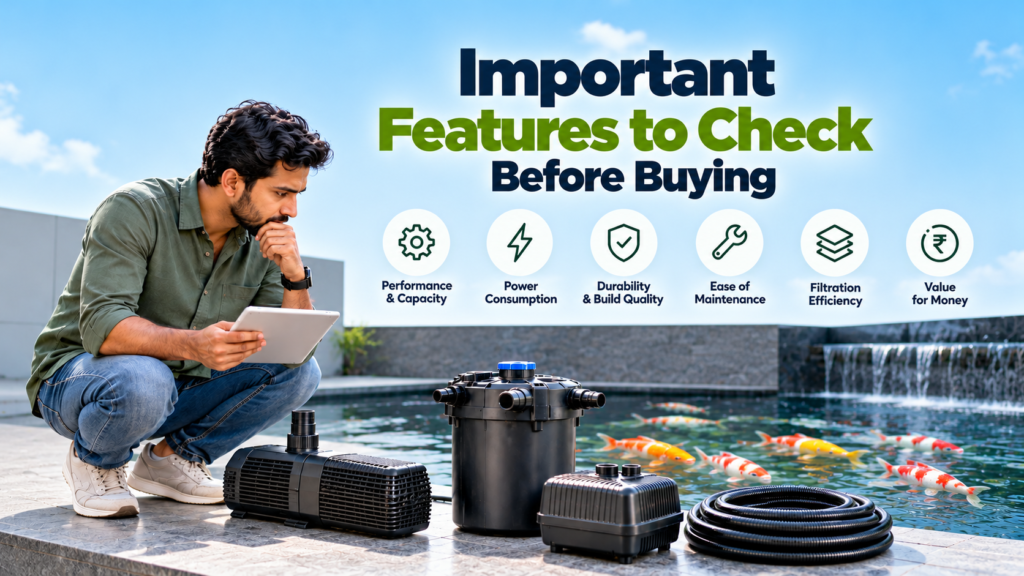
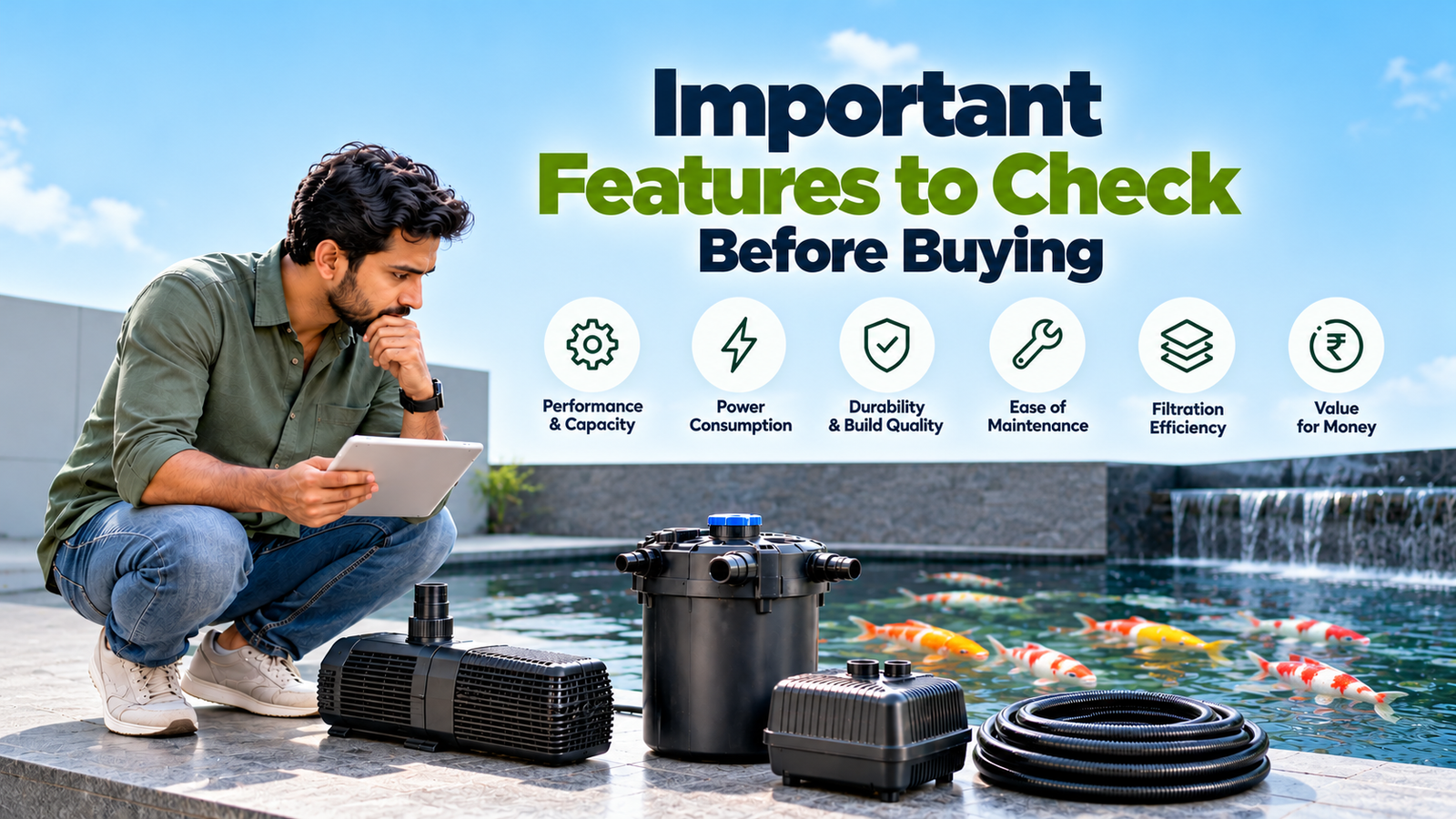
When comparing the best pond air pump for koi, consider these specifications.
Power Consumption
Air pumps often operate for extended periods, so electricity consumption matters. Check the rated wattage and calculate the approximate daily energy use.
Daily energy consumption (kWh) = Power in watts × Operating hours ÷ 1,000
For example, a 40-watt air pump operating continuously for 24 hours uses approximately 0.96 kWh per day.
Actual electricity costs depend on your local tariff and the pump’s real operating load.
Number of Outlets
Multiple outlets can make it easier to supply several diffusers. Check whether the pump can maintain adequate airflow when all outlets are in use.
A distribution manifold can help direct air to different pond areas. Adjustable valves may be useful for balancing airflow, but avoid restricting the system beyond the manufacturer’s recommendations.
Noise and Vibration
If your koi pond is near a home, patio, or seating area, noise can be an important consideration. Look for low-noise designs and install the pump on a stable surface that limits vibration.
Outdoor Protection
Install the pump in a dry, well-ventilated and weather-protected location. Electrical connections should be suitable for outdoor use and protected with appropriate safety devices installed by a qualified electrician.
Do not allow rainwater or pond water to enter the pump housing.
Spare Parts and Maintenance
Check the availability of replacement diaphragms, membranes, valves, filters, and other service parts. A pump with accessible replacement components may be more economical to maintain over time.
How to Install a Pond Air Pump
Correct installation helps the air pump deliver consistent aeration.
- Choose a suitable location: Place the pump in a dry, shaded, well-ventilated area protected from rain and flooding.
- Position the pump safely: Follow the manufacturer’s instructions for mounting height and protection against water flowing back into the pump.
- Connect the airline tubing: Use suitable tubing and secure connections to prevent air leakage.
- Attach the diffuser: Connect the tubing to a compatible air stone, disc diffuser, or other approved diffuser.
- Position the diffuser: Place it where bubbles and circulation can reach the required areas. Avoid positioning it where it will continuously stir accumulated sludge.
- Check airflow: Start the system and inspect each outlet for consistent bubbling.
- Monitor the pond: Observe fish behaviour and check dissolved oxygen when possible, particularly during hot weather and periods of heavy stocking.
Use a suitable check valve where recommended by the manufacturer to help prevent water from flowing back through the airline. Keep all electrical equipment protected from water.
Pond Air Pump Maintenance Tips
Regular maintenance helps maintain airflow and can extend equipment life.
- Inspect airline tubing for cracks, blockages, and loose connections.
- Clean diffusers when deposits reduce bubble output.
- Check the pump’s air intake filter and clean or replace it as recommended.
- Inspect diaphragms, membranes, and valves according to the manufacturer’s service schedule.
- Keep ventilation openings free from dust and debris.
- Listen for unusual noise or vibration.
- Check that every diffuser is producing adequate airflow.
- Keep a backup aeration plan for power cuts, especially in heavily stocked ponds.
If the bubbles become weaker, check the diffuser and tubing before assuming the pump has failed. A blocked diffuser or leaking connection can reduce performance significantly.
Common Mistakes to Avoid
Choosing a pump based only on pond volume: Fish load, depth, and filtration requirements also matter.
Ignoring operating pressure: A pump may not deliver its advertised free-air output at the bottom of a deep pond.
Using too few diffusers: Poorly distributed aeration may leave some areas with inadequate circulation.
Placing the pump in an exposed location: Rain, flooding, overheating, and poor ventilation can damage equipment.
Switching off aeration unnecessarily: Koi and biological filters continue consuming oxygen at night. Continuous aeration is generally important for stocked koi ponds, with equipment sized for the application.
Ignoring dissolved oxygen: Bubbles alone do not confirm that oxygen levels are adequate. Testing dissolved oxygen is especially useful during hot weather, after treatment, or when fish are gasping at the surface.
Frequently Asked Questions
1. What is the best pond air pump for koi?
The best pond air pump is one that supplies sufficient airflow at the pond’s operating depth, suits the number of koi, supports the filtration system, and can run reliably. Consider pump type, wattage, pressure rating, noise, and replacement-part availability before buying.
2. Should a koi pond air pump run all day?
In most stocked koi ponds, continuous aeration is beneficial because fish and beneficial bacteria consume oxygen throughout the day and night. Provide a suitable backup plan for power interruptions.
3. Can a waterfall replace a pond air pump?
A waterfall helps aerate water through surface agitation, but it may not provide adequate oxygen distribution in every pond. A dedicated air pump can supplement circulation and aeration, especially in deep or heavily stocked ponds.
4. Where should I place air stones in a koi pond?
Position diffusers to provide broad, balanced coverage. In many ponds, bottom placement helps move water upward, but diffuser positioning should account for depth, fish behaviour, temperature, and accumulated debris.
5. Does a bigger air pump always mean better aeration?
Not necessarily. The pump must match the pond and diffuser system. Excessive circulation can disturb fish or sediment, while an undersized pump may not supply enough air. Select an appropriate capacity and monitor water conditions.
6. How do I know if my koi pond needs more aeration?
Fish gathering near waterfalls or inlets, gasping at the surface, or showing unusual lethargy may indicate low oxygen, although other problems can cause similar symptoms. Increase aeration immediately if low oxygen is suspected, check water quality, and measure dissolved oxygen when possible.
Conclusion
Choosing the best pond air pump for koi means balancing airflow, pond depth, fish population, power consumption, reliability, and diffuser placement. A properly sized aeration system supports koi health, improves gas exchange, and helps beneficial bacteria in the filtration system function effectively.
Before purchasing, calculate your pond’s water volume, evaluate your fish load, and verify the pump’s delivered airflow at the required operating depth. Combine good aeration with appropriate filtration, regular maintenance, and water-quality monitoring for a healthier koi pond.
Explore pond aeration equipment and related filtration products at GreenfinIndia.com to find a solution suited to your pond setup.