

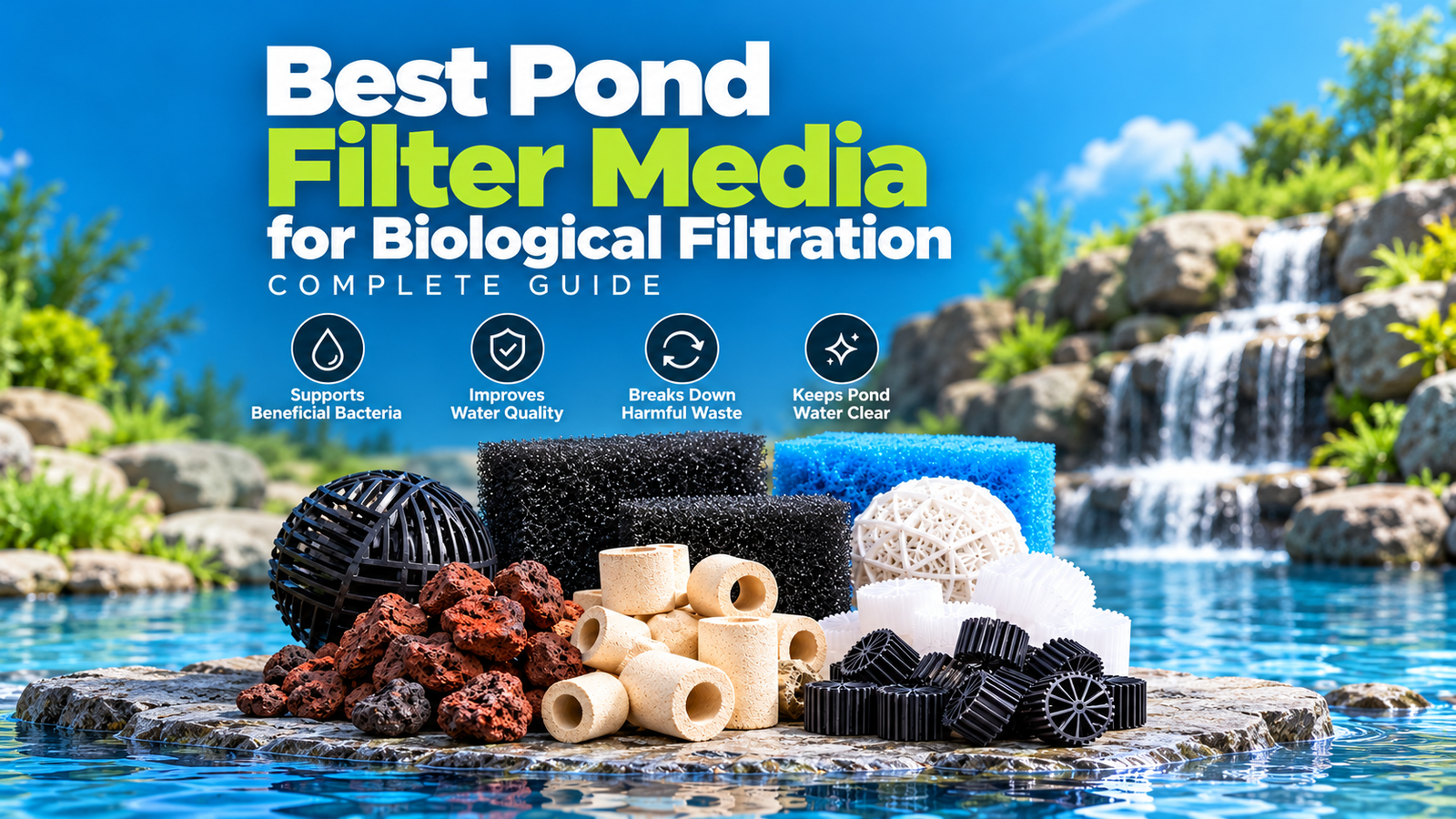
Choosing the best pond filter media is essential for maintaining clean, healthy water in garden ponds and koi ponds. The right filter media supports beneficial bacteria, helps break down harmful fish waste, and improves overall water quality. Whether you have a small ornamental pond or a large koi pond, understanding different types of pond filter media can help you build an efficient filtration system.
Biological filtration is particularly important in ponds containing koi and other fish because fish produce ammonia through their waste and respiration. Beneficial bacteria living on suitable filter media convert ammonia into nitrite and then nitrate through a process called nitrification. This process helps maintain a healthier aquatic environment when combined with proper water circulation, aeration, and routine maintenance.
In this guide, we explain the best pond filter media for biological filtration, how different media work, and how to choose the right option for your pond.
What Is Pond Filter Media?
Pond filter media is the material placed inside a pond filtration system to help remove waste and support biological filtration. Different types of media perform different functions, depending on their structure, surface area, and position within the filter.
Pond filter media generally falls into three categories:
- Mechanical filter media: Captures suspended particles, leaves, uneaten fish food, and other solid waste.
- Biological filter media: Provides surfaces where beneficial bacteria grow and process toxic nitrogen compounds.
- Chemical filter media: Uses materials such as activated carbon or specialised resins to remove certain dissolved substances.
For most fish ponds, mechanical and biological filtration form the foundation of an effective filtration system.
Why Is Biological Filter Media Important?
Fish waste, uneaten food, and decomposing organic matter contribute to ammonia accumulation in pond water. Ammonia can be toxic to fish, particularly at higher pH levels and temperatures.
Biological filter media provides a surface for beneficial microorganisms to colonise. These microorganisms help convert ammonia into nitrite and subsequently nitrate.
The main benefits of biological pond filter media include:
- Supports beneficial bacteria growth.
- Helps process ammonia and nitrite.
- Improves biological filtration efficiency.
- Supports healthier conditions for koi and other pond fish.
- Helps maintain more stable water quality.
- Reduces the accumulation of harmful nitrogen compounds when the system is properly sized and maintained.
Important: Biological filter media does not immediately make water safe. Beneficial bacteria need time to establish themselves, and an immature filter may not process fish waste effectively. Regular water testing is essential, especially when setting up a new pond or adding more fish.
Best Pond Filter Media for Biological Filtration
Different types of pond filter media offer different advantages. The best choice depends on your filtration system, pond size, fish stocking level, maintenance requirements, and available space.
1. Bio Balls
Bio balls are lightweight plastic media commonly used in pond filters, biological chambers, and trickle filtration systems.
Their structured surfaces provide areas where beneficial bacteria can grow. Their open design also allows water to circulate through the media.
Benefits of bio balls:
- Lightweight and reusable.
- Durable under normal operating conditions.
- Allow water to pass through easily.
- Suitable for many pond filtration systems.
- Relatively easy to clean when necessary.
Best for: Garden ponds, koi ponds, biological filter chambers, and trickle filters.
Bio balls are particularly useful when you want durable media that can remain in a filtration system for a long time. However, their performance depends on the design of the media, available surface area, water flow, and oxygen supply.
2. Ceramic Filter Media
Ceramic filter media is commonly used in aquarium and pond filtration systems. Many ceramic products have porous structures that provide surfaces for beneficial bacteria.
Depending on the product, ceramic media can offer a useful combination of surface area and water flow.
Benefits of ceramic filter media:
- Provides surfaces for beneficial bacterial colonies.
- Available in different shapes and pore structures.
- Suitable for many biological filtration systems.
- Can be used in compatible filter chambers and baskets.
Best for: Small and medium ponds, compact biological filters, and systems designed for ceramic media.
Ceramic media can be an effective option when the filter design allows adequate water movement through the material. Choose products specifically intended for pond or aquarium filtration.
3. Japanese Filter Mat
Japanese filter mats are widely used in koi pond filtration systems. These mats typically consist of a structured, open material that supports biological colonisation while also trapping some suspended solids.
Their open structure allows water to move through the media when correctly installed and maintained.
Benefits of Japanese filter mats:
- Suitable for many biological filter chambers.
- Provide substantial colonisation surfaces.
- Can support both mechanical and biological filtration.
- Reusable when properly maintained.
- Available in different thicknesses and densities.
Best for: Koi ponds, multi-chamber filters, and larger pond filtration systems.
Japanese filter mats are particularly useful in systems where easy access and practical maintenance are important. They should be installed so that water flows evenly through the material rather than bypassing it.
4. Moving Bed Filter Media
Moving bed media consists of lightweight plastic pieces designed to circulate inside a biological filter chamber through water movement and aeration.
As the media moves, beneficial bacteria colonise its surfaces. The constant movement helps maintain oxygen availability and reduces the accumulation of excessive biofilm on the media.
Benefits of moving bed media:
- Supports oxygen-rich biological filtration.
- Provides a large amount of media within a compact chamber.
- Allows continuous movement and mixing.
- Can be effective in heavily stocked fish ponds when correctly sized.
- Often requires less manual cleaning than static biological media.
Best for: Koi ponds, high-biomass fish systems, and filtration systems designed for moving bed operation.
Moving bed media requires an appropriately designed chamber, sufficient aeration, and suitable retention screens to prevent the media from escaping.
Not all plastic bio media is designed for moving bed use. Always select media compatible with the intended filtration method.
5. Lava Rock
Lava rock is a naturally porous volcanic material sometimes used in pond filtration systems.
Its irregular surface provides places for microorganisms to colonise. However, its performance varies according to the rock’s porosity, size, and consistency.
Benefits of lava rock:
- Naturally textured surface.
- Can provide bacterial colonisation areas.
- May be available at relatively low cost.
- Can be used in certain large filter chambers.
Best for: Selected garden pond filtration systems where the filter design accommodates the material.
Lava rock can trap debris between its pieces, potentially restricting water flow and making cleaning difficult. It is often less convenient than purpose-designed biological media for koi ponds requiring reliable, easy-to-maintain filtration.
Choose clean material that is suitable for aquatic use and does not introduce unwanted contaminants.
6. Bio Rings
Bio rings are ring-shaped filter media commonly made from ceramic or other suitable materials. Their structure provides surfaces for beneficial bacteria and allows water to flow around and through the media.
Benefits of bio rings:
- Simple to install in compatible filters.
- Available in different materials and sizes.
- Can provide useful bacterial colonisation surfaces.
- Suitable for filter baskets and chambers designed for them.
Best for: Compact biological filters, smaller ponds, and supplementary biological filtration.
The effectiveness of bio rings depends on their material, pore structure, surface area, and how water passes through them. Some ceramic rings are intended mainly for aquarium filtration, so check their suitability before using them in larger outdoor ponds.
7. Plastic Hel-X-Style Biological Media
Specialised plastic biological media is designed with structured shapes that provide surfaces for bacterial colonisation while maintaining water flow.
Some products are intended for moving bed systems, while others are designed for static applications.
Benefits:
- Lightweight and durable.
- Available in designs with substantial surface area.
- Can support effective biological filtration.
- Certain types work well in aerated moving bed chambers.
Best for: Engineered koi pond filters, advanced biological filtration systems, and suitable high-flow filter chambers.
Performance varies by product. Compare the manufacturer’s specifications, intended application, and recommended operating conditions rather than selecting media based on its appearance alone.
Pond Filter Media Comparison
The following table provides a general comparison of common pond filter media. Actual performance depends on product design and filtration conditions.
| Filter Media | Main Advantage | Maintenance Consideration | Best Application |
|---|---|---|---|
| Bio balls | Durable and lightweight | Remove accumulated debris when needed | Static or trickle filters |
| Ceramic media | Porous surfaces in many products | Handle carefully and avoid excessive cleaning | Compatible biological filters |
| Japanese filter mats | Practical for multi-chamber systems | Periodic cleaning may be necessary | Koi ponds and chamber filters |
| Moving bed media | Continuous movement and oxygen exposure | Requires aeration and media retention | Moving bed biological filters |
| Lava rock | Naturally textured surface | Can accumulate debris and restrict flow | Selected garden pond systems |
| Bio rings | Easy to use in compatible filters | Clean gently when flow is restricted | Compact filter chambers |
| Specialised plastic bio media | Durable designs for biological filtration | Depends on static or moving bed use | Purpose-designed filtration systems |
There is no single best pond filter media for every pond. The correct choice depends on the filter design, fish load, water flow, oxygen availability, and maintenance requirements.
How to Choose the Best Pond Filter Media for Your Pond
Before buying pond filter media, evaluate the following factors.
1. Calculate Your Pond’s Water Volume
Knowing the pond’s water volume is the first step in choosing suitable filtration equipment.
For a rectangular pond:
Water volume in litres = Length (m) × Width (m) × Average water depth (m) × 1,000
For example, a pond measuring 4 metres long, 3 metres wide, and 1 metre deep has a theoretical volume of:
4 × 3 × 1 × 1,000 = 12,000 litres
For irregular ponds, calculate the approximate volume using the average depth or divide the pond into simpler shapes.
Remember that actual operating volume may be lower because of sloping sides, shelves, rocks, and other features.
2. Consider the Number and Size of Your Fish
A pond containing a few small ornamental fish has different filtration requirements from a pond containing many large koi.
Koi produce substantial waste as they grow, and feeding levels influence the biological load placed on the filter.
Consider:
- The number of fish.
- Their current size and expected growth.
- Daily feeding quantity.
- Water temperature.
- Available filtration capacity.
A heavily stocked koi pond generally requires more robust mechanical and biological filtration than a lightly stocked garden pond of the same volume.
3. Check the Available Filter Space
Different media require different amounts of space and different operating conditions.
For example:
- Japanese mats are suitable for compatible static chambers.
- Moving bed media needs space to circulate.
- Bio balls can be used in suitable static or trickle configurations.
- Ceramic media should be placed in a filter that provides appropriate water flow and support.
Do not fill a chamber with media without considering water distribution, oxygen supply, and the possibility of clogging.
4. Ensure Adequate Water Flow
Biological filter media needs a consistent supply of oxygenated water containing ammonia and nitrite.
If water bypasses the media or flow becomes restricted by accumulated debris, biological filtration can become less effective.
Choose a pump that provides an appropriate flow rate after accounting for pipework, fittings, elevation, and other hydraulic losses.
5. Consider Ease of Maintenance
A pond filter should be easy to inspect and maintain.
Mechanical filtration should remove solids before they accumulate excessively in biological chambers. This helps reduce clogging and prevents trapped organic waste from decomposing unnecessarily within the system.
Choose media that matches the amount of maintenance you can realistically perform.
How Much Pond Filter Media Do You Need?
The quantity of biological filter media required depends on several factors, including fish biomass, feeding rate, filter design, water temperature, and the media’s characteristics.
Pond volume alone is not enough to determine the exact quantity.
For example, two ponds containing 10,000 litres of water may need very different biological filtration capacities if one contains a few goldfish and the other contains many large koi.
To estimate the appropriate quantity:
- Calculate the pond’s operating water volume.
- Estimate the fish biomass and daily feeding rate.
- Identify the type and specifications of the biological media.
- Check the filter manufacturer’s recommendations.
- Confirm that the chamber provides suitable flow and oxygenation.
- Monitor ammonia and nitrite to evaluate actual filtration performance.
Avoid choosing media solely by weight or by filling a chamber completely. The media must function correctly within the overall filtration system.
How to Install Biological Filter Media
Correct installation helps beneficial bacteria establish and improves filtration reliability.
Step 1: Install Mechanical Filtration First
Where the filter design permits, remove large debris and suspended solids before water enters the main biological chamber.
Mechanical filtration helps prevent biological media from becoming clogged.
Step 2: Place the Biological Media Correctly
Arrange the media according to the filter manufacturer’s instructions. Ensure water passes through the intended media area instead of finding an easier route around it.
Use appropriate baskets, supports, or retention screens where required.
Step 3: Maintain Adequate Aeration
Beneficial nitrifying bacteria require oxygen.
Ensure the system provides adequate dissolved oxygen and water circulation, particularly in heavily stocked koi ponds and moving bed filters.
Step 4: Allow the Filter to Mature
A new biological filter needs time to develop a stable bacterial population.
During this period:
- Feed fish conservatively.
- Test ammonia and nitrite regularly.
- Avoid adding excessive numbers of fish.
- Maintain suitable water circulation and aeration.
- Avoid replacing all established biological media at once.
Filter maturation time varies with temperature, water chemistry, the bacterial population, and the load placed on the system.
Step 5: Monitor Water Quality
Use suitable water tests to check ammonia, nitrite, and other relevant parameters.
If ammonia or nitrite becomes detectable at concerning levels, reduce feeding as appropriate, investigate the cause, and take prompt corrective action to protect the fish.
Biological filtration should be evaluated by water quality, not simply by how clear the pond looks.
How to Clean Biological Filter Media
Biological filter media should not be cleaned more aggressively than necessary because cleaning can remove beneficial bacteria.
Follow these maintenance practices:
- Remove accumulated sludge from the filter when required.
- Clean reusable media gently when flow is restricted.
- Where practical, use dechlorinated water or water taken from the pond.
- Avoid exposing biological media to chlorinated tap water during cleaning.
- Do not clean or replace all established biological media simultaneously.
- Maintain water flow and oxygenation throughout the system.
Mechanical media may need more frequent cleaning than biological media because it is designed to capture solids.
The correct cleaning frequency depends on the filter design, fish load, feeding rate, and amount of debris entering the pond.
Common Mistakes When Choosing Pond Filter Media
Avoid these common mistakes when building or upgrading a pond filtration system.
1. Choosing media based only on price
Low-cost media may not provide the most practical solution for your filter design. Consider durability, maintenance, flow characteristics, and suitability for your application.
2. Ignoring mechanical filtration
Biological media can become clogged when excessive solid waste enters the biological chamber. Appropriate mechanical filtration helps protect the biological stage.
3. Using insufficient media for the fish load
A filter that is too small may struggle to process the ammonia produced by the fish. Size the complete system according to the biological load rather than pond volume alone.
4. Providing insufficient oxygen
Nitrifying bacteria require oxygen. Poor circulation and low dissolved oxygen can compromise biological filtration and fish health.
5. Cleaning biological media too aggressively
Aggressive cleaning can reduce the beneficial bacterial population and disrupt filtration.
6. Expecting immediate results from a new filter
A new biological filter requires time to mature. Clear-looking water does not necessarily mean ammonia and nitrite are under control.
Frequently Asked Questions
1. What Is the Best Pond Filter Media for Biological Filtration?
The best pond filter media depends on the filtration system. Japanese filter mats, specialised plastic biological media, bio balls, and suitable ceramic media can all support beneficial bacteria. For koi ponds, choose media that matches the filter design, fish load, water flow, and maintenance requirements.
2. Is Moving Bed Media Better Than Bio Balls?
Neither option is universally better. Moving bed media is designed to circulate in an aerated chamber, while bio balls are commonly used in static or trickle filtration systems. Choose the type compatible with your filter and its intended operating conditions.
3. Can I Use Ceramic Media in a Koi Pond Filter?
Yes, if the ceramic media is suitable for pond filtration and compatible with the filter’s design. Check its specifications, flow requirements, durability, and recommended application before installation.
4. How Long Does Biological Filter Media Take to Work?
A new biological filter typically takes several weeks to develop an effective bacterial population, although the time varies with temperature, water chemistry, oxygen availability, and the initial bacterial population. Monitor ammonia and nitrite during the cycling process.
5. Does Biological Filter Media Remove Green Pond Water?
Biological filter media primarily supports the breakdown of ammonia and nitrite. It does not directly remove the suspended algae responsible for typical green pond water. Suitable UV clarification, nutrient management, and effective overall pond maintenance may be needed to address the problem.
6. How Often Should Pond Filter Media Be Replaced?
Durable biological media can often remain in service for years when properly maintained. Replace it when it becomes damaged, deteriorates, or can no longer function effectively. Avoid replacing all established biological media at once because doing so may disrupt biological filtration.
7. Can I Use Different Types of Pond Filter Media Together?
Yes. Many filtration systems combine mechanical and biological media to perform different functions. For example, a multi-chamber filter may use mechanical filtration in the first stage and biological media in subsequent chambers. Ensure each material is appropriate for its location and the system’s water flow.
8. Is More Filter Media Always Better?
Not necessarily. Additional media can increase the available colonisation area, but only if water flow, oxygen supply, and filter design support its effective use. Properly sized and maintained filtration is more important than simply maximising the quantity of media.
Conclusion: Choose the Right Pond Filter Media for Healthy Water
Choosing the best pond filter media is an important part of maintaining a healthy pond. Bio balls, Japanese filter mats, moving bed media, ceramic media, and specialised plastic media all have potential uses in suitable filtration systems.
For koi ponds, focus on the fish’s biological load, the filter’s design, mechanical pre-filtration, adequate oxygenation, and easy maintenance. These factors work together to support beneficial bacteria and maintain safe water conditions.
At Greenfin The Pond Studio, choosing suitable pond filtration equipment starts with understanding your pond’s size, fish population, and filtration requirements.
Explore the pond filtration products available at Greenfinindia.com to find equipment and media suited to your setup. For a large or heavily stocked koi pond, consider evaluating the complete filtration system rather than selecting biological media in isolation.