

A beautiful pond waterfall adds movement, soothing sounds, and a premium look to any outdoor space. However, choosing the right pump is essential to maintain consistent water flow, achieve the desired waterfall effect, and keep your pond ecosystem healthy. An undersized pump may produce weak water flow, while an oversized pump can waste electricity and create excessive splashing.
If you are searching for the best pond pump for waterfalls, understanding pump flow rate, head height, energy efficiency, and installation requirements will help you make the right decision.
In this complete buying guide, we will explain how to choose a pond waterfall pump, calculate the required flow rate, compare pump types, and maintain your equipment for reliable performance.
What Is a Pond Waterfall Pump?
A pond waterfall pump is a water pump designed to circulate water from a pond or reservoir to a waterfall outlet. It moves water through pipes or hoses to a higher point, where the water flows back into the pond.
Pond waterfall pumps are commonly used for:
- Garden pond waterfalls
- Koi pond water features
- Rock waterfalls and cascading streams
- Decorative ponds and fountains
- Outdoor water features with filtration systems
Many pond pumps can also support water circulation and filtration when installed with a suitable plumbing arrangement.
Why Choosing the Right Pond Pump Matters
Selecting the correct pump is important for both the appearance of your waterfall and the overall performance of your pond.
1. Consistent Water Flow
The correct pump provides sufficient water flow to create a steady waterfall. This helps prevent weak or uneven water movement.
2. Better Water Circulation
Water circulation helps distribute oxygen and reduces stagnant areas. In fish ponds, adequate circulation should be combined with suitable aeration and filtration.
3. Energy Efficiency
A properly sized pump can deliver the required flow without unnecessary power consumption. Choosing a pump based only on its maximum wattage or advertised flow rate may lead to an inefficient setup.
4. Improved Water Feature Performance
The right pump helps you achieve the waterfall effect you want, from a gentle stream to a wider, more powerful cascade.
5. Reliable Long-Term Operation
A pump selected for the actual operating conditions is less likely to struggle against excessive head height, restrictive plumbing, or an unsuitable installation.
How to Choose the Best Pond Pump for Waterfalls
Before purchasing a pond waterfall pump, consider the following factors.
1. Calculate the Required Flow Rate
Flow rate is one of the most important factors when selecting the best pond pump for waterfalls. It determines how much water the pump can deliver over a specific period.
Flow rate is commonly measured in litres per hour (LPH) or gallons per hour (GPH).
The required flow rate depends on:
- Waterfall width
- Desired water depth over the waterfall edge
- Waterfall height
- Pipe diameter and length
- Pipe bends and other plumbing restrictions
For a smooth, relatively uniform sheet of water, a useful starting estimate is approximately 100–150 litres per hour per centimetre of waterfall width. This is a preliminary design guideline rather than a universal requirement; the ideal flow varies with the waterfall lip, drop, and desired appearance.
For example, a waterfall with a width of 30 cm might start with a target flow of approximately 3,000–4,500 LPH at the waterfall outlet.
Remember that this is the flow required at the outlet, not necessarily the pump’s advertised maximum flow rate.
2. Understand Pump Head Height
Head height is the vertical distance between the pump’s water level and the point where water is discharged. It is a critical consideration for elevated waterfalls.
As water travels upwards through pipes, the pump must overcome vertical lift and friction losses.
For example, if the waterfall outlet is 1.5 metres above the pond’s water level, the pump must deliver the required flow at that elevation, plus account for losses in the plumbing.
Important: A pump advertised with a maximum flow of 8,000 LPH may deliver considerably less water at a higher head height.
Always check the pump’s flow-versus-head performance curve before purchasing. If the manufacturer provides a performance chart, use it to estimate the flow available at your installation’s total dynamic head.
3. Choose the Correct Pump Type
Pond waterfall pumps generally fall into two main categories.
Submersible pond pumps
These pumps operate underwater inside the pond or a suitable pump chamber.
Advantages:
- Relatively simple installation
- No separate external pump housing required
- Generally convenient for small and medium-sized water features
- Often suitable for garden ponds and decorative waterfalls
Considerations:
- Require suitable protection against debris
- Must be installed according to the manufacturer’s immersion instructions
- Maintenance may require accessing the pump inside the pond
External pond pumps
External pumps are installed outside the pond and connected through appropriate plumbing.
Advantages:
- Convenient access for servicing
- Suitable models can support larger water features
- Can be practical for dedicated filtration and waterfall systems
Considerations:
- Require suitable plumbing and installation space
- Priming and suction arrangements depend on the pump design
- Incorrect installation can cause air leaks, loss of prime, or poor performance
For many residential garden waterfalls, a submersible pump is a practical starting point. Larger ponds or complex filtration systems may benefit from an appropriately selected external pump.
4. Check Energy Consumption
A pond waterfall pump may operate for many hours every day, so energy consumption should be considered before buying.
Check the pump’s rated wattage and calculate its approximate daily electricity consumption.
Formula:
Daily energy consumption (kWh) = Pump power (W) × Operating hours ÷ 1,000
For example, a 100 W pump running continuously for 24 hours consumes approximately 2.4 kWh per day.
At an illustrative electricity rate of ₹8 per kWh, this equals approximately ₹19.20 per day, or ₹576 over 30 days.
Actual electricity costs depend on your tariff, operating schedule, and the pump’s real power consumption. A pump with a higher maximum flow rate is not automatically more efficient.
5. Consider Debris Handling and Maintenance
Outdoor ponds often contain leaves, sediment, algae, and other debris. These materials can obstruct pump intakes and reduce performance.
Before purchasing, check:
- The manufacturer’s permitted particle size
- Whether a protective intake screen is included
- How easily the pump can be opened for cleaning
- Whether spare parts are available
- Whether the pump is suitable for continuous operation
For ponds with fish, avoid allowing excessive debris to accumulate around the intake. A suitable pre-filter or pump chamber can make maintenance easier.
6. Check Build Quality and Warranty
A pond pump should be designed for the conditions in which it will operate.
Look for appropriate water protection, reliable seals, suitable electrical ratings, and a clearly stated warranty. For outdoor installations, use electrical protection and installation practices appropriate to wet environments.
A reliable supplier can also help you identify the correct pump capacity, replacement parts, and compatible accessories.
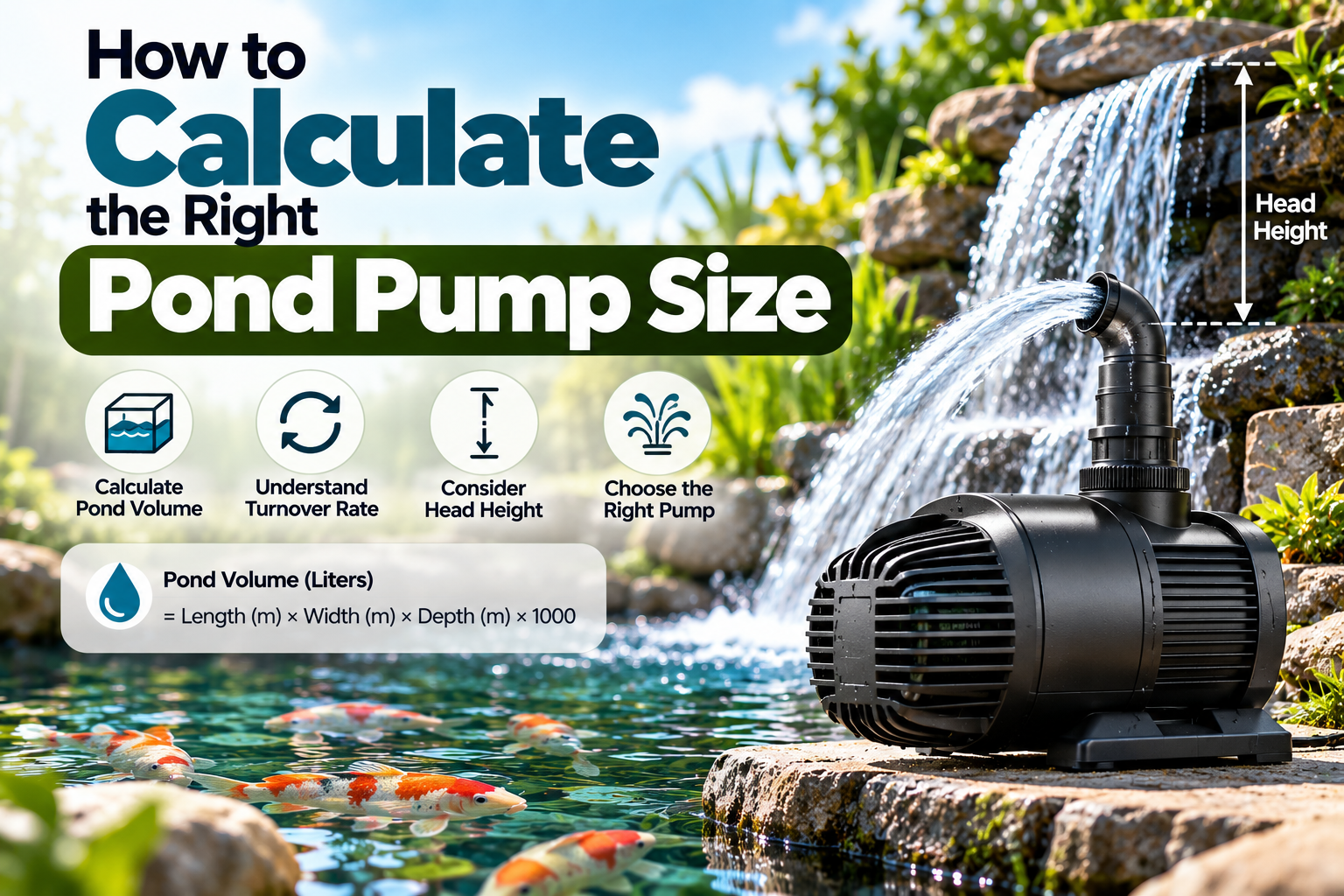
How to Calculate the Right Pond Pump Size
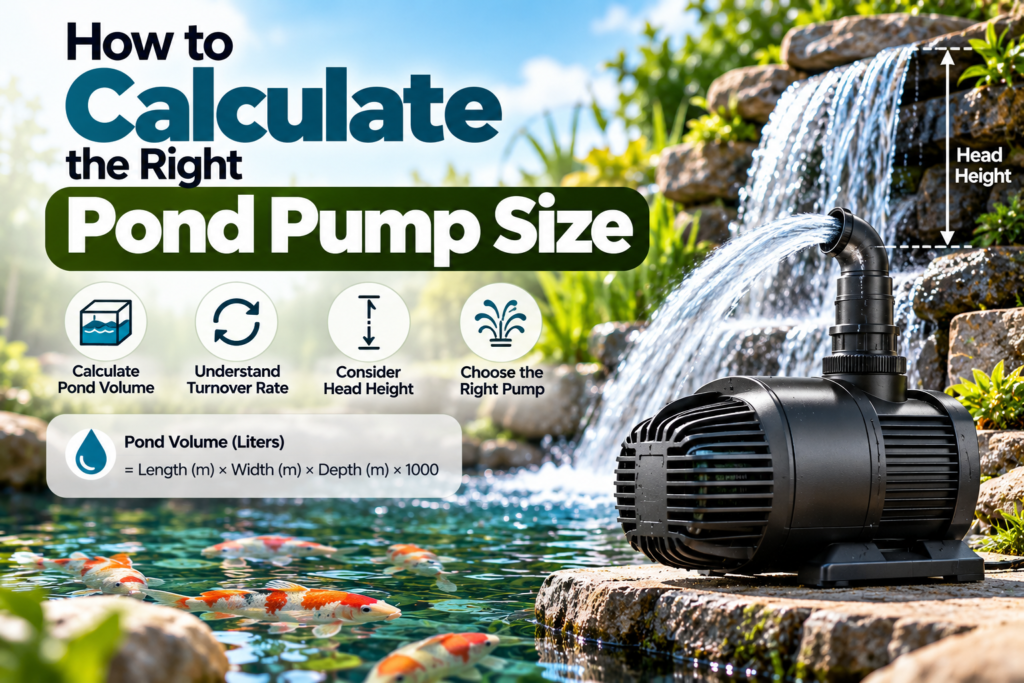
Use this simple process to estimate the pump capacity required for your waterfall.
Step 1: Measure the waterfall width.
Measure the width of the waterfall edge where water will flow over.
Step 2: Decide the desired water flow.
Choose whether you want a gentle trickle, a moderate cascade, or a strong waterfall.
Step 3: Calculate the initial flow requirement.
For a relatively uniform waterfall sheet, use the preliminary estimate of 100–150 LPH per centimetre of width.
Step 4: Measure the vertical lift.
Measure the height from the pond’s water level to the waterfall outlet.
Step 5: Account for plumbing losses.
Consider pipe diameter, pipe length, bends, valves, and other restrictions.
Step 6: Select a pump using its performance curve.
Choose a pump that can deliver the required flow at the estimated total dynamic head.
Example: Selecting a Pump for a 60 cm Waterfall
Suppose you have a garden pond with the following specifications:
| Parameter | Example measurement |
|---|---|
| Waterfall width | 60 cm |
| Desired flow rate | 6,000–9,000 LPH |
| Vertical lift | 1.5 metres |
| Plumbing | Pipework with bends |
| Application | Outdoor garden pond |
Using the preliminary guideline, the initial flow target is 6,000–9,000 LPH at the waterfall outlet.
The next step is to compare pump performance curves and identify a model that delivers the target flow at the actual operating head. A pump advertised as 9,000 LPH may not provide 9,000 LPH after installation.
This example is intended for preliminary selection. The final pump size should be based on the waterfall design and the manufacturer’s performance data.
Pond Waterfall Pump vs Fountain Pump
Although some pumps can operate both waterfalls and fountains, their suitability depends on the intended application.
| Feature | Waterfall pump | Fountain pump |
|---|---|---|
| Main purpose | Continuous water flow over a waterfall | Create decorative spray patterns |
| Flow requirement | Often high, depending on waterfall width | Depends on nozzle and spray height |
| Head requirement | Depends on waterfall elevation | Depends on nozzle pressure and height |
| Plumbing | Often connected to a pipe or hose | Commonly connected to a fountain nozzle |
| Selection priority | Flow at operating head | Flow and pressure required by nozzle |
If you want both a waterfall and a fountain, calculate the combined flow requirements if both features will operate simultaneously. You may need a suitably sized pump with separate flow controls or dedicated pumps for each feature.
Common Pond Waterfall Pump Problems and Solutions
Even a correctly selected pump can experience performance issues if the installation or maintenance is inadequate.
Weak Waterfall Flow
Possible causes:
- Blocked pump intake
- Dirty pre-filter
- Kinked or undersized pipe
- Excessive vertical lift
- Worn or damaged impeller
Solution: Switch off the power safely, inspect the intake and plumbing, and clean the pump according to the manufacturer’s instructions. Check the actual head height against the pump’s performance curve.
Pump Making Unusual Noise
Possible causes:
- Debris inside the impeller housing
- Air entering the system
- Loose installation
- Worn bearings or other internal components
Solution: Disconnect the power before inspecting the pump. Remove accessible debris and check the installation. If unusual noise continues, arrange servicing.
Waterfall Stops Working
Possible causes:
- Electrical supply interruption
- Blocked intake
- Failed impeller or motor
- Loss of prime in a pump that requires priming
- Air leaks in suction plumbing
Solution: Check the electrical supply and inspect the pump safely. For external pumps, follow the manufacturer’s priming and suction-line instructions.
Pump Consumes Too Much Electricity
Possible causes:
- Pump is oversized for the desired waterfall
- Excessive plumbing restrictions
- Unnecessary operating time
- Inefficient operating conditions
Solution: Review the required flow, plumbing arrangement, and pump performance curve. If continuous circulation or filtration is necessary for fish health, do not reduce operating hours without ensuring the pond remains adequately filtered and aerated.
Pond Waterfall Pump Maintenance Tips
Regular maintenance helps keep your pond waterfall operating reliably.
- Inspect the pump intake regularly. Remove leaves and debris before they restrict water flow.
- Clean the impeller when required. Follow the manufacturer’s maintenance instructions.
- Check pipes and hoses. Look for leaks, blockages, kinks, and damaged connections.
- Monitor waterfall flow. A noticeable decrease may indicate a blockage or equipment problem.
- Maintain the pond filter. Clean mechanical filtration components as required, while preserving beneficial bacteria in biological filter media.
- Inspect electrical connections. Use suitable protection for outdoor water installations and never handle electrical equipment with wet hands.
- Check performance after maintenance. Confirm that water circulation and the waterfall have returned to normal.
Do not run a submersible pump dry or operate any pump outside its specified conditions.
Where to Buy a Pond Pump for Your Waterfall
Choosing the right equipment is easier when you have access to suitable pumps, filtration products, and technical guidance.
At Greenfin The Pond Studio, you can explore pond equipment for garden ponds, koi ponds, waterfalls, and other outdoor water features.
Before choosing a pump, prepare the following details:
- Pond dimensions and approximate water volume
- Waterfall width and vertical height
- Desired water flow
- Pipe diameter and approximate pipe length
- Whether the pump will also supply a filter or fountain
These details help narrow down suitable pump options and reduce the risk of purchasing a pump that cannot deliver the required flow.
Explore pond equipment at Greenfin India to find suitable pond pumps, filtration products, and accessories for your setup.
Frequently Asked Questions
1. What is the best pond pump for waterfalls?
The best pond pump for waterfalls is one that provides the required flow rate at the actual operating head while meeting your energy-efficiency, installation, and maintenance requirements. There is no single pump size that suits every waterfall.
2. How many litres per hour does a pond waterfall need?
The required flow depends on waterfall width, height, and design. As a preliminary guideline for a relatively uniform sheet of water, approximately 100–150 LPH per centimetre of width can be used to estimate the initial flow target. Confirm the final requirement for your specific waterfall.
3. Can I use a normal pond pump for a waterfall?
Yes, provided the pump is designed for the application and can deliver sufficient water at the required head height. Check its performance curve, installation requirements, and suitability for continuous operation.
4. Should a pond waterfall pump run continuously?
Many pond waterfall pumps are designed for continuous operation. If the pump also supports essential filtration or circulation for fish, continuous operation may be necessary. Follow the equipment manufacturer’s instructions and maintain adequate aeration and filtration.
5. Is a bigger pond pump always better?
No. An oversized pump may increase electricity costs, cause excessive splashing, and exceed the capacity of the plumbing or waterfall design. Choose a pump based on the required flow at the operating head rather than maximum advertised flow alone.
6. What is the difference between LPH and head height?
LPH means litres per hour and measures water flow. Head height describes the elevation or pressure the pump must overcome. Both are important because the flow delivered by a pump generally decreases as operating head increases.
7. Can one pump run a waterfall and a pond filter?
Yes, if the pump can provide sufficient flow and pressure for both systems, and the plumbing is designed appropriately. Ensure that flow is distributed correctly and that the filter does not receive more flow than its rated capacity.
Conclusion
Choosing the best pond pump for waterfalls involves more than checking the maximum litres-per-hour rating. You need to consider waterfall width, vertical lift, pipe friction, energy consumption, maintenance, and the requirements of any connected filtration system.
Start by calculating the desired flow at the waterfall outlet, then choose a pump that can deliver that flow at the actual operating head. A correctly sized pump will help create an attractive waterfall while supporting reliable pond circulation.
Whether you are planning a small garden waterfall or a large koi pond feature, selecting the right equipment is an important step towards a beautiful and manageable pond.
Need help selecting the right pond pump? Visit Greenfinindia.com to explore pond equipment for your next project.
SEO Settings
SEO Title: Best Pond Pump for Waterfalls: Complete Buying Guide
Meta Description: Discover how to choose the best pond pump for waterfalls. Learn about flow rate, head height, pump types, sizing, energy efficiency and maintenance.
Focus Keyword: best pond pump for waterfalls
URL Handle: best-pond-pump-for-waterfalls
Suggested Image Alt Text: Best pond pump for waterfalls with water flowing over an outdoor garden pond
Suggested Internal Links:
- Pond Pumps
- Pond Filtration Systems
- UV Pond Filters
- Best Filtration System for Koi Ponds
- How to Choose the Right Pond Pump
Suggested Call to Action: Explore pond pumps and filtration equipment at Greenfin India to find the right solution for your pond waterfall.