

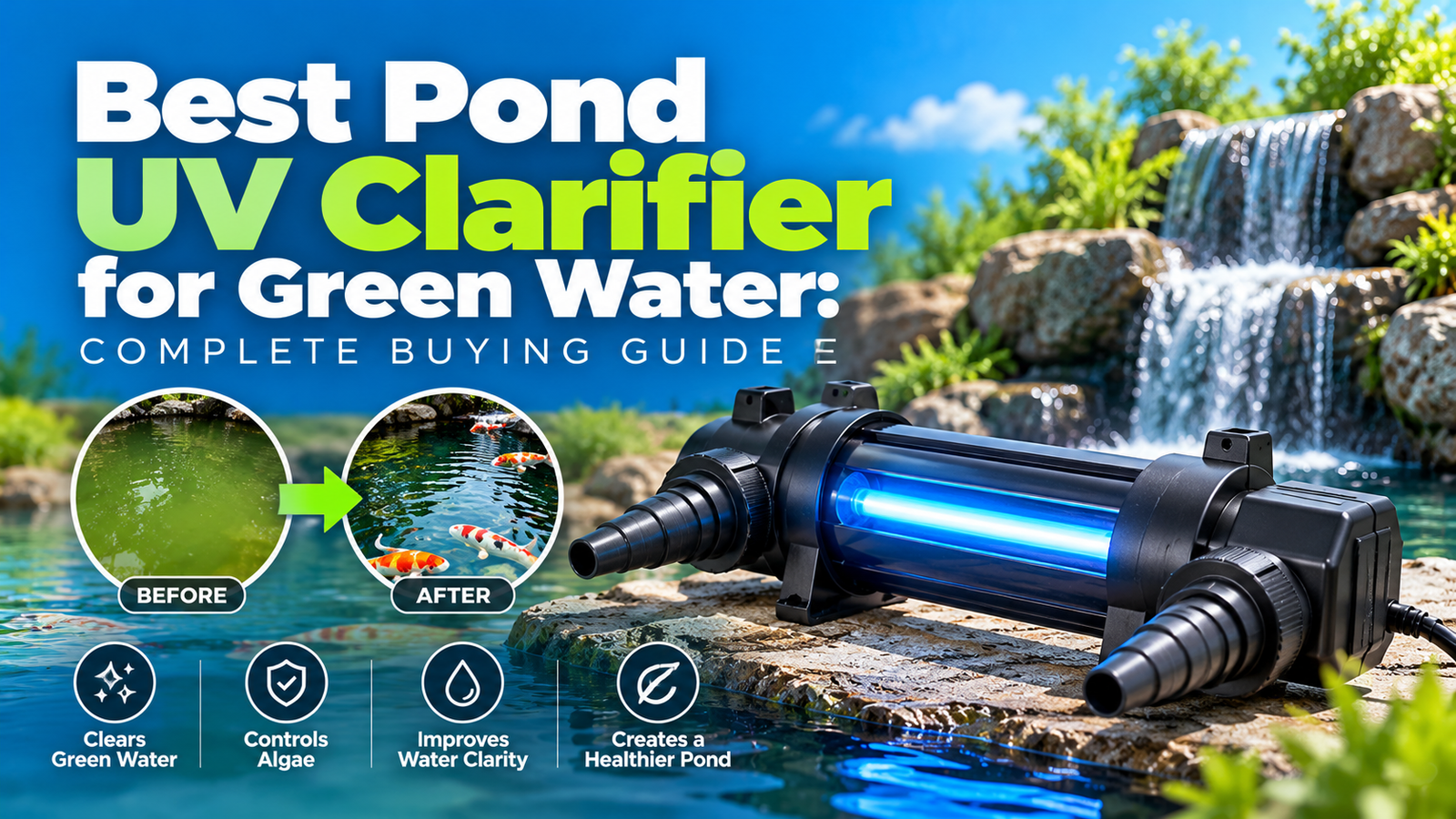
Green pond water is one of the most common problems faced by garden pond owners and koi fish keepers. Even when a pond has a working pump and filter, the water can turn green and cloudy because of suspended microscopic algae. This can make it difficult to see your fish and reduce the visual appeal of your pond.
One effective solution is a pond UV clarifier. This equipment uses ultraviolet light to treat water flowing through a specially designed chamber. When correctly sized and installed, a UV clarifier can help control suspended algae and improve water clarity.
Choosing the best pond UV clarifier for green water depends on several factors, including pond volume, fish stocking level, pump flow rate, UV power, and the overall filtration system.
In this guide, we explain how pond UV clarifiers work, what features to consider before purchasing one, and how to choose the right system for your pond.
What Is a Pond UV Clarifier?
A pond UV clarifier is a device that uses ultraviolet radiation, typically UV-C, to treat microorganisms suspended in pond water as they pass through the unit.
The water flows through a chamber containing a UV lamp protected by a suitable quartz sleeve. The lamp exposes the flowing water to UV-C radiation, which can damage the genetic material of susceptible microorganisms.
When used correctly, a UV clarifier can help control suspended green-water algae. The treated algae can then be captured by mechanical filtration or settle out of the water, depending on the system.
A UV clarifier does not physically remove debris by itself. The pond still needs suitable mechanical and biological filtration to manage solid waste and fish waste.
Benefits of a Pond UV Clarifier
A properly selected and maintained UV clarifier can provide several benefits:
- Helps control suspended algae responsible for green pond water.
- Improves water clarity when the main problem is free-floating algae.
- Allows pond owners to see fish more clearly.
- Works alongside mechanical and biological filtration.
- Can reduce the need to rely on chemical treatments for suspended green-water algae.
- Is available in different capacities for small garden ponds and larger koi ponds.
Important: A UV clarifier does not remove all types of algae. String algae attached to rocks, pond walls, or other surfaces may require different management methods.
Why Does Pond Water Turn Green?
Green pond water is commonly caused by microscopic algae growing in the water column. Several conditions can encourage algae growth.
1. Excessive Sunlight
Ponds exposed to direct sunlight for long periods may experience increased algae growth, particularly when sufficient nutrients are available.
2. Excess Nutrients
Fish waste, uneaten food, decomposing leaves, and other organic material can release nutrients into pond water.
Excess nutrients can support algae growth, especially when combined with warm temperatures and strong sunlight.
3. Insufficient Filtration
A pond with inadequate mechanical filtration may accumulate organic waste and suspended particles. Poorly maintained biological filtration can also contribute to water-quality problems.
4. Overfeeding Fish
Uneaten fish food decomposes and contributes to the nutrient load. Feeding appropriate quantities helps reduce unnecessary waste.
5. Poor Pond Maintenance
Leaves, sludge, and decaying organic material can accumulate in ponds if routine maintenance is neglected.
Addressing these underlying factors helps improve long-term water quality. A UV clarifier is most effective when used as part of a properly maintained pond filtration system.
Best Pond UV Clarifier for Green Water: What Should You Choose?
The best UV clarifier depends on your pond’s size, fish population, and filtration requirements. Rather than selecting a unit based only on wattage, consider its complete operating specifications.
1. Integrated UV Pond Filters
An integrated UV pond filter combines UV clarification with mechanical and biological filtration in a single unit.
These systems are useful when the pond owner wants to manage suspended algae and fish waste using a compact filtration setup.
Advantages:
- Combines multiple filtration functions.
- Can simplify installation.
- Suitable for compatible small and medium pond setups.
- Reduces the need to install separate filtration units in some applications.
Best for: Garden ponds, ornamental fish ponds, and suitable small to medium koi ponds.
Before purchasing, check the manufacturer’s recommended pond capacity, maximum flow rate, fish-stocked pond rating, and filter maintenance requirements.
2. Inline Pond UV Clarifiers
Inline UV clarifiers are installed within a suitable water circulation system, typically on the return line from a pump or filter.
Water passes through the UV chamber before returning to the pond.
Advantages:
- Can be integrated into an existing filtration system.
- Available in a range of UV power ratings.
- Allows independent selection of mechanical, biological, and UV filtration components.
- Suitable for many established pond systems.
Best for: Existing garden ponds and koi ponds that need additional UV clarification.
Confirm that the unit is compatible with your plumbing arrangement, pump flow, and installation conditions.
3. Pressure Filters with Built-In UV Clarification
Pressure pond filters combine a closed filter chamber with mechanical and biological filtration. Some models also include an integrated UV lamp.
These filters can be useful when a compact system is needed and the pump must move water through the filter under pressure.
Advantages:
- Combines filtration stages in one system.
- Can be convenient for selected pond installations.
- Some models offer cleaning mechanisms that simplify maintenance.
- May support water features such as waterfalls when correctly configured.
Best for: Small and medium garden ponds and suitable ornamental fish ponds.
Always check the filter’s actual rated capacity and the manufacturer’s instructions. A model’s advertised maximum pond volume may depend on fish stocking and operating conditions.
4. Standalone UV-C Clarifiers
A standalone UV-C clarifier focuses on UV treatment and is used alongside a separate mechanical and biological filtration system.
This arrangement allows pond owners to select UV equipment according to their requirements.
Advantages:
- Can be added to an existing filtration setup.
- Allows separate maintenance of the UV unit.
- Provides flexibility when upgrading a pond system.
- Available in different designs and power ratings.
Best for: Ponds with existing filters that require additional control of suspended algae.
A standalone UV clarifier is not a replacement for biological filtration. Fish waste and ammonia must still be managed by an appropriately designed filtration system.
How to Choose the Right Pond UV Clarifier
Before purchasing a UV clarifier, evaluate the following factors.
1. Calculate Your Pond’s Water Volume
Knowing your pond’s water volume helps narrow down the appropriate equipment options.
For a rectangular pond:
Water volume in litres = Length (m) × Width (m) × Average water depth (m) × 1,000
For example, a pond measuring 4 metres long, 3 metres wide, and 1 metre deep has a theoretical volume of:
4 × 3 × 1 × 1,000 = 12,000 litres
For irregular ponds, estimate the volume using the average depth or calculate individual sections separately.
The actual operating volume may be lower because of sloping sides, rocks, shelves, and other features.
2. Check the Recommended Pond Capacity
UV clarifiers are often marketed for particular pond volumes. However, the appropriate rating depends on more than water volume alone.
Consider:
- Whether the pond contains fish.
- The number and size of the fish.
- Daily feeding levels.
- Exposure to direct sunlight.
- The severity of the green-water problem.
- The performance of the existing filtration system.
A heavily stocked koi pond may require a more capable system than a lightly stocked ornamental pond with the same volume.
Always check the manufacturer’s recommendations for fish ponds rather than relying only on the maximum advertised capacity.
3. Consider UV Power
UV clarifiers are available with different lamp power ratings, commonly expressed in watts.
Higher wattage does not automatically mean better performance. Effectiveness also depends on water flow, chamber design, lamp condition, and the UV dose delivered to the water.
Select a unit based on the manufacturer’s guidance for your pond conditions.
4. Check the Flow Rate
Water must pass through the UV chamber at a suitable rate to receive the intended UV exposure.
If the flow rate is too high for the unit’s design, the water may receive insufficient UV treatment. If it is too low, circulation and overall pond turnover may be inadequate.
Check the manufacturer’s recommended operating flow rate and ensure the pump can deliver the required flow after accounting for pipework, fittings, and elevation.
5. Consider Your Existing Filter
A UV clarifier works best as part of a complete filtration system.
Mechanical filtration helps capture suspended particles and dead algae. Biological filtration supports beneficial bacteria that process ammonia and nitrite.
For koi ponds, both stages are particularly important because fish waste can create a substantial biological load.
6. Check Lamp Replacement and Maintenance Requirements
UV lamps gradually lose their effectiveness with use, even if they continue to illuminate visibly.
Before purchasing, check:
- Recommended lamp replacement intervals.
- Availability of replacement lamps.
- Quartz sleeve cleaning requirements.
- Electrical and water-sealing specifications.
- Access for servicing the unit.
Following the manufacturer’s maintenance schedule helps keep the system operating effectively.
How Does a Pond UV Clarifier Work?
A pond UV clarifier treats water as it passes through a UV chamber.
The process generally follows these steps:
Step 1: Water Circulation
A pond pump moves water through the filtration system.
Step 2: Mechanical Filtration
Where the system includes suitable mechanical filtration before the UV unit, suspended debris can be removed to help maintain good operating conditions.
Step 3: UV Treatment
Water passes through the UV chamber, where the lamp exposes susceptible suspended microorganisms to UV-C radiation.
Step 4: Algae Removal
UV treatment can damage suspended algae so that they clump together or become easier for the filtration system to capture.
Step 5: Water Returns to the Pond
The treated water returns to the pond through the system’s return line or water feature.
Results depend on the UV unit’s specifications, water flow, lamp condition, and the underlying cause of the green water.
How Long Does a UV Clarifier Take to Clear Green Pond Water?
The time required to improve water clarity varies with the severity of the algae problem, pond volume, sunlight exposure, nutrient levels, and the performance of the filtration system.
Some ponds show improvement within several days, while heavily affected ponds may take longer.
To improve results:
- Keep the UV lamp clean and operational.
- Ensure water passes through the UV chamber correctly.
- Maintain appropriate mechanical filtration.
- Remove accumulated organic debris.
- Avoid overfeeding fish.
- Monitor water quality.
- Reduce excessive nutrient inputs.
If green water persists, verify that the UV unit is correctly sized and that its lamp and quartz sleeve are functioning as intended.
Remember that UV treatment does not remove the nutrients that support future algae growth. Long-term control requires good pond maintenance and nutrient management.
UV Clarifier vs Pond Filter: What Is the Difference?
Although UV clarifiers and pond filters can be used together, they perform different functions.
| Feature | UV Clarifier | Mechanical Pond Filter | Biological Pond Filter |
|---|---|---|---|
| Main function | Controls susceptible suspended microorganisms | Captures physical debris | Supports beneficial bacteria |
| Helps with green water | Yes, when caused by suspended algae | Helps capture treated algae | Indirectly supports overall water quality |
| Removes solid waste | No | Yes | Not its primary purpose |
| Processes ammonia | No | No, not its primary function | Yes, through biological activity |
| Requires maintenance | Yes | Yes | Yes |
| Suitable for koi ponds | Yes, when correctly sized | Yes | Essential for effective fish-waste management |
For most fish ponds, these components work best as complementary parts of the same system.
Common Mistakes When Using a Pond UV Clarifier
Avoid the following mistakes to get better results from your UV system.
Choosing a Unit Based Only on Wattage
UV wattage is only one factor. The unit must be suitable for the pond’s volume, fish load, water flow, and algae problem.
Ignoring Mechanical Filtration
Dead or damaged algae may need to be captured by mechanical filtration. Without appropriate filtration, the water may remain cloudy or particles may continue circulating.
Using an Incorrect Flow Rate
Water moving through the chamber too quickly may not receive the intended UV exposure. Follow the unit manufacturer’s flow specifications.
Forgetting to Replace the UV Lamp
A lamp may continue to glow even when its UV output has declined. Follow the recommended replacement schedule.
Ignoring Nutrient Control
Excessive fish feeding, accumulated sludge, and decomposing leaves can contribute to recurring algae problems. UV treatment alone does not address these underlying causes.
Neglecting Electrical Safety
Pond equipment operates around water and must be installed according to the manufacturer’s instructions. Use appropriate electrical protection, waterproof connections, and qualified installation support where necessary.
Safety warning: Never look directly at an operating UV-C lamp or expose your skin or eyes to its radiation. Switch off and isolate the power before servicing the unit.
Frequently Asked Questions
1. What Is the Best Pond UV Clarifier for Green Water?
The best pond UV clarifier is one correctly rated for your pond volume, fish population, and operating flow rate. Inline UV clarifiers, integrated UV pond filters, and pressure filters with built-in UV systems can all be suitable, depending on the installation.
2. Does a UV Clarifier Remove Green Pond Water?
A properly sized UV clarifier can help control suspended algae responsible for green water. Mechanical filtration then helps remove the treated algae and other particles from the system.
3. How Many Watts of UV Do I Need for My Pond?
The required UV power depends on pond volume, fish stocking, sunlight exposure, algae severity, water flow, and the unit’s design. Follow the manufacturer’s recommendations for your specific application instead of relying on a universal watts-per-litre calculation.
4. Can I Use a UV Clarifier in a Koi Pond?
Yes. UV clarifiers are commonly used in koi ponds to help control suspended algae. They should be combined with adequate mechanical and biological filtration, proper aeration, and routine water-quality monitoring.
5. Should a UV Clarifier Be Installed Before or After the Filter?
The recommended position depends on the equipment design. In many systems, mechanical filtration before the UV unit helps reduce suspended debris and maintain effective UV operation. Always follow the manufacturer’s plumbing and installation instructions.
6. Does UV Treatment Harm Koi Fish?
When the UV lamp is enclosed in a properly designed chamber and installed correctly, the pond water can be treated without directly exposing the fish to the lamp. Never operate an exposed UV-C lamp where fish, people, or animals could be exposed to its radiation.
7. Will a UV Clarifier Remove String Algae?
No. UV clarifiers primarily target susceptible microorganisms suspended in the water. String algae attached to pond surfaces usually requires other management methods, including controlling nutrients, removing excess growth, and improving pond maintenance.
8. How Often Should I Replace a Pond UV Lamp?
Replacement intervals vary by lamp type and manufacturer. Follow the specified operating-hour or seasonal replacement schedule, even if the lamp still appears to be working.
9. Can a UV Clarifier Work Without a Pond Filter?
A UV clarifier can operate in some pump-driven systems without a dedicated mechanical filter, provided the installation meets the manufacturer’s requirements. However, a proper filtration system is strongly recommended for fish ponds because UV treatment does not remove solid waste or process ammonia.
10. Is a UV Clarifier Enough to Keep Pond Water Clear?
No. UV clarification helps control suspended algae, but clear and healthy pond water also depends on suitable filtration, balanced fish stocking, proper feeding, water circulation, and nutrient management.
Conclusion: Choose the Right Pond UV Clarifier for Clearer Water
A pond UV clarifier can be an effective solution for green water caused by suspended algae. However, choosing the right unit requires more than simply selecting the highest wattage or largest advertised pond capacity.
Consider your pond’s water volume, fish population, pump flow rate, existing filtration system, and maintenance requirements before purchasing.
For koi ponds and other fish ponds, combine suitable UV clarification with mechanical filtration, biological filtration, and regular water-quality testing.
At Greenfin The Pond Studio, selecting the right pond equipment starts with understanding your pond’s requirements.
Explore the pond filtration equipment available at Greenfinindia.com to find suitable pond filters, pumps, and UV clarification systems for your setup.