

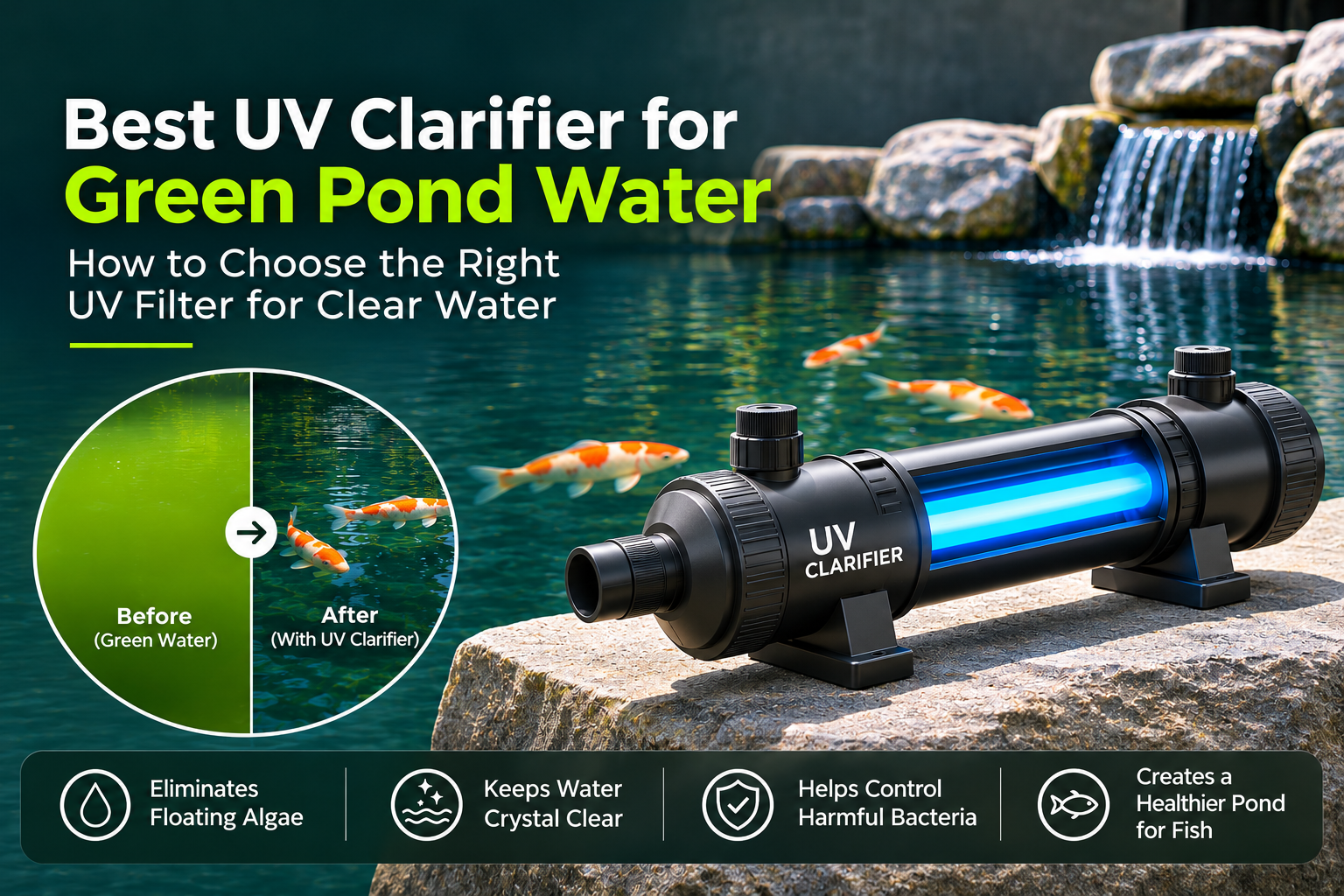
Green pond water is one of the most common problems faced by outdoor pond owners. It usually occurs because of suspended microscopic algae that multiply rapidly when sunlight, excess nutrients and warm temperatures create favourable conditions. Green water can reduce visibility, affect the appearance of your pond and make it difficult to observe koi and other ornamental fish.
One of the most effective solutions for controlling suspended green-water algae is a UV clarifier for ponds. A UV clarifier uses ultraviolet light to treat algae as pond water passes through the unit, helping improve water clarity.
Choosing the right UV clarifier depends on several factors, including pond water volume, pump flow rate, fish population and the intensity of sunlight.
In this guide, we will explain how UV clarifiers work, how to select the right model and how to maintain your UV filtration system for better pond water quality.
What Is a UV Clarifier for a Fish Pond?
A UV clarifier is a pond filtration device that uses ultraviolet-C (UV-C) light to control suspended algae and certain microorganisms in circulating pond water.
It generally consists of:
- UV-C lamp
- Quartz glass sleeve
- Waterproof housing
- Water inlet and outlet
- Electrical connection
- Internal water flow chamber
When pond water passes through the UV chamber, it is exposed to UV-C radiation. This damages the reproductive ability of suspended algae, causing them to clump together. These particles can then be captured by the mechanical filtration system.
A UV clarifier is particularly useful for ponds experiencing green water caused by free-floating algae.
Why Does Pond Water Turn Green?
Before choosing the best UV clarifier, it is important to understand why your pond water becomes green.
The main reasons include:
1. Excessive Sunlight
Outdoor ponds exposed to direct sunlight for long periods can experience rapid algae growth.
2. Excess Fish Waste
Koi and other pond fish produce waste that contributes to nutrient accumulation. Excess nutrients encourage algae multiplication.
3. Overfeeding Fish
Uneaten fish food decomposes in the water and increases nutrient levels, creating favourable conditions for algae growth.
4. Poor Filtration
An undersized or poorly maintained filtration system may struggle to remove fish waste and organic matter.
5. High Nutrient Levels
Excess phosphate and nitrate can encourage algae growth, particularly in ponds with inadequate filtration and maintenance.
How Does a UV Clarifier Remove Green Pond Water?
A UV clarifier works continuously as part of the pond’s water circulation system.
The process generally follows these steps:
- Pond water is drawn into the filtration system using a pond pump.
- Water passes through the UV clarifier chamber.
- The UV-C lamp exposes suspended algae to ultraviolet radiation.
- The treated algae lose their ability to reproduce normally and begin clumping together.
- The clumped particles are removed through mechanical filtration.
- Cleaner water returns to the pond.
Important: A UV clarifier does not physically remove dead algae from the pond. A mechanical filter is necessary to capture the clumped algae particles.
Best UV Clarifier for Green Pond Water: What Should You Choose?
The best UV clarifier depends on your pond size, fish population, water circulation and filtration requirements.
Here are some important factors to consider before purchasing one.
1. UV Wattage
UV clarifiers are available in different wattage capacities. Common options include:
- 9W UV clarifiers
- 11W UV clarifiers
- 18W UV clarifiers
- 24W UV clarifiers
- 36W UV clarifiers
- 55W UV clarifiers
- Higher-capacity commercial UV systems
Higher wattage does not automatically mean better performance. The correct wattage depends on the pond volume, water flow rate, algae conditions and the manufacturer’s recommended application.
2. Pond Water Volume
Always calculate your pond’s water volume before selecting a UV clarifier.
For a rectangular pond:
Water Volume (Litres) = Length × Width × Water Depth × 1,000
Measurements should be in metres.
For example:
- Length: 4 metres
- Width: 3 metres
- Water depth: 1.2 metres
Water volume:
4 × 3 × 1.2 × 1,000 = 14,400 litres.
This calculation helps you identify an appropriate UV clarifier based on the manufacturer’s capacity recommendations.
3. Pump Flow Rate
The pump must deliver an appropriate flow rate through the UV chamber.
If water moves too quickly, it may not receive sufficient UV exposure. If the flow is too low, overall pond circulation may become inadequate.
Always check the recommended operating flow rate of the UV clarifier.
4. Fish Population
A koi pond with a high fish population produces more waste than a lightly stocked ornamental pond.
Such ponds require effective mechanical and biological filtration alongside UV clarification.
5. Outdoor Pond Conditions
Ponds exposed to direct sunlight may experience more severe algae growth. In these situations, an appropriately sized UV clarifier and a properly designed filtration system are particularly important.
UV Clarifier vs UV Sterilizer: What Is the Difference?
Although these terms are sometimes used interchangeably, their applications can differ.
| Feature | UV Clarifier | UV Sterilizer |
|---|---|---|
| Main purpose | Control suspended green-water algae | Treat microorganisms |
| UV exposure | Designed for algae clarification | May use higher UV doses |
| Water flow | Depends on model | Depends on target organism and dose |
| Application | Garden ponds and fish ponds | Advanced pond and aquarium systems |
The actual performance depends on UV intensity, exposure time, lamp condition and water clarity.
For most garden ponds experiencing green water, a properly sized UV clarifier is a practical starting point.
Benefits of Using a UV Clarifier in Koi Ponds
Installing a UV clarifier offers several advantages.
1. Helps Control Green Water
It targets suspended algae responsible for green pond water.
2. Improves Water Visibility
By reducing suspended algae, it helps improve visibility and makes it easier to observe koi fish.
3. Supports Pond Filtration
It works alongside mechanical and biological filtration to maintain better water quality.
4. Helps Maintain Pond Appearance
Clearer water improves the overall appearance of outdoor ponds and water features.
5. Suitable for Continuous Operation
Many pond UV clarifiers are designed for continuous operation according to their manufacturer’s instructions.
How to Install a UV Clarifier in a Fish Pond
Correct installation is important for effective performance.
Follow these steps:
- Select a UV clarifier suitable for your pond volume.
- Install the pond pump according to the required circulation system.
- Connect the pump outlet to the UV clarifier inlet.
- Connect the UV outlet to the mechanical filtration system or the recommended return arrangement.
- Ensure all plumbing connections are secure.
- Switch on the water circulation system.
- Check for leaks and confirm proper water flow.
- Power the UV lamp according to the manufacturer’s instructions.
Safety note: Never look directly at an operating UV-C lamp. Always disconnect electrical power before opening or servicing the UV unit. UV-C radiation can damage eyes and skin.
How to Maintain a Pond UV Clarifier
Regular maintenance helps maintain UV performance.
Clean the Quartz Sleeve
Mineral deposits and dirt can accumulate on the quartz sleeve and reduce UV transmission. Clean it according to the manufacturer’s maintenance instructions.
Replace the UV Lamp
UV lamps gradually lose their effectiveness even when they continue to glow.
Replace the lamp according to the manufacturer’s recommended operating hours.
Check Water Flow
Inspect inlet and outlet connections for blockages. Make sure the pump is supplying the correct flow rate.
Inspect Electrical Connections
Check cables, plugs and waterproof connections regularly. Always disconnect power before inspection.
Maintain Mechanical Filtration
Clean mechanical filter media regularly to prevent accumulated algae and debris from reducing filtration efficiency.
Common Mistakes to Avoid When Using a UV Clarifier
Avoid these mistakes when installing or operating a pond UV system:
- Choosing a UV clarifier without calculating pond water volume.
- Using an unsuitable pump flow rate.
- Ignoring quartz sleeve cleaning.
- Continuing to use an old UV lamp beyond its recommended service life.
- Depending entirely on UV clarification without mechanical filtration.
- Overfeeding fish and allowing excess nutrients to accumulate.
- Ignoring biological filtration and regular water testing.
A UV clarifier is not a replacement for a complete pond filtration system.
Frequently Asked Questions (FAQs)
1. What is the best UV clarifier for green pond water?
The best UV clarifier depends on pond water volume, fish population, pump flow rate and algae conditions. Choose a model with a suitable wattage and manufacturer-recommended pond capacity.
2. How long does a UV clarifier take to clear green pond water?
Depending on algae concentration, UV capacity, water circulation and mechanical filtration, visible improvement may take several days to a few weeks.
3. Can a UV clarifier remove all types of pond algae?
No. UV clarifiers primarily target suspended algae responsible for green water. They do not directly remove string algae, blanket weed or algae attached to pond surfaces.
4. Should I run my pond UV clarifier continuously?
Many pond UV clarifiers are designed for continuous operation during the pond season. Follow the manufacturer’s operating instructions.
5. Does a UV clarifier harm koi fish?
When correctly installed in a closed UV chamber, the UV-C light does not directly expose koi fish. The lamp should never be operated outside its protective housing.
6. Do I need a filter along with a UV clarifier?
Yes. A mechanical filter is important for capturing algae particles after UV treatment. Biological filtration is also necessary to process harmful ammonia and nitrite produced by fish waste.
7. When should I replace my pond UV lamp?
Follow the lamp manufacturer’s recommended replacement interval. Many conventional UV-C lamps require replacement after approximately 8,000–9,000 operating hours, depending on the lamp type.
Conclusion
Green pond water can affect the appearance of your pond and make it difficult to enjoy the beauty of koi fish. A properly selected UV clarifier for green pond water is an effective solution for controlling suspended algae.
However, the best results come from combining UV clarification with proper mechanical filtration, biological filtration, suitable water circulation and regular pond maintenance.
Before purchasing a UV clarifier, calculate your pond’s water volume, check the pump flow rate and select a suitable UV wattage.
At Greenfin The Pond Studio, you can explore pond pumps, UV clarifiers, pond filters and other pond equipment to help build an effective pond filtration system.
Visit **https://greenfinindia.com/**