

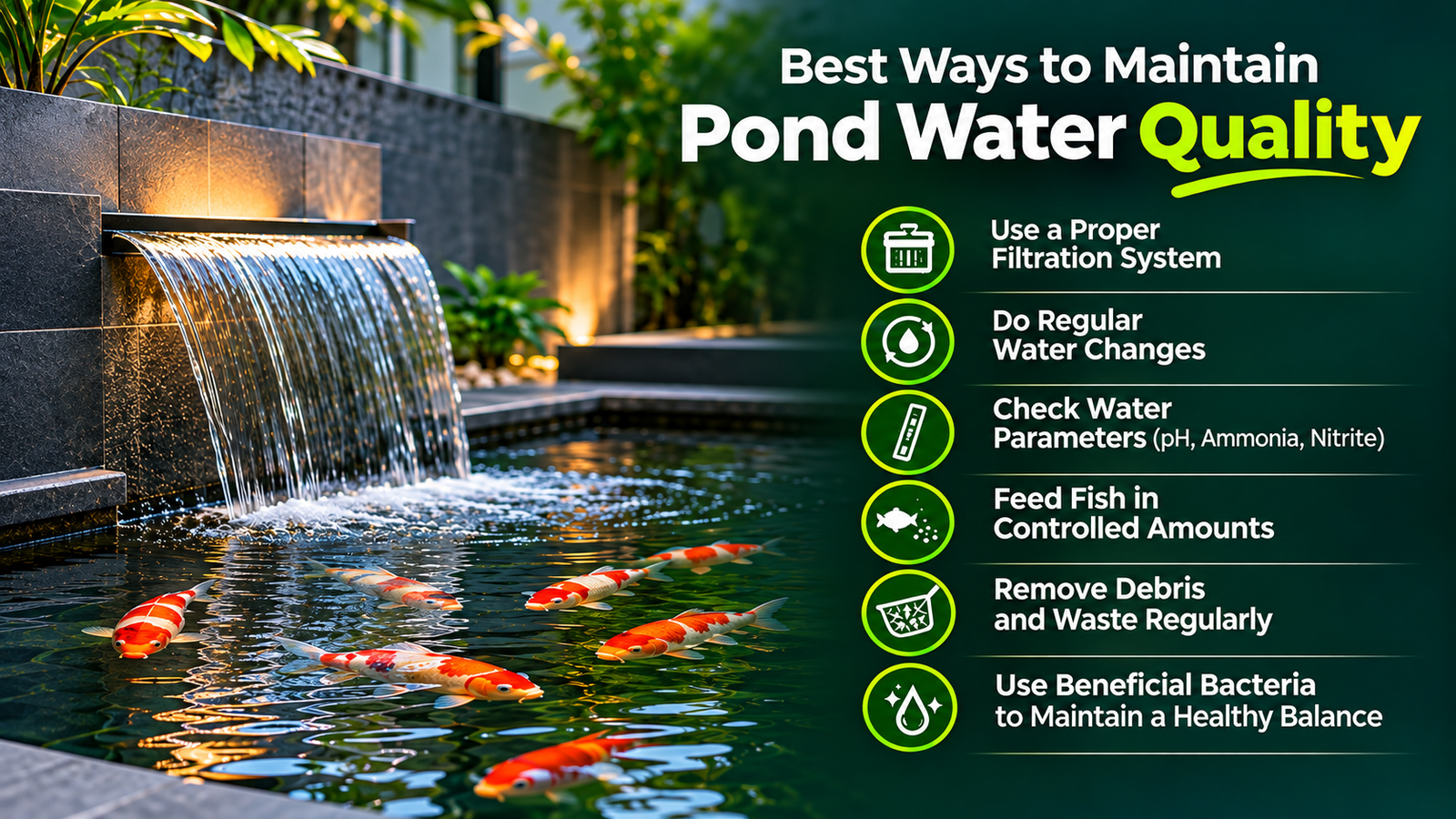
Maintaining good pond water quality is essential for keeping fish healthy, preventing algae growth and creating a clean, beautiful pond environment. Whether you have a small garden pond, an outdoor koi pond or a large ornamental pond, proper water management plays an important role in maintaining a healthy aquatic ecosystem.
Poor water quality can lead to cloudy water, unpleasant odours, excessive algae growth, low oxygen levels and fish health problems. Regular maintenance, effective filtration, proper aeration and balanced fish feeding can help prevent these issues.
In this guide, we will explore the best ways to maintain pond water quality and explain how to keep your pond clean, clear and healthy throughout the year.
1. Install an Efficient Pond Filtration System
A good filtration system is one of the most important components of a healthy pond. It removes waste materials, uneaten fish food, suspended particles and harmful substances from the water.
A pond filtration system generally includes three types of filtration.
Mechanical Filtration
Mechanical filtration removes visible waste particles such as fish waste, leaves, dirt and uneaten food.
Common mechanical filter media include:
- Filter sponges
- Filter brushes
- Filter mats
- Filter pads
Regular cleaning of mechanical filter media helps maintain proper water flow and filtration efficiency.
Biological Filtration
Biological filtration supports beneficial bacteria that break down harmful ammonia and nitrite produced by fish waste and decomposing organic matter.
Common biological filter media include:
- Bio balls
- Ceramic rings
- K1 moving bed media
- Lava rock
- Bio filter media blocks
Biological filtration is particularly important for koi ponds because koi fish produce considerable waste.
UV Filtration
UV clarifiers use ultraviolet light to control suspended green-water algae.
They help improve water clarity by treating green water caused by free-floating algae. However, UV filtration does not replace mechanical or biological filtration.
Tip: Choose a pond filtration system based on pond water volume, fish quantity, feeding rate and overall pond conditions.
2. Perform Regular Partial Water Changes
Regular partial water changes help maintain stable water conditions and reduce accumulated dissolved waste.
Over time, fish waste, uneaten food and organic materials can affect pond water quality.
Follow these practices:
- Replace approximately 10–20% of pond water periodically, adjusting according to water test results and pond conditions.
- Use properly treated replacement water.
- Avoid sudden temperature or pH changes.
- Never replace all pond water unnecessarily.
- Check water quality before and after major water changes.
For koi ponds with heavy fish stocking, more frequent partial water changes may be required.
3. Monitor Pond Water Parameters
Testing pond water regularly helps identify potential problems before they affect fish health.
The following parameters are particularly important.
| Water parameter | Recommended target |
|---|---|
| pH | Generally 7.0–8.5 |
| Ammonia (NH3/NH4+) | 0 mg/L |
| Nitrite (NO2-) | 0 mg/L |
| Dissolved oxygen | Preferably above 6 mg/L |
| Nitrate (NO3-) | Keep low; ideally below 50 mg/L |
These are general koi pond management targets. Suitable ranges can vary depending on fish species and local conditions. Stable water parameters are often more important than making frequent adjustments.
Why Is Water Testing Important?
- Detects harmful ammonia and nitrite.
- Identifies sudden pH changes.
- Helps monitor biological filter performance.
- Prevents water quality problems.
- Supports healthy fish growth.
Use a reliable pond water testing kit to monitor these parameters regularly.
4. Prevent Excessive Algae Growth
Algae growth is one of the most common problems in outdoor ponds. Excess nutrients, direct sunlight and poor filtration can encourage algae to grow rapidly.
Excessive algae can cause green water, reduce visibility and contribute to oxygen fluctuations.
Effective Ways to Control Algae
- Avoid overfeeding fish.
- Remove accumulated leaves and organic waste.
- Maintain an efficient biological filtration system.
- Install a suitable UV clarifier for suspended green-water algae.
- Reduce excessive direct sunlight where practical.
- Maintain proper water circulation.
Remember that some algae growth is natural in ponds. The goal is to control excessive growth rather than eliminate every form of algae.
5. Maintain Proper Water Circulation
Good water circulation ensures that water moves throughout the pond instead of remaining stagnant in certain areas.
A suitable pond pump helps move water through the filtration system and improves overall circulation.
Benefits of proper water circulation include:
- Reduces stagnant water areas.
- Helps distribute dissolved oxygen.
- Improves filtration efficiency.
- Supports a healthier pond environment.
- Helps transport suspended waste towards filtration equipment.
Choose a pond pump according to pond volume, filter requirements, pipe diameter and required flow rate.
For ponds with waterfalls or fountains, calculate the additional flow requirement based on the desired water feature.
6. Provide Sufficient Aeration
Dissolved oxygen is essential for fish survival and beneficial bacterial activity.
Low oxygen levels can stress fish, particularly during hot weather, at night and in heavily stocked ponds.
Ways to Improve Pond Oxygen Levels
- Install a suitable pond air pump.
- Use air stones or diffuser discs.
- Maintain proper water movement.
- Add a waterfall or fountain.
- Avoid excessive fish stocking.
- Keep biological filtration working efficiently.
For koi ponds, adequate aeration is especially important because koi fish require good oxygen availability.
7. Avoid Overfeeding Your Pond Fish
Overfeeding is a major contributor to poor pond water quality.
Uneaten fish food decomposes and releases nutrients into the water. Fish waste also increases the biological load on the filtration system.
Best Feeding Practices
- Feed fish only what they can consume within a few minutes.
- Avoid feeding more than necessary.
- Remove uneaten food.
- Select good-quality fish food.
- Adjust feeding according to water temperature and fish activity.
Proper feeding helps reduce waste production and keeps the pond filtration system operating efficiently.
8. Remove Leaves, Debris and Organic Waste
Leaves, dead plants, fish waste and other organic materials can accumulate at the bottom of a pond.
As these materials decompose, they release nutrients and consume oxygen.
Regular cleaning helps prevent excessive organic waste accumulation.
Pond Cleaning Tips
- Remove floating leaves using a pond net.
- Clean accumulated debris from the pond bottom.
- Check skimmers and bottom drains.
- Remove dead aquatic plants.
- Clean mechanical filter media when required.
A pond vacuum can also help remove settled sludge and debris.
9. Maintain Your Pond Filter Regularly
Even an efficient filtration system requires regular maintenance.
A blocked or poorly maintained filter can reduce water circulation and filtration performance.
Pond Filter Maintenance Checklist
- Inspect the filter regularly.
- Remove accumulated dirt from mechanical filter media.
- Check pump intake and outlet pipes.
- Inspect UV clarifier bulbs according to manufacturer recommendations.
- Check for leaks and blockages.
- Avoid cleaning all biological filter media at the same time.
- Avoid using untreated tap water to clean biological media, as chlorine and chloramine can damage beneficial bacteria.
Maintaining beneficial bacteria is essential for stable biological filtration.
10. Adjust Pond Maintenance According to Seasons
Pond maintenance requirements change throughout the year.
| Season | Important maintenance activities |
|---|---|
| Summer | Monitor oxygen levels, temperature and evaporation |
| Monsoon | Check overflow, drainage and water quality after rainfall |
| Winter | Adjust fish feeding according to temperature and activity |
| Spring | Inspect filtration, remove debris and monitor water parameters |
Pond Maintenance During the Monsoon
Rainwater can introduce dirt, pollutants and other unwanted substances into outdoor ponds.
Heavy rainfall can also change pond water chemistry.
During the rainy season:
- Monitor pH and water quality after heavy rainfall.
- Check pond overflow and drainage systems.
- Remove leaves and debris.
- Inspect pump and filtration systems.
- Ensure electrical equipment is protected from water exposure.
Common Pond Water Quality Problems and Solutions
| Problem | Possible cause | Recommended solution |
|---|---|---|
| Green water | Suspended algae | Suitable UV clarifier and nutrient control |
| Cloudy water | Suspended particles or bacterial bloom | Improve filtration and monitor water parameters |
| Bad smell | Accumulated organic waste | Remove sludge and improve circulation |
| Fish gasping at surface | Low oxygen or water quality issue | Increase aeration and test water immediately |
| Excessive algae | Excess nutrients and sunlight | Improve filtration and control feeding |
| Foamy water | Organic waste and dissolved proteins | Improve filtration and remove organic debris |
Essential Equipment for Maintaining Pond Water Quality
Having the right equipment makes pond maintenance easier and more effective.
| Equipment | Main purpose |
|---|---|
| Pond Pump | Maintains water circulation |
| Biological Pond Filter | Supports beneficial bacteria |
| Mechanical Filter | Removes suspended waste |
| UV Clarifier | Controls suspended green-water algae |
| Pond Air Pump | Improves oxygen availability |
| Pond Skimmer | Collects floating leaves and debris |
| Filter Media | Supports mechanical and biological filtration |
| Water Testing Kit | Monitors important water parameters |
Choosing equipment according to your pond size and fish population is essential for achieving good results.
Frequently Asked Questions (FAQs)
1. How can I keep my pond water clean naturally?
Maintain a balanced fish population, avoid overfeeding, remove organic debris, provide sufficient aeration and maintain beneficial bacteria through biological filtration.
2. How often should I change pond water?
A partial water change of around 10–20% periodically is a common starting point. The actual frequency depends on fish stocking, feeding levels, filtration capacity and water test results.
3. Why does my pond water turn green?
Green pond water is usually caused by suspended microscopic algae. Excess nutrients, sunlight and insufficient nutrient management can encourage algae growth.
4. Does a UV filter help keep pond water clear?
Yes. A correctly sized UV clarifier helps control suspended green-water algae. However, it does not remove sludge or replace biological filtration.
5. How important is biological filtration in a koi pond?
Biological filtration is essential because it supports beneficial bacteria that convert toxic ammonia into nitrite and then into less harmful nitrate through the nitrogen cycle.
6. How do I know if my pond water is unhealthy for fish?
Warning signs include fish gasping at the surface, unusual swimming behaviour, cloudy water, unpleasant smells and sudden changes in water parameters. Test ammonia, nitrite, pH and dissolved oxygen immediately when problems occur.
7. Can too many fish affect pond water quality?
Yes. Excessive fish stocking increases waste production and oxygen demand, placing additional pressure on the filtration system.
Conclusion
Maintaining good pond water quality requires regular attention to filtration, aeration, water circulation, fish feeding and water testing.
The best ways to maintain pond water quality include installing an efficient filtration system, performing suitable partial water changes, controlling algae growth, removing organic waste and providing sufficient oxygen.
For koi ponds and outdoor ornamental ponds, selecting the correct pond pump, UV clarifier and biological filtration system makes a significant difference in long-term water quality.
At Greenfin The Pond Studio, we provide pond filtration equipment, pond pumps, UV clarifiers, filter media and pond construction solutions to help create and maintain healthy pond environments.
Explore pond products and solutions at Greenfinindia.com.