

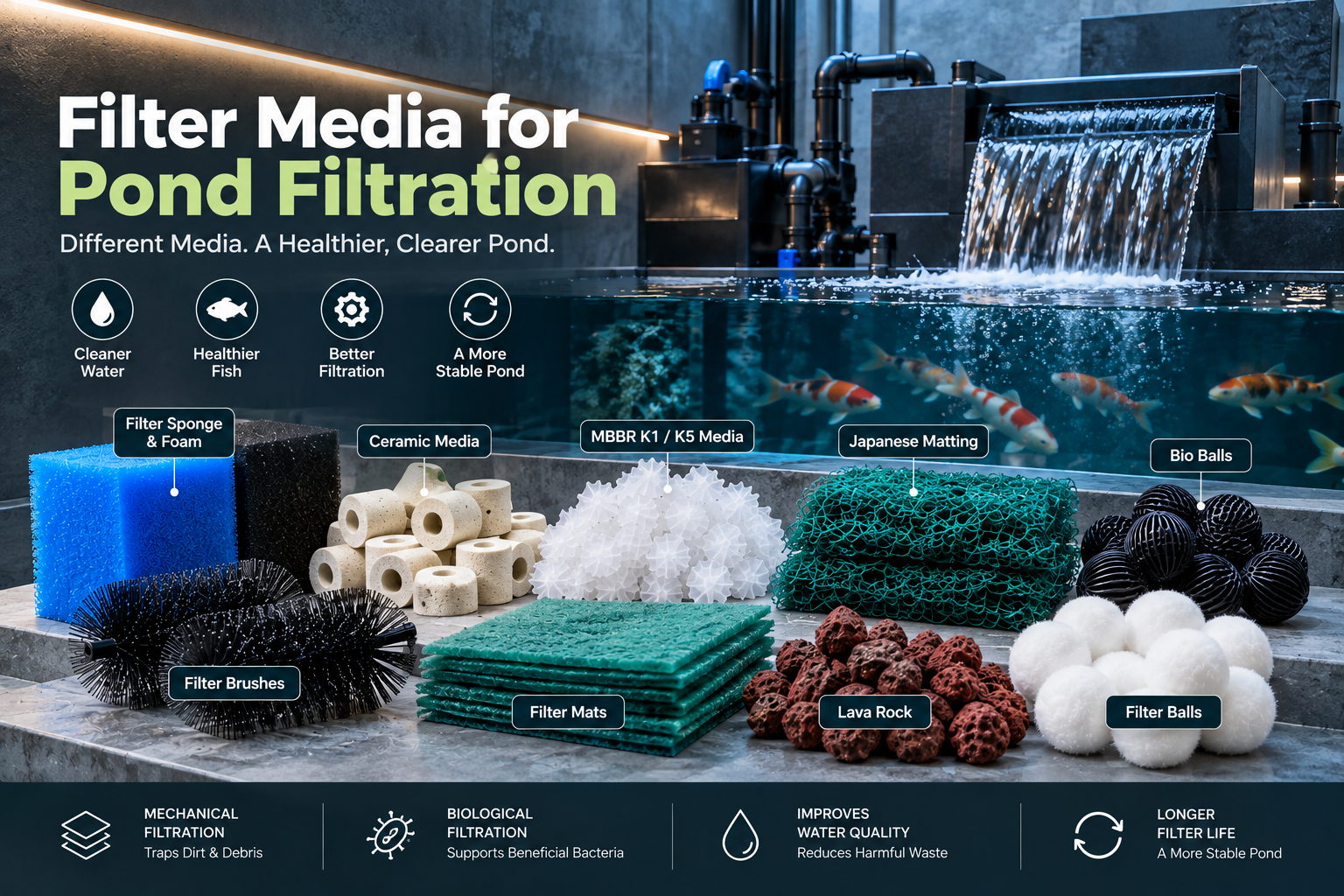
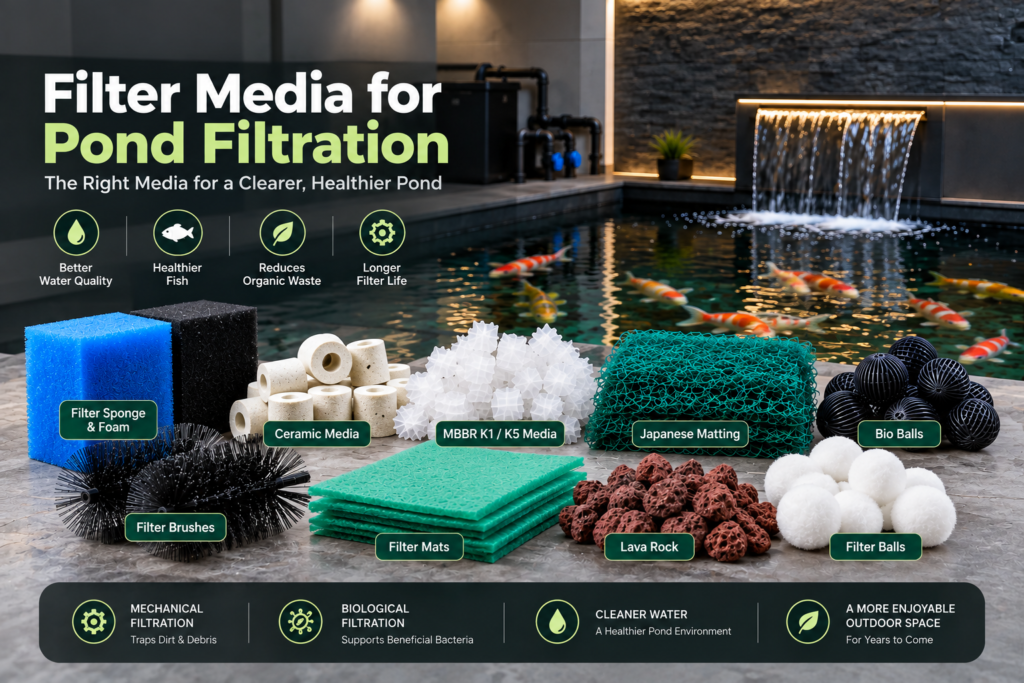
A good pond filtration system is essential for maintaining clean, clear, and healthy pond water. Whether you have a koi pond, ornamental pond, garden pond, or water feature, the filtration system needs the right filter media for pond filtration to effectively remove waste and support beneficial bacteria.
Pond filter media play different roles depending on their design and application. Some media physically trap dirt and suspended particles, while others provide a large surface area for beneficial bacteria that help break down harmful compounds produced by fish waste and organic matter.
Choosing the right combination of filter media can improve water quality, support fish health, reduce maintenance, and help your pond filtration system operate more efficiently.
In this guide, we explain the different types of pond filter media, how they work, where to use them, and how to choose the right media for your pond.
What Is Pond Filter Media?
Pond filter media are materials placed inside a pond filtration system to help remove unwanted substances from the water.
Depending on the type, pond filter media can provide:
- Mechanical filtration
- Biological filtration
- Chemical filtration
- Increased surface area for beneficial bacteria
- Improved water clarity
- Better waste management
A properly designed filtration system often uses multiple types of media rather than relying on a single material.
Why Is Filter Media Important for Pond Filtration?
Pond water contains fish waste, uneaten food, leaves, dust, algae, and other organic matter. Without effective filtration, these substances can accumulate and affect water quality.
The right filter media for pond filtration helps separate solids and supports biological processes that keep the pond ecosystem more stable.
Good filtration can help:
- Reduce suspended particles
- Improve water clarity
- Support beneficial bacteria
- Process ammonia and nitrite
- Reduce organic waste accumulation
- Create healthier conditions for koi and other fish
- Reduce the frequency of intensive pond cleaning
However, filter media work most effectively when combined with suitable pond pumps, proper circulation, adequate aeration, and regular maintenance.
Types of Pond Filter Media
There are several types of filter media available for pond filtration systems. Each has a different purpose.
1. Filter Sponge and Foam
Foam and sponge media are commonly used for mechanical filtration.
They trap larger particles and suspended debris as pond water passes through them.
They are useful for:
- Removing visible debris
- Pre-filtration
- Protecting biological media from excessive clogging
- Improving water clarity
Different foam densities can capture particles of different sizes.
Coarse foam is generally useful for larger debris, while finer foam can capture smaller suspended particles.
2. Ceramic Filter Media
Ceramic media provide a porous surface where beneficial bacteria can colonize.
These bacteria play an important role in biological filtration by converting harmful ammonia and nitrite into less harmful nitrate.
Ceramic media are commonly used in:
- Biological filter chambers
- Multi-chamber pond filters
- Koi pond filtration systems
- Water gardens
The effectiveness of ceramic media depends on its structure, surface area, water flow, and overall filtration design.
3. MBBR K1 and K5 Media
Moving Bed Biofilm Reactor media, commonly called MBBR media, are popular biological filter media for ponds.
The media move continuously inside a filter chamber when supplied with sufficient aeration.
As the media circulate, beneficial bacteria grow on their surfaces.
MBBR media can be used in:
- Koi pond filtration
- Multi-chamber filters
- Biological filtration chambers
- Custom pond filtration systems
- High-bioload systems
One advantage of moving-bed systems is that the media can remain continuously moving, helping reduce the accumulation of trapped solids.
4. Japanese Matting
Japanese matting is a popular biological and mechanical filtration material used in many pond filtration systems.
Its open structure allows water to pass through while providing surfaces for beneficial bacteria.
Japanese matting is commonly used in:
- Koi ponds
- Multi-chamber filters
- Gravity-fed filtration systems
- Biological filter chambers
It can be cut to fit different filtration chambers and is relatively easy to maintain.
5. Filter Brushes
Filter brushes are commonly used as mechanical filtration media.
Their long bristles help trap larger debris and suspended solids as water flows through the filter chamber.
They are particularly useful as an initial filtration stage because they can capture larger waste before water reaches finer or biological media.
Regular cleaning is important because heavily clogged brushes can restrict water flow.
6. Filter Balls
Filter balls are lightweight filtration media that can provide surface area for biological bacteria while also helping trap smaller particles.
They can be used in different pond filter chambers depending on the filtration system design.
Their lightweight construction can make them convenient to handle during maintenance.
7. Bio Balls
Bio balls are designed primarily for biological filtration.
Their open structure provides surfaces for beneficial bacteria to colonize.
They are commonly used in:
- Biological filter chambers
- Waterfalls
- Wet/dry filtration systems
- Pond filters
- Koi filtration systems
Bio balls are particularly useful when a large amount of surface area is needed without using very dense media.
8. Filter Mats
Filter mats are available in different densities and structures.
They can provide both mechanical and biological filtration depending on how they are used.
Coarser mats can be positioned earlier in the filtration process to capture larger debris, while finer mats can be used for additional particle filtration.
9. Lava Rock
Lava rock has a naturally porous structure that can provide surfaces for beneficial bacteria.
It has historically been used in some pond filtration systems because it is readily available and can provide substantial surface area.
However, its weight and potential for collecting debris should be considered when designing a filtration system.
Mechanical vs Biological Pond Filter Media
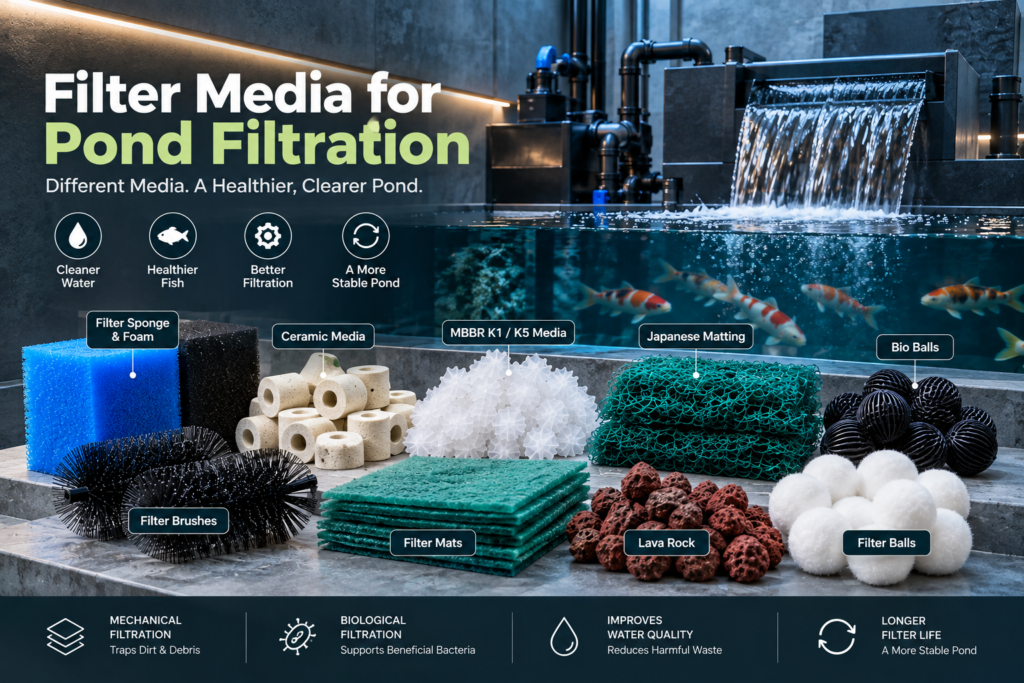
Understanding the difference between mechanical and biological filtration is important when choosing pond media.
Mechanical Filter Media
Mechanical media physically capture particles from the water.
Examples include:
- Filter brushes
- Foam
- Filter mats
- Filter socks
- Mechanical pads
The primary purpose is to remove solid waste before it reaches the biological filtration stage.
Biological Filter Media
Biological media provide surfaces where beneficial bacteria can live.
Examples include:
- Ceramic media
- Bio balls
- MBBR media
- Japanese matting
- Specialized biological media
These bacteria help process ammonia and nitrite as part of the pond’s nitrogen cycle.
A good filtration system generally combines both mechanical and biological filtration.
What Is the Best Filter Media for a Koi Pond?
There is no single filter media that is best for every koi pond.
The right combination depends on:
- Pond volume
- Number and size of koi
- Feeding level
- Pump flow rate
- Filter chamber size
- Mechanical pre-filtration
- Maintenance requirements
- Available space
For example, a koi pond may use a mechanical stage to remove solid waste, followed by biological media such as MBBR media or Japanese matting.
High-bioload ponds may require more biological filtration capacity and efficient mechanical pre-filtration.
How Much Filter Media Does a Pond Need?
The amount of filter media required depends on the pond’s biological load rather than simply the pond’s water volume.
Important factors include:
- Pond volume
- Fish population
- Fish size
- Feeding quantity
- Filter design
- Media type
- Water flow
- Aeration
A pond containing a large number of koi can require substantially more biological filtration than a lightly stocked ornamental pond of the same volume.
This is why filtration should be designed according to the complete pond system rather than selecting media based only on litres of water.
How to Arrange Pond Filter Media
The order of filtration stages can significantly affect performance.
A typical filtration arrangement may look like:
Pond → Mechanical Filtration → Fine Mechanical Filtration → Biological Filtration → UV Clarification → Pond
For example:
First Stage – Mechanical
Use:
- Filter brushes
- Coarse sponge
- Coarse filter mats
The goal is to remove larger debris.
Second Stage – Fine Mechanical
Use:
- Fine filter mats
- Fine sponge
- Other suitable polishing media
This stage helps remove smaller suspended particles.
Third Stage – Biological
Use:
- MBBR media
- Ceramic media
- Bio balls
- Japanese matting
This stage provides surfaces for beneficial bacteria.
Final Stage
Depending on the system, water may pass through a UV clarifier before returning to the pond.
The exact arrangement should be designed around the pond’s pump, filter type, flow rate, and maintenance requirements.
Should Pond Filter Media Be Cleaned?
Yes, but different media should be cleaned differently.
Mechanical media usually require more frequent cleaning because they collect physical waste.
Biological media generally should not be aggressively cleaned unless necessary because beneficial bacteria live on their surfaces.
When cleaning biological media, avoid completely sterilizing the media unnecessarily.
A careful maintenance routine helps preserve biological activity while keeping water flow unrestricted.
How to Clean Pond Filter Media
Mechanical Media
Remove accumulated debris and rinse the media appropriately.
If possible, use pond water removed during maintenance rather than untreated chlorinated tap water for biological media.
Biological Media
Biological media generally need less frequent cleaning.
If they become heavily clogged with sludge, gently clean them while avoiding unnecessary disruption of the bacterial colonies.
Check Water Flow
After cleaning, make sure water can move freely through every filter chamber.
Restricted flow can reduce filtration efficiency and place additional load on the pond pump.
Filter Media and Beneficial Bacteria
Beneficial bacteria are an essential part of biological pond filtration.
These microorganisms colonize suitable surfaces within the filtration system and help process nitrogenous waste.
Providing sufficient biological media can increase the available surface area for bacterial colonization.
However, simply adding more media does not automatically guarantee better filtration.
The media need:
- Adequate water flow
- Oxygen
- Appropriate conditions for bacterial growth
- Proper mechanical pre-filtration
This is particularly important for moving-bed biological filters, where strong aeration helps keep the media moving and oxygenated.
Can Filter Media Remove Green Pond Water?
Filter media alone may not always solve green pond water.
Green water is commonly associated with suspended microscopic algae.
A combination of:
- Mechanical filtration
- Biological filtration
- UV clarification
- Proper pond circulation
- Appropriate feeding
- Nutrient management
may be required depending on the cause.
A UV clarifier can be particularly useful for controlling suspended algae when correctly sized and installed.
Common Mistakes When Choosing Pond Filter Media
Using Only One Type of Media
Different media perform different functions. Combining mechanical and biological filtration can create a more effective system.
Using Too Much Fine Media
Very fine media can clog quickly if large debris is not removed first.
Poor Mechanical Pre-Filtration
If solid waste reaches the biological chamber in large quantities, biological media can become clogged with sludge.
Insufficient Aeration
Some biological systems, especially moving-bed filters, require strong aeration to maintain effective media movement and oxygen levels.
Incorrect Water Flow
Water should pass through the filtration system at a rate appropriate for the filter design.
Ignoring Maintenance
Even high-quality filter media require maintenance. A neglected filter can eventually restrict water flow and reduce filtration performance.
How to Choose the Right Pond Filter Media
Before purchasing pond filter media, consider the following:
Pond Size
Calculate the approximate pond volume.
Fish Load
Consider the number and size of koi or other fish.
Filter Type
Different filtration systems require different media.
Mechanical Filtration
Make sure the system has adequate mechanical filtration before biological media.
Biological Capacity
Choose sufficient biological media for the pond’s fish load and feeding level.
Maintenance
Consider how easy the media will be to remove and clean.
Pump Flow
Ensure the filtration system and media are compatible with the required water flow.
Final Thoughts
Choosing the right filter media for pond filtration is an important part of designing a reliable pond filtration system. Mechanical media help remove physical waste, while biological media provide surfaces for beneficial bacteria that support the pond’s nitrogen cycle.
For koi ponds and heavily stocked ponds, a combination of effective mechanical filtration, high-capacity biological media, proper aeration, and suitable water circulation can provide a strong foundation for maintaining water quality.
Remember that there is no universal filter media combination for every pond. The best filtration setup depends on the pond volume, fish load, pump flow, filter design, and maintenance requirements.
With the right filtration equipment and regular maintenance, you can create a cleaner, clearer, and healthier pond environment for your fish.
Frequently Asked Questions
What is the best filter media for pond filtration?
There is no single best media for every pond. Mechanical media such as brushes and filter mats can remove solids, while biological media such as MBBR, ceramic media, bio balls, and Japanese matting support beneficial bacteria.
What filter media is best for a koi pond?
Koi ponds typically benefit from strong mechanical filtration followed by biological media. MBBR media, Japanese matting, ceramic media, and bio balls are commonly used depending on the filter design and fish load.
How often should pond filter media be cleaned?
Mechanical media may need frequent cleaning depending on the amount of debris collected. Biological media generally require less frequent cleaning and should not be aggressively cleaned without a reason.
Does pond filter media remove green water?
Filter media can help improve water clarity, but suspended algae may require additional treatment such as UV clarification along with proper filtration and pond maintenance.
Can I mix different types of pond filter media?
Yes. Combining different media can allow the filtration system to perform multiple functions, such as mechanical particle removal and biological filtration.
Do biological filter media need oxygen?
Yes. Beneficial bacteria require oxygen-rich conditions. Adequate water circulation and, in many systems, aeration help support biological filtration.
Greenfin The Pond Studio
Explore pond pumps, UV clarifiers, pond filtration systems, biological filter media, aeration equipment, and other pond equipment at GreenfinIndia.com.