

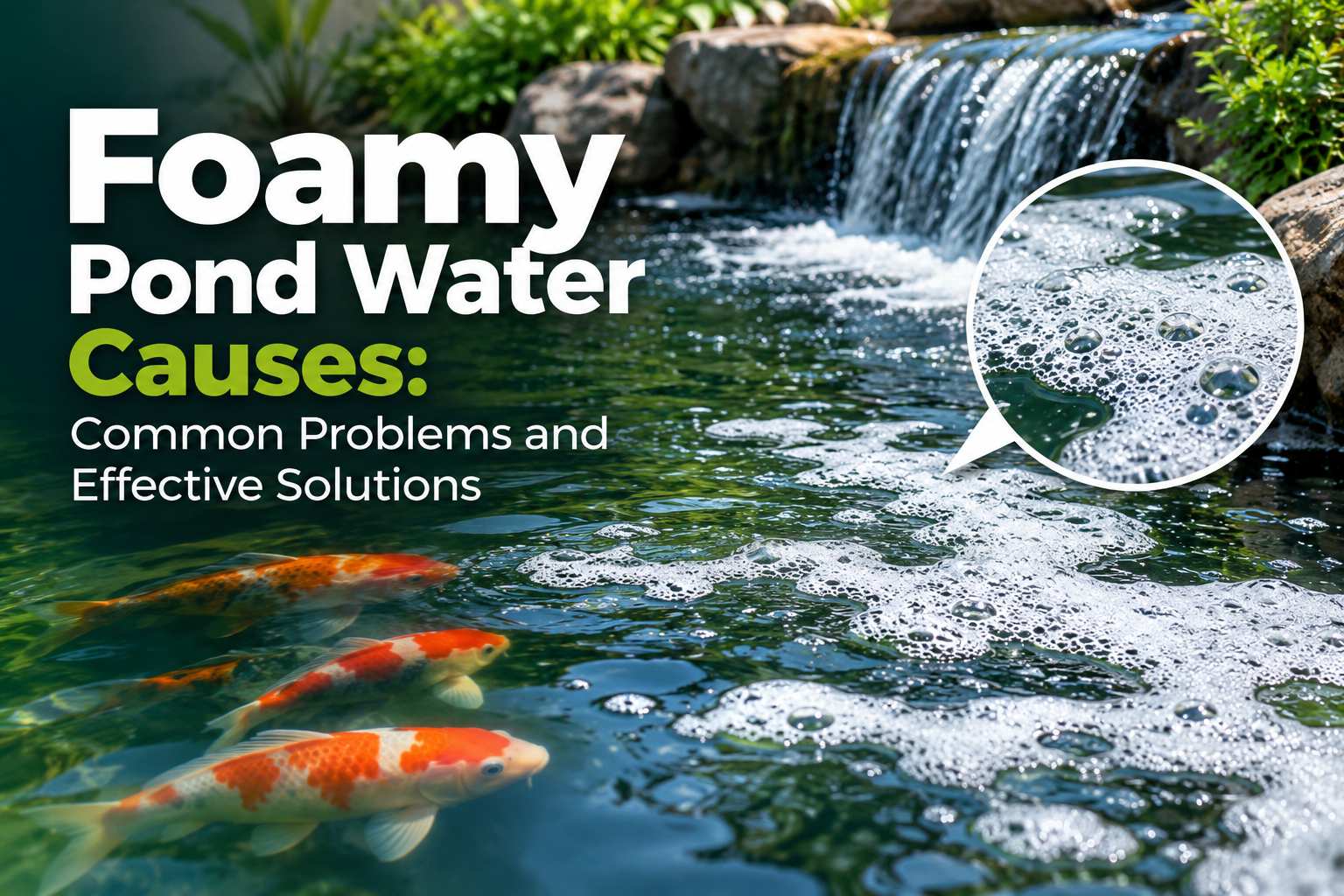
Understanding foamy pond water causes is important for maintaining clean water and healthy fish in outdoor ponds, koi ponds, and ornamental water gardens. Foam often appears near waterfalls, fountains, pond pumps, and water outlets. While a small amount of temporary foam may be normal, thick or persistent foam can indicate excess organic waste, overfeeding, or filtration problems.
Identifying the reason behind foamy pond water helps you choose the right solution instead of simply removing the bubbles from the surface.
In this guide, we explain the common causes of pond foam, how to prevent it, and the best ways to maintain healthy pond water.
What Are the Main Foamy Pond Water Causes?
The most common foamy pond water causes include the accumulation of dissolved organic compounds, fish waste, uneaten food, decaying leaves, and inadequate filtration. Water movement from pumps, waterfalls, and fountains introduces air into the water, allowing foam to form when these substances are present.
Common causes include:
- Excess fish waste and uneaten food
- Overfeeding koi and other pond fish
- Poor or undersized pond filtration
- Accumulation of leaves and organic debris
- Excessive organic waste in heavily stocked ponds
- New pond setups with developing biological filtration
- Vigorous water movement that makes existing foam more visible
Understanding these causes makes it easier to identify the appropriate treatment.
1. Excess Fish Waste and Uneaten Food
One of the most common foamy pond water causes is the accumulation of fish waste and leftover food. As organic material breaks down, it releases compounds that can contribute to persistent surface foam.
This problem is especially common in koi ponds containing large fish or a high stocking density.
How to solve it
- Feed fish appropriate portions.
- Remove uneaten food before it decomposes.
- Remove visible waste and debris.
- Clean mechanical filter components when necessary.
- Test ammonia and nitrite if water quality deteriorates.
Proper feeding practices reduce unnecessary waste and help your pond filtration system operate more efficiently.
2. Overfeeding Koi Fish
Overfeeding can increase organic waste in a pond and place additional pressure on the filtration system. Uneaten pellets break down in the water, while the increased feeding load can lead to greater waste production.
If you notice foam appearing after increasing the amount of fish food, review your feeding routine.
Solutions for overfeeding
- Feed according to fish size, water temperature, and seasonal activity.
- Offer smaller portions that fish can consume promptly.
- Remove leftover pellets.
- Avoid increasing feeding amounts without considering filter capacity.
- Monitor water quality regularly.
Reducing excess food is one of the simplest ways to prevent foamy pond water.
3. Poor Pond Filtration
Inadequate filtration is another important cause of foamy pond water. A clogged or undersized filter may struggle to remove solid waste, allowing organic material to accumulate.
Even when pond water appears clear, dissolved organic compounds may remain and contribute to foam.
How to improve pond filtration
A suitable filtration system should combine the following components where appropriate:
Mechanical filtration: Removes solid waste, uneaten food, and debris.
Biological filtration: Supports beneficial bacteria that convert toxic ammonia into nitrite and then nitrate under suitable conditions.
Pond pump: Circulates water through the filtration system at the required flow rate.
UV clarifier: Helps control suspended algae that cause green water but does not directly remove the dissolved organic compounds responsible for foam.
Choose filtration equipment based on pond volume, fish population, feeding rate, and the manufacturer’s specifications.
4. Decaying Leaves and Organic Debris
Leaves, dead aquatic plants, algae, and other organic materials can accumulate in outdoor ponds. As they decompose, they increase the organic load and may contribute to foam formation.
Rain and wind can introduce additional debris, making the problem worse during certain seasons.
How to prevent debris-related foam
- Remove fallen leaves using a pond net.
- Trim dead or decaying plant material.
- Clean skimmers and mechanical filter sections.
- Remove excessive debris from the pond bottom when necessary.
- Inspect the pond after heavy rainfall or strong winds.
Regular maintenance reduces the amount of organic material entering your filtration system.
5. Waterfalls, Fountains, and Pond Pumps
Waterfalls, fountains, and pond pumps introduce air into the water and improve circulation. These features are generally beneficial, particularly when they support oxygen exchange.
However, vigorous water movement can make existing foam more visible when dissolved organic compounds are present.
What should you do?
- Check for excess organic waste.
- Inspect the filter and pump intake.
- Maintain adequate aeration, especially in koi ponds.
- Confirm that water is circulating through the filter correctly.
- Adjust water flow only if necessary and without compromising oxygen levels.
A waterfall or pump is not necessarily the underlying problem. It may simply make foam caused by other water-quality issues more noticeable.
6. New Pond Setup and Biological Filtration
New ponds often experience changes in water quality while beneficial bacteria establish themselves in the biological filter. During this period, the filtration system may not yet be processing fish waste efficiently.
Organic waste can accumulate and contribute to foamy water.
Solutions for new ponds
- Allow biological filtration to mature gradually.
- Introduce fish cautiously rather than stocking the pond all at once.
- Test ammonia and nitrite frequently during the cycling period.
- Avoid aggressively cleaning all biological media at once.
- Use suitable water conditioners when required.
Foam in a new pond should not automatically be considered harmless. Monitor fish behaviour and water quality closely.
7. High Fish Stocking Density
A pond containing too many koi for its filtration capacity may accumulate organic waste faster than the filter can process it.
As fish grow, their waste production increases. A system that worked for smaller fish may become inadequate over time.
How to manage the problem
- Calculate the pond’s actual water volume.
- Assess the number and size of the koi.
- Review the filter’s mechanical and biological capacity.
- Check pump flow and plumbing restrictions.
- Upgrade the filtration system if it cannot handle the existing fish load.
A well-designed filtration system helps control organic waste and supports more stable water quality.
How to Remove Foamy Pond Water
The best solution depends on the underlying cause. Follow these steps to address the problem safely.
Step 1: Observe the fish
Check whether fish are swimming normally, eating, and breathing comfortably. Gasping at the surface or unusual lethargy can indicate an oxygen or water-quality problem.
Step 2: Test the water
Check ammonia, nitrite, pH, and temperature. Dissolved oxygen testing is particularly useful for heavily stocked ponds or during hot weather.
Step 3: Remove organic waste
Remove uneaten food, leaves, dead plant matter, and other visible debris.
Step 4: Inspect the filtration system
Check for blocked filter media, reduced pump flow, or excessive waste accumulation. Clean mechanical components as necessary while protecting biological filter media.
Step 5: Perform a partial water change if needed
If water tests or observations indicate deteriorating water quality, a carefully managed partial water change may help. Use appropriately conditioned water with a suitable temperature and chemistry.
Step 6: Monitor the results
Observe whether foam decreases over the following days. If it persists, investigate the organic load and filtration capacity rather than repeatedly treating the surface.
Avoid adding chemicals without identifying the cause and confirming that the treatment is safe for your fish.
Can Foamy Pond Water Harm Fish?
Foam itself is not always directly harmful. Small amounts of temporary foam near a waterfall may be normal. However, persistent foam can indicate excess organic compounds or inadequate waste management.
The underlying problem may threaten fish if it contributes to ammonia or nitrite accumulation, poor oxygen conditions, or other water-quality issues.
Watch for these warning signs:
- Fish gasping at the surface
- Red or irritated gills
- Loss of appetite
- Unusual lethargy
- Cloudy water or a foul smell
- Sudden changes in water quality
If fish show signs of distress, maintain adequate aeration, check dissolved oxygen and toxic nitrogen compounds, and take appropriate corrective action.
How to Prevent Foamy Pond Water
Preventive maintenance is more effective than repeatedly removing foam after it appears.
- Avoid overfeeding pond fish.
- Remove leaves and other organic debris regularly.
- Maintain mechanical and biological filtration correctly.
- Ensure the pump provides adequate circulation.
- Monitor ammonia and nitrite.
- Avoid overcrowding the pond.
- Perform appropriate partial water changes when needed.
- Inspect the pond more frequently after heavy rainfall or seasonal changes.
- Review filter capacity as fish grow.
- Investigate persistent foam instead of relying only on surface treatments.
Following these practices helps maintain stable water quality and reduces the likelihood of recurring foam.
Frequently Asked Questions About Foamy Pond Water Causes
What are the most common foamy pond water causes?
The most common causes are excess dissolved organic compounds, fish waste, uneaten food, decaying leaves, overfeeding, and inadequate filtration. Water movement from fountains and waterfalls can make the foam more visible.
Why is my pond water foamy all of a sudden?
Sudden foam may occur after heavy feeding, the introduction of organic debris, a change in filtration performance, or a change in water chemistry. Inspect the filter and test the water to identify the source.
Is white foam in a koi pond normal?
Small amounts of temporary foam near a waterfall can be normal. Thick or persistent white foam may indicate excess organic compounds and should be investigated.
Will a UV filter remove pond foam?
A UV clarifier primarily helps control suspended algae responsible for green water. It generally does not remove dissolved organic compounds that contribute to foam.
Does changing pond water help remove foam?
A suitable partial water change may reduce dissolved organic compounds. However, the result depends on the underlying cause, and water changes should be managed carefully to avoid stressing fish.
Can overfeeding cause foamy pond water?
Yes. Uneaten food decomposes and adds organic waste to the pond. Feeding appropriate portions and removing leftovers can help reduce foam.
Should I turn off my pond pump when foam appears?
No, not simply to remove foam. The pump generally supports circulation and filtration. Check the equipment and maintain adequate oxygen levels instead of switching off essential circulation.
Conclusion
Understanding foamy pond water causes helps you identify whether the problem comes from excess organic waste, overfeeding, poor filtration, or vigorous water movement. Although temporary foam is not always a concern, persistent foam should prompt a closer look at pond water quality and filtration performance.
By feeding fish responsibly, removing debris, maintaining an appropriately sized filtration system, and monitoring water parameters, you can help keep your pond cleaner and your fish healthier.
Looking for pond pumps, filters, UV clarifiers, and filter media? Explore the pond equipment range at GreenfinIndia.com to find products suited to your pond setup and maintenance requirements.