

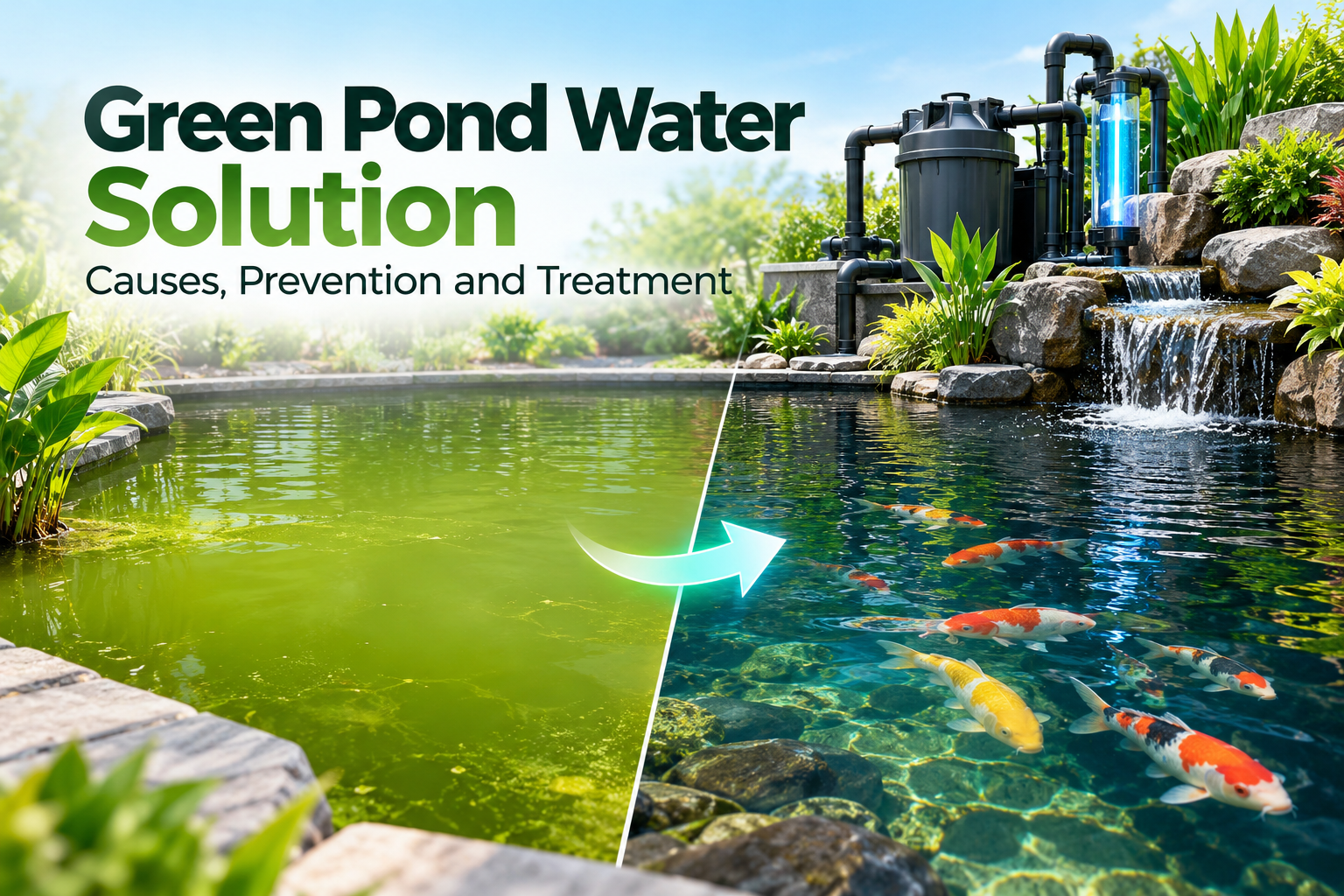
Green pond water is one of the most common problems faced by koi pond owners and outdoor water garden enthusiasts. A pond that was once clear and beautiful can quickly turn green, making it difficult to see fish, rocks, and other underwater features. In most cases, this green appearance is caused by microscopic algae suspended in the water.
Finding the right green pond water solutions involves more than simply cleaning the pond or replacing the water. Understanding the cause of the problem and maintaining a balanced pond ecosystem are essential for achieving long-lasting water clarity.
In this guide, we will explore the common causes of green pond water, effective treatment methods, the role of UV clarifiers and filtration systems, and practical ways to prevent algae from returning.
What Causes Green Pond Water?
Green pond water usually develops when microscopic algae multiply rapidly in the water column. These algae are too small to be removed easily by ordinary mechanical filtration unless the filtration system is specifically designed to capture them or a suitable treatment causes them to clump together.
Several factors contribute to algae growth.
1. Excess Sunlight
Sunlight provides the energy algae need to grow. Outdoor ponds that receive direct sunlight for many hours each day are more likely to experience algae blooms, especially when nutrients are abundant.
Although sunlight is necessary for aquatic plants and a healthy pond environment, excessive exposure can encourage rapid algae growth.
2. Excess Nutrients in Pond Water
Nitrogen and phosphorus are important nutrients for aquatic life, but excessive concentrations can encourage algae blooms.
Common sources include:
- Uneaten fish food.
- Fish waste and decomposing organic matter.
- Fallen leaves and dead aquatic plants.
- Nutrients entering the pond through garden runoff.
- Inadequate removal of accumulated sludge.
Overfeeding koi and keeping too many fish in a pond can increase the nutrient load beyond what the filtration system can process effectively.
3. Inadequate Pond Filtration
A pond filtration system helps remove suspended debris and process fish waste. When filtration is undersized, poorly maintained, or unsuitable for the pond’s fish population, waste and nutrients may accumulate.
Mechanical filtration captures particles, while biological filtration supports beneficial bacteria that convert toxic ammonia into nitrite and then nitrate. Neither function alone guarantees the removal of microscopic suspended algae.
4. Poor Water Circulation
Insufficient circulation can contribute to dead zones where debris accumulates and water quality deteriorates. Proper circulation helps transport waste toward filtration equipment and distributes oxygen throughout the pond.
However, increasing pump flow alone will not necessarily eliminate green water. The pump, filter, and any UV clarifier must work together as a properly designed system.
5. Warm Water and Seasonal Changes
Warm temperatures, abundant sunlight, and nutrient-rich water can encourage algae growth. Ponds may experience green water during warmer months or after heavy rainfall introduces nutrients and organic matter.
In tropical regions such as Kerala, warm weather and seasonal monsoon runoff can make consistent pond maintenance especially important.
Best Green Pond Water Solutions Methods
The most effective treatment depends on the cause of the green water, the pond’s volume, the number of fish, and the existing filtration setup.
1. Install a Suitable UV Pond Clarifier
A UV pond clarifier is one of the most effective equipment-based solutions for green water caused by suspended algae.
The unit exposes water passing through it to ultraviolet radiation. This damages the algae’s ability to reproduce and helps the cells clump together, making them easier for suitable downstream filtration to capture.
Benefits of a UV pond clarifier:
- Helps clear green water caused by suspended algae.
- Improves underwater visibility when correctly sized and installed.
- Works continuously alongside the pond’s filtration system.
- Requires no direct application of algaecide to the pond.
For best results, choose a UV clarifier based on the pond’s actual water volume, flow rate, algae load, and manufacturer’s recommendations. Excessive flow through an undersized unit may reduce treatment effectiveness.
Regularly inspect the UV lamp, quartz sleeve, seals, and electrical connections according to the manufacturer’s instructions. Replace the lamp at the recommended interval, even if it still appears to illuminate.
Important: A UV clarifier does not remove sludge, correct excessive feeding, or replace biological filtration. Water clarity also depends on adequate mechanical filtration to capture the treated algae.
2. Improve Mechanical and Biological Filtration
A properly designed pond filtration system is essential for maintaining clear, healthy water.
Mechanical filtration removes physical waste such as fish debris, uneaten food, and other suspended particles. Biological filtration provides a surface for beneficial bacteria to process fish waste.
Common filtration options include:
- Mechanical filter: Captures solid waste before it decomposes.
- Biological filter: Supports beneficial bacteria that process ammonia and nitrite.
- Pressurized pond filter: Offers a compact filtration option for suitable pond sizes and flow requirements.
- Multi-chamber filtration system: Allows different stages of mechanical and biological treatment.
- Rotary drum filter: Automatically removes fine solids from the water in appropriately designed systems.
- UV pond filter or clarifier: Helps control suspended algae when correctly sized.
For koi ponds, filtration should be selected according to water volume, fish stocking, feeding rate, and the amount of waste produced. A pond with many koi generally requires more filtration capacity than a pond of the same size with only a few fish.
Clean mechanical filter components as needed, but avoid unnecessarily washing biological media in chlorinated tap water, as this can damage beneficial bacteria. Follow the manufacturer’s cleaning instructions.
3. Reduce Excessive Sunlight
Managing sunlight can help prevent algae blooms, particularly in shallow outdoor ponds.
Consider these practical methods:
- Install partial shade using a pergola, shade sail, or suitable pond cover.
- Use carefully selected aquatic plants to provide limited surface shade.
- Avoid placing the pond where it receives uninterrupted intense sunlight throughout the day, if the design is still being planned.
- Maintain a balance between shade and adequate light for aquatic plants.
Avoid covering the entire pond with dense vegetation. Koi need sufficient open swimming space, and excessive plant coverage can interfere with gas exchange and pond maintenance.
Shade helps reduce algae growth, but it may not clear an existing bloom without appropriate filtration and treatment.
4. Control Fish Feeding and Organic Waste
Excess nutrients are a major contributor to recurring green water. Good feeding habits and routine waste removal can reduce the nutrients available to algae.
Follow these practices:
- Feed koi only the amount they can consume promptly.
- Remove uneaten food instead of allowing it to decompose.
- Remove fallen leaves and dead plant material.
- Clean accumulated sludge when necessary without disturbing the pond ecosystem excessively.
- Avoid adding more fish than the filtration system can support.
Test the pond water regularly, particularly for ammonia, nitrite, nitrate, and pH. Ammonia and nitrite should remain at zero in a properly functioning, established koi pond.
Remember that nitrate readings alone do not reveal the entire nutrient situation, and a pond can still develop algae even when individual test results appear acceptable.
5. Use Pond Treatments Carefully
Some pond treatments are designed to help manage nutrients, organic waste, or algae. However, not every product is suitable for every pond.
Beneficial bacteria products may support biological processes, while certain treatments can help manage specific water-quality problems when used according to their labels.
Before using any chemical algaecide, consider the following:
- Confirm that the product is suitable for koi and other pond inhabitants.
- Follow the label instructions and dosage based on actual water volume.
- Ensure sufficient aeration, particularly when an algae bloom is severe.
- Avoid killing large quantities of algae rapidly, because decomposition can consume oxygen and endanger fish.
- Never combine treatments unless the manufacturers explicitly confirm compatibility.
For ponds containing koi, a gradual, system-based approach is generally preferable to aggressive chemical treatment.
How to Prevent Green Pond Water
Preventing algae blooms is easier than repeatedly treating a pond after the water turns green. A consistent maintenance routine helps maintain water quality and supports healthy fish.
Weekly Pond Maintenance
A simple weekly routine should include:
- Check that the pond pump is operating correctly.
- Inspect the filter and remove accumulated mechanical waste as needed.
- Remove fallen leaves and uneaten fish food.
- Observe fish behaviour and check for unusual surface gasping or lethargy.
- Inspect the water for changes in colour, clarity, or smell.
- Confirm that aeration and water circulation are functioning properly.
The cleaning frequency depends on the pond’s fish population, feeding rate, debris load, and filtration capacity.
Monthly Equipment Inspection
Inspect the pump intake, filter plumbing, UV clarifier, and other pond equipment according to the manufacturer’s maintenance schedule. Check for blockages, reduced flow, leaks, and worn components.
Do not switch off or thoroughly sterilise the entire biological filtration system during routine cleaning. Beneficial bacteria are important for converting fish waste into less harmful compounds.
Maintain a Balanced Pond Ecosystem
A healthy pond combines appropriate fish stocking, adequate filtration, good circulation, sensible feeding, and controlled nutrient input.
Aquatic plants can contribute to nutrient uptake and shade, but they should complement rather than replace a properly designed filtration system, especially in heavily stocked koi ponds.
How Long Does It Take to Clear Green Pond Water?
The time required depends on the severity of the algae bloom, the size of the pond, the effectiveness of the filtration system, and whether the underlying causes have been corrected.
With a correctly sized UV clarifier and effective mechanical filtration, visible improvement may begin within several days. Some ponds take one to two weeks or longer to become noticeably clearer.
For the best results:
- Ensure that water is passing through the UV unit at the recommended flow rate.
- Confirm that mechanical filtration can capture the algae after treatment.
- Remove excess organic waste.
- Avoid overfeeding.
- Maintain adequate aeration and monitor fish behaviour.
If the water remains green despite appropriate treatment, check for an undersized UV unit, excessive flow, a worn lamp, a dirty quartz sleeve, inadequate filtration, or continued nutrient input.
Common Mistakes to Avoid When Treating Green Pond Water
Some maintenance practices can make algae problems worse or put fish at risk.
Replacing all the pond water at once: A complete water change can cause temperature, pH, and other water-chemistry changes. Unless there is an urgent water-quality emergency, partial water changes are generally preferable. Always dechlorinate replacement water where necessary and match its temperature as closely as practical.
Cleaning every filter component simultaneously: Excessive cleaning can remove beneficial bacteria and destabilise the biological filter. Clean mechanical components as needed while protecting the biological media.
Adding more chemicals without identifying the cause: Different treatments target different problems. Confirm whether the issue is suspended algae, debris, poor filtration, or another water-quality concern before selecting a product.
Choosing a pump or UV unit based only on wattage: Power consumption alone does not establish whether equipment is suitable. Consider actual flow, head height, pond volume, filtration requirements, and manufacturer specifications.
Ignoring fish behaviour: Fish gasping at the surface, rapid breathing, or unusual lethargy may indicate low oxygen or poor water quality. Check dissolved oxygen where possible and test ammonia and nitrite promptly.
Frequently Asked Questions
1. What is the best green pond water solution?
For green water caused by suspended algae, a correctly sized UV pond clarifier combined with effective mechanical filtration is often a reliable solution. Reducing excess nutrients and managing sunlight help prevent the problem from returning.
2. Can a pond pump alone clear green water?
A pump improves circulation and transports water through the filtration system, but it does not normally eliminate microscopic suspended algae by itself. A suitable UV clarifier and effective filtration may be necessary.
3. Is green pond water harmful to koi fish?
Green water itself is not always directly harmful, and some ponds can support healthy fish despite a green appearance. However, a severe algae bloom may contribute to oxygen depletion, particularly at night or when algae die and decompose. Monitor water quality and fish behaviour.
4. How do I clear green pond water naturally?
Reduce excess feeding, remove organic waste, improve filtration, manage sunlight, and maintain appropriate aquatic plant coverage. These steps can help, although severe suspended-algae blooms may require a UV clarifier.
5. Does a UV clarifier remove all types of pond algae?
No. UV clarifiers primarily help control suspended algae that pass through the unit. They do not directly remove attached algae growing on pond walls, rocks, or other surfaces. String algae and other forms may require different management methods.
6. How do I choose the right UV clarifier for my pond?
Calculate the pond’s water volume and consider fish stocking, sunlight exposure, algae severity, pump flow, and the manufacturer’s rated pond capacity. For heavily stocked koi ponds, seek a system designed for the actual biological and solids-filtration requirements.
7. Should I clean my entire pond when the water turns green?
Not usually. Draining and thoroughly cleaning the entire pond can disrupt the established biological ecosystem and stress fish. Identify the cause first, improve filtration, remove excess debris, and use appropriate partial water changes when needed.
Conclusion
Green pond water is a common challenge, but the right combination of equipment and maintenance can significantly improve water clarity.
The most effective green pond water solution begins with identifying the cause of the algae bloom. A suitable UV clarifier can help control suspended algae, while mechanical and biological filtration manage waste and maintain water quality. Controlling sunlight, avoiding overfeeding, and following a consistent maintenance routine help prevent future outbreaks.
Whether you maintain a small ornamental pond or a large koi pond, choosing the right pond pump, filtration system, and UV equipment can make routine maintenance easier and help create a healthier environment for your fish.
Looking for pond filtration equipment? Explore pond pumps, UV clarifiers, pond filters, and other pond-care products at Greenfin India to find equipment suited to your pond’s requirements.