

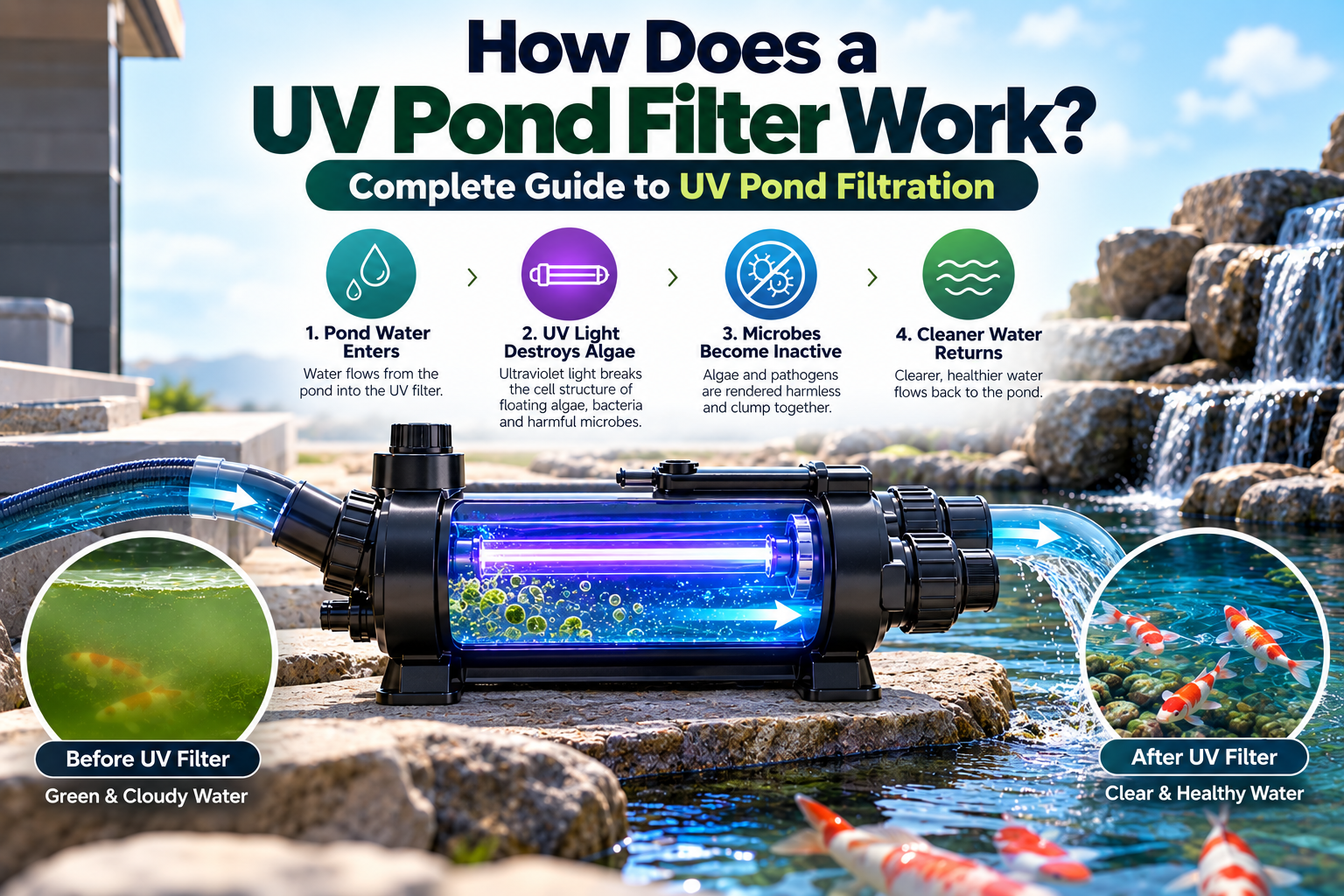
A pond can have a good pump and biological filter and still develop green or cloudy water. One common solution is a UV pond filter, also called a UV clarifier or ultraviolet pond clarifier.
But how does a UV pond filter work?
A UV pond filter uses ultraviolet light to expose microorganisms and suspended algae in the water to UV-C radiation as water passes through the unit. This can help control suspended algae and improve water clarity.
UV filtration is especially useful for garden ponds, koi ponds, and ornamental ponds where green water is a recurring problem.
In this guide, we’ll explain how UV pond filters work, what they can and cannot remove, where to install one, how to choose the correct UV size, and how to maintain it.
What Is a UV Pond Filter?
A UV pond filter is a pond-water treatment device that contains a UV-C lamp inside a protective housing.
Water from the pond is pumped through the UV unit. As the water passes around the UV lamp, microorganisms and suspended algae are exposed to ultraviolet radiation.
The treated water then continues through the pond filtration system or returns to the pond, depending on the installation.
A UV unit is commonly used alongside:
- Pond pumps
- Mechanical filters
- Biological filters
- Pond skimmers
- Bottom drains
- Pond filter systems
A UV clarifier should generally be considered one part of a complete pond filtration system, not a replacement for mechanical or biological filtration.
How Does a UV Pond Filter Work?
The basic process is relatively simple.
Step 1: Pond Water Is Pumped
A pond pump moves water from the pond toward the filtration system.
Step 2: Water Enters the UV Housing
The water flows through the UV unit, where it passes close to the UV-C lamp.
Step 3: UV-C Light Acts on Suspended Organisms
The UV-C radiation can damage the genetic material of microorganisms exposed to sufficient UV energy.
For suspended algae, this can cause individual cells to lose their ability to reproduce and remain suspended in the water.
Step 4: Water Continues Through the Filtration System
The treated water then moves onward through the pond system.
When suspended algae clump together or become easier to capture, mechanical filtration can remove the resulting particles.
Step 5: Clearer Water
With appropriate UV exposure, filtration, and maintenance, the pond can become visibly clearer.
What Does a UV Pond Filter Remove?
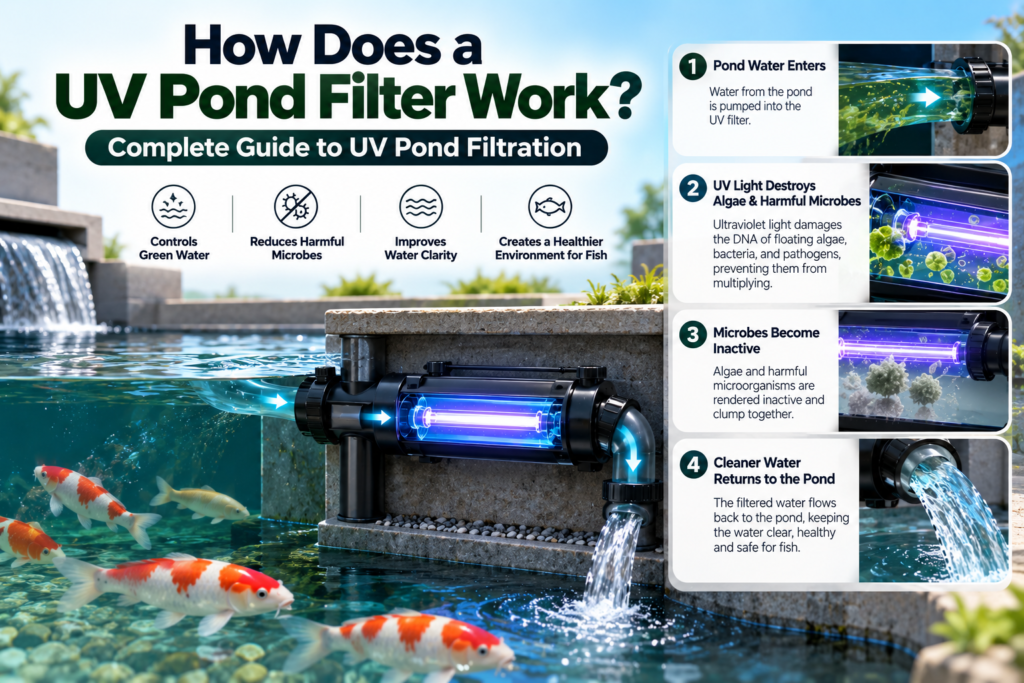
UV filtration is mainly useful for controlling suspended microorganisms, particularly the algae responsible for green-water conditions.
It can help with:
- Suspended green algae
- Certain free-floating microorganisms
- Some waterborne microorganisms, depending on UV dose and system design
However, the effectiveness depends on factors such as:
- UV lamp power
- Water flow rate
- UV exposure time
- Water clarity
- Lamp condition
- Quartz sleeve cleanliness
- Organism type
UV filtration is therefore not a universal treatment for every pond-water problem.
What Does a UV Pond Filter NOT Remove?
This is an important distinction.
A UV clarifier does not physically remove:
- Fish waste
- Leaves
- Uneaten food
- Mud
- Large debris
- Settled sludge
- Dead algae particles
It also does not replace biological filtration.
Mechanical filtration removes physical particles, while biological filtration provides a habitat for beneficial microorganisms that help process fish waste.
UV treatment performs a different function.
UV Clarifier vs UV Sterilizer
The terms UV clarifier and UV sterilizer are sometimes used interchangeably in the pond and aquarium industry, but their intended applications can differ.
A UV clarifier is commonly used to control suspended algae and improve water clarity.
A UV sterilizer generally refers to a system designed around higher UV exposure intended to reduce certain microorganisms.
The actual performance depends on:
- UV intensity
- Flow rate
- Exposure time
- Lamp condition
- Water quality
- Organism susceptibility
Therefore, do not choose a UV unit based only on the word “sterilizer” or “clarifier” on the product packaging.
Does a UV Pond Filter Kill Algae?
A UV pond filter can help control suspended algae that cause green water.
However, it does not remove every type of algae.
For example, algae attached to:
- Pond walls
- Rocks
- Waterfalls
- Pipes
- Decorative surfaces
are not continuously passing through the UV chamber and therefore will not simply disappear because a UV unit is installed.
UV filtration is most useful for free-floating or suspended algae in the water column.
Why Does a Pond Turn Green?
Green pond water is commonly associated with suspended algae.
Several factors can encourage algae growth:
- Excess sunlight
- Nutrient accumulation
- Fish waste
- Overfeeding
- High phosphate or nitrate availability
- Warm temperatures
- Insufficient filtration
- Poor circulation
Installing a UV clarifier can help control suspended algae, but addressing the underlying conditions is also important.
Where Should a UV Pond Filter Be Installed?
The ideal installation depends on the specific equipment and filtration design.
A common arrangement is:
Pond → Pump → Mechanical Filtration → UV → Biological Filtration → Pond
However, some systems may use a different arrangement.
Always follow the manufacturer’s recommended installation and flow direction.
The important point is that the water must pass through the UV chamber at an appropriate flow rate.
Why Is Water Flow Rate Important?
The UV lamp needs enough contact time with the water to deliver an effective UV dose.
If water passes through the UV chamber too quickly, the exposure time may be insufficient for the intended application.
Therefore:
Higher pump flow does not always mean better UV performance.
When selecting a UV unit, consider both:
- UV lamp wattage
- Recommended flow rate
The correct combination depends on the manufacturer’s specifications and the intended use.
How to Choose the Right UV Pond Filter
There is no universal UV size for every pond.
Consider these factors:
1. Pond Volume
Start by calculating the approximate amount of water in the pond.
For example:
Length × Width × Average Depth = Pond Volume
For irregular ponds, estimate the average depth and actual water volume as accurately as possible.
2. Pond Type
A lightly stocked ornamental pond may have different requirements from a heavily stocked koi pond.
3. Fish Load
More fish generally means more waste and potentially greater nutrient availability for algae.
4. Sunlight Exposure
Ponds exposed to strong sunlight may experience more algae growth.
5. Pump Flow
Check the manufacturer’s recommended flow range for the UV unit.
6. Existing Filtration
Consider how the UV unit will work with your mechanical and biological filtration.
Example UV Pond System
Consider a koi pond with:
Pond volume: 10,000 litres
Suppose the filtration system circulates the pond water through the filter continuously.
A UV unit should be selected based on:
- Pond volume
- Manufacturer’s UV recommendation
- Actual pump flow
- Desired UV application
- Water clarity
- Koi stocking level
Instead of selecting a UV lamp based only on “watts per litre,” compare the manufacturer’s recommended pond capacity and flow rate with your actual system.
UV Pond Filter vs Mechanical Filter
These two systems perform different jobs.
| Feature | UV Pond Filter | Mechanical Filter |
|---|---|---|
| Suspended algae | Helps control | Captures after clumping |
| Fish waste | Does not remove | Removes |
| Leaves | Does not remove | Removes |
| Fine particles | Limited direct removal | Removes |
| Biological filtration | No | Depends on media |
| Water clarity | Can improve | Can improve |
The two systems can work together.
UV Pond Filter vs Biological Filter
Biological filtration and UV filtration should not be treated as alternatives.
Biological Filter
Provides a surface for beneficial microorganisms and helps process fish waste.
UV Filter
Uses ultraviolet radiation to treat water passing through the UV chamber.
For a koi pond, both can have important roles.
Does UV Filtration Harm Beneficial Bacteria?
Beneficial bacteria living on established biological filter media are not continuously exposed to the UV lamp because they live on surfaces within the biological filter.
A properly designed pond filtration system can therefore use UV treatment alongside biological filtration.
However, UV treatment can affect free-floating microorganisms that pass through the UV chamber.
How Long Does a UV Pond Lamp Last?
UV lamp performance decreases over time even if the lamp still appears to be working.
The exact replacement interval depends on the lamp type, operating hours, manufacturer, and system design.
Many UV lamps are replaced approximately once per pond season or according to the manufacturer’s recommended service interval.
Always follow the product manufacturer’s instructions.
How to Maintain a UV Pond Filter
Regular maintenance helps maintain UV performance.
Clean the Quartz Sleeve
Mineral deposits and dirt can accumulate on the quartz sleeve surrounding the UV lamp.
A dirty sleeve can reduce the amount of UV radiation reaching the water.
Check the UV Lamp
Inspect the lamp according to the manufacturer’s maintenance instructions.
If the lamp has reached its recommended service life, replace it.
Maintain the Pump
A clogged intake or dirty pump can reduce water flow through the UV system.
Clean Mechanical Filters
If the mechanical filtration is clogged, water circulation can decrease.
Check Connections
Inspect hoses, fittings, seals, and electrical connections regularly.
Always disconnect electrical equipment from the power supply before carrying out maintenance.
Signs Your UV Pond Filter May Not Be Working Properly
If your pond remains green despite operating a UV unit, check:
- Is the UV lamp still within its service life?
- Is the quartz sleeve clean?
- Is water actually passing through the UV chamber?
- Is the flow rate within the recommended range?
- Is the UV unit correctly sized?
- Is the mechanical filtration working?
- Is excessive sunlight reaching the pond?
- Is the pond heavily stocked?
- Is there excessive nutrient accumulation?
A UV problem is not always caused by the UV lamp itself.
Common UV Pond Filter Mistakes
Using an Incorrect Flow Rate
A pump that moves water too quickly through the unit may reduce UV exposure.
Choosing a UV Unit Only by Pond Size
Pond volume is important, but fish load, sunlight, flow rate, and filtration design also matter.
Not Cleaning the Quartz Sleeve
Mineral buildup can reduce UV transmission.
Forgetting to Replace the Lamp
A lamp can continue to illuminate while its UV output has decreased.
Expecting UV to Remove Pond Waste
UV treatment does not replace mechanical filtration.
Ignoring the Cause of Algae
UV can help control suspended algae, but reducing excessive nutrients and improving overall pond management is also important.
Is a UV Pond Filter Necessary for Every Pond?
Not necessarily.
A well-balanced pond with good biological filtration, mechanical filtration, adequate circulation, appropriate stocking, and controlled nutrient levels may not always require UV treatment.
However, UV filtration can be particularly useful when:
- Green water is a recurring problem
- The pond receives strong sunlight
- Water clarity is difficult to maintain
- The pond contains koi
- The filtration system is designed to incorporate UV treatment
Benefits of Using a UV Pond Filter
A properly sized and maintained UV system can provide several benefits:
Clearer Pond Water
UV treatment can help control suspended algae responsible for green water.
Better Pond Appearance
Clearer water allows better visibility of koi and pond features.
Support for Koi Pond Management
UV can complement mechanical and biological filtration in a koi pond.
Reduced Green Water Problems
It can be an effective tool for managing recurring suspended algae.
Frequently Asked Questions
How does a UV pond filter work?
A UV pond filter passes pond water around a UV-C lamp. The ultraviolet radiation affects microorganisms and suspended algae exposed to sufficient UV energy, helping improve water clarity.
Does a UV filter make pond water clear?
It can help clear green water caused by suspended algae. However, mechanical filtration and good pond management are still necessary for removing physical waste and maintaining water quality.
Does a UV pond filter kill algae?
It can control suspended algae that pass through the UV chamber. It will not directly remove algae growing on pond surfaces.
How long should a UV pond filter run?
UV systems are commonly operated whenever the pond filtration system is running, but the correct operating schedule depends on the equipment and pond design. Follow the manufacturer’s instructions.
How often should a UV pond lamp be replaced?
Follow the manufacturer’s recommended replacement interval. UV output decreases over time even when the lamp still appears to be working.
Does a UV filter replace a pond filter?
No. A UV unit is not a replacement for mechanical or biological filtration.
Can I use a UV filter with a koi pond?
Yes. UV clarifiers are commonly used as part of koi pond filtration systems, particularly where suspended algae and green water are concerns.
Does UV filtration remove fish waste?
No. Fish waste needs to be removed through mechanical filtration and processed through biological filtration.
Final Thoughts
So, how does a UV pond filter work?
A UV pond filter passes pond water through a chamber containing a UV-C lamp. The UV radiation acts on suspended microorganisms and algae that are exposed to the appropriate UV dose, helping reduce green water and improve clarity.
However, UV filtration is only one part of a successful pond filtration system.
For the best results, combine an appropriately sized UV unit with mechanical filtration, biological filtration, proper pond circulation, adequate aeration, sensible feeding, and regular maintenance.
If you’re experiencing persistent green water or planning a new koi pond filtration system, choosing the correct UV unit and flow rate is important.
Looking for pond filtration equipment? Explore Greenfin India’s range of pond pumps, UV filters, pond filtration systems, filter media, and other pond equipment for your pond setup.