

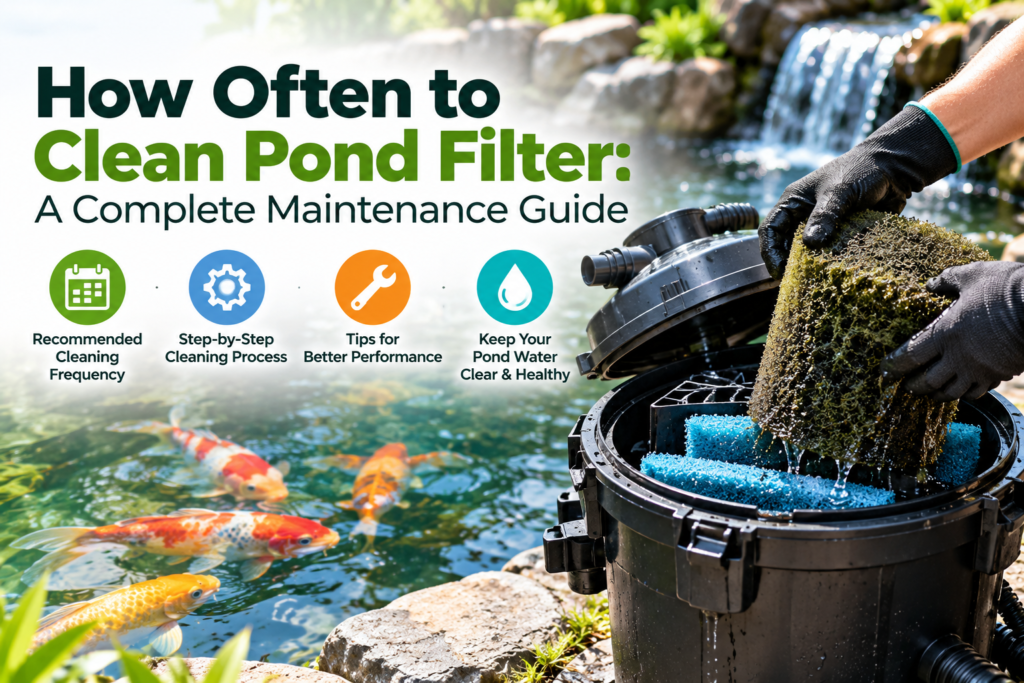
Knowing how often to clean pond filter equipment is essential for maintaining clear water, healthy fish, and an efficient pond filtration system. A pond filter removes fish waste, uneaten food, and other debris while supporting beneficial bacteria that help maintain water quality.
However, cleaning your pond filter too frequently or using the wrong method can damage beneficial bacteria and disrupt biological filtration. On the other hand, neglecting filter maintenance can reduce water flow and allow waste to accumulate.
In this guide, we explain how often to clean different pond filters, how to maintain filter media, and the best practices for keeping your pond water clean and healthy.
How Often to Clean Pond Filter Equipment?
The ideal pond filter cleaning frequency depends on the filter type, pond size, fish population, feeding rate, and amount of waste accumulating in the system.
As a general rule, inspect your pond filter weekly and clean it whenever debris buildup or reduced water flow indicates that maintenance is needed. Some mechanical filters require cleaning several times a week, while biological filter media may need attention only occasionally.
Recommended pond filter cleaning schedule
| Pond filter component | Recommended maintenance |
|---|---|
| Mechanical filter screens | Inspect weekly; clean when debris accumulates |
| Filter sponges and mats | Clean when clogged or water flow decreases |
| Biological filter media | Inspect regularly; clean gently when necessary |
| Pressurised pond filters | Backwash according to the manufacturer’s instructions and filter condition |
| Pond pump intake | Inspect weekly; remove blockages as needed |
| UV clarifier quartz sleeve | Inspect periodically and clean according to the manufacturer’s instructions |
These are general guidelines rather than fixed intervals. Heavily stocked koi ponds may require more frequent mechanical filtration maintenance than ponds with fewer fish.
1. How Often Should You Clean a Mechanical Pond Filter?
Mechanical filtration removes solid particles such as fish waste, uneaten food, leaves, and other debris. Because these materials accumulate inside the filter, mechanical components often require the most frequent cleaning.
Signs your mechanical filter needs cleaning
- Water flow through the filter has decreased.
- Filter screens or sponges are visibly clogged.
- Debris is accumulating inside the filter chamber.
- Water is overflowing or bypassing the filter media.
- The filter is no longer removing solid waste effectively.
In a heavily stocked koi pond, mechanical filter screens may need attention daily. In a lightly stocked ornamental pond, weekly inspection may be sufficient.
How to clean a mechanical pond filter
- Follow the manufacturer’s instructions for shutting down the equipment safely.
- Remove trapped leaves, fish waste, and other debris.
- Rinse reusable mechanical media gently using suitable rinse water.
- Avoid household detergents and cleaning chemicals.
- Reinstall the media correctly and restore water circulation.
Regular mechanical filter cleaning prevents excessive waste accumulation and helps maintain efficient filtration.
2. How Often Should You Clean Biological Pond Filter Media?
Biological filter media support beneficial bacteria that process ammonia and nitrite produced by fish waste. These bacteria are essential for maintaining a healthy pond environment.
Common biological filter media include bio balls, ceramic media, porous biological media, and moving-bed media.
Unlike mechanical media, biological media should not be cleaned aggressively or unnecessarily.
When should biological media be cleaned?
Clean biological media when excessive debris or sludge restricts water flow or affects the filter’s performance. Depending on the filter design and pond conditions, this might be necessary every few months or less frequently.
Best practices for biological filter maintenance
- Use removed pond water or appropriately dechlorinated water when rinsing media, where suitable.
- Avoid cleaning all biological media simultaneously if this could significantly reduce beneficial bacteria.
- Do not allow biological media to dry out unnecessarily.
- Follow the manufacturer’s maintenance instructions.
- Monitor ammonia and nitrite, especially after substantial cleaning.
Important: Biological filter media do not need to be cleaned simply because a particular number of days or weeks has passed. Their condition and the performance of the filtration system should determine when maintenance is required.
3. How Often Should You Backwash a Pressurised Pond Filter?
Pressurised pond filters are commonly used in garden ponds and ornamental ponds. Many models feature a backwashing mechanism that helps remove accumulated waste without requiring the filter to be completely dismantled.
The required cleaning frequency depends on the model, fish stocking level, feeding rate, and debris load.
Signs your pressurised filter needs backwashing
- Water flow from the filter outlet decreases.
- A pressure gauge shows an increase above its normal operating level, where fitted.
- The cleaning indicator signals that maintenance is required.
- The manufacturer’s instructions recommend a cleaning cycle.
Some filters may need weekly backwashing, while heavily stocked ponds may require more frequent cleaning.
How to backwash a pond filter
- Follow the manufacturer’s instructions for stopping the pump.
- Set the filter valve to the appropriate cleaning position.
- Run the backwash cycle for the recommended duration.
- Perform a rinse cycle if the filter requires it.
- Return the valve to the normal filtration setting before restarting the pump.
Never change a multiport valve setting while the pump is running unless the manufacturer explicitly permits it.
4. How Often Should You Clean a Pond Pump and Intake Filter?
A pond pump circulates water through the filtration system. Its intake screen or pre-filter prevents larger debris from entering the pump.
When the intake becomes clogged, water circulation can decrease, affecting the performance of the entire filtration system.
Recommended pump maintenance
Inspect the pump intake and pre-filter weekly. In ponds with falling leaves, algae, or a large fish population, inspect them more frequently.
Remove debris when it restricts water flow. Check the impeller and other serviceable parts according to the manufacturer’s instructions.
Remember that cleaning the pump will not solve every filtration problem. If water quality remains poor, the filter may be undersized or unable to process the pond’s waste load.
5. Factors That Affect Pond Filter Cleaning Frequency
There is no single maintenance schedule suitable for every pond. Several factors influence how often you need to clean your pond filter.
Pond size and water volume
Pond volume affects the amount of water the filtration system must process. However, a large pond does not automatically require less maintenance; fish population, waste production, and filter capacity are also important.
Number and size of fish
Koi produce considerable waste as they grow. A pond containing many large koi generally requires more attention to mechanical filtration than a lightly stocked pond.
Feeding frequency
Frequent feeding can increase the organic waste entering the filtration system. Feed appropriate portions and remove uneaten food to reduce unnecessary waste.
Filter type
Mechanical filters, biological filters, pressurised filters, and drum filters use different filtration methods and cleaning mechanisms. Always follow the maintenance requirements of the specific model.
Weather and seasonal changes
Falling leaves, heavy rainfall, algae growth, and changes in feeding activity can affect filter maintenance needs. Inspect the system more frequently when the debris load increases.
Pump flow and filter capacity
An undersized filter may clog quickly or struggle to handle the pond’s waste. Reduced pump flow or restricted plumbing can also affect filtration performance.
6. What Happens If You Do Not Clean Your Pond Filter?
Neglecting pond filter maintenance can reduce filtration efficiency and affect fish health.
Common problems include:
- Reduced water circulation
- Accumulation of fish waste and debris
- Cloudy or deteriorating water quality
- Blocked mechanical filter media
- Increased risk of ammonia or nitrite accumulation if biological filtration is impaired
- Greater maintenance problems caused by restricted flow
A dirty filter is not always an emergency, but a blocked filter or failing pump should be addressed promptly.
If fish are gasping at the surface or behaving unusually, check dissolved oxygen and water quality immediately rather than assuming that filter cleaning alone will resolve the problem.
7. How to Clean a Pond Filter Without Killing Beneficial Bacteria
Beneficial bacteria are vital for biological filtration. Aggressive cleaning can remove established bacteria and reduce the filter’s ability to process fish waste.
Follow these steps to clean your pond filter safely.
Step 1: Identify the filter media
Determine which components remove solid waste and which support biological filtration. Each type requires a different cleaning approach.
Step 2: Remove accumulated solid waste
Clean mechanical screens, brushes, and collection chambers first. This removes much of the debris without unnecessarily disturbing biological media.
Step 3: Use suitable rinse water
Where appropriate, rinse biological media with removed pond water or appropriately dechlorinated water. Untreated chlorinated or chloraminated tap water can harm beneficial bacteria.
Step 4: Avoid cleaning all biological media at once
If substantial cleaning is necessary, preserve part of the established biological media whenever the filter design permits.
Step 5: Restore circulation and monitor water quality
Restart the system according to the manufacturer’s instructions. Check water flow and monitor ammonia and nitrite after major maintenance.
Never leave fish without adequate circulation or aeration while the filtration system is being serviced.
8. How to Maintain a Pond Filter Throughout the Year
A consistent maintenance routine helps prevent filtration problems before they affect your fish.
Weekly maintenance
- Inspect the filter and pump for reduced flow.
- Check mechanical media for debris.
- Remove leaves and uneaten food.
- Observe fish behaviour and water clarity.
Monthly maintenance
- Review filtration performance.
- Inspect accessible plumbing connections.
- Check water-test results.
- Inspect UV equipment according to the manufacturer’s instructions.
Seasonal maintenance
- Increase inspections during periods of heavy leaf fall or debris accumulation.
- Adjust cleaning frequency as fish feeding activity changes.
- Review filter capacity as fish grow.
- Carry out recommended equipment servicing.
Adapt this routine to your pond’s actual conditions. Some heavily stocked ponds require daily mechanical waste removal, while other ponds need less frequent intervention.
9. How to Know If Your Pond Filter Is Too Small
If you constantly need to clean your pond filter, the problem may be insufficient filtration capacity rather than poor maintenance.
Warning signs include frequent clogging, persistently poor water quality, and elevated ammonia or nitrite despite appropriate maintenance.
When choosing a pond filtration system, consider:
- Actual pond water volume
- Number and size of fish
- Feeding rate and waste production
- Mechanical filtration capacity
- Biological filter media capacity
- Required pump flow rate
- Maintenance requirements
For large or heavily stocked koi ponds, a properly designed multi-stage filtration system can improve waste management and make routine maintenance easier.
Explore pond pumps, pressure filters, biological filtration equipment, and filter media at GreenfinIndia.com to find equipment suited to your pond.
Frequently Asked Questions
How often to clean pond filter equipment?
Inspect your pond filter weekly. Clean mechanical components when debris accumulates or water flow decreases. Biological filter media generally need less frequent cleaning and should be rinsed gently only when necessary.
Should I clean my pond filter every week?
Not necessarily. Weekly inspection is a useful starting point, but some mechanical filters need cleaning several times a week, while biological media may require attention only occasionally.
Can I clean my pond filter with tap water?
Avoid using untreated chlorinated or chloraminated tap water to rinse biological filter media because these disinfectants can harm beneficial bacteria. Follow the manufacturer’s recommendations for suitable rinse water.
How often should I clean biological filter media?
Clean biological media when accumulated debris restricts water flow or affects performance. Depending on the pond and filter design, cleaning may be required every few months or less frequently.
Should I turn off my pond pump when cleaning the filter?
Follow the manufacturer’s instructions. Many filters require the pump to be switched off before opening the filter or changing valve settings. Restore normal circulation promptly after maintenance.
Why is my pond water cloudy after cleaning the filter?
Cloudiness may result from disturbed debris, changes in water chemistry, or disruption of biological filtration. Check water quality, inspect the filter, and monitor ammonia and nitrite.
Does cleaning a pond filter improve water quality?
Yes. Removing accumulated waste and restoring normal flow can improve filtration. However, aggressive cleaning of biological media may damage beneficial bacteria and temporarily reduce the filter’s ability to process fish waste.
Conclusion
Knowing how often to clean pond filter equipment helps you maintain healthy fish, effective filtration, and good water quality. Inspect your filter weekly, clean mechanical components when necessary, and protect beneficial bacteria by avoiding unnecessary cleaning of biological media.
The correct maintenance frequency depends on pond volume, fish stocking, feeding