

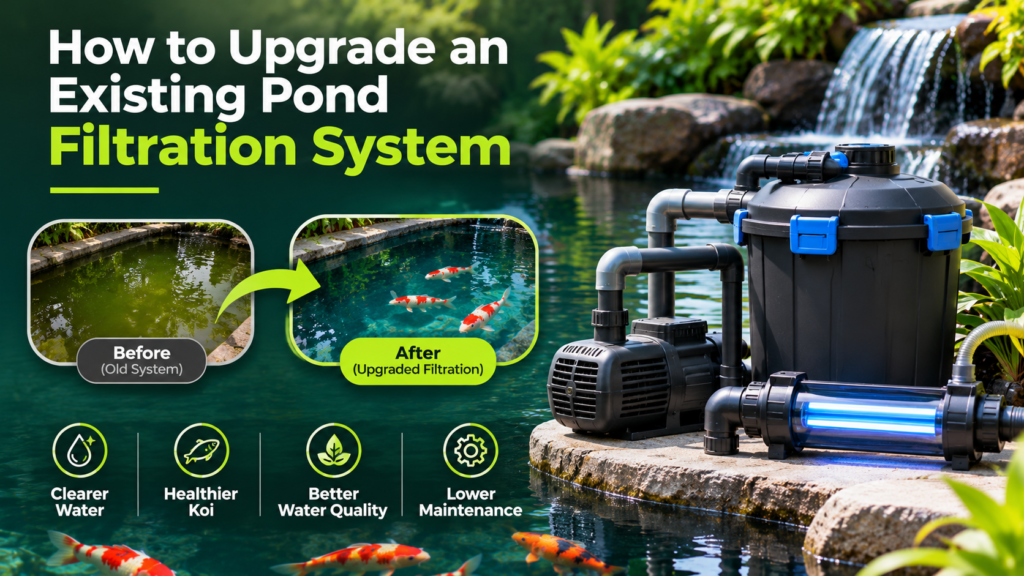
Maintaining clean and healthy pond water is essential for the growth, health and colour of ornamental fish, especially koi. A properly designed pond filtration system helps remove fish waste, uneaten food, suspended particles and harmful substances from the water.
However, as a pond gets older, its filtration requirements may change. Increasing the number of fish, growing fish size, poor water circulation, excessive algae growth and insufficient filter capacity can all affect filtration performance.
If your pond water frequently becomes cloudy, develops unpleasant smells or accumulates excessive waste, your existing filtration system may need an upgrade.
Upgrading an existing pond filtration system does not always mean replacing all the equipment. In many cases, improving the mechanical filtration, biological filter media, water pump or UV clarifier can significantly improve overall performance.
In this guide, we will explain how to identify filtration problems, choose suitable equipment and upgrade your existing pond filtration system for better water quality.
1. Signs Your Existing Pond Filtration System Needs an Upgrade
Before purchasing new equipment, identify the problems with your current filtration system.
Here are some common signs that indicate your pond may need a filtration upgrade.
A. Cloudy or Green Pond Water
If your pond water frequently becomes green or cloudy, your existing filtration system may not be effectively controlling suspended particles or algae.
Green water is commonly associated with free-floating algae, which can increase due to sunlight and excess nutrients.
A suitable UV clarifier, combined with effective mechanical and biological filtration, can help improve water clarity.
B. Excessive Fish Waste Accumulation
Fish waste, uneaten food and organic debris can accumulate when mechanical filtration is insufficient.
This can increase the maintenance requirements and negatively affect water quality.
Upgrading the mechanical filtration stage can help remove solid waste more efficiently.
C. Poor Water Circulation
Insufficient water movement can create stagnant areas where waste accumulates.
A suitable pond pump and properly positioned water returns help improve circulation and distribute filtered water throughout the pond.
D. Frequent Filter Cleaning
If you need to clean your pond filter very frequently, it may be undersized or unsuitable for the amount of waste produced by your fish.
An upgraded filtration system with improved mechanical waste separation can reduce the frequency of manual cleaning.
E. Increasing Fish Population
As koi grow, their food consumption and waste production also increase.
A filter that was suitable when the pond had fewer or smaller fish may no longer provide sufficient filtration.
In this situation, increasing filtration capacity or adding additional filtration stages may be necessary.
2. Understand Your Existing Pond Filtration System
Before upgrading, understand how your current filtration system works.
Most pond filtration systems include three important filtration stages.
A. Mechanical Filtration
Mechanical filtration removes physical waste from pond water.
Common examples include:
- Filter sponges.
- Filter brushes.
- Filter mats.
- Filter wool.
- Sieve filters.
- Settlement chambers.
- Rotary drum filters.
If your pond contains excessive solid waste, improving mechanical filtration should be one of your first priorities.
B. Biological Filtration
Biological filtration uses beneficial bacteria to convert toxic ammonia produced by fish waste into nitrite and subsequently into less harmful nitrate.
Common biological filter media include:
- Bio balls.
- Ceramic rings.
- Moving bed media.
- Porous biological media.
- Japanese filter mats.
- Sintered glass media.
Biological filtration is particularly important in koi ponds because koi produce significant amounts of waste.
When upgrading biological filtration, provide adequate media surface area, water flow and oxygen supply.
C. UV Clarification
UV clarifiers help control free-floating algae responsible for green pond water.
Water passes through a UV chamber, where ultraviolet radiation affects suspended algae and other susceptible microorganisms.
UV clarification is useful for improving water clarity, but it does not replace mechanical or biological filtration.
3. Upgrade Your Pond Filter for Better Waste Removal
The mechanical filter is one of the most important components of a pond filtration system.
If your existing filter cannot handle the amount of solid waste entering the system, consider upgrading it.
Option 1: Upgrade to a Larger Pond Filter
A larger filter can provide additional space for mechanical and biological filtration media.
When selecting a replacement filter, consider:
- Pond water volume.
- Number and size of fish.
- Feeding quantity.
- Manufacturer-recommended capacity.
- Actual water flow rate.
Do not select a filter based only on its advertised maximum pond capacity. Heavy koi stocking may require a more powerful filtration arrangement.
Option 2: Install a Pressurized Pond Filter
Pressurized pond filters are compact filtration units designed for convenient installation.
Many models include mechanical and biological filtration stages, with some also incorporating UV clarification.
Benefits include:
- Compact installation.
- Suitable for many small and medium pond setups.
- Convenient plumbing connections.
- Easier maintenance on suitable models.
- Useful for upgrading existing pump-fed systems.
Option 3: Install a Multi-Chamber Filtration System
A multi-chamber filtration system separates mechanical and biological filtration into different sections.
This arrangement provides flexibility when selecting filter media and designing the filtration process.
It is particularly useful for medium and large koi ponds.
Option 4: Upgrade to a Rotary Drum Filter
A Rotary Drum Filter (RDF) is an advanced mechanical filtration solution.
It uses a fine screen to separate solid waste from pond water and automatically cleans the screen through a washing mechanism.
Benefits include:
- Automatic mechanical waste removal.
- Reduced manual cleaning.
- Efficient separation of suspended solids.
- Improved performance in appropriately designed systems.
- Suitable for advanced koi pond filtration setups.
For larger koi ponds with heavy fish stocking, an RDF can be an effective filtration upgrade.
4. Upgrade Your Biological Filter Media
Sometimes, the existing filter housing is sufficient, but the biological media inside it may be inadequate.
In this situation, upgrading the filter media can improve biological filtration without replacing the complete filter.
Recommended Biological Filter Media
| Filter media | Main purpose |
|---|---|
| Bio balls | Biological filtration |
| Ceramic rings | Provides surface area for beneficial bacteria |
| Moving bed media | Supports biological filtration with aeration and movement |
| Japanese filter mats | Mechanical and biological filtration |
| Porous media | Provides surfaces for bacterial colonisation |
| Sintered glass media | High-surface-area biological filtration |
Important Tips When Upgrading Filter Media
- Avoid replacing all established biological media at once.
- Keep existing mature media wet and oxygenated.
- Introduce new media gradually.
- Maintain good water flow through the media.
- Provide sufficient oxygen for beneficial bacteria.
- Monitor ammonia and nitrite during the upgrade.
Replacing all biological media suddenly can disrupt the established bacterial colony and cause dangerous ammonia or nitrite increases.
5. Upgrade Your Pond Pump for Better Water Circulation
A pond pump is responsible for moving water from the pond through the filtration system and returning filtered water.
An undersized pump may not provide sufficient circulation, while an oversized pump may exceed the filter’s recommended flow rate.
Before upgrading your pond pump, consider the following:
1. Pond water volume
Calculate the actual pond capacity in litres.
2. Required circulation
Determine the required circulation based on fish stocking, pond design and filtration requirements.
3. Filter flow capacity
Check the maximum recommended flow rate of your filter.
4. Head height
Consider the vertical distance between the pond and filter return point.
5. Pipe resistance
Long pipes, narrow pipe diameters, bends and fittings can reduce actual pump output.
Choose a pump based on its performance at the required operating head, not just its maximum advertised flow rate.
6. Upgrade Your UV Clarifier for Green Pond Water
Green water is a common issue in outdoor ponds exposed to direct sunlight.
If your existing UV clarifier is not providing satisfactory results, check whether its wattage, condition and flow rate are appropriate for your pond.
Important Factors When Choosing a UV Clarifier
- Total pond water volume.
- Fish stocking levels.
- Sunlight exposure.
- Algae growth intensity.
- UV lamp wattage.
- Water flow through the UV chamber.
- Manufacturer’s recommended operating conditions.
A UV clarifier should be selected according to the manufacturer’s specifications rather than using pond volume alone.
Also inspect the UV bulb regularly and replace it according to the recommended service life.
Remember that UV clarification helps control suspended algae but cannot remove settled fish waste or replace biological filtration.
7. Improve Pond Plumbing and Water Circulation
An efficient filtration system requires proper plumbing.
Even high-quality filters and pumps may perform poorly when the plumbing arrangement restricts water movement.
Consider upgrading the following components:
A. Bottom Drain
A bottom drain collects settled fish waste and directs it towards the filtration system.
Adding a properly designed bottom drain can improve waste collection in suitable pond renovations.
B. Pond Skimmer
A pond skimmer removes floating leaves, insects and surface debris.
It is particularly useful for outdoor koi ponds surrounded by trees and garden areas.
C. Return Water Lines
Position filtered water returns to encourage circulation throughout the pond.
Avoid creating stagnant areas where debris can accumulate.
D. Pipe Diameter
Use suitable pipe diameters based on pump flow rate and plumbing design.
Undersized pipes can increase resistance and reduce actual system performance.
8. Best Pond Filtration Upgrade Options Based on Pond Size
Different pond sizes and stocking levels require different filtration arrangements.
The following table provides general examples rather than fixed equipment recommendations.
| Pond type | Suggested filtration arrangement |
|---|---|
| Small garden pond | Suitable mechanical and biological filter with pond pump |
| Medium koi pond | Multi-stage filter with biological media and UV clarification |
| Large koi pond | Multi-chamber filtration or suitable RDF system |
| Heavy-stocked koi pond | Advanced mechanical filtration, large biological capacity and appropriate aeration |
| Outdoor pond | Mechanical and biological filtration with suitable UV clarification where required |
The final equipment selection should be based on water volume, fish quantity, feeding levels and actual water flow requirements.
9. Common Mistakes to Avoid When Upgrading a Pond Filter
Upgrading equipment without understanding the existing system can create additional problems.
Avoid these common mistakes:
- Choosing an undersized filter: Always consider fish stocking levels and waste production.
- Installing an oversized pump: Excessive flow can affect filter performance.
- Ignoring biological filtration: Mechanical filtration alone cannot maintain a healthy pond.
- Replacing all filter media at once: This can remove established beneficial bacteria.
- Ignoring UV maintenance: An old or damaged UV bulb may not perform effectively.
- Poor plumbing design: Incorrect pipe sizing and excessive bends can reduce water flow.
- Ignoring aeration: Beneficial bacteria and fish require sufficient dissolved oxygen.
- Not testing water quality: Monitor ammonia, nitrite, nitrate and pH during and after upgrades.
10. Step-by-Step Guide to Upgrading Your Existing Pond Filtration System
Follow these steps before investing in new pond equipment.
Step 1: Calculate pond water volume
Measure the pond’s length, width and average water depth to estimate its total capacity.
Step 2: Check fish stocking levels
Record the number and approximate size of fish in your pond.
Step 3: Inspect the existing filtration system
Check the filter condition, media quantity, pump output and UV clarifier.
Step 4: Identify the main filtration problem
Determine whether the issue is poor mechanical filtration, insufficient biological capacity, inadequate circulation or green water.
Step 5: Select suitable equipment
Choose the filter, pump, media and UV clarifier according to the actual pond requirements.
Step 6: Upgrade gradually
Avoid making sudden changes to the established biological filtration system.
Step 7: Monitor water quality
Test ammonia and nitrite regularly after the upgrade. Ensure that the filtration system is functioning correctly before increasing fish feeding.
11. Why Choose Greenfin for Pond Filtration System Upgrades?
At Greenfin The Pond Studio, we provide pond equipment and filtration solutions designed to support healthy and clean pond environments.
Whether you have a small garden pond or a large koi pond, selecting the right filtration equipment is important for long-term performance.
Our pond-related products and services include:
- Pond pumps and filtration equipment.
- UV clarifiers and sterilizers.
- Mechanical and biological filter media.
- Pond filtration system installation.
- Existing pond filtration upgrades.
- Pond renovation and infrastructure improvements.
- Complete pond construction solutions.
We help pond owners understand their filtration requirements and select suitable equipment based on pond dimensions, fish quantity and water conditions.
If your existing pond filter is not performing efficiently, contact Greenfin for assistance in selecting a suitable filtration upgrade.
Website: www.greenfinindia.com
WhatsApp: 9496979715
Frequently Asked Questions (FAQs)
1. When should I upgrade my existing pond filtration system?
Consider upgrading when your pond frequently develops cloudy or green water, accumulates excessive fish waste, has poor water circulation or requires frequent filter cleaning.
2. Can I upgrade my pond filter without replacing the complete system?
Yes. In many cases, you can improve filtration by adding biological media, upgrading the pump, installing a UV clarifier or improving mechanical filtration.
3. Which pond filter is best for koi ponds?
Multi-chamber filters, pressurized filters and rotary drum filters are common options. The best choice depends on pond size, fish stocking and maintenance requirements.
4. Does upgrading filter media improve pond water quality?
Yes. Suitable biological media provides surfaces for beneficial bacteria, while mechanical media helps remove physical waste.
5. How do I choose the right pond pump during an upgrade?
Consider pond volume, desired circulation, filter flow requirements, pipe diameter and total head height.
6. Will a UV clarifier remove green pond water?
A correctly sized and installed UV clarifier can help control free-floating algae responsible for green water. It does not remove solid waste or replace biological filtration.
7. Can I add a rotary drum filter to an existing koi pond?
Yes, in many cases. However, the plumbing arrangement, available installation space, water flow and filtration design must be checked before installation.
8. How long does it take for an upgraded biological filter to become effective?
It depends on the maturity of the existing bacterial colony, media type, water temperature, oxygen supply and fish load. New biological media may take several weeks to establish a mature bacterial population.
SEO Details for Shopify
| SEO field | Recommended content |
|---|---|
| Focus keyword | Pond Filtration System Upgrade |
| SEO title | How to Upgrade an Existing Pond Filtration System |
| Meta description | Learn how to upgrade an existing pond filtration system. Discover better pond filters, pumps, UV clarifiers and filter media for cleaner, healthier pond water. |
| URL handle | how-to-upgrade-existing-pond-filtration-system |
| Blog category | Pond Filtration & Maintenance |
Recommended Internal Linking
Link this blog to other relevant Greenfin India articles:
- Best Filtration System for Koi Ponds
- Best Filter Media for Koi Ponds: Types, Benefits and Uses
- How to Choose the Right Bottom Drain for a Koi Pond
- Pond Skimmer vs Bottom Drain
- Best Pond Pumps for Waterfalls
- Best Pond UV Clarifier for Green Water
SEO tip: Use the focus keyword naturally in the introduction, at least one H2 heading, image-free content sections and the conclusion. Add relevant product links to SunSun pond filters, pond pumps, UV clarifiers and biological filter media to connect organic search traffic with Greenfin’s product pages.