

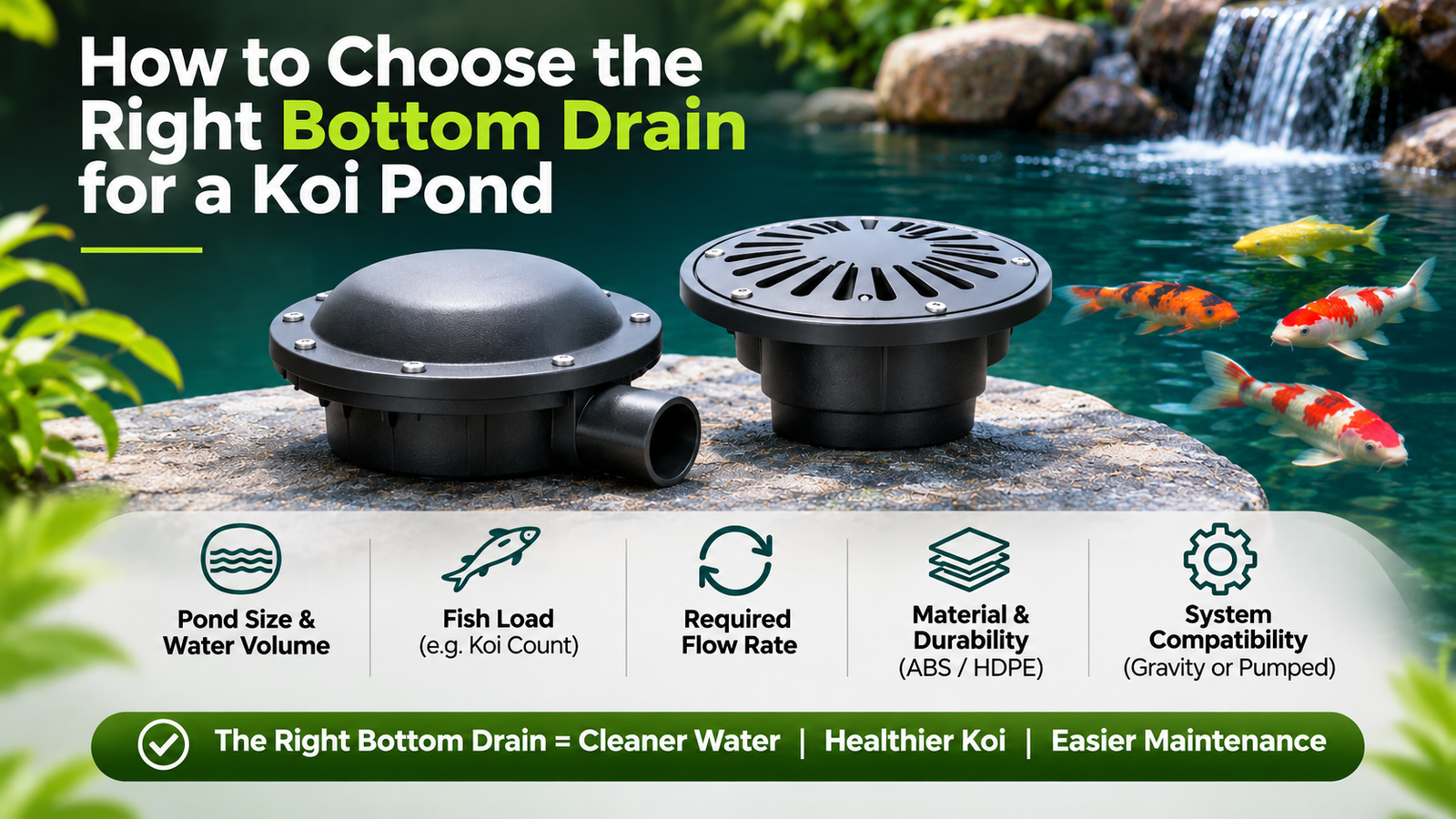

Maintaining clean and healthy water is one of the most important aspects of keeping koi fish. A properly designed filtration system helps remove fish waste, uneaten food and other debris before they affect water quality. However, even the best pond filter may not work efficiently if waste is not collected and transported properly.
This is where a koi pond bottom drain becomes essential.
A bottom drain is installed at the lowest point of a pond to collect fish waste, settled debris and other unwanted materials. It helps move waste towards the filtration system, reducing the accumulation of dirt at the bottom of the pond.
Choosing the right bottom drain is important for maintaining effective water circulation, improving filtration performance and reducing regular pond cleaning.
In this guide, we will explain the different types of koi pond bottom drains, how to select the correct size, installation considerations and how to choose the best option for your pond.
1. What Is a Koi Pond Bottom Drain?
A koi pond bottom drain is a plumbing fitting installed at the bottom of a pond. It connects to a pipe that carries waste-laden water towards a mechanical filtration system.
Most koi pond bottom drains are designed with a circular body and a removable or fixed dome cover. The dome creates a gap between the pond floor and the drain opening, allowing water and settled waste to enter.
The collected water is then transported to a filtration system, where solid waste is separated before biological filtration takes place.
A properly installed bottom drain helps:
- Remove fish waste and settled debris.
- Reduce dirt accumulation at the pond bottom.
- Improve overall water circulation.
- Reduce manual pond cleaning.
- Support better filtration performance.
- Maintain a healthier environment for koi fish.
For medium and large koi ponds, installing an appropriately sized bottom drain can significantly improve the efficiency of the filtration system.
2. Different Types of Koi Pond Bottom Drains
There are several types of bottom drains available for koi ponds. The right choice depends on pond construction, filtration design, budget and installation requirements.
A. Standard Bottom Drain
A standard bottom drain is one of the most commonly used options in koi pond construction.
It is generally installed directly into the pond floor and connected to a pipe leading towards the mechanical filtration system.
Features:
- Simple and practical design.
- Suitable for concrete koi ponds.
- Helps collect settled fish waste.
- Compatible with gravity-fed filtration systems.
- Available in different pipe connection sizes.
This is a good option for most conventional koi pond installations.
B. Bottom Drain with Air Diffuser
An aerated bottom drain includes an air diffuser fitted above the drain dome. It releases air bubbles that rise towards the water surface.
These rising bubbles create upward water movement, encouraging debris to move towards the bottom drain.
Benefits:
- Provides additional oxygenation.
- Improves vertical water circulation.
- Helps move suspended debris.
- Supports better pond water movement.
- Combines waste collection and aeration.
Aerated bottom drains are particularly useful for koi ponds where oxygen supply and circulation are important.
C. Bottom Drain with Removable Dome
Some bottom drains feature removable domes that make inspection and maintenance easier.
The dome controls the water entry gap and helps guide waste towards the drain opening.
Benefits:
- Easier access for inspection.
- Adjustable water entry gap on suitable models.
- Practical for maintenance.
- Helps prevent large debris from entering the pipe.
When selecting this type, check the construction quality and compatibility with your pond plumbing.
3. How to Choose the Right Bottom Drain Size
Selecting the correct size is one of the most important steps when purchasing a koi pond bottom drain.
Bottom drains are commonly available with different pipe connection sizes, such as 2-inch, 3-inch and 4-inch connections.
The appropriate size depends on water flow, pipe length, filtration capacity and pond design.
| Bottom drain connection | General application |
|---|---|
| 2-inch | Small ponds and suitable low-flow systems |
| 3-inch | Medium-sized pond systems |
| 4-inch | Larger koi ponds and higher-flow gravity-fed systems |
These are general application guidelines, not fixed pond-volume limits.
Factors to Consider
1. Pond water volume
Calculate the total water capacity before selecting the drain. Larger ponds generally require greater waste-handling capacity.
2. Water flow rate
The drain and connected pipework must support the intended water flow without excessive restriction.
3. Pipe diameter
The drain connection, pipe diameter and filtration inlet must be compatible.
4. Pond dimensions
Pond length, width, depth and floor design influence the number and placement of bottom drains.
5. Filtration system
The bottom drain should be selected according to the mechanical filtration system, such as a settlement chamber, sieve filter or rotary drum filter.
Always follow the manufacturer’s recommended flow rates and installation specifications.
4. How Many Bottom Drains Does a Koi Pond Need?
The number of bottom drains depends on the pond’s dimensions, shape, floor slope and circulation design.
A small pond may require one appropriately positioned bottom drain, while larger ponds may need multiple drains to ensure effective waste collection.
Consider the following points:
- Pond length and width.
- Pond floor configuration.
- Water circulation direction.
- Filtration system capacity.
- Pump flow rate.
- Distance between drains and filtration equipment.
For example, a large rectangular koi pond may benefit from multiple bottom drains positioned across the floor to reduce dead zones where waste can accumulate.
It is important to design the drain layout before starting construction. Adding bottom drains after completing pond construction can be expensive and complicated.
5. Bottom Drain Installation: Important Things to Consider
Correct installation is essential for getting the best performance from a koi pond bottom drain.
A. Install at the Lowest Point
The bottom drain should be positioned at the lowest point of the pond floor.
This allows gravity and water movement to guide settled waste towards the drain.
B. Provide a Suitable Floor Slope
A gently sloping pond floor helps fish waste and debris move towards the drain.
A practical design often uses a gentle slope towards the central drain or drains, depending on pond geometry.
C. Use Proper Pipe Connections
Use suitable pond-grade plumbing pipes and fittings.
Ensure that:
- Pipe connections are properly sealed.
- The pipe diameter is suitable for the flow rate.
- Unnecessary bends are avoided.
- Pipes are adequately supported.
- Underground pipework is pressure-tested before covering.
D. Connect to the Correct Filtration System
The bottom drain should connect to a mechanical filtration stage capable of handling solid waste.
Common options include:
- Settlement chambers.
- Sieve filters.
- Rotary drum filters.
- Suitable mechanical pond filters.
After mechanical filtration, water can pass through biological filtration before returning to the pond.
6. Bottom Drain vs Pond Skimmer: What Is the Difference?
A bottom drain and a pond skimmer perform different functions. Both are useful components in a properly designed koi pond filtration system.
| Feature | Bottom Drain | Pond Skimmer |
|---|---|---|
| Collection area | Pond bottom | Water surface |
| Removes | Fish waste and settled debris | Leaves, floating debris and surface dirt |
| Installation | Pond floor | Pond wall or surface |
| Main purpose | Bottom waste collection | Surface cleaning |
| Ideal use | Koi ponds | Outdoor ponds and koi ponds |
For outdoor koi ponds, using both a bottom drain and a skimmer can provide more complete waste collection.
The bottom drain collects settled waste, while the skimmer removes floating debris before it sinks.
7. Best Filtration Systems to Use with a Bottom Drain
A bottom drain works most effectively when connected to a suitable filtration system.
Here are three commonly used filtration options.
A. Settlement Chamber Filter
A settlement chamber allows heavier solid waste to settle before water moves to the next filtration stage.
It is a traditional option for gravity-fed koi pond filtration systems.
B. Sieve Filter
A sieve filter uses a fine screen to separate solid waste from pond water.
It helps reduce the solid waste entering the biological filtration stage.
C. Rotary Drum Filter (RDF)
A rotary drum filter is an advanced mechanical filtration solution.
It automatically removes suspended and solid waste through a fine filtration screen and cleaning mechanism.
RDF systems are suitable for koi ponds requiring efficient mechanical waste separation and reduced manual cleaning.
The right filtration system depends on pond capacity, fish stocking levels, maintenance preferences and budget.
8. Common Mistakes to Avoid When Choosing a Bottom Drain
Choosing the wrong bottom drain or installing it incorrectly can reduce filtration efficiency.
Avoid these common mistakes:
- Selecting an undersized drain: A drain that cannot support the required flow may reduce waste collection efficiency.
- Ignoring pipe diameter: Incorrect pipe sizing can restrict water movement.
- Incorrect drain positioning: Poor placement may leave areas where debris accumulates.
- Not planning the filtration system: Drain installation should be designed together with the complete filtration layout.
- Ignoring pond floor slope: An unsuitable floor design can make waste collection less effective.
- Using poor-quality plumbing materials: Low-quality fittings may cause leakage and long-term maintenance problems.
- Not considering future maintenance: Ensure that the drain and pipework can be inspected and serviced when necessary.
Planning these details during construction helps avoid expensive modifications later.
9. How to Maintain a Koi Pond Bottom Drain
Although bottom drains reduce manual cleaning, regular inspection is still necessary.
Follow these maintenance practices:
- Inspect the drain dome regularly.
- Check for blockages in the drain pipe.
- Monitor water flow towards the filtration system.
- Remove accumulated debris when necessary.
- Check plumbing connections for leakage.
- Inspect air diffusers on aerated bottom drains.
- Clean the connected mechanical filtration system regularly.
Regular maintenance helps maintain consistent water circulation and filtration performance.
10. How to Select the Best Bottom Drain for Your Pond
Before purchasing a bottom drain, consider your pond’s complete design rather than choosing a product based only on price.
Use this checklist:
| Selection factor | What to check |
|---|---|
| Pond size | Total water volume and dimensions |
| Drain type | Standard or aerated |
| Connection size | 2-inch, 3-inch or 4-inch |
| Material | Durability and pond compatibility |
| Flow rate | Manufacturer specifications |
| Installation | Gravity-fed or pump-fed design |
| Filtration | Compatibility with mechanical filtration |
| Maintenance | Accessibility and cleaning requirements |
If you are planning a new koi pond, it is always better to finalize the bottom drain, plumbing and filtration design before construction begins.
11. Why Choose Greenfin for Koi Pond Filtration Solutions?
At Greenfin The Pond Studio, we understand that every koi pond requires a properly planned filtration system.
Choosing the right equipment depends on pond size, fish quantity, water circulation and filtration requirements.
Greenfin offers pond equipment and solutions, including:
- Pond pumps and filtration systems.
- UV clarifiers.
- Mechanical and biological filter media.
- Pond construction and filtration installation.
- Pond renovation and filtration upgrades.
- Koi pond equipment and accessories.
Whether you are building a new koi pond or upgrading an existing filtration system, choosing the correct equipment can help improve pond water quality and simplify maintenance.
Explore pond equipment at www.greenfinindia.com.
For pond filtration enquiries, contact Greenfin through WhatsApp: 9496979715.
Frequently Asked Questions (FAQs)
1. What is the purpose of a bottom drain in a koi pond?
A bottom drain collects settled fish waste, uneaten food and debris from the pond floor and transports them towards the filtration system.
2. Which size bottom drain is best for a koi pond?
The suitable size depends on pond dimensions, water flow rate and filtration design. Common connection sizes include 2-inch, 3-inch and 4-inch.
3. Is an aerated bottom drain better than a standard bottom drain?
An aerated bottom drain provides additional oxygenation and improves vertical water circulation while collecting waste. It can be beneficial for koi ponds with suitable aeration requirements.
4. Does every koi pond need a bottom drain?
A bottom drain is highly beneficial for permanent and medium-to-large koi ponds. Small ponds may use alternative waste collection arrangements depending on their design.
5. Can I install a bottom drain in an existing koi pond?
Yes, but installation can be difficult if the pond is already completed. It may require structural modifications and additional plumbing work.
6. Should I use a bottom drain and skimmer together?
Yes. A bottom drain collects settled waste, while a skimmer removes floating debris. Using both can improve overall pond cleanliness.
7. Which filter is best for a bottom drain system?
Settlement chambers, sieve filters and rotary drum filters are commonly used for mechanical filtration. The right choice depends on pond size, flow rate and filtration requirements.
8. Does a bottom drain reduce pond maintenance?
Yes. It helps transport settled waste towards the filtration system, reducing manual cleaning. However, regular filter and plumbing maintenance is still necessary.