

A clean pond is essential for maintaining healthy fish, clear water, and a balanced pond ecosystem. Over time, ponds naturally collect sludge, fallen leaves, dead plants, fish waste, uneaten food, dirt, and other organic debris. If this material is allowed to build up, it can affect water quality, encourage algae growth, create unpleasant odors, and reduce the overall health of fish and aquatic life.
Learning how to remove sludge and debris from a pond can help you maintain better water quality and reduce the need for major pond cleaning. With the right combination of manual cleaning, filtration, pond skimming, water management, and regular maintenance, you can keep your pond cleaner for longer.
In this guide, we will explain what pond sludge is, why it accumulates, how to remove it safely, and how to prevent excessive sludge and debris buildup.
What Is Pond Sludge?
Pond sludge is a layer of organic material that gradually settles at the bottom of a pond. It can contain decomposing leaves, fish waste, uneaten food, dead algae, plant material, dust, and other organic particles.
Some sediment is normal in an outdoor pond. However, excessive sludge can become a problem when it accumulates faster than the pond’s natural biological processes can break it down.
A thick layer of sludge can:
- Reduce pond water quality
- Produce unpleasant smells
- Increase organic waste
- Encourage algae growth
- Reduce available oxygen
- Affect beneficial bacteria
- Create poor conditions for fish
- Block or reduce the efficiency of pond equipment
- Make the pond look dirty and neglected
Regular pond maintenance helps prevent these problems.
What Causes Sludge and Debris to Build Up?
Understanding the source of pond debris is the first step toward controlling it.
1. Fallen Leaves and Organic Material
Outdoor ponds are constantly exposed to leaves, flowers, branches, dust, and other materials from surrounding areas. When these materials enter the pond and sink to the bottom, they slowly decompose and become part of the sludge layer.
2. Fish Waste
Fish naturally produce waste. In heavily stocked ponds, particularly koi ponds, fish waste can become a significant source of organic material.
Good filtration and appropriate stocking levels are important for managing fish waste.
3. Uneaten Fish Food
Overfeeding fish can contribute significantly to pond waste. Food that remains uneaten eventually breaks down and adds nutrients and organic matter to the water.
Feed fish only an amount they can consume within a reasonable period and remove excess food whenever possible.
4. Dead Algae and Aquatic Plants
Algae and plant material eventually die and settle at the bottom of the pond. As they decompose, they contribute to sludge accumulation.
5. Soil and Dust
Rainwater and runoff can carry soil, sand, dust, and other particles into outdoor ponds. Construction areas and unprotected pond edges can make this problem worse.
How to Remove Sludge and Debris from a Pond
The right cleaning method depends on the pond’s size, depth, fish population, filtration system, and amount of sludge.
Here are some practical methods.
1. Remove Floating Debris with a Pond Skimmer
One of the easiest ways to reduce pond debris is to remove it before it sinks.
A pond skimmer collects floating leaves, insects, small branches, and other debris from the surface of the water.
Removing floating debris regularly prevents it from eventually decomposing at the bottom of the pond.
A skimmer is especially useful for ponds located near trees or gardens where leaves frequently fall into the water.
Benefits of a Pond Skimmer
- Removes floating debris
- Reduces organic waste
- Helps protect the filtration system
- Improves water appearance
- Reduces the amount of material reaching the pond bottom
For larger ponds, installing an appropriately sized skimming system can significantly reduce routine cleaning work.
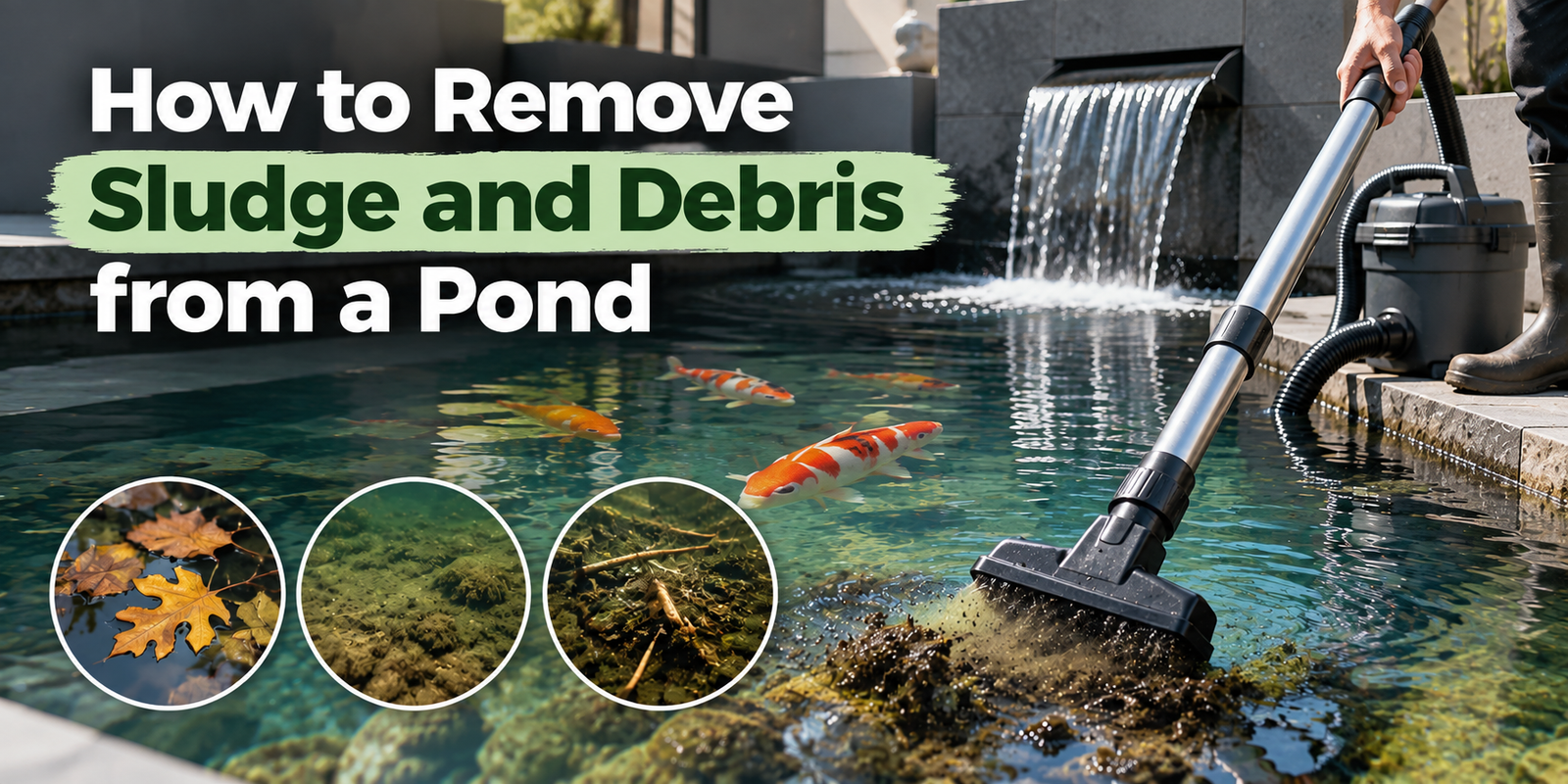
2. Use a Pond Vacuum
A pond vacuum is one of the most effective tools for removing accumulated sludge from the bottom of a pond.
Unlike a standard pond net, a pond vacuum can remove fine sediment, organic waste, and sludge from underwater surfaces.
Before vacuuming, remove large leaves and branches with a pond net. Then slowly move the vacuum over areas where sludge has accumulated.
When Should You Use a Pond Vacuum?
A pond vacuum can be useful when:
- There is visible sludge on the pond floor
- The pond has accumulated organic waste
- Water has an unpleasant smell
- The bottom of the pond looks dirty
- Manual cleaning is difficult
- The pond has limited access for draining
When cleaning a pond containing fish, work carefully to avoid unnecessary stress or disturbance.
3. Use a Pond Net for Leaves and Large Debris
A pond net is a simple but useful maintenance tool.
Use it regularly to remove:
- Fallen leaves
- Large pieces of plant material
- Twigs
- Floating debris
- Dead insects
- Other visible waste
Removing debris early is much easier than dealing with it after it sinks and decomposes.
For ponds surrounded by trees, using a pond net every few days during heavy leaf fall can significantly reduce the amount of organic matter entering the pond.
4. Clean the Pond Filter Regularly
Your pond filtration system plays an important role in removing suspended particles and processing organic waste.
Mechanical filtration captures physical debris, while biological filtration provides surfaces for beneficial bacteria that help process organic waste.
A dirty or overloaded filter cannot perform efficiently.
Depending on the type of filtration system, regular maintenance may involve:
- Removing trapped debris
- Cleaning filter sponges or mechanical media
- Checking water flow
- Inspecting pipes and connections
- Checking pumps
- Inspecting biological media
- Removing excessive accumulated waste
When cleaning biological filter media, avoid unnecessarily sterilizing or replacing all biological media at once, because beneficial bacteria are an important part of biological filtration.
5. Check and Clean the Pond Pump
A pond pump is responsible for circulating water through the filtration system, waterfall, fountain, or other pond features.
If the pump becomes clogged with leaves, algae, or debris, water circulation can decrease.
Reduced circulation can contribute to poor water quality and inefficient filtration.
During routine maintenance, check:
- Pump intake
- Impeller
- Protective housing
- Pipes and hoses
- Pre-filter or strainer
- Water flow
Always follow the manufacturer’s instructions when cleaning or servicing a pond pump.
6. Remove Excess Dead Plants
Aquatic plants can improve the appearance and ecosystem of a pond, but dead leaves, stems, and roots can contribute to sludge.
Regularly remove:
- Dead leaves
- Rotting stems
- Excess plant material
- Dead flowers
- Decaying vegetation
Healthy plants can remain in the pond, but excessive decaying material should not be allowed to accumulate.
7. Partial Water Changes
A partial water change can help reduce suspended waste and improve overall water quality.
However, replacing water does not remove the source of sludge at the pond bottom. If a thick layer of sediment has accumulated, physical removal or pond vacuuming may still be necessary.
When performing a water change in a fish pond, avoid sudden changes in temperature and water chemistry.
Always consider the quality of replacement water before adding it to the pond.
8. Drain and Deep Clean the Pond When Necessary
Some ponds eventually require a more thorough cleaning.
A complete pond clean may be considered when:
- Sludge has accumulated heavily
- Filtration cannot keep up with waste
- Water quality remains poor despite regular maintenance
- The pond has severe debris accumulation
- Major pond renovation or filtration upgrades are being carried out
For fish ponds, particularly koi ponds, a major clean should be carefully planned to minimize fish stress and protect beneficial biological filtration.
If you are unsure how to handle a major pond clean, professional pond maintenance services can help.
How Often Should You Remove Pond Sludge?
There is no single cleaning schedule that works for every pond.
The required frequency depends on:
- Pond size
- Pond depth
- Fish population
- Number of koi
- Amount of feeding
- Surrounding trees
- Amount of rainfall
- Filtration capacity
- Water circulation
- Aquatic plant growth
A pond surrounded by trees may require frequent debris removal, while a well-designed pond with efficient filtration and minimal surrounding vegetation may require less manual cleaning.
Instead of waiting until the pond becomes heavily contaminated, perform small maintenance tasks regularly.
Signs Your Pond Has Too Much Sludge
Watch for these warning signs:
Bad Odor
A strong rotten or unpleasant smell can indicate excessive organic decomposition.
Dark Material at the Bottom
If you can see a thick layer of dark organic material on the pond floor, sludge may be accumulating.
Poor Water Clarity
Excess organic waste can contribute to cloudy or poor-quality water.
Increased Algae Growth
High levels of nutrients from decomposing organic matter can contribute to algae problems.
Reduced Water Flow
If pumps, skimmers, or filters become clogged with debris, water circulation may decrease.
Fish Behaving Abnormally
Changes in fish behavior can sometimes indicate water-quality problems. Test the water and investigate the cause rather than assuming sludge is the only problem.
How to Prevent Sludge from Building Up
Removing sludge is important, but preventing excessive accumulation is even better.
Install a Proper Pond Filtration System
A properly designed filtration system helps manage solid waste and biological waste.
Depending on pond size and design, filtration may include:
- Mechanical filters
- Biological filters
- Pressurized filters
- Multi-chamber filtration systems
- Rotary Drum Filters
- UV clarifiers
- Pre-filters
- Pond skimmers
The filtration system should be selected according to pond volume, fish load, pump flow, and the intended use of the pond.
Use a Pond Skimmer
A skimmer can continuously remove floating debris before it sinks.
This is particularly useful for outdoor ponds exposed to leaves and other organic material.
Avoid Overfeeding Fish
Overfeeding is one of the easiest ways to increase organic waste.
Feed fish according to their requirements and remove uneaten food when necessary.
Maintain Good Water Circulation
Good circulation helps move waste toward the filtration system and reduces stagnant areas.
Pumps, bottom drains, skimmers, and properly designed plumbing can work together to improve waste collection and filtration.
Keep Pond Edges Clean
Leaves, grass clippings, soil, and other garden debris can easily enter a pond.
Keep the surrounding area maintained and prevent unnecessary runoff from entering the pond.
Should You Remove All Pond Sludge?
Not necessarily.
A small amount of natural sediment is not automatically harmful. A pond is a living ecosystem containing microorganisms and beneficial biological activity.
The goal is not always to make the pond completely free of every particle of sediment.
Instead, focus on controlling excessive sludge and decomposing organic waste that negatively affects water quality, fish health, filtration, or pond appearance.
Pond Sludge Removal for Koi Ponds
Koi ponds require special attention because koi produce considerable waste and are often kept at higher stocking densities than natural garden ponds.
A good koi pond system should ideally include:
- Appropriate mechanical filtration
- Biological filtration
- Adequate water circulation
- Proper aeration
- Efficient waste collection
- Suitable pond depth and volume
- Regular water testing
- Routine maintenance
Bottom drains and skimmers can also help move solid waste toward the filtration system before it decomposes.
For heavily stocked koi ponds, filtration design is particularly important.
When Should You Consider Professional Pond Cleaning?
DIY pond maintenance is possible for many small ponds, but larger or heavily stocked ponds may require professional assistance.
Consider professional pond cleaning when:
- The pond contains a large amount of sludge
- Fish need to be safely relocated during cleaning
- The filtration system requires modification
- Pumps or plumbing need servicing
- Water quality problems continue
- The pond has poor circulation
- You are planning a pond renovation
- The pond requires waterproofing or structural repairs
A professional pond inspection can help identify whether the problem is caused by sludge, inadequate filtration, poor circulation, excessive fish load, or a combination of factors.
Final Thoughts
Knowing how to remove sludge and debris from a pond is an important part of maintaining a healthy and attractive pond. Regularly removing leaves, cleaning filters, maintaining pumps, controlling excess organic waste, and using suitable pond equipment can significantly reduce sludge accumulation.
For larger ponds and koi ponds, a properly designed pond filtration system, skimmer, pump, bottom drain, and aeration system can make ongoing maintenance much easier.
Rather than waiting until the pond becomes heavily contaminated, establish a regular maintenance routine. Small, consistent cleaning tasks can prevent major pond problems and help keep the water cleaner, clearer, and healthier throughout the year.
Frequently Asked Questions
What is the easiest way to remove pond sludge?
For small amounts of sludge, a pond vacuum is a practical option. For larger accumulations, professional pond cleaning or a planned pond drain-and-clean may be required.
Can a pond filter remove sludge?
A filtration system can remove suspended and collected waste, but it may not remove thick sludge that has already settled on the pond floor. Physical sludge removal may still be necessary.
How often should a pond be cleaned?
Cleaning frequency depends on pond size, fish load, surrounding vegetation, filtration, and weather conditions. Regular debris removal and filter maintenance are generally more effective than waiting for heavy sludge accumulation.
Does pond sludge cause algae?
Excess organic matter can contribute nutrients to the water as it decomposes, which can contribute to algae growth. However, algae problems can have multiple causes, including sunlight, nutrient levels, water circulation, and filtration.
Is a pond skimmer useful for sludge control?
Yes. A skimmer helps remove floating leaves and debris before they sink and decompose, which can reduce the amount of organic material eventually becoming sludge.
Can I clean a koi pond without removing the fish?
Some light maintenance, such as surface debris removal and controlled pond vacuuming, can often be performed without removing fish. Major cleaning may require a different approach depending on the pond condition and fish population. Fish safety should be the priority.
What equipment is useful for pond cleaning?
Common pond-cleaning equipment includes pond nets, pond vacuums, skimmers, pumps, mechanical filters, biological filters, UV clarifiers, and suitable water-testing equipment.