

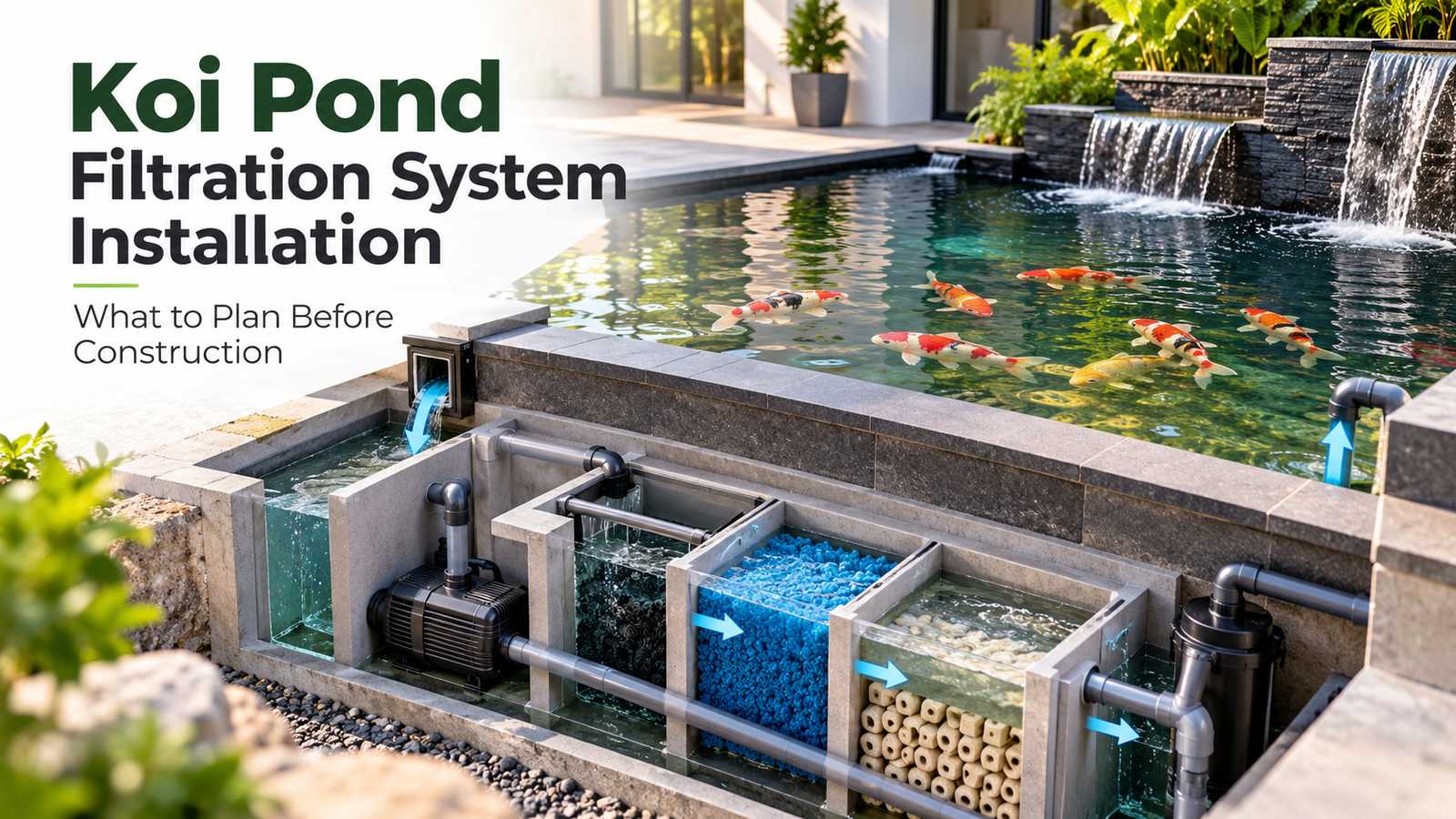
Building a koi pond requires more than creating a beautiful water feature. A well-designed filtration system is essential for maintaining clear water, supporting healthy koi, managing fish waste, and keeping water quality stable throughout the year.
One of the most important decisions is planning the koi pond filtration system installation before construction begins. Proper planning helps determine the location of bottom drains, skimmers, filter chambers, pumps, plumbing lines, and electrical connections. It can also reduce costly modifications after the pond is completed.
Whether you are planning a small residential koi pond or a large outdoor koi pond, this guide explains the important factors to consider before starting construction.
At Greenfin The Pond Studio, we understand the importance of integrating pond construction and filtration design from the beginning. This guide will help you understand the process and prepare for a successful koi pond project.
Why Plan Koi Pond Filtration Before Construction?
A koi pond filtration system works best when its components are designed to operate together. Pond dimensions, water depth, fish stocking, drain placement, pipework, and pump selection all affect the system’s performance.
Installing filtration equipment after construction can be more complicated because it may require additional plumbing, excavation, or structural modifications.
Planning the system in advance provides several benefits:
- Better waste removal: Properly positioned bottom drains and skimmers help transport waste towards the filtration system.
- Improved water quality: Mechanical and biological filtration help control solid waste and harmful nitrogen compounds.
- Efficient water circulation: Correct pump sizing and pipe design help achieve the required flow.
- Simpler maintenance: Accessible filter chambers, valves, and pumps make routine servicing easier.
- Lower long-term costs: A well-designed system can reduce avoidable modifications and unnecessary energy consumption.
- Cleaner pond appearance: Equipment can be concealed without sacrificing access for maintenance.
The goal is to create a filtration system that supports the pond’s biological needs while remaining practical to operate and maintain.
1. Calculate the Pond’s Water Volume
The first step in koi pond filtration system installation is calculating the pond’s water volume.
Water volume helps establish the starting point for selecting pumps, estimating filtration requirements, and planning circulation. However, pond volume alone is not enough to determine the correct filter size. Fish population, feeding rate, waste production, and the filter manufacturer’s specifications must also be considered.
For a rectangular pond, calculate the volume using this formula:
Water volume in litres = Length (m) × Width (m) × Average water depth (m) × 1,000
For example, consider a pond with these dimensions:
- Length: 4 metres
- Width: 3 metres
- Average water depth: 1.2 metres
Water volume = 4 × 3 × 1.2 × 1,000
Total water volume = 14,400 litres
This is the theoretical volume before accounting for internal structures, shelves, or other features that displace water.
For ponds with irregular shapes or varying depths, divide the pond into smaller sections and calculate their volumes separately.
Why Water Volume Matters
An accurate volume estimate helps with:
- Selecting an appropriately sized pond pump.
- Comparing filtration systems.
- Planning the required circulation rate.
- Calculating water treatments according to product instructions.
- Estimating the total system water volume, including connected filter chambers.
Before purchasing equipment, use the expected operating water level rather than the maximum external dimensions of the pond.
2. Choose the Right Filtration System
Selecting the right filtration system is one of the most important parts of koi pond construction.
Koi produce considerable waste, particularly when they are kept at high stocking densities or fed frequently. The filtration system must handle both visible solid waste and dissolved waste generated by fish and decomposing organic material.
Most koi pond filtration designs combine mechanical filtration with biological filtration.
Mechanical Filtration
Mechanical filtration removes suspended solids such as fish waste, uneaten food, leaves, and other debris.
Common options include:
- Filter brushes.
- Filter mats and sponges.
- Sieve filters.
- Rotary drum filters.
- Mechanical settlement chambers.
The appropriate option depends on the pond’s size, waste load, available space, budget, and desired maintenance frequency.
Removing solid waste before it breaks down can reduce the organic load entering the biological filtration stage.
Biological Filtration
Biological filtration provides surfaces for beneficial bacteria that process toxic ammonia into nitrite and then nitrate.
Common biological filter media include:
- Moving-bed media.
- Ceramic biological media.
- Suitable porous filter media.
- Other media specifically designed for biological filtration.
Biological capacity should be selected according to the expected fish load and feeding rate, not simply the pond’s water volume.
The biological filter must also receive adequate oxygenated water. New biological media need time to mature, so the pond should not be stocked heavily immediately after installation.
Which Filtration System Is Suitable?
A pressurized filter may be appropriate for a smaller ornamental koi pond with a relatively light fish load.
A multi-chamber filtration system offers flexibility for separating mechanical and biological stages. A gravity-fed system can be particularly useful for larger koi ponds designed with bottom drains.
A rotary drum filter can provide automated mechanical waste removal in suitably designed systems, although it generally requires a larger initial investment and additional equipment.
Choose the configuration that suits the actual pond design rather than selecting equipment based on appearance or price alone.
3. Plan Bottom Drain Installation
Bottom drains are important components in many koi pond designs, especially larger ponds with dedicated filtration chambers.
They help transport settled waste from the pond floor into the filtration system. When correctly positioned and integrated with water circulation, they can reduce the accumulation of debris in areas that are difficult to clean manually.
What to Consider Before Installing Bottom Drains
Pond dimensions and shape: Drain quantity and placement depend on the pond’s footprint, floor profile, depth, and hydraulic design.
Floor slope: The pond floor should be designed to direct waste towards the drains where appropriate. The required slope depends on the construction method and pond layout.
Pipe diameter: Drain pipework must be sized to carry the intended flow without excessive resistance or blockage risk.
Drain access: Plan inspection and maintenance access for connected pipework and valves.
Waterproofing: Drain bodies and pipe penetrations must be integrated correctly with the pond’s structural and waterproofing system.
Bottom drains should be planned before the concrete base or waterproofing work is completed. Retrofitting them later can be expensive and disruptive.
4. Install a Pond Skimmer for Surface Debris
A pond skimmer removes floating debris from the water surface before it sinks and decomposes.
Leaves, pollen, insects, and floating organic matter can accumulate on the surface of an outdoor koi pond. A suitably sized skimmer helps collect this material and supports overall pond cleanliness.
Where Should a Pond Skimmer Be Installed?
Skimmer placement depends on the prevailing wind direction, return-water circulation, pond shape, and the intended flow pattern.
During design, consider:
- The expected movement of floating debris.
- The location of water returns and waterfalls.
- The skimmer’s operating water level.
- Access for removing collected debris.
- The connection between the skimmer and pump or filter system.
A skimmer and bottom drain perform different functions. The skimmer collects surface debris, while the bottom drain helps transport waste from the pond floor.
For many koi ponds, using both provides more comprehensive waste collection than relying on either one alone.
5. Design the Filter Chamber or Filter Pit
A filter chamber provides a dedicated location for the filtration equipment, valves, plumbing, and pumps.
For a new koi pond, planning the chamber during construction makes it easier to connect the drains and filtration stages. It also provides an opportunity to keep the equipment discreet while allowing convenient access for servicing.
Important Filter Chamber Design Considerations
Space for equipment: Allow sufficient room for the filter, pump, valves, and any additional equipment.
Maintenance access: Ensure that filter lids can open fully and that mechanical media can be removed without obstruction.
Drainage: Provide a suitable way to discharge cleaning water and accumulated waste. Ensure that the arrangement will not cause flooding or unwanted backflow.
Waterproofing: Underground chambers may require appropriate structural design, waterproofing, and drainage depending on soil and groundwater conditions.
Ventilation and electrical safety: Protect electrical equipment from water ingress and provide safe access for inspection and maintenance.
Future upgrades: Where practical, allow room for additional filtration, UV equipment, or other components if the pond’s requirements change.
The filter chamber should be designed around the selected equipment rather than choosing a chamber size first and trying to fit the entire system into it later.
6. Select the Correct Pond Pump
The pond pump circulates water between the pond and the filtration system. Selecting the correct pump is essential for achieving the required circulation without excessive energy consumption.
A pump that is too small may fail to provide the required flow through the filters. An oversized pump can increase operating costs and may create excessive flow for some components.
What Determines Pump Selection?
Consider the following factors:
- Total pond and connected system water volume.
- Required circulation rate.
- Filter manufacturer’s recommended flow range.
- Pipe diameter and total pipe length.
- Vertical lift and waterfall height.
- Bends, valves, and other sources of hydraulic resistance.
- Pump efficiency and expected operating hours.
The advertised maximum flow rate is usually measured under favourable conditions. Actual flow decreases as the pump works against greater resistance.
For this reason, select a pump using its performance curve at the expected operating head rather than relying only on the maximum litres-per-hour figure.
Pump Placement and Plumbing
The pump’s position depends on whether the filtration system is pump-fed or gravity-fed.
In a pump-fed arrangement, a pump sends water to the filter. In a typical gravity-fed arrangement, water flows into the filter by gravity and a return pump moves filtered water back to the pond.
These configurations have different hydraulic requirements, so the pipework and equipment must be designed accordingly.
7. Plan the Pipework Before Civil Construction
Pond plumbing should be planned before construction begins because pipes may pass beneath the pond floor, through concrete walls, or into an underground filter chamber.
Poorly planned plumbing can lead to reduced flow, difficult maintenance, leaks, and costly repairs.
Pipework Planning Checklist
- Determine the required flow through each filtration line.
- Select suitable pipe diameters for the intended flow.
- Minimise unnecessary bends and restrictive fittings.
- Provide isolation valves where equipment needs to be serviced.
- Include suitable drain and waste-discharge connections.
- Use appropriate fittings for the pond’s operating conditions.
- Protect pipework against damage during construction.
- Test connections and pipework before covering them permanently.
For larger ponds, it is particularly important to plan the bottom-drain lines, skimmer connections, filter inlets, and return lines as one coordinated system.
Pipe diameter should be selected using flow requirements and hydraulic calculations, not just the diameter of the pump outlet.
8. Include UV Clarification and Aeration Where Needed
Mechanical and biological filtration form the foundation of most koi pond filtration systems. Additional equipment may improve water clarity and oxygen availability when selected for the specific application.
UV Clarifier
A UV clarifier exposes passing water to ultraviolet radiation to help control suspended algae responsible for green water.
When selecting a UV clarifier, consider the manufacturer’s recommended flow, UV output, water clarity, pond conditions, and maintenance requirements.
A UV clarifier does not remove accumulated sludge or replace biological filtration.
Pond Aeration
Koi and beneficial filter bacteria require oxygen. Aeration can help maintain dissolved oxygen levels, particularly during warm weather, heavy feeding, or periods of high biological activity.
Common options include air pumps, diffusers, and air stones.
The appropriate aeration capacity depends on pond depth, fish load, temperature, water circulation, and the system’s oxygen demand.
For heavily stocked koi ponds, consider how oxygen will be supplied to both the pond and biological filter, including what happens during a power failure.
9. Plan Electrical Connections and Backup Systems
Pond pumps, UV clarifiers, air pumps, and automatic filtration equipment require safe electrical installation.
Because pond equipment operates near water, electrical safety should be addressed during the design stage.
Important considerations include:
- Outdoor-rated electrical equipment and suitable enclosures.
- Proper earthing and residual-current protection as required by local electrical standards.
- Safe cable routing away from damage and standing water.
- Accessible isolation switches.
- Adequate electrical capacity for all equipment.
- Appropriate protection against water ingress.
Electrical installation should be completed by a qualified professional in accordance with applicable requirements.
Why Backup Aeration Matters
A power failure can stop circulation and reduce oxygen supply, especially in a heavily stocked koi pond.
A suitable backup air pump or other planned emergency aeration arrangement can help reduce risk. Choose the backup system according to the pond’s oxygen requirements and expected outage duration.
10. Waterproofing and Construction Quality
Even a correctly designed filtration system cannot compensate for poor structural construction or leaking plumbing.
Waterproofing should be considered alongside the pond’s concrete structure, drain fittings, pipe penetrations, and water-return connections.
Before Filling the Pond
Check that:
- Concrete and structural work have cured as specified.
- Pipe penetrations and drain connections are properly sealed.
- Waterproofing has been applied and cured according to the selected product’s instructions.
- Plumbing has been tested for leaks.
- The pond floor and walls have been inspected.
- The filter chamber and waste-discharge arrangements are functioning correctly.
Where appropriate, conduct a controlled water-retention test before introducing fish. The test duration and procedure should reflect the construction system and waterproofing manufacturer’s recommendations.
Do not introduce koi until the water is safe and the biological filtration system is sufficiently established.
11. Commission the Filtration System Before Adding Koi
Commissioning is the process of checking that the complete system operates as intended.
Once construction and installation are complete, inspect the system before introducing fish.
Commissioning Checklist
- Fill the pond and check for leaks.
- Inspect drains, skimmers, valves, and pipe connections.
- Start the pump and verify the actual water flow.
- Check for leaks, abnormal noise, and excessive vibration.
- Confirm that the filter operates within its specified flow range.
- Check the UV clarifier and aeration equipment, if installed.
- Verify that water levels and waste-discharge arrangements are working correctly.
- Test water parameters, including ammonia, nitrite, pH, and temperature.
- Establish biological filtration and monitor water quality.
- Introduce fish gradually when the system is ready.
A newly installed biological filter needs time to develop an effective bacterial population. Follow water-testing results and use an appropriate fishless cycling procedure or carefully managed stocking plan.
Clear water alone does not confirm that the pond is biologically ready for koi.
12. Common Mistakes to Avoid During Koi Pond Construction
Planning ahead can help prevent many common filtration problems.
Selecting a filter only by pond volume: Two ponds with the same water volume may require different filtration capacity because their fish populations and feeding rates differ.
Installing drains without planning the filter chamber: Drain positions, pipe routes, and filtration equipment should be coordinated before the base is constructed.
Ignoring maintenance access: Filters that are difficult to reach can become neglected, reducing system performance.
Choosing an unsuitable pump: Pump selection should account for the actual operating head and required flow.
Underestimating waste production: Large koi and heavy feeding can create a substantial filtration load.
Skipping leak testing: Plumbing and waterproofing defects are more difficult to correct after construction is finished.
Adding fish too early: Biological filtration needs time to mature, and water quality must be monitored before stocking.
Ignoring future servicing: Plan for cleaning, media replacement where required, UV maintenance, and access to electrical equipment.
13. Professional Koi Pond Construction and Filtration Installation
A successful koi pond combines structural construction, waterproofing, plumbing, filtration, circulation, aeration, and safe electrical installation.
Professional planning is especially useful for large ponds, heavily stocked koi ponds, complex waterfalls, and installations that require underground filter chambers.
A coordinated design can help avoid mismatched pumps, inadequate filtration, inaccessible equipment, and costly changes after construction.
At Greenfin The Pond Studio, pond projects can be planned around the site layout, required pond dimensions, filtration requirements, and intended appearance.
What to Prepare Before Requesting a Pond Construction Quote
To help plan your project, prepare the following details:
- Pond dimensions: Length, width, and intended water depth.
- Location: Indoor or outdoor installation and available site space.
- Fish requirements: Expected number and size of koi.
- Design preference: Simple pond, modern koi pond, waterfall pond, or landscaped feature.
- Filtration preference: Compact filter, multi-chamber system, or another suitable design.
- Additional features: Bottom drains, skimmers, UV clarifier, aeration, lighting, or fountain.
- Budget: Approximate project budget, including civil work and equipment.
Site conditions, soil characteristics, groundwater, access, and local construction requirements may also affect the final design and quotation.
Frequently Asked Questions
1. What is the first step in koi pond filtration system installation?
The first step is to assess the pond’s dimensions, water volume, fish load, and site layout. These details help determine the filtration configuration, pump requirements, drain placement, and filter chamber design.
2. Which filter is best for a koi pond?
The best filter depends on the pond’s volume, fish population, feeding rate, and maintenance requirements. Pressurized filters can suit smaller ponds, while multi-chamber and gravity-fed systems can offer advantages for larger koi ponds.
3. Do I need a bottom drain in my koi pond?
Bottom drains are highly useful in many larger koi pond designs because they help transport settled waste to the filtration system. Whether they are necessary depends on the pond’s size, design, cleaning method, and filtration arrangement.
4. Where should the pond filter be installed?
The location depends on the filtration type. Pressurized filters offer flexible placement within manufacturer limits, while gravity-fed systems typically require a filter chamber positioned below the pond’s water level.
5. How much does koi pond filtration system installation cost in India?
The cost varies according to pond size, filter type, pump capacity, plumbing, civil work, waterproofing, electrical installation, and additional features. A site-specific assessment and equipment schedule are the best starting points for an accurate quotation.
6. How long does it take to install a koi pond filtration system?
The installation period depends on the pond’s dimensions, construction method, plumbing complexity, and filtration equipment. A new pond with civil work and an underground filter chamber generally requires more time than installing a compact filter on an existing pond.
7. How often should a koi pond filter be cleaned?
Cleaning frequency depends on the filter design, fish load, feeding rate, and debris entering the pond. Monitor flow and accumulated waste, and follow the manufacturer’s cleaning instructions.
8. Can I upgrade the filtration system of an existing koi pond?
Yes. An upgrade may involve adding mechanical filtration, increasing biological media capacity, improving circulation, adding aeration, or modifying plumbing. The existing pond layout and equipment should be assessed before deciding on the changes.
Conclusion
Planning the koi pond filtration system installation before construction is one of the most effective ways to build a pond that is easier to maintain and better suited to its fish population.
Start by calculating the pond’s water volume, selecting the filtration configuration, and planning bottom drains, skimmers, pipework, pump placement, and filter chamber access. Integrate waterproofing, electrical safety, UV clarification, and aeration into the design where required.
A properly designed filtration system supports healthy koi, helps manage waste, and reduces the likelihood of expensive modifications after construction.
Planning a new koi pond or upgrading an existing one?
Contact Greenfin The Pond Studio to discuss your pond construction and filtration requirements. Explore pond pumps, filters, UV clarifiers, and other pond equipment at GreenfinIndia.com.
Plan your filtration before construction and build a pond designed for long-term performance.