

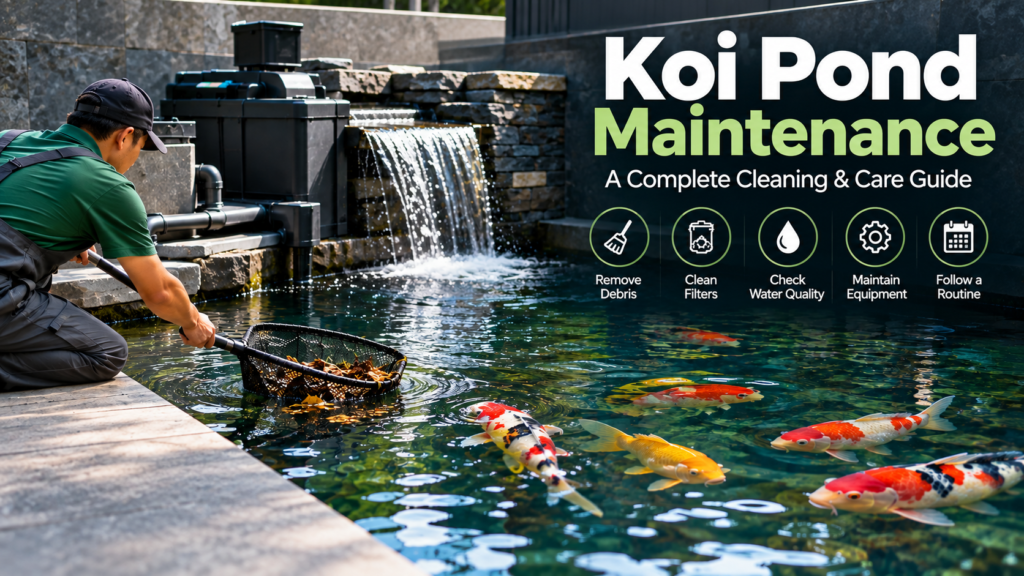
A clean and well-maintained koi pond provides a healthier environment for fish and keeps the water looking clear and attractive. But how often should you actually clean a koi pond?
The answer depends on several factors, including pond size, number of koi, filtration system, amount of debris, algae growth, weather conditions, and water quality.
Koi ponds usually don’t need to be completely emptied and scrubbed frequently. Instead, regular maintenance such as removing debris, cleaning filters, checking water parameters, and performing partial water changes can help keep the pond healthy throughout the year.
In this guide, we’ll explain how often to clean a koi pond, what should be cleaned, and how to create a simple maintenance routine.
How Often Should You Clean a Koi Pond?
For most koi ponds, maintenance is best divided into daily, weekly, monthly, and seasonal tasks.
A simple schedule can look like this:
| Maintenance Task | Recommended Frequency |
|---|---|
| Remove leaves and floating debris | Daily or as needed |
| Check koi behavior | Daily |
| Check water level | Daily or every few days |
| Clean skimmer basket | Weekly or as needed |
| Check water parameters | Weekly |
| Partial water change | As needed, based on water quality |
| Clean mechanical filter media | When flow decreases or media becomes clogged |
| Inspect pump and plumbing | Monthly |
| Remove accumulated pond sludge | As needed |
| Inspect UV clarifier | Monthly/seasonally |
| Deep pond maintenance | Periodically, based on pond condition |
There is no universal cleaning schedule for every koi pond. A heavily stocked pond may require more frequent maintenance than a lightly stocked pond with efficient filtration.
Daily Koi Pond Maintenance
Daily maintenance doesn’t have to take much time.
A quick inspection can help you identify problems before they become serious.
Remove Floating Debris
Remove leaves, flowers, insects, and other large debris from the pond surface using a pond net or skimmer.
Removing debris early prevents it from sinking and decomposing at the bottom of the pond.
Observe Your Koi
Watch your koi while they are swimming and feeding.
Look for unusual behavior such as:
- Staying near the surface
- Gasping
- Loss of appetite
- Unusual swimming
- Staying isolated
- Rubbing against surfaces
Changes in fish behavior can indicate water-quality or health problems and should be investigated.
Check the Water Level
Evaporation can lower the water level, particularly during hot weather.
Keep the pond at an appropriate operating level so pumps, skimmers, and filtration systems function correctly.
Weekly Koi Pond Maintenance
Weekly maintenance is where much of the routine pond care takes place.
Check Water Quality
Regularly test important water parameters such as:
- Ammonia
- Nitrite
- Nitrate
- pH
- Temperature
Testing becomes particularly important if the pond is heavily stocked, newly established, or experiencing unusual fish behavior.
Clean the Skimmer
If your pond has a skimmer, inspect and clean the skimmer basket regularly.
Leaves and debris can restrict water flow if allowed to accumulate.
Inspect the Pump
Check that the pond pump is operating correctly and that water circulation has not decreased.
A sudden reduction in flow may indicate:
- Blocked intake
- Clogged pre-filter
- Dirty filter media
- Plumbing obstruction
- Pump wear
Check the Pond Surface
Remove floating debris and inspect the pond for excessive algae or unusual water conditions.
How Often Should You Clean a Koi Pond Filter?
Your pond filter is one of the most important parts of the filtration system.
However, don’t clean biological filter media unnecessarily.
Mechanical filter sections collect solid waste and may need more frequent cleaning.
Biological media should generally be cleaned carefully and only when necessary because beneficial bacteria live on the media.
When Should You Clean the Filter?
Consider cleaning filter components when:
- Water flow decreases
- Mechanical media becomes heavily clogged
- Water quality begins to deteriorate
- The filter is visibly filled with debris
- The manufacturer’s maintenance schedule recommends cleaning
Whenever possible, follow the maintenance instructions for your specific filter system.
Should You Completely Empty a Koi Pond?
In most situations, completely draining a koi pond should not be part of routine weekly or monthly maintenance.
A full pond clean is a much more significant procedure and may be appropriate only in certain situations, such as:
- Severe sludge accumulation
- Major pond renovation
- Serious water-quality problems
- Structural repairs
- Major filtration upgrades
- Emergency fish-health situations
Before completely draining a pond, consider the impact on the fish and biological filtration system.
For routine maintenance, partial water changes and filtration maintenance are generally more practical.
How Often Should You Change Koi Pond Water?
Water changes should be based on the pond’s water quality, stocking level, filtration system, and maintenance requirements.
Rather than following one fixed percentage for every pond, monitor your water parameters and follow an appropriate maintenance routine.
When adding replacement water, make sure it is suitable for the koi and properly treated when necessary.
Avoid sudden changes in water conditions.
How to Remove Pond Sludge
Organic matter can accumulate at the bottom of a koi pond.
This may include:
- Fish waste
- Uneaten food
- Dead leaves
- Algae
- Plant debris
- Other organic material
A small amount of natural sediment is normal, but excessive sludge can contribute to poor water quality.
Depending on the pond design, sludge can be removed using:
- Pond vacuum
- Manual cleaning
- Bottom drain
- Appropriate filtration equipment
Ponds with effective bottom drains and properly designed filtration systems can make waste removal easier.
How Often Should You Remove Pond Sludge?
The frequency depends on how quickly sludge accumulates.
Inspect the pond regularly and remove excessive accumulation when necessary.
Ponds surrounded by trees may collect leaves much faster than ponds in open areas.
Likewise, heavily stocked koi ponds may produce more organic waste.
How to Control Algae in a Koi Pond
Algae are common in outdoor ponds.
Some algae growth is normal, but excessive algae can make the pond appear green or cloudy.
Common causes include:
- Excess nutrients
- Too much sunlight
- Overstocking
- Overfeeding
- Insufficient filtration
- Poor circulation
Instead of simply removing visible algae, identify the underlying cause.
A suitable filtration system, UV clarifier, adequate circulation, controlled feeding, and regular maintenance can all contribute to better pond water quality.
How Often Should You Clean a Pond UV Clarifier?
A UV clarifier can help control suspended algae and improve water clarity when correctly sized and maintained.
The UV unit itself usually requires periodic inspection.
Depending on the model, maintenance may include:
- Cleaning the quartz sleeve
- Checking the UV lamp
- Inspecting seals
- Checking water flow
- Replacing the UV lamp according to manufacturer guidance
Always follow the manufacturer’s maintenance instructions because service intervals vary between models.
Seasonal Koi Pond Maintenance
Outdoor ponds experience changing conditions throughout the year.
Summer
Hot weather can increase evaporation and influence dissolved oxygen levels.
During warmer periods:
- Monitor water temperature
- Check water levels
- Maintain good aeration
- Avoid overfeeding
- Monitor koi behavior
Monsoon and Heavy Rain
Heavy rain can introduce leaves, soil, pollutants, and other debris into the pond.
After heavy rainfall:
- Check water level
- Inspect filtration
- Remove debris
- Check water parameters
- Inspect overflow systems
- Observe koi behavior
Winter
In cooler conditions, koi metabolism and feeding requirements can change depending on local temperatures.
Follow appropriate seasonal feeding practices and continue monitoring water quality.
Signs Your Koi Pond Needs Cleaning
Your pond may require additional maintenance if you notice:
Cloudy Water
Cloudiness can have several causes, including suspended particles, biological changes, or algae.
Green Water
Green water is often associated with suspended algae.
Excessive Sludge
Large amounts of organic waste at the bottom can indicate that waste removal needs attention.
Reduced Filter Flow
Reduced flow may indicate clogged filter media, blocked plumbing, or pump problems.
Bad Odor
An unpleasant smell may indicate excessive organic waste or poor water conditions.
Increased Algae
Rapid algae growth may indicate excess nutrients, sunlight, or insufficient filtration.
Does a Larger Koi Pond Need More Cleaning?
Not necessarily.
A larger pond can contain more water volume, but its maintenance requirements depend on the complete system.
A well-designed pond with:
- Appropriate filtration
- Bottom drains
- Skimmers
- Adequate pump circulation
- UV clarification
- Proper aeration
may be easier to maintain than a smaller pond with inadequate filtration.
This is why pond design and filtration should be considered together.
How Filtration Reduces Pond Cleaning
A properly designed filtration system can significantly reduce the amount of manual cleaning required.
Different filtration stages perform different jobs.
Mechanical Filtration
Captures larger particles and solid waste.
Biological Filtration
Provides surfaces for beneficial bacteria that help process dissolved waste.
UV Clarification
Can help control suspended algae and improve water clarity.
Bottom Drain
Helps transport settled waste toward the filtration system when correctly designed.
Skimmer
Removes floating leaves and surface debris.
A combination of these systems can make long-term koi pond maintenance easier.
Koi Pond Cleaning Checklist
Use this simple checklist to stay on top of maintenance.
Daily
- Observe koi
- Check water level
- Remove obvious floating debris
- Check pump operation
Weekly
- Check water parameters
- Clean skimmer basket
- Inspect filter flow
- Remove accumulated debris
- Check koi feeding behavior
Monthly
- Inspect pump and plumbing
- Inspect filtration equipment
- Check UV clarifier
- Inspect pond edges and equipment
- Check for sludge accumulation
Seasonally
- Perform deeper inspection
- Check filtration performance
- Inspect UV system
- Review pump performance
- Remove excessive sludge
- Inspect pond structure and plumbing
Common Koi Pond Cleaning Mistakes
Cleaning Everything at Once
A complete cleaning of every component can unnecessarily disturb the biological filtration system.
Over-Cleaning Biological Media
Biological media should be handled carefully to preserve beneficial bacteria.
Ignoring the Cause of Green Water
Removing algae without addressing excess nutrients or inadequate filtration may only provide a temporary improvement.
Overfeeding Koi
Uneaten food contributes to organic waste and can affect water quality.
Ignoring Filter Flow
Reduced flow is often an early sign that filtration equipment needs attention.
Final Thoughts
So, how often should you clean a koi pond?
The answer depends on your pond’s size, fish population, filtration system, surrounding environment, weather, and water quality.
Instead of completely cleaning the pond on a fixed schedule, focus on regular maintenance:
- Remove debris
- Monitor water quality
- Maintain filters
- Check pumps
- Control algae
- Remove excessive sludge
- Maintain UV systems
- Observe your koi
A well-designed pond filtration system can reduce maintenance requirements and help maintain better water quality.
If you’re planning a new koi pond or upgrading an existing system, choosing the right combination of pond pump, filtration, UV clarification, aeration, skimmer, and bottom drain can make a significant difference in long-term maintenance.
Explore pond pumps, UV filters, filtration systems, and pond equipment at GreenfinIndia.com.
Frequently Asked Questions
How often should I clean my koi pond?
Routine maintenance should be performed regularly, while deeper cleaning should be based on sludge accumulation, water quality, filtration performance, and pond conditions.
Should I drain my koi pond every year?
Routine annual draining is not necessarily required for every koi pond. Well-designed ponds can often be maintained through regular filtration maintenance, debris removal, and appropriate water changes.
How often should I clean my koi pond filter?
Clean mechanical filter components when they become clogged or restrict water flow. Biological media generally requires gentler and less frequent cleaning.
How do I keep my koi pond water clear?
Maintain appropriate filtration, control feeding, remove debris, manage algae, maintain good circulation, and monitor water quality.
How often should I remove pond sludge?
Remove excessive sludge when it accumulates. The required frequency depends on pond design, fish stocking, surrounding vegetation, and filtration.
Does a UV filter help keep koi pond water clear?
A properly sized and maintained UV clarifier can help control suspended algae and improve water clarity.