

Maintaining clean, healthy water is essential for every pond, especially ponds that contain koi and other ornamental fish. Fish waste, uneaten food, leaves, and other organic materials can gradually reduce water quality if they are not managed properly. A reliable filtration system helps remove waste and supports a healthy pond environment.
A multi-chamber pond filter is a filtration system that uses multiple connected compartments to treat pond water in stages. Each chamber can perform a different filtration function, including mechanical filtration and biological filtration.
In this guide, we will explain what a multi-chamber pond filter is, how it works, its main benefits, the types of filter media used, and how to choose the right system for your pond.
What Is a Multi-Chamber Pond Filter?
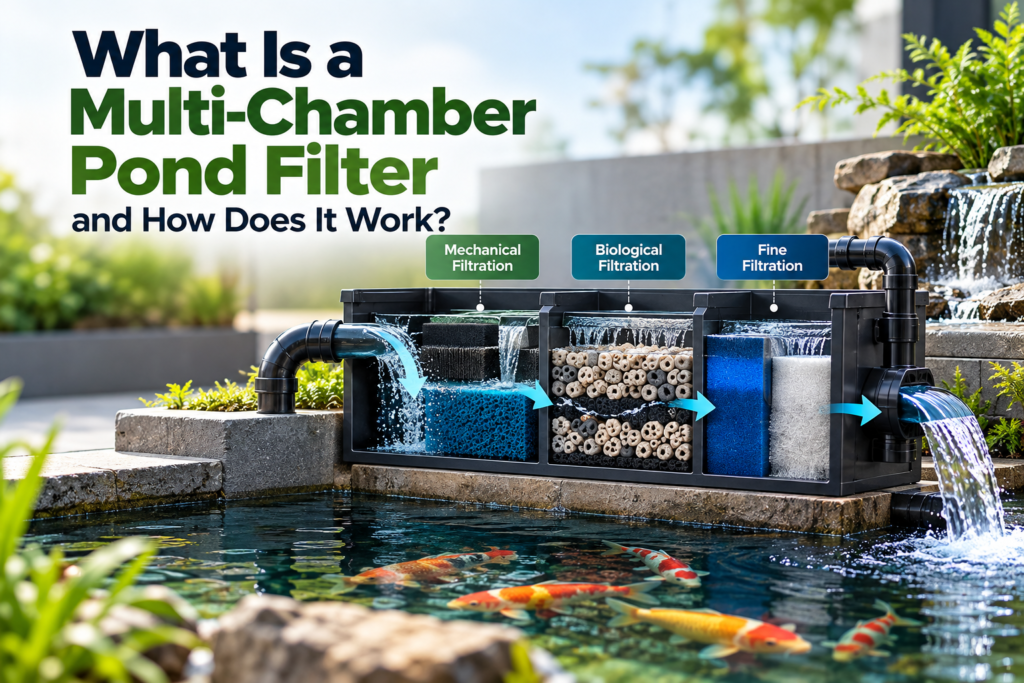
A multi-chamber pond filter is a pond filtration system divided into two or more compartments. Pond water passes through these chambers in sequence, allowing different types of filtration to take place.
The chambers may contain filter brushes, sponge mats, Japanese filter mats, ceramic media, bio balls, or other suitable filtration materials.
A typical multi-chamber pond filtration system includes:
- Mechanical filtration: Removes suspended solids and larger waste particles.
- Biological filtration: Provides surfaces for beneficial bacteria that help process toxic ammonia and nitrite.
- Fine filtration: Captures smaller particles that pass through earlier stages, depending on the media used.
- Optional polishing or treatment stage: May include additional media or equipment for specific water-quality requirements.
The exact arrangement depends on the filter design, pond size, fish stocking level, and the manufacturer’s recommendations.
Multi-chamber filters are commonly used in koi ponds, ornamental fish ponds, and larger outdoor pond systems that require reliable water treatment.
How Does a Multi-Chamber Pond Filter Work?
A multi-chamber pond filter works by passing water through several filtration stages before returning it to the pond.
1. Water Enters the First Chamber
Water is delivered to the filter through a suitable pump-fed or gravity-fed arrangement.
The first chamber often contains mechanical filtration materials such as filter brushes or coarse mats. These materials capture larger particles, including fish waste, leaves, and uneaten food.
Removing larger debris early helps prevent excessive solids from accumulating in later chambers.
2. Mechanical Filtration Removes Suspended Waste
After entering the filter, pond water passes through materials designed to trap solid particles.
Common mechanical filtration materials include:
- Filter brushes
- Coarse filter sponges
- Japanese filter mats
- Other purpose-designed mechanical media
The type and arrangement of media determine how effectively the filter captures waste. Mechanical media must be cleaned regularly to prevent clogging and restricted water flow.
3. Biological Filtration Processes Fish Waste
The next chamber or chambers contain biological filter media that provide surfaces for beneficial microorganisms.
Fish release ammonia through their waste and other biological processes. Beneficial bacteria in a mature biological filter convert ammonia into nitrite and then into nitrate through the nitrogen cycle.
Ammonia and nitrite are harmful to fish when present at elevated concentrations. Biological filtration helps manage these compounds, but the filter must be adequately sized, properly established, and supplied with sufficient oxygen.
Common biological filter media include:
- Bio balls
- Ceramic filter media
- Porous biological media
- Suitable biological filter mats
The best media depends on the filter design, available space, water flow, and pond’s biological load.
4. Additional Chambers Provide Further Treatment
Some multi-chamber pond filters include extra compartments for additional mechanical filtration or biological media.
An additional chamber can provide more media capacity and help improve the overall treatment process when properly designed.
Certain systems may also incorporate equipment such as a UV clarifier. A UV clarifier is usually installed in the appropriate part of the water circuit and helps control suspended green-water algae when correctly sized and operated.
A UV clarifier does not replace mechanical or biological filtration.
5. Filtered Water Returns to the Pond
After passing through the filter stages, treated water returns to the pond through a suitable outlet or return line.
The return flow helps maintain water circulation and distributes treated water throughout the pond.
For best results, the pond pump, plumbing, filter capacity, and return outlets should be designed to work together.
Main Types of Multi-Chamber Pond Filter Media
Different media perform different roles inside the filtration system.
| Filter Media | Main Function | Typical Placement |
|---|---|---|
| Filter brushes | Traps larger suspended debris | Early mechanical stage |
| Coarse sponge | Captures particles and provides some bacterial surface area | Mechanical stage |
| Japanese filter mat | Provides mechanical filtration and biological surface area | Mechanical or combined stage |
| Bio balls | Provides surfaces for beneficial bacteria | Biological stage |
| Ceramic media | Supports beneficial bacteria, depending on its porosity and design | Biological stage |
| Other porous biological media | Provides surface area for bacterial colonisation | Biological stage |
Not every filter requires all these materials. Follow the manufacturer’s recommended layout and avoid packing media so tightly that it restricts water flow.
Benefits of a Multi-Chamber Pond Filter
1. Multiple Filtration Stages
A multi-chamber system separates filtration functions into different compartments. This makes it possible to remove larger solids before water reaches the biological media.
2. Supports Biological Filtration
The biological chambers provide surfaces for beneficial bacteria that help process ammonia and nitrite.
This is particularly important in koi ponds, where fish stocking and feeding can create a substantial biological load.
3. Flexible Filter Media Arrangement
Depending on the system’s design, owners can select suitable mechanical and biological media for their filtration requirements.
Any changes should remain compatible with the filter’s intended flow path and media capacity.
4. Easier Stage-by-Stage Maintenance
Separate compartments allow you to inspect and clean mechanical media without necessarily disturbing every stage of the filter.
Careful maintenance can help preserve the beneficial bacteria needed for biological filtration.
5. Suitable for Many Outdoor Ponds
Multi-chamber filtration systems can be used for koi ponds and ornamental ponds of different sizes, provided the system is properly designed for the pond’s volume, fish load, feeding rate, and waste production.
Multi-Chamber Pond Filter vs Pressure Pond Filter
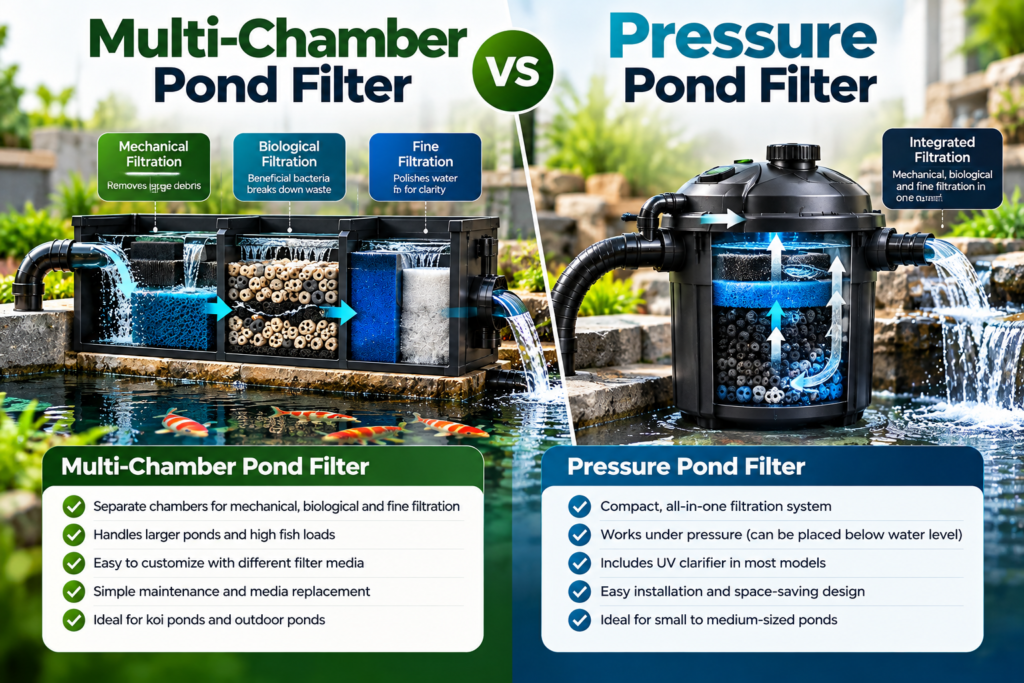
Multi-chamber and pressure pond filters can both help maintain water quality, but they differ in design and typical applications.
| Feature | Multi-Chamber Pond Filter | Pressure Pond Filter |
|---|---|---|
| Design | Multiple open or separately enclosed compartments | Sealed vessel designed to operate under pressure |
| Media capacity | Depends on chamber dimensions and configuration | Depends on the specific filter model |
| Installation | Often installed in a dedicated filter area | Often compact and suitable for space-limited installations |
| Maintenance | Usually requires access to individual chambers | May include a backwash or cleaning mechanism |
| Common applications | Medium to large ponds and koi systems | Small to medium ponds and suitable compact systems |
| Space requirements | May require more installation space | Often requires less space |
Neither system is automatically better for every pond. The right choice depends on fish stocking, maintenance preferences, available space, water flow, and filtration requirements.
How to Choose the Right Multi-Chamber Pond Filter
Before purchasing a multi-chamber pond filter, consider the following factors.
1. Calculate Your Pond Volume
Pond volume is an important starting point when selecting filtration equipment.
For a rectangular pond:
Pond volume in litres = Length (m) × Width (m) × Average water depth (m) × 1,000
For example, a pond measuring 4 metres long, 3 metres wide, and 1 metre deep has a nominal volume of:
4 × 3 × 1 × 1,000 = 12,000 litres
For irregular ponds, use the average water depth and account for the actual shape.
2. Consider the Number and Size of Fish
A pond with many koi generally produces more waste than a lightly stocked ornamental pond of the same volume.
Fish size, feeding frequency, and the amount of uneaten food also affect the required biological filtration capacity.
Choose a system based on the expected fish load, not just the number of litres in the pond.
3. Check the Recommended Flow Rate
The pump must deliver a suitable flow rate through the filter.
Actual flow depends on pump performance, elevation, pipe diameter, pipe length, fittings, and the resistance created by the filter.
Always check the filter manufacturer’s recommended flow range and ensure the plumbing arrangement is compatible with the system.
4. Evaluate Mechanical and Biological Capacity
Check the available space for mechanical media and biological media.
A filter needs sufficient capacity to capture solids while providing adequate surface area for beneficial bacteria. Good water distribution and sufficient oxygen are also important for biological performance.
5. Consider Maintenance Access
The filter should be accessible for inspection and cleaning. Make sure there is enough room to remove the media, drain waste, and carry out routine maintenance.
A well-designed filter that is easy to maintain is more practical than a system that is difficult to access.
How to Maintain a Multi-Chamber Pond Filter
Regular maintenance helps maintain water flow and filtration performance.
- Inspect the mechanical chambers: Check for accumulated fish waste, leaves, and debris.
- Clean mechanical media when needed: Remove trapped solids before they restrict water flow.
- Protect beneficial bacteria: Avoid cleaning all biological media at the same time with untreated tap water or disinfectants.
- Check the pump and plumbing: Inspect the pump intake, pipes, valves, and return lines for blockages.
- Monitor water quality: Test ammonia and nitrite, particularly in newly established ponds or heavily stocked systems.
- Check water flow: Reduced return flow may indicate clogged media, a blocked pump intake, or a plumbing problem.
- Inspect additional equipment: If the system includes a UV clarifier, follow its maintenance schedule and replace the lamp as specified by the manufacturer.
Avoid replacing or aggressively cleaning all biological media at once. This can reduce the beneficial bacterial population and disrupt biological filtration.
Common Multi-Chamber Pond Filter Problems
Why Is My Pond Water Still Cloudy?
Cloudy water can result from suspended solids, disturbed substrate, insufficient mechanical filtration, or other water-quality issues.
Check the mechanical media, filter flow, pond circulation, and water parameters before deciding which treatment is needed.
Why Is My Pond Filter Flow Rate Low?
Common causes include a blocked pump intake, dirty mechanical media, clogged plumbing, or a pump that is unsuitable for the system’s operating conditions.
Inspect each part of the circulation system to identify the restriction.
Why Is Ammonia Present Despite Having a Filter?
Possible causes include an immature biological filter, excessive fish stocking, overfeeding, inadequate oxygen, or insufficient biological capacity.
Test the water, reduce feeding if appropriate, improve aeration, and address the underlying cause. Ammonia and nitrite require prompt attention because they can harm fish.
Does a Multi-Chamber Filter Remove Green Water?
Mechanical and biological filtration alone may not reliably eliminate suspended algae responsible for green water. Depending on the problem, a correctly sized UV clarifier and appropriate nutrient management may help.
Frequently Asked Questions
1. Is a multi-chamber pond filter good for koi ponds?
Yes. A properly designed multi-chamber filter can be suitable for koi ponds because it can provide separate stages for mechanical and biological filtration. Its capacity must match the pond’s fish load and waste production.
2. How many chambers should a pond filter have?
There is no universal ideal number. The required number depends on the filter design, the available space, the type of media, and the pond’s filtration requirements.
3. Which filter media is best for a multi-chamber pond filter?
Mechanical media such as brushes and mats can capture solids, while suitable biological media provide surfaces for beneficial bacteria. Many systems use a combination of media selected for each stage.
4. How often should I clean a multi-chamber pond filter?
The frequency depends on fish stocking, feeding, pond debris, and filter capacity. Inspect the mechanical stages regularly and clean them when waste accumulates or water flow decreases. Maintain biological media carefully.
5. Does a multi-chamber pond filter need a separate pump?
Many systems require a pond pump to move water through the filter, although some are designed for gravity-fed installation. Check the system’s design and installation requirements before buying.
6. Can I add a UV clarifier to a multi-chamber pond filter?
Yes, if the UV clarifier and plumbing are compatible with the filtration system. The correct installation position, flow rate, and UV capacity depend on the equipment and the pond’s needs.
Conclusion
A multi-chamber pond filter is a practical filtration option for koi ponds and ornamental ponds that need staged water treatment. By combining mechanical filtration with biological filtration, it helps remove suspended waste and supports the beneficial bacteria responsible for processing ammonia and nitrite.
The best system depends on pond volume, fish stocking, feeding rate, pump flow, media capacity, and maintenance requirements. Correct sizing and regular maintenance are essential for achieving reliable results.
At GreenfinIndia, explore pond pumps, filtration equipment, filter media, and UV clarifiers to plan a pond filtration system that suits your pond’s requirements.