

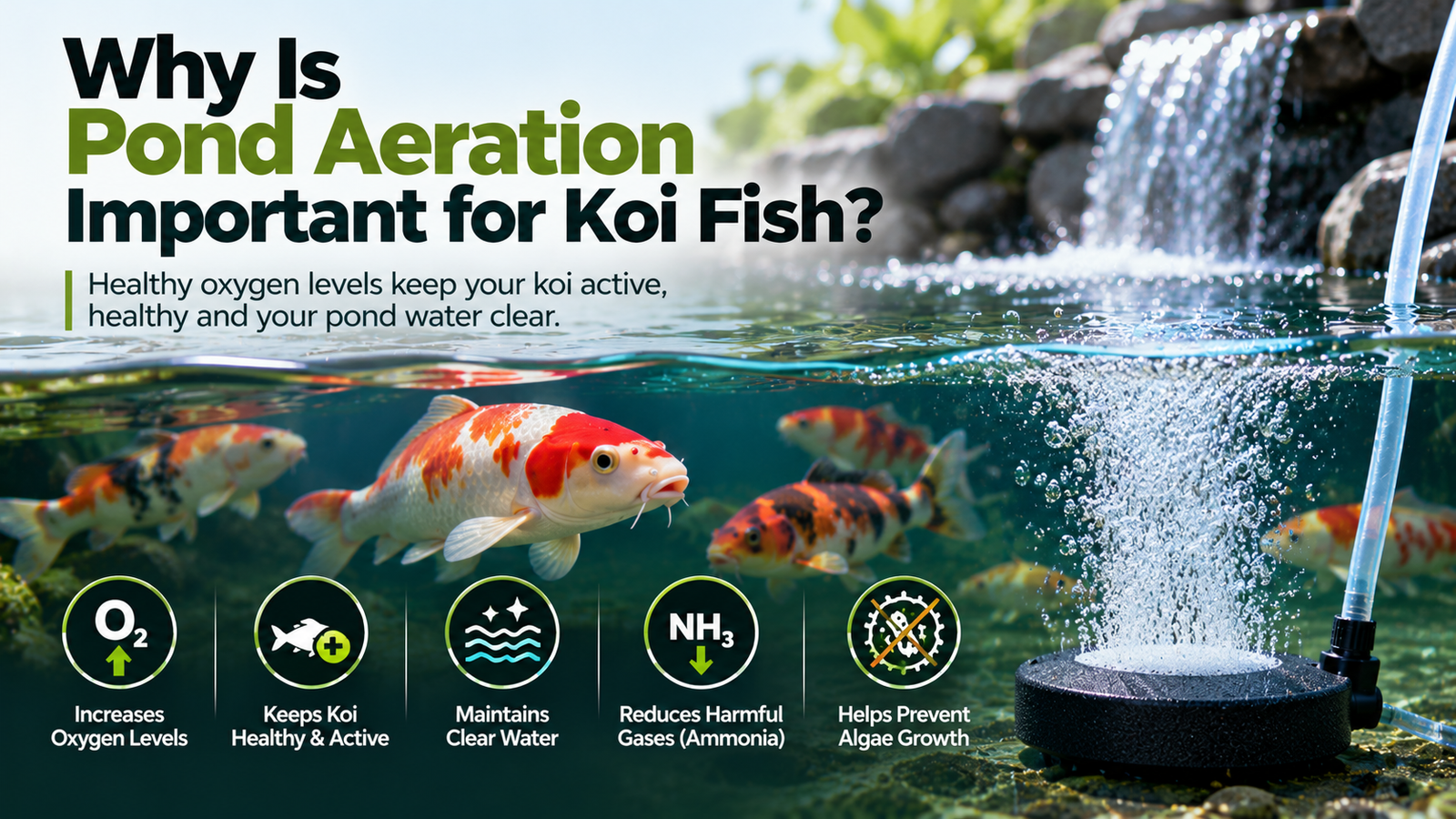
Koi fish are beautiful, active, and popular among pond enthusiasts. However, keeping koi healthy requires more than clean water and proper feeding. One of the most important factors in maintaining a healthy koi pond is adequate oxygen.
Pond aeration helps increase dissolved oxygen levels, supports beneficial bacteria, improves water circulation, and creates a healthier environment for koi fish. Without sufficient oxygen, koi may experience stress, reduced appetite, and serious health problems.
Whether you have a small garden pond or a large koi pond, understanding the importance of pond aeration can help you maintain better water quality and protect your fish throughout the year.
In this guide, we will explain how pond aeration works, its benefits, the different types of aeration equipment, and how to choose the right aeration system for your pond.
What Is Pond Aeration?
Pond aeration is the process of increasing oxygen exchange between the air and pond water. It helps maintain adequate dissolved oxygen, which is essential for fish, beneficial bacteria, and other aquatic organisms.
In a koi pond, oxygen enters the water naturally through surface gas exchange and photosynthesis. However, natural oxygen supply may not be sufficient in ponds with high fish stocking levels, warm water, excessive organic waste, or limited water movement.
An aeration system helps improve oxygen availability by creating bubbles, disturbing the water surface, or circulating water between different pond areas.
Common pond aeration equipment includes:
- Pond air pumps
- Air stones and air diffusers
- Bottom-mounted aeration systems
- Water pumps and circulation systems
- Waterfalls and fountains
Each system works differently, and the best choice depends on pond depth, size, fish population, and existing filtration equipment.
Why Is Pond Aeration Important for Koi Fish?
1. Provides Essential Oxygen for Koi Fish
Koi fish absorb dissolved oxygen through their gills. When oxygen levels fall too low, fish may become stressed and struggle to breathe.
Adequate aeration helps maintain a suitable oxygen supply, particularly in ponds with many koi or large adult fish.
Signs of possible low oxygen include:
- Koi gathering near waterfalls or other areas with moving water.
- Fish gasping at the water surface.
- Unusual lethargy or reduced activity.
- Rapid gill movement.
These signs can also indicate other water-quality problems. If fish are gasping, increase aeration immediately and check dissolved oxygen, ammonia, nitrite, temperature, and pump operation.
2. Supports Beneficial Bacteria in Pond Filters
Biological filtration is essential for maintaining a healthy koi pond. Beneficial bacteria convert toxic ammonia into nitrite and then into nitrate through the biological nitrogen cycle.
These bacteria need oxygen to function effectively in conventional aerobic biological filters.
Insufficient oxygen can reduce biological filtration efficiency and contribute to the accumulation of harmful ammonia and nitrite.
A well-designed aeration system supports the biological filter by helping maintain adequate oxygen availability. Some filtration systems also use dedicated air pumps to supply oxygen directly to moving-bed filter media.
3. Improves Water Circulation
Pond aeration can help reduce stagnant areas where debris and organic waste accumulate. Air diffusers placed near the pond bottom create rising bubbles that move water upward and encourage circulation.
Better circulation can help transport waste toward drains or mechanical filtration equipment, depending on the pond’s design.
However, aeration alone does not physically remove waste from the pond. Mechanical filtration, bottom drains, skimmers, and regular maintenance may still be required.
4. Helps During Hot Weather
Warm water holds less dissolved oxygen than cooler water. At the same time, koi metabolism and the oxygen demand of microorganisms can increase as temperatures rise.
These conditions make summer an important period for monitoring pond oxygen levels.
During hot weather, consider:
- Running suitable aeration equipment continuously.
- Checking the pond’s water temperature.
- Avoiding excessive feeding.
- Removing decaying leaves and organic debris.
- Maintaining adequate water circulation.
- Monitoring fish behaviour, especially early in the morning.
In warm climates, including Kerala, effective aeration can be particularly valuable during hot, humid periods and in heavily stocked outdoor ponds.
5. Helps Maintain a Healthier Pond Ecosystem
Oxygen supports many biological processes within a pond. Adequate oxygen levels help beneficial microorganisms break down organic waste under aerobic conditions.
Poorly oxygenated areas can encourage undesirable anaerobic decomposition, which may produce unpleasant odours and potentially harmful compounds.
Consistent aeration, combined with good waste management and filtration, helps create a more stable pond environment.
6. Supports High-Density Koi Ponds
Koi ponds with many fish require careful oxygen management. More fish generally means greater oxygen consumption and increased waste production.
Large koi also have significant oxygen requirements, especially when water temperatures are high or the fish are actively swimming and feeding.
If your pond has a high stocking density, you should evaluate the aeration system alongside the pump, mechanical filter, and biological filter capacity.
Do not rely on pond volume alone when selecting equipment. Fish size, feeding rate, water temperature, and filtration design all influence oxygen demand.
What Are the Different Types of Pond Aeration Systems?
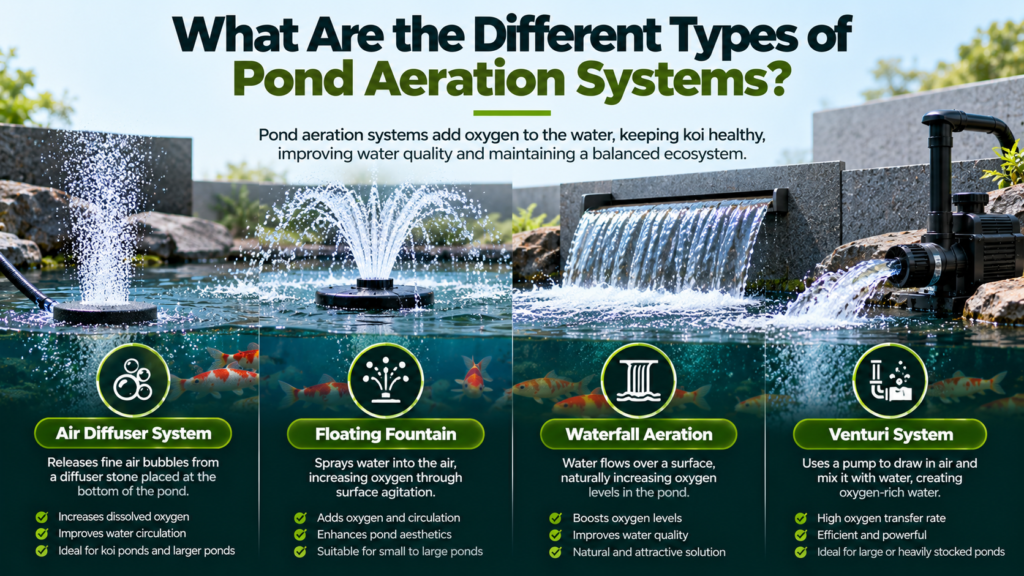
Choosing the right aeration equipment is essential for maintaining a healthy koi pond.
1. Pond Air Pump with Air Stones
An air pump supplies air through airline tubing to air stones or diffusers placed inside the pond.
The bubbles rise toward the surface and encourage gas exchange. In deeper ponds, bottom-mounted diffusers can also generate useful water circulation.
Benefits:
- Simple installation in many pond setups.
- Suitable for small and medium-sized ponds when correctly sized.
- Can provide continuous aeration.
- Useful for supplying air to dedicated filter chambers.
When choosing an air pump, consider its airflow output at the operating pressure, pond depth, number of diffusers, and the resistance of the tubing.
2. Bottom-Mounted Pond Aeration System
Bottom aeration systems use diffusers placed near the pond floor. Rising bubbles move water upward and encourage circulation throughout the pond.
These systems can be especially useful in deeper koi ponds where surface aeration alone may not provide adequate circulation.
Benefits:
- Encourages circulation in deeper water.
- Supports oxygen exchange.
- Can help reduce stagnant areas.
- May complement mechanical and biological filtration.
Position diffusers carefully so that circulation patterns are suitable for your pond and do not unnecessarily disturb fish or interfere with waste collection.
3. Waterfall Aeration
Waterfalls introduce oxygen through turbulence as water flows over rocks, spillways, or other surfaces and returns to the pond.
A waterfall can provide both visual appeal and useful water movement. However, its aeration effectiveness depends on the flow rate, drop height, surface area, and the way water returns to the pond.
Benefits:
- Improves surface movement.
- Enhances the appearance of the pond.
- Can support circulation when paired with a suitable pump.
- Provides some oxygen exchange through turbulence.
A waterfall should not automatically be considered sufficient for every koi pond, particularly during hot weather or in ponds with high fish populations.
4. Pond Fountains
Fountains spray or circulate water through the air, increasing contact between water and air.
They can contribute to oxygen exchange, but their effectiveness depends on the fountain’s design, flow rate, and pond conditions.
Benefits:
- Adds a decorative feature.
- Creates surface movement.
- Can improve circulation in suitable pond designs.
Some fountains are designed primarily for decoration rather than high oxygen transfer. Check the equipment specifications before using one as the main aeration system.
How Much Aeration Does a Koi Pond Need?
There is no single air pump size suitable for every koi pond. The correct aeration capacity depends on pond volume, depth, fish stocking, water temperature, filter requirements, and the design of the diffusers.
When selecting an aeration system, consider the following factors.
Pond Volume
Calculate your pond’s approximate water volume in litres. This provides a useful starting point for equipment selection, but it is not enough to determine the required airflow on its own.
Pond Depth
Deeper ponds create greater back pressure on an air pump. As the operating depth increases, the pump may deliver less airflow than its advertised free-air rating.
Choose a pump that provides the required airflow at the actual operating depth.
Fish Stocking Level
A pond with many large koi needs more careful oxygen management than a lightly stocked pond of the same size.
Consider the number and size of fish, feeding frequency, and biological filtration load.
Number of Diffusers
Multiple diffusers may improve oxygen distribution and circulation, depending on pond shape and diffuser placement. Confirm that the pump can supply the combined airflow required by all diffusers.
Dissolved Oxygen Testing
A dissolved oxygen meter provides a more reliable assessment of oxygen conditions than observing bubbles alone.
For many koi ponds, maintaining dissolved oxygen around 6–8 mg/L is a useful general target, although the ideal level depends on water temperature, fish health, and the overall system. Higher levels may be desirable under demanding conditions, and sustained low levels require prompt attention.
Should You Run Pond Aeration 24 Hours a Day?
For most koi ponds, running the aeration system continuously is a good practice, particularly where the pond is heavily stocked or relies on oxygen-dependent biological filtration.
Oxygen levels can fall overnight because photosynthesis stops while fish, plants, and microorganisms continue consuming oxygen. This means early morning can be a critical time for monitoring pond conditions.
Continuous aeration helps reduce the risk of sudden oxygen shortages.
For reliable operation:
- Inspect air pumps, airline tubing, and diffusers regularly.
- Keep backup aeration equipment available for emergencies.
- Consider a battery-powered or backup air pump if power interruptions are common.
- Check that the filtration system continues operating correctly.
- Monitor oxygen levels during hot weather and after unusually heavy feeding.
An air pump should be selected for continuous-duty operation if it is intended to run all day.
Common Pond Aeration Mistakes to Avoid
Even when aeration equipment is installed, some mistakes can reduce its effectiveness.
Using an Undersized Air Pump
A small pump may not provide sufficient airflow at the required depth. Always check the pump’s performance specifications under operating conditions.
Ignoring Dissolved Oxygen Levels
A pond can look healthy while oxygen levels are approaching dangerous levels. Test oxygen when possible, especially during hot weather and in heavily stocked ponds.
Depending Only on a Waterfall
A waterfall may improve oxygen exchange but may not provide sufficient oxygen for every pond. Additional air diffusers can be useful when oxygen demand is high.
Neglecting Filter Maintenance
Clogged mechanical filters and accumulated organic waste can increase oxygen demand and reduce water circulation. Maintain the filter system according to the manufacturer’s instructions.
Switching Off Aeration at Night
Turning off aeration can increase the risk of low oxygen during the hours when photosynthesis is absent. Continuous operation is generally preferable for koi ponds that depend on supplemental aeration.
Ignoring Power Failures
A power outage can interrupt both aeration and filtration. A suitable backup air pump can provide valuable protection during an emergency.
Frequently Asked Questions About Pond Aeration
1. Do koi fish need an air pump?
Not every pond requires a separate air pump, but many koi ponds benefit from one. The need depends on stocking density, water circulation, temperature, pond design, and the oxygen supplied by existing equipment.
2. Can koi survive without pond aeration?
Koi can survive without a dedicated air pump if natural gas exchange and water movement provide enough oxygen. However, heavily stocked ponds and warm-water conditions can make supplemental aeration essential for reliable oxygen management.
3. Is a waterfall enough to oxygenate a koi pond?
Sometimes, but not always. Waterfall height, flow rate, and pond oxygen demand determine how effective it is. A separate aeration system may be necessary for deeper or heavily stocked ponds.
4. Does aeration help pond filters work better?
Yes. Adequate oxygen supports beneficial bacteria in aerobic biological filters. Some filter designs also require direct aeration to maintain their intended operation.
5. Can too much aeration harm koi fish?
Aeration is generally beneficial when properly designed. However, excessive turbulence or strong currents in unsuitable areas can stress fish or interfere with waste collection. Distribute airflow according to the pond’s layout and the fish’s needs.
6. Is pond aeration necessary during the monsoon?
Aeration can remain important during the monsoon because heavy rain, changing temperatures, organic runoff, and sudden water-quality changes can affect pond conditions. Continue monitoring fish behaviour and water quality, and adjust equipment according to the pond’s requirements.
Conclusion
Pond aeration is an important part of maintaining a healthy koi pond. Adequate oxygen supports koi respiration, beneficial bacteria, biological filtration, and overall pond stability. It becomes particularly important in warm weather, heavily stocked ponds, and systems with high organic waste loads.
Choosing the right air pump, diffuser, waterfall, or fountain depends on your pond’s size, depth, stocking level, and filtration design. For best results, combine suitable aeration with mechanical filtration, biological filtration, regular water testing, and proper maintenance.
Looking for reliable pond aeration equipment? Explore pond pumps, air pumps, filtration systems, and other pond equipment at Greenfinindia.com to find suitable solutions for your koi pond.