

A clean and healthy pond is more than just an attractive feature for your garden or outdoor space. Good pond maintenance helps maintain water quality, supports healthy fish, improves filtration performance, and keeps unwanted algae and debris under control.
If you are looking for a complete pond cleaning guide, it is important to understand that pond cleaning is not simply about removing dirty water. A properly maintained pond needs a combination of debris removal, filter maintenance, water-quality management, algae control, pump inspection, and regular observation.
Whether you have a small decorative pond, a koi pond, or a large outdoor pond, following a consistent maintenance routine can make it easier to keep the water clear and the pond ecosystem stable.
In this guide, we explain how to clean a pond, when to clean it, what equipment you may need, and how to maintain good pond water quality.
Why Is Pond Cleaning Important?
Outdoor ponds naturally collect leaves, dust, dirt, fish waste, uneaten food, plant debris, and other organic material.
If this waste is allowed to accumulate, it can contribute to:
- Poor water clarity
- Excessive algae growth
- Unpleasant odors
- Increased organic waste
- Reduced filtration performance
- Poor water quality
- Reduced oxygen levels
- Stress for fish
Regular pond maintenance helps reduce these problems and allows the filtration system to work more effectively.
How Often Should You Clean a Pond?
There is no single cleaning schedule that works for every pond.
The ideal maintenance frequency depends on:
- Pond size
- Number of fish
- Fish species
- Amount of plant growth
- Filtration system
- Amount of debris entering the pond
- Weather conditions
- Water-quality readings
Instead of relying only on a fixed schedule, inspect the pond regularly and monitor water quality.
A heavily stocked koi pond may require more frequent maintenance than a lightly stocked decorative pond.
Pond Cleaning Guide: Step-by-Step
Step 1: Remove Leaves and Floating Debris
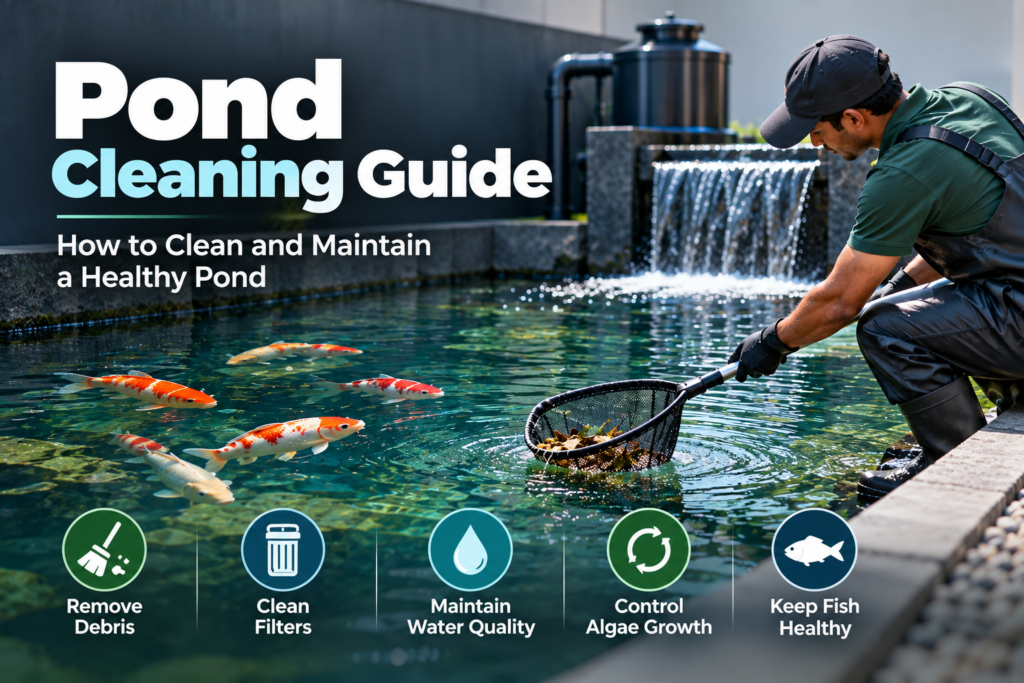
Start by removing visible leaves, sticks, dead insects, and other floating debris.
A pond net or skimmer can make this task easier.
Removing debris regularly is important because organic material eventually breaks down and adds nutrients and waste to the water.
During autumn or windy weather, you may need to remove leaves more frequently.
Step 2: Remove Excess Algae
Some algae are normal in outdoor ponds, but excessive growth can affect water clarity and appearance.
Common types include:
- Green water algae
- String or blanket algae
- Surface algae
- Algae growing on pond walls and rocks
Use a suitable pond net, brush, or algae-removal tool to physically remove excessive growth.
However, don’t remove every trace of algae unnecessarily. A pond is an ecosystem, and the goal should be balance rather than making every surface completely sterile.
Step 3: Check the Pond Pump
The pond pump is an important part of circulation and filtration.
During cleaning, inspect the pump for:
- Reduced water flow
- Blocked intake
- Leaves and debris
- Impeller buildup
- Damaged cables
- Unusual noise
A blocked pump can reduce circulation and affect the performance of waterfalls, fountains, and filtration systems.
Always disconnect electrical equipment safely before removing or servicing a pump.
Step 4: Clean the Pond Filter
A pond filter collects suspended particles and provides surfaces for beneficial microorganisms.
Depending on your filtration system, it may contain:
- Mechanical filter pads
- Brushes
- Japanese mat
- Bio media
- Ceramic media
- Other biological filtration materials
Mechanical media can become clogged with debris and require cleaning.
When cleaning biological media, avoid aggressively sterilizing it because beneficial microorganisms are important for biological filtration.
Whenever possible, follow the filter manufacturer’s maintenance instructions.
Step 5: Check the UV Clarifier
If your pond uses a UV clarifier, inspect the system during routine maintenance.
A UV clarifier can help control suspended algae that contribute to green water.
Check:
- UV lamp condition
- Quartz sleeve cleanliness
- Water flow
- Electrical connections
- Manufacturer-recommended replacement interval
A UV clarifier cannot replace mechanical and biological filtration. It works as part of a complete pond filtration system.
Step 6: Remove Accumulated Sludge
Over time, organic waste can accumulate at the bottom of a pond.
This material may contain:
- Fish waste
- Dead leaves
- Plant debris
- Uneaten food
- Fine sediment
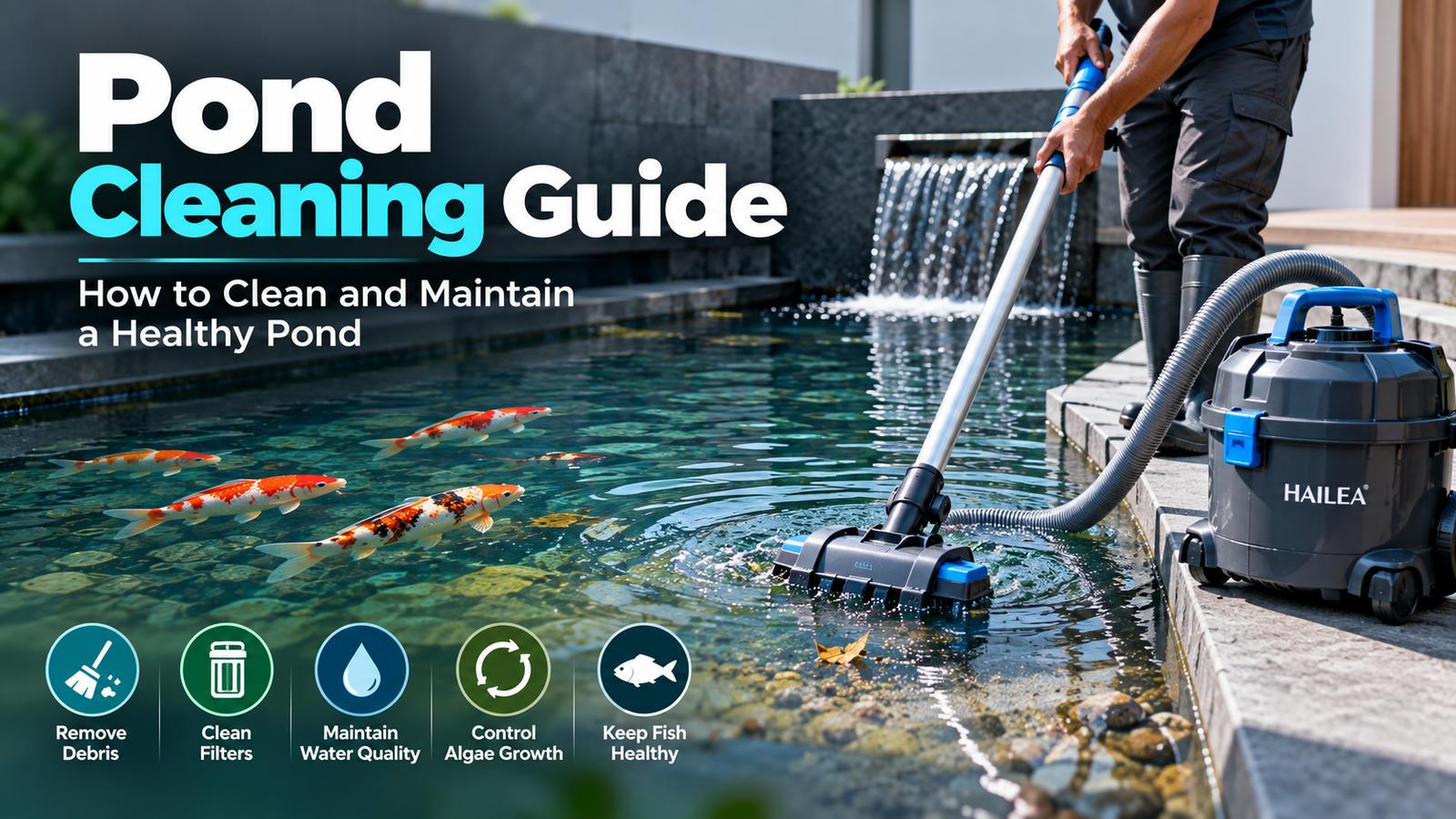
A pond vacuum can help remove accumulated sludge without requiring the entire pond to be emptied.
For larger ponds, professional pond cleaning equipment may be more appropriate.
Step 7: Inspect Aquatic Plants
Aquatic plants can contribute to a healthy pond ecosystem, but dead leaves and excessive growth should be managed.
Remove:
- Dead leaves
- Rotting stems
- Excessive floating vegetation
- Decaying plant material
Trim plants according to their species and growth requirements.
Healthy plants can also compete with algae for nutrients, helping support a balanced pond environment.
Step 8: Check Water Level
Outdoor ponds naturally lose water through evaporation and, depending on the setup, splash-out.
Check the pond water level regularly.
If adding tap water, use an appropriate water conditioner when necessary, particularly where chlorine or chloramine may be present.
Avoid making sudden major changes to the pond’s water chemistry.
Should You Drain the Entire Pond?
A complete pond drain is not always necessary.
In many situations, regular maintenance can include:
- Removing debris
- Cleaning mechanical filtration
- Removing sludge
- Managing algae
- Checking pumps
- Monitoring water parameters
- Performing appropriate partial water changes
Completely draining a pond can significantly disturb the pond ecosystem and beneficial microorganisms.
A full clean may be appropriate in certain situations, such as severe sludge accumulation, major pond renovation, structural repairs, or serious water-quality problems.
For fish ponds, especially koi ponds, major cleaning should be planned carefully to minimize stress.
How to Keep Pond Water Crystal Clear
Clear pond water depends on several factors rather than one product.
1. Use Proper Filtration
Choose a filtration system appropriate for the pond’s volume and biological load.
A filtration system may combine:
Mechanical filtration + Biological filtration + UV clarification
Each stage performs a different role.
2. Choose the Right Pond Pump
The pump should provide suitable circulation through the filtration system.
An undersized or poorly selected pump can reduce filtration performance.
When choosing a pump, consider:
- Pond volume
- Required flow rate
- Filter specifications
- Waterfall height
- Pipe length
- Pipe diameter
- Head height
3. Control Fish Feeding
Overfeeding is a common contributor to pond water-quality problems.
Uneaten food breaks down and adds organic waste to the pond.
Feed fish an appropriate quantity and remove excess food when necessary.
4. Avoid Overstocking
More fish means more waste.
A properly planned fish population makes it easier for the filtration system to maintain water quality.
5. Control Sunlight and Algae
Excess sunlight can contribute to algae growth.
Aquatic plants can provide shade and compete for nutrients, while suitable filtration and UV clarification can help manage water clarity.
Pond Water Testing
Cleaning the pond is only one part of pond maintenance.
Regularly monitoring water parameters can help identify problems before they become serious.
Depending on the pond and fish species, you may monitor:
- Ammonia
- Nitrite
- Nitrate
- pH
- Temperature
- Dissolved oxygen
- Water hardness
Koi and other fish can be affected by poor water quality even when the pond looks visually clean.
This is why clear water does not always mean healthy water.
Common Pond Cleaning Mistakes
Over-Cleaning the Pond
Trying to make a pond completely sterile can disturb beneficial microorganisms and the natural ecosystem.
Cleaning All Filter Media at Once
Aggressively cleaning or replacing all biological media can reduce beneficial microbial populations.
Removing All Pond Water Unnecessarily
A complete water replacement can cause sudden changes in water chemistry and temperature.
Ignoring the Pump
A dirty or blocked pump can reduce circulation and filtration performance.
Overusing Algae Treatments
Chemical treatments should not be used as a substitute for addressing the underlying cause of excessive algae.
Overfeeding Fish
Excess food increases organic waste and can contribute to water-quality problems.
Ignoring Filter Capacity
A filtration system should be selected according to the pond’s actual volume, fish load, and expected waste production.
Pond Cleaning Checklist
Use this simple checklist for routine maintenance:
Daily or Frequent Checks
- Observe fish behavior
- Check water level
- Remove visible floating debris
- Check pump and waterfall flow
- Check for unusual water discoloration
Weekly Checks
- Remove leaves and debris
- Inspect algae growth
- Check filter flow
- Inspect pump intake
- Check fish feeding and behavior
Monthly or As Needed
- Clean mechanical filter media
- Inspect biological filter media
- Check UV clarifier
- Inspect pump and plumbing
- Remove accumulated sludge
- Trim aquatic plants
- Test water parameters
The exact schedule should be adjusted according to your pond’s size, stocking, filtration system, and environmental conditions.
Pond Cleaning Equipment You May Need
Having the right equipment makes pond maintenance easier.
Common pond-cleaning equipment includes:
- Pond skimmer
- Pond net
- Pond vacuum
- Pond brush
- Water testing kit
- Pond pump
- UV clarifier
- Mechanical filter
- Biological filter media
- Water conditioner
- Aeration system
For larger koi ponds, a properly designed filtration system can significantly reduce the amount of manual cleaning required.
When Should You Consider Professional Pond Cleaning?
Professional pond cleaning may be useful when:
- The pond has severe sludge buildup
- Water quality is difficult to control
- The filtration system is inadequate
- The pond has a large fish population
- The pump or filtration system requires upgrading
- The pond requires structural repairs
- Major algae problems continue despite routine maintenance
- You are planning a pond renovation or filtration upgrade
A professional inspection can help identify whether the problem is caused by the pond design, filtration capacity, circulation, stocking level, or maintenance routine.
Frequently Asked Questions
How often should a pond be cleaned?
The required frequency depends on pond size, fish population, filtration, plants, and environmental conditions. Regular light maintenance is usually preferable to waiting until large amounts of waste accumulate.
How do I clean a koi pond?
Remove floating debris, control algae, clean mechanical filtration, inspect the pump and UV system, remove accumulated sludge when necessary, and regularly monitor water parameters.
Should I completely drain my koi pond to clean it?
Not necessarily. Many ponds can be maintained without completely draining them. A full drain may be appropriate for major renovation, severe sludge accumulation, structural repairs, or specific water-quality situations.
How do I keep my pond water clear?
Use appropriately sized mechanical and biological filtration, maintain good circulation, control feeding and stocking, manage algae, remove debris, and use UV clarification when appropriate.
Does a UV filter clean pond water?
A UV clarifier can help control suspended algae and improve water clarity, but it does not replace mechanical and biological filtration.
How do I remove pond sludge?
Small amounts of sludge can sometimes be removed manually, while a pond vacuum can be useful for larger accumulations. Larger ponds may require professional cleaning equipment.
How can I prevent green pond water?
Maintain appropriate filtration and circulation, avoid overfeeding, control nutrient accumulation, manage sunlight, maintain aquatic plants where appropriate, and consider UV clarification for suspended algae.
Final Thoughts
A good pond cleaning guide should focus on more than simply removing dirty water. Effective pond maintenance is about creating a balanced system where filtration, circulation, aeration, fish stocking, plants, and regular cleaning work together.
Regularly removing debris, maintaining your pond filter, checking the pump, controlling algae, monitoring water parameters, and managing fish feeding can help maintain healthier and clearer pond water.
For larger koi ponds or complex outdoor water features, selecting the right pond pump, filtration system, UV clarifier, filter media, and aeration system can make long-term maintenance much easier.
Greenfin The Pond Studio provides pond equipment and pond solutions, including pond filtration systems, pumps, UV clarifiers, pond construction, filtration upgrades, and pond infrastructure services.
Build it right, filter it properly, and maintain it consistently for a healthier and more beautiful pond.