

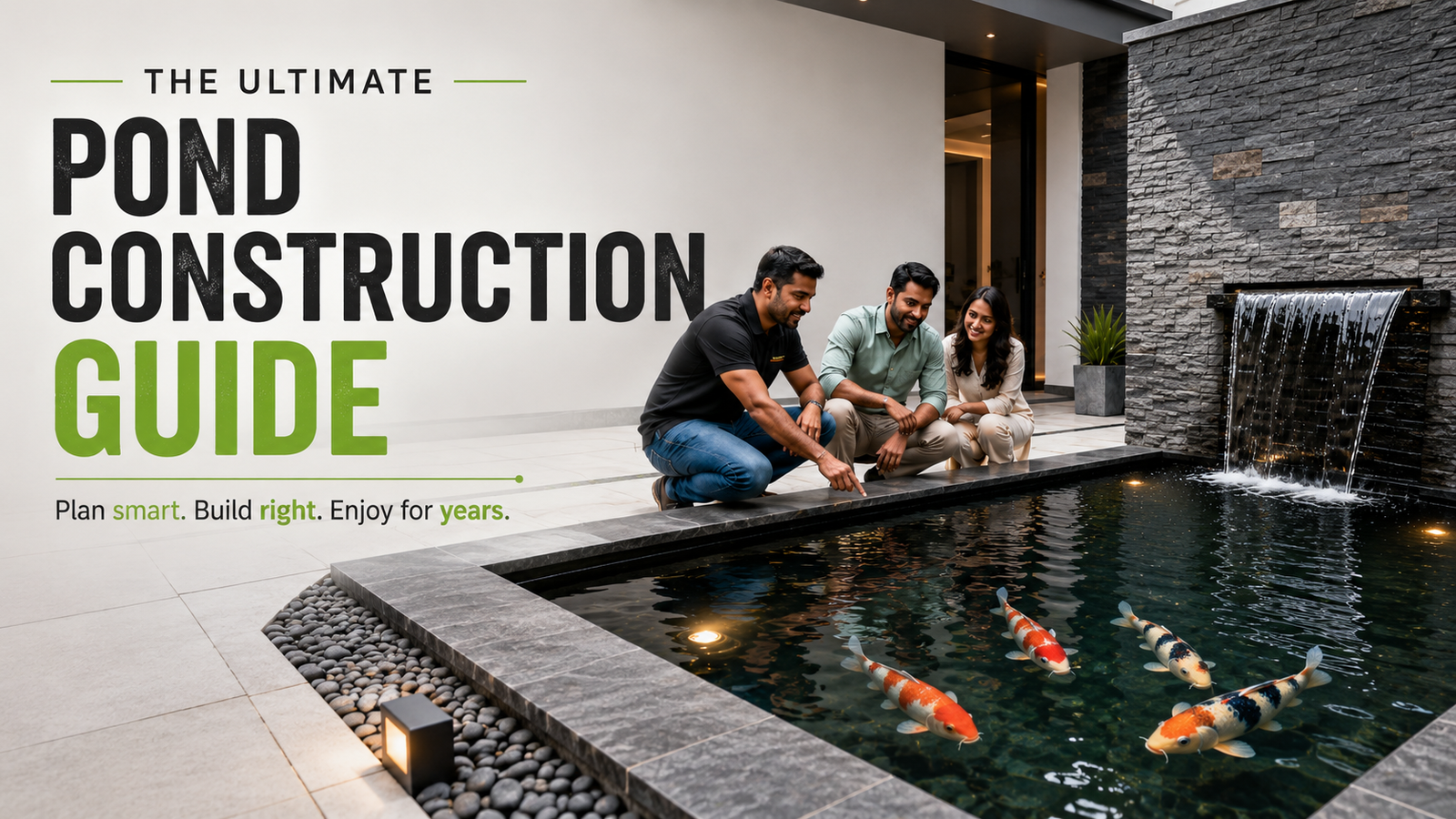
A beautifully designed pond can completely transform an outdoor space. Whether you want a peaceful garden pond, a decorative water feature, a natural pond, or a dedicated koi pond, proper planning is essential for creating a healthy and long-lasting aquatic environment.
Building a pond involves more than excavating the ground and adding water. The location, size, depth, waterproofing, filtration, plumbing, circulation, fish capacity, landscaping, and future maintenance requirements must all be considered before construction begins.
This complete Pond Construction Guide explains the most important factors you need to know before building a pond. It will help you avoid common construction mistakes and create a pond that remains clear, attractive, and easy to maintain.
At Greenfin The Pond Studio, we provide professional pond construction, filtration installation, equipment selection, landscaping support, and maintenance solutions for different types of residential and commercial ponds.
Why Proper Pond Planning Is Important
A successful pond starts with a detailed plan. Many pond problems develop because decisions are made only after construction has already started.
Poor planning can lead to:
- Regular water leakage
- Green or cloudy pond water
- Poor water circulation
- Fish health problems
- Difficult maintenance
- Inadequate filtration
- High electricity consumption
- Overflow during heavy rain
- Accumulation of waste at the bottom
- Expensive repairs or reconstruction
Following a proper Pond Construction Guide allows you to plan the complete pond ecosystem before civil work begins.
The pond design should consider both appearance and functionality. A visually attractive pond will not remain beautiful for long without effective filtration, proper plumbing, sufficient oxygenation, and easy maintenance access.
Decide the Purpose of the Pond
Before selecting the pond design, determine how the pond will be used. Different types of ponds require different depths, filtration systems, construction materials, and maintenance routines.
Decorative Garden Pond
A decorative garden pond is mainly designed to improve the appearance of a landscape. It may include aquatic plants, small ornamental fish, fountains, stones, waterfalls, and garden lighting.
These ponds are usually suitable for:
- Home gardens
- Villas
- Resorts
- Hotels
- Restaurants
- Office landscapes
- Courtyards
Decorative ponds may not require extremely deep construction, but they still need proper circulation and filtration to prevent stagnant water and algae growth.
Koi Pond
A koi pond is specifically designed for keeping koi fish. Koi produce a significant amount of waste and require excellent water quality, sufficient swimming space, strong biological filtration, and high oxygen levels.
A professional koi pond usually includes:
- Adequate depth
- Bottom drainage
- Mechanical filtration
- Biological filtration
- UV clarification
- Powerful water circulation
- Aeration
- Easy cleaning access
This Pond Construction Guide strongly recommends planning the complete filtration system before beginning a koi pond project.
Natural Pond
A natural pond uses plants, stones, beneficial bacteria, shallow planting zones, and natural filtration principles to create a balanced ecosystem.
Natural ponds can look extremely attractive, but their performance depends on correct plant selection, circulation, sunlight exposure, and nutrient control.
Swimming Pond
A natural swimming pond combines a swimming area with a separate regeneration or filtration zone. It requires specialised engineering, waterproofing, safety planning, circulation, and water treatment.
Swimming ponds should always be designed and constructed by experienced professionals.
Select the Right Pond Location
Location is one of the most important decisions in pond construction.
Choose an area where the pond can be clearly viewed from the house, garden seating area, balcony, restaurant, reception area, or other important viewing points.
Sunlight Exposure
A pond requires some sunlight, but excessive direct sunlight can increase water temperature and encourage algae growth.
Ideally, the pond should receive a balance of sunlight and shade. Avoid placing the pond under complete shade because aquatic plants may struggle to grow.
The correct sunlight level depends on:
- Pond depth
- Local climate
- Fish population
- Plant selection
- Filtration capacity
- Water circulation
In hot regions, partial shade can help control water temperature.
Avoid Large Trees
Building a pond directly under a large tree can create several problems. Falling leaves, flowers, seeds, branches, and organic debris can enter the water and increase the maintenance requirement.
Tree roots can also interfere with excavation, plumbing, concrete structures, and pond liners.
Check Drainage Conditions
Rainwater from surrounding areas should not flow directly into the pond. Surface runoff can carry soil, fertilisers, chemicals, garden waste, and contaminants into the water.
The surrounding ground level should be properly planned so rainwater moves away from the pond.
Choose the Correct Pond Size
The pond size should match the available space, intended fish population, filtration capacity, and budget.
A pond that is too small may experience rapid temperature changes and unstable water conditions. It may also become overcrowded if too many fish are added.
Before construction, calculate:
- Pond length
- Pond width
- Average depth
- Total water volume
- Expected fish population
- Pump flow requirement
- Filter capacity
The total pond volume is especially important when selecting pumps, filters, UV clarifiers, aerators, water treatments, and fish stocking levels.
Determine the Right Pond Depth
The ideal pond depth depends on the type of pond and the fish being kept.
Small decorative ponds can have shallow areas for plants. However, deeper areas usually provide more stable water temperatures and better protection for fish.
Koi ponds generally require greater depth because koi need sufficient vertical and horizontal swimming space. Deeper ponds are also less affected by sudden temperature fluctuations.
When deciding the pond depth, consider:
- Fish species
- Fish size
- Local temperature
- Water volume
- Child safety
- Cleaning requirements
- Construction conditions
- Soil stability
A pond should not have only one uniform depth unless the design specifically requires it. Different levels can be created for aquatic plants, decorative stones, fish movement, and maintenance access.
Select the Pond Construction Method
There are several pond construction methods. The right choice depends on the pond size, design, location, budget, and expected lifespan.
Reinforced Concrete Pond
Concrete ponds are commonly used for permanent koi ponds, commercial ponds, formal garden ponds, and customised water features.
Advantages include:
- Strong and durable structure
- Customisable shape
- Suitable for large ponds
- Ideal for tiled or stone finishes
- Supports viewing glass and architectural features
Concrete pond construction requires proper reinforcement, curing, waterproofing, expansion planning, and surface preparation.
Incorrect concrete work can result in structural cracks and leakage. Therefore, experienced civil and waterproofing professionals should handle the construction.
Pond Liner
Flexible pond liners are suitable for natural-shaped ponds and certain garden pond projects.
Advantages include:
- Flexible design
- Faster installation
- Suitable for irregular shapes
- Fewer structural cracking concerns
The ground must be properly prepared before installing the liner. Sharp stones, roots, and construction waste should be removed. A protective underlay is recommended to prevent punctures.
Preformed Pond
Preformed ponds are manufactured in fixed shapes and sizes. They are generally suitable for small decorative gardens.
They are quick to install but offer limited customisation.
Plan Waterproofing Carefully
Waterproofing is one of the most critical parts of this Pond Construction Guide.
Even a small leak can cause:
- Continuous water loss
- Increased water bills
- Damage to the surrounding landscape
- Soil erosion
- Structural problems
- Unstable water parameters
- Pump damage caused by low water levels
Concrete ponds require a suitable waterproofing system that is safe for fish and aquatic life.
The waterproofing process may include:
- Surface cleaning
- Crack treatment
- Corner reinforcement
- Application of waterproofing layers
- Proper curing
- Water testing
- Final surface finishing
Always complete a water-holding test before installing fish, plants, decorative stones, or expensive equipment.
Design the Pond Filtration System
A pond is a living ecosystem. Fish waste, uneaten food, leaves, dust, algae, and organic matter continuously enter the water.
A proper filtration system removes waste and supports beneficial bacteria that help process harmful substances.
Mechanical Filtration
Mechanical filtration removes visible particles from the water, including:
- Fish waste
- Leaves
- Uneaten food
- Dust
- Algae particles
- Organic debris
Common mechanical filtration components include filter brushes, filter mats, sieves, settling chambers, foam, and drum filters.
Biological Filtration
Biological filtration provides a surface for beneficial bacteria to grow. These bacteria convert toxic ammonia and nitrite into less harmful nitrate.
Biological filter media may include:
- Bio-balls
- Ceramic media
- Moving-bed media
- Sintered glass media
- Porous stone media
- Specialised pond bio-media
The biological filter capacity should be selected according to the pond volume and fish load, not only the physical size of the pond.
UV Clarifier
A UV clarifier can help control free-floating algae that causes green pond water.
The UV unit should be appropriately sized for the pond volume and water flow rate. Water must pass through the UV chamber at the correct speed for effective treatment.
A UV clarifier supports the filtration system, but it does not replace mechanical or biological filtration.
Select the Correct Pond Pump
The pond pump circulates water through the filter, waterfall, UV clarifier, fountain, or other water feature.
An incorrectly sized pump can lead to poor filtration or unnecessary power consumption.
When choosing a pond pump, consider:
- Total pond volume
- Required circulation rate
- Height of the waterfall
- Pipe length
- Pipe diameter
- Number of bends
- Filter resistance
- UV unit resistance
- Required water feature flow
The pump flow rate decreases as water is pushed upward or through long plumbing lines. Therefore, the pump should be selected according to its actual performance at the required head height.
A professional Pond Construction Guide should always include pump and plumbing calculations before purchasing equipment.
Plan the Plumbing Before Civil Work
Pond plumbing should not be treated as an afterthought. Pipes, drains, skimmers, return jets, pump chambers, and filter connections must be planned before concrete work is completed.
Important plumbing components may include:
- Bottom drain
- Surface skimmer
- Suction line
- Filter inlet
- Filter outlet
- Pond return line
- Overflow line
- Wastewater outlet
- Rainwater diversion
- Fountain line
- Waterfall line
Proper pipe sizing reduces flow resistance and improves pump efficiency.
Access points should also be provided so pumps, valves, UV lamps, and filters can be serviced without breaking the pond structure.
Install a Bottom Drain
A bottom drain helps move settled waste from the deepest part of the pond toward the filtration system.
Without a bottom drain, fish waste and organic debris may collect at the bottom, creating unhealthy conditions and increasing manual cleaning requirements.
The pond floor should be slightly sloped toward the bottom drain. This allows waste to move naturally toward the drainage point.
Bottom drain planning is especially important for koi ponds and heavily stocked fish ponds.
Add a Surface Skimmer
A pond skimmer removes floating debris before it sinks.
It can collect:
- Dry leaves
- Flowers
- Insects
- Dust
- Floating algae
- Uneaten fish food
The skimmer should be positioned according to the prevailing wind direction and pond circulation pattern.
Using both a bottom drain and a surface skimmer provides more complete waste removal.
Provide Adequate Aeration
Fish, beneficial bacteria, and other aquatic organisms require dissolved oxygen.
Oxygen levels can decrease during hot weather, at night, or when the pond contains too many fish.
Aeration can be provided using:
- Air pumps
- Air stones
- Diffusers
- Waterfalls
- Fountains
- Venturi systems
- Moving-bed biofilters
Waterfalls and fountains improve surface movement, but a dedicated air pump may still be necessary for heavily stocked koi ponds.
Backup aeration is also useful during power failures.
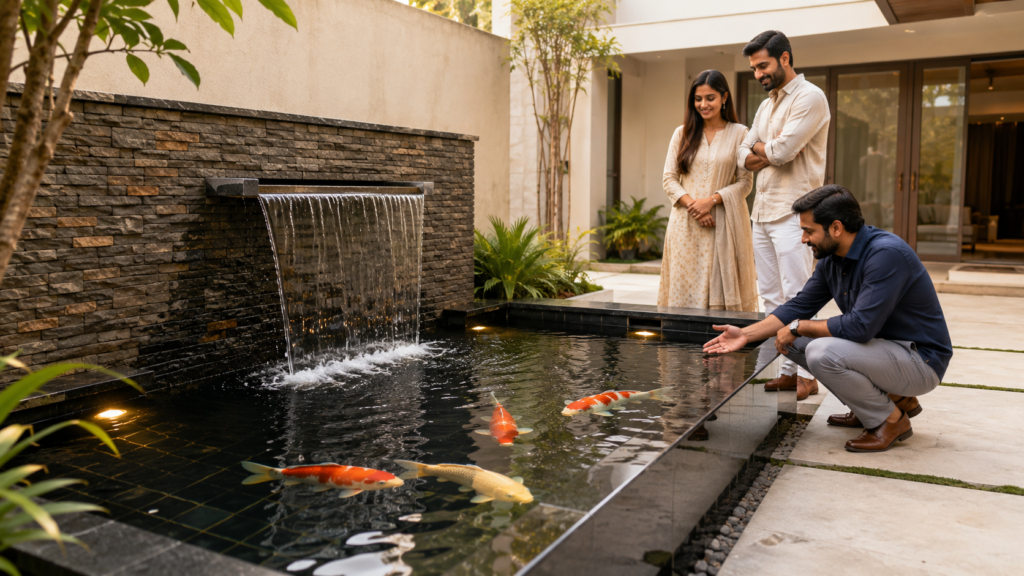
Plan the Waterfall or Fountain Properly
Waterfalls and fountains improve the appearance of the pond and increase water movement.
However, they must be correctly designed to avoid:
- Excessive water loss
- Splashing outside the pond
- Noise problems
- Uneven flow
- Pump overload
- Water leakage
- Difficult cleaning
The waterfall height, width, flow rate, stone arrangement, and plumbing should be coordinated with the pump capacity.
Water should always return safely to the pond without flowing behind the waterfall structure.
Select Fish-Safe Finishing Materials
All materials used inside the pond should be safe for fish and aquatic plants.
Avoid materials that may release harmful chemicals, alter the pH, rust, or have sharp edges.
Suitable finishes may include:
- Fish-safe waterproof coating
- Pond-safe tiles
- Natural stone
- Smooth cement finishes
- Fish-safe sealants
- Properly installed pond liners
Any adhesive, grout, paint, waterproofing chemical, or sealant should be fully cured before filling the pond.
After construction, the pond may require cleaning, repeated filling, draining, and water testing before fish are introduced.
Consider Viewing Glass
Viewing glass can create a premium appearance and allow koi and other pond fish to be viewed from the side.
The glass specification depends on:
- Pond depth
- Water pressure
- Glass panel size
- Support structure
- Installation method
- Safety requirements
Laminated toughened glass and a properly designed metal or structural support channel may be required.
Viewing glass installation should always be handled by experienced professionals because incorrect glass thickness or support can create a serious safety risk.
Landscape Around the Pond
Landscaping helps the pond blend naturally with the surrounding environment.
Suitable pond landscaping may include:
- Natural stones
- Gravel
- Timber decking
- Garden lights
- Pathways
- Seating areas
- Low-maintenance plants
- Decorative cladding
- Pebbles
- Water-tolerant planting
Avoid excessive planting close to the pond edge, especially plants that drop large quantities of leaves or have aggressive root systems.
The surrounding area should provide safe walking access for feeding fish, cleaning the pond, and servicing the filtration system.
Plan Electrical Safety
Pond pumps, UV clarifiers, lights, air pumps, automatic feeders, and other equipment require electricity.
Outdoor electrical installations must be protected from rain, water splashes, flooding, and accidental contact.
Electrical planning should include:
- Weatherproof sockets
- Proper earthing
- Circuit protection
- Safe cable routing
- Separate equipment switches
- Pump control access
- Backup power planning
Electrical work near water should always be completed by a qualified electrician.
Cycle the Pond Before Adding Fish
A newly constructed pond should not be filled with fish immediately.
The biological filtration system needs time to develop beneficial bacteria. This process is known as pond cycling.
During cycling, monitor:
- Ammonia
- Nitrite
- Nitrate
- pH
- Chlorine
- Water temperature
Tap water may contain chlorine or chloramine, which can harm fish and beneficial bacteria. A suitable water conditioner should be used when necessary.
Add fish gradually instead of introducing the full fish population at once. This gives the biological filter time to adjust to the increased waste load.
Common Pond Construction Mistakes
Following a reliable Pond Construction Guide can help prevent expensive errors.
Common mistakes include:
Building the Pond Too Shallow
Shallow ponds heat up quickly and may not provide enough swimming space for large fish.
Installing an Undersized Filter
A filter should be selected according to the pond volume, fish load, feeding level, and environmental conditions.
Using Small Plumbing Pipes
Undersized pipes restrict water flow and reduce pump efficiency.
Ignoring Maintenance Access
Filters, pumps, valves, and UV units must be accessible for cleaning and servicing.
Adding Too Many Fish
Overstocking increases waste production, oxygen demand, disease risk, and filtration requirements.
Poor Waterproofing
Inadequate surface preparation or incorrect waterproofing materials can result in leaks and structural damage.
No Overflow System
A pond without an overflow line may flood during heavy rain.
Adding Fish Immediately
New ponds require proper cleaning, conditioning, filtration, and cycling before fish are introduced.
How Much Does Pond Construction Cost?
Pond construction cost depends on several factors, including:
- Pond dimensions
- Pond depth
- Excavation conditions
- Concrete or liner construction
- Reinforcement requirements
- Waterproofing system
- Tile, stone, or cladding finish
- Pump capacity
- Filtration system
- UV clarifier
- Plumbing
- Electrical work
- Viewing glass
- Waterfalls and fountains
- Landscaping
- Lighting
- Accessibility of the site
A small decorative pond may require a lower investment, while a large koi pond with viewing glass, advanced filtration, landscaping, and automation will cost considerably more.
A site inspection is usually necessary to provide an accurate pond construction estimate. Ground conditions, travel distance, equipment access, drainage, and the existing landscape can all affect the final cost.
Why Professional Pond Construction Is Recommended
Professional pond construction helps ensure that the civil structure, waterproofing, filtration, plumbing, electrical system, and equipment work together correctly.
An experienced pond specialist can help with:
- Pond design
- Site evaluation
- Volume calculation
- Pump selection
- Filter sizing
- Plumbing layout
- Bottom drain installation
- Skimmer positioning
- Waterproofing recommendations
- Waterfall and fountain design
- Fish capacity planning
- Landscaping coordination
- Maintenance planning
Attempting to correct an improperly built pond can cost significantly more than planning it correctly from the beginning.
Final Pond Construction Checklist
Before starting your pond project, confirm the following:
- The purpose of the pond is clearly defined.
- The pond location has been selected carefully.
- The dimensions and water volume are calculated.
- The depth is suitable for the intended fish.
- The construction method has been finalised.
- Waterproofing materials are fish-safe.
- The filtration system is properly sized.
- The pond pump can provide sufficient flow.
- Plumbing is planned before civil work.
- A bottom drain and skimmer are considered.
- Aeration is sufficient.
- Overflow and wastewater drainage are included.
- Electrical connections are weatherproof.
- Equipment can be accessed for maintenance.
- Landscaping will not contaminate the pond.
- The pond will be cycled before adding fish.
Conclusion
Building a successful pond requires careful planning, suitable materials, effective waterproofing, efficient filtration, proper circulation, safe electrical installation, and long-term maintenance access.
This Pond Construction Guide provides the essential information needed before constructing a garden pond, koi pond, natural pond, or decorative water feature.
The most important step is to design the entire pond ecosystem before beginning excavation or civil work. The structure, filtration system, plumbing, pump, drainage, aeration, fish capacity, and landscaping should all be planned as one complete system.
Greenfin The Pond Studio offers professional pond construction, koi pond filtration, pond equipment installation, waterfall development, landscaping support, and pond maintenance solutions.
With the right design and professional support, your pond can remain clear, healthy, attractive, and enjoyable for many years.