

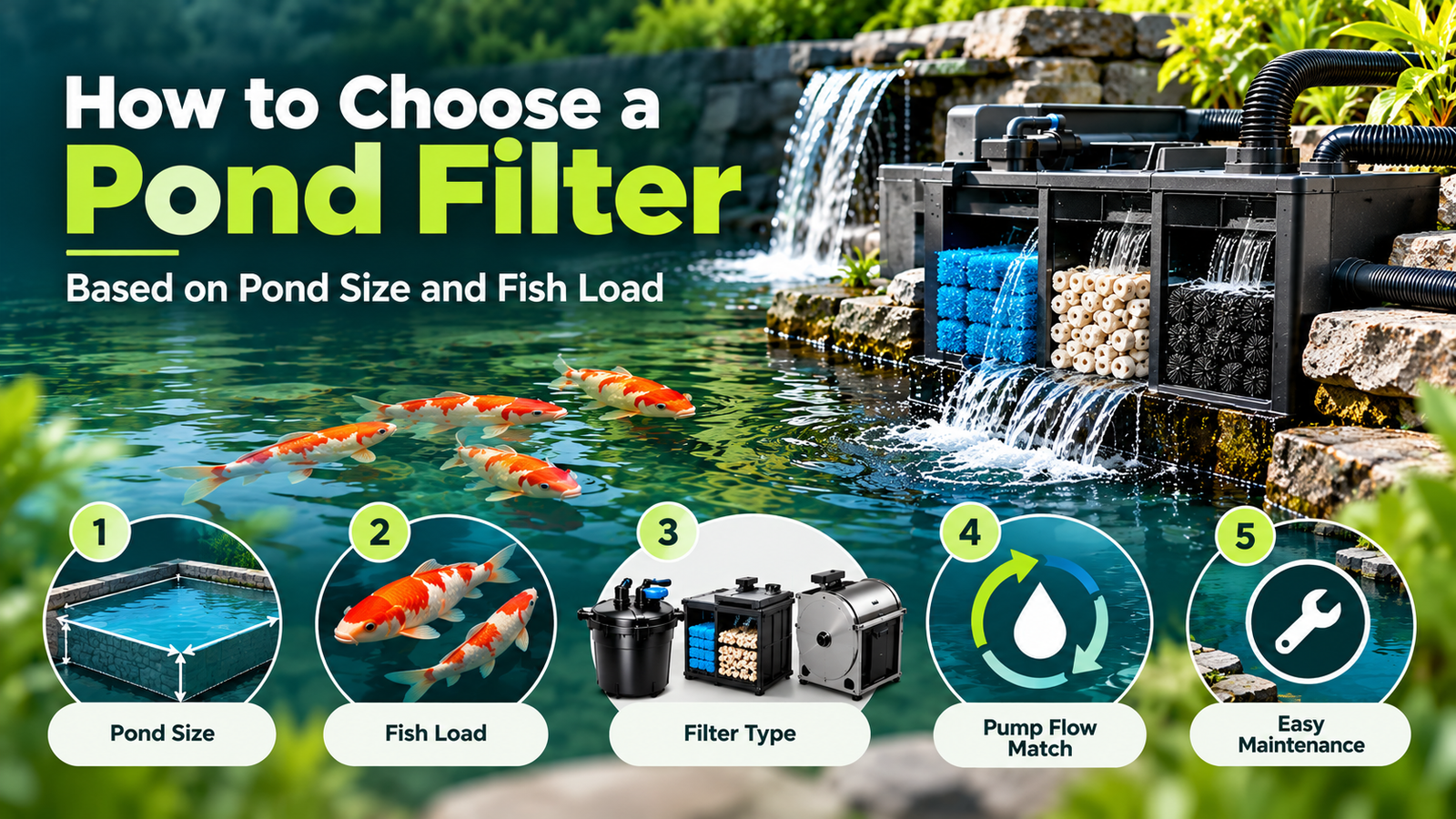
Choosing the right pond filtration system is essential for maintaining clear water, healthy fish, and a balanced pond environment. Whether you have a small garden pond or a large koi pond, the filter must be capable of handling the water volume, fish waste, and organic debris produced every day.
Selecting a pond filter for fish pond applications involves more than simply matching a filter to the pond’s water capacity. Fish stocking density, feeding frequency, pump flow rate, mechanical filtration, and biological filtration all affect the performance of the system.
An undersized filter may struggle to remove waste, while an incorrectly selected pump can reduce filtration efficiency. Understanding these factors helps you build a reliable filtration system that supports healthy fish and reduces maintenance.
In this guide, we explain how to choose the right pond filter based on pond size and fish load, compare different filter types, and identify the important specifications to check before purchasing pond filtration equipment.
Why Is Pond Filtration Important?
A pond filter helps maintain water quality by removing solid waste and supporting biological processes that break down harmful substances.
Fish release waste through their gills and excretion. Uneaten food, decaying leaves, and other organic material also contribute to the pond’s waste load. Without adequate filtration, these substances can accumulate and create unhealthy conditions.
A properly designed pond filtration system helps to:
- Remove suspended particles and solid waste.
- Support beneficial bacteria that process toxic ammonia and nitrite.
- Improve water clarity.
- Reduce the accumulation of organic waste.
- Support a healthier environment for koi and other pond fish.
- Make routine pond maintenance more manageable.
However, filtration alone is not enough. Adequate aeration, suitable fish stocking, regular water testing, and appropriate feeding practices are also necessary.
Step 1: Calculate Your Pond’s Water Volume
The first step in choosing a pond filter is determining how much water your pond holds.
Filter manufacturers often specify the maximum pond volume a product can support. However, these ratings may assume particular fish loads and operating conditions, so they should be treated as a starting point rather than a universal guarantee.
How to Calculate Pond Volume
For a rectangular pond, use this formula:
Pond volume in litres = Length × Width × Average water depth in metres × 1,000
For example, consider a pond with the following dimensions:
- Length: 4 metres
- Width: 3 metres
- Average water depth: 1 metre
Calculation:
4 × 3 × 1 × 1,000 = 12,000 litres
The pond contains approximately 12,000 litres of water when filled to the assumed average depth.
For irregular ponds, use an estimate of the average depth and account for sloping sides, shelves, and other features. The actual operating volume may be lower than the volume calculated from the maximum dimensions.
Why Pond Volume Matters
A larger pond generally requires greater filtration capacity because it contains more water and may support more fish. However, two ponds with the same water volume can have very different filtration requirements.
For example, a lightly stocked ornamental pond may have a relatively low waste load. A koi pond of the same size may require significantly more filtration because koi produce substantial waste and are often fed more heavily.
This is why pond volume must always be considered alongside fish load.
Step 2: Consider Your Fish Load
Fish load refers to the quantity and size of fish in a pond and the amount of waste they produce.
When selecting a pond filter for fish pond applications, fish load is one of the most important factors to consider.
Light Fish Load
A lightly stocked pond with a few small fish generally produces less waste than a heavily stocked koi pond.
A suitable filtration system may include a mechanical filter, a biological filter, and adequate water circulation. The final configuration depends on pond size, feeding, and the type of fish.
Moderate Fish Load
A pond with a moderate number of fish requires stronger waste processing and more consistent water circulation.
Consider a filter with sufficient mechanical capacity to collect solids and enough biological media to support beneficial bacteria. Regular water testing helps determine whether the system is keeping up with the waste load.
Heavy Fish Load
Heavily stocked koi ponds require careful filtration planning because larger fish and frequent feeding increase the production of ammonia and solid waste.
Depending on the pond design, suitable options may include:
- A multi-chamber filtration system.
- A pressurised pond filter with an appropriate biological stage.
- A drum filter or another high-capacity mechanical filter combined with biological filtration.
- A dedicated aeration system to support fish and biological activity.
The system should be designed around the expected mature size of the fish, feeding rate, and maintenance requirements, rather than the number of fish alone.
Important: There is no single universal fish-per-litre rule that guarantees safe stocking. Fish size, species, temperature, oxygen availability, and filtration performance all affect the appropriate stocking level.
Step 3: Understand Mechanical and Biological Filtration
Most fish ponds benefit from both mechanical and biological filtration. These processes serve different purposes and should be selected together.
What Is Mechanical Filtration?
Mechanical filtration removes solid particles from the water before they continue through the system.
Examples of material removed include:
- Fish waste and uneaten food.
- Leaves and other organic debris.
- Suspended particles.
- Fine dirt and other visible solids.
Common mechanical filtration components include filter sponges, brushes, filter mats, settling chambers, and specialised screen or drum filters.
Mechanical filtration reduces the amount of solid waste circulating in the pond. It also helps prevent excessive organic material from accumulating in biological filter media.
Choose a filter with sufficient capacity to collect the expected solids without requiring excessively frequent cleaning.
What Is Biological Filtration?
Biological filtration uses beneficial microorganisms that colonise suitable filter media.
These microorganisms convert toxic ammonia produced by fish and organic waste into nitrite and then into nitrate through the nitrification process. Ammonia and nitrite are toxic to fish, so an established biological filter is essential for a healthy pond.
Common biological filter media include:
- Plastic bio-media with a high surface area.
- Moving-bed media designed for suitable aerated chambers.
- Ceramic media intended for biological filtration.
- Porous biological media compatible with the filter design.
Different media require different operating conditions. For example, moving-bed media needs adequate aeration and movement, while other media may be used in static chambers.
Biological filtration takes time to establish. A new filter should not be assumed to be fully mature immediately after installation.
Why Both Types Are Important
Mechanical filtration captures physical waste, while biological filtration processes harmful nitrogen compounds.
A pond filter that collects debris but has insufficient biological capacity may struggle with ammonia and nitrite. Conversely, a biological filter that receives excessive solid waste may become clogged and perform poorly.
For this reason, an effective pond filtration system should provide suitable mechanical separation and biological treatment for the pond’s fish load.
Step 4: Choose the Right Type of Pond Filter
Different filter designs suit different pond sizes, fish loads, and maintenance preferences.
1. Pressurised Pond Filter
A pressurised filter is a closed unit through which water passes under pressure from a pump.
Many models combine mechanical and biological filtration, and some include a UV clarifier for controlling suspended algae.
Best suited for:
- Small and medium-sized garden ponds.
- Decorative ponds with waterfalls.
- Compact installations where space is limited.
- Pond owners who prefer convenient cleaning features.
Before buying, check the manufacturer’s rated pond capacity, fish-load assumptions, maximum flow rate, and cleaning mechanism. A model suitable for a lightly stocked ornamental pond may not be sufficient for a heavily stocked koi pond of the same volume.
2. Multi-Chamber Pond Filter
A multi-chamber filter divides filtration into separate sections. Depending on the design, these may include settling, mechanical filtration, and biological filtration stages.
Best suited for:
- Medium and large ponds.
- Koi ponds with higher waste loads.
- Custom-built filtration systems.
- Installations requiring flexible filter-media arrangements.
The advantage of a multi-chamber system is that different stages can be designed for specific purposes. Mechanical sections can collect solids, while biological sections provide suitable conditions for beneficial bacteria.
Correct chamber sizing, water distribution, cleaning access, and oxygen supply are important for reliable operation.
3. Drum Filter
A drum filter is an automated mechanical filtration system that uses a screen to separate solid particles from the water. Many systems clean the screen automatically when a sensor detects reduced water flow or a change in water level.
Drum filters are often paired with a separate biological filtration stage.
Best suited for:
- Larger koi ponds.
- Heavily stocked ponds.
- Systems with substantial solid-waste production.
- Pond owners seeking reduced manual mechanical-filter cleaning.
Drum filters generally involve a higher initial investment and require appropriate plumbing, power, drainage, and maintenance arrangements.
4. Gravity-Fed Filtration System
A gravity-fed system allows water to flow from a pond drain or skimmer into a filter chamber, with a pump returning the filtered water to the pond.
This design is often used in professionally planned koi ponds because it can move waste toward mechanical filtration without requiring all incoming water to be pulled through a pump first.
Best suited for:
- New koi pond construction.
- Larger ponds with bottom drains.
- Custom multi-stage filtration layouts.
- Installations where efficient solids handling is a priority.
Gravity-fed systems require careful planning of pipe diameters, water levels, filter elevation, and pump placement.
Quick Comparison of Pond Filter Types
| Filter type | Typical application | Main consideration |
|---|---|---|
| Pressurised filter | Small and medium ponds | Check actual fish-load capacity |
| Multi-chamber filter | Medium and large ponds | Requires space and planned maintenance |
| Drum filter | Large or heavily stocked ponds | Higher cost and installation complexity |
| Gravity-fed system | Planned koi ponds | Requires careful plumbing and level design |
No single filter type is best for every pond. Choose based on the actual water volume, fish load, available space, budget, and maintenance preferences.
Step 5: Select the Correct Pond Pump Flow Rate
A pond filter can only perform effectively when the water flow through it is appropriate for the filter’s design.
The pump must move enough water through the filtration system without exceeding the filter’s permitted flow rate.
Calculate a Starting Flow Rate
A common starting point for planning a pond system is to consider how quickly the entire pond volume should pass through the filter.
For example, if a 12,000-litre pond is designed around a nominal turnover time of two hours:
12,000 ÷ 2 = 6,000 litres per hour
This gives a theoretical flow rate of 6,000 L/h.
However, a two-hour turnover is an illustrative planning assumption, not a universal requirement. Heavily stocked koi ponds, particular filter designs, and different hydraulic layouts may require a different flow rate.
Account for Head Height and Pipe Resistance
A pump’s advertised flow rate is usually measured under specified test conditions. Actual flow will decrease depending on the installation.
Important factors include:
- Height the pump must lift the water.
- Length and diameter of the pipework.
- Number of elbows, bends, and fittings.
- Resistance through the filter and UV equipment.
- Flow restrictions caused by partially blocked components.
Check the pump’s performance curve to estimate the actual flow at the required operating head.
Avoid Excessive Flow
Too much flow can reduce filtration effectiveness if water passes through a filter faster than its design allows.
Excessive flow may also cause mechanical solids to pass through inadequately sized filtration stages or create unwanted turbulence in biological chambers.
Always check the filter’s minimum and maximum recommended flow rates, and select a pump that meets those requirements under real operating conditions.
Step 6: Match Filter Capacity to Your Pond
Manufacturers often provide a maximum recommended pond volume. The rating may differ depending on whether the pond contains ornamental fish or koi.
Use the manufacturer’s rating as a starting point and adjust your selection according to the actual waste load.
For example, consider two hypothetical ponds:
Pond A: Lightly stocked ornamental pond
- Water volume: 5,000 litres.
- Small number of fish.
- Moderate feeding.
- Limited debris entering the pond.
A suitably rated pressurised filter or compact multi-stage system may be appropriate.
Pond B: Heavily stocked koi pond
- Water volume: 5,000 litres.
- Several large koi.
- Frequent feeding.
- Higher waste production.
This pond may require a substantially more capable filtration arrangement, even though its volume is identical to Pond A.
The difference is the biological and mechanical load placed on the filter.
What Should You Check Before Buying?
Review the following specifications:
- Recommended pond volume for your fish type.
- Maximum fish-load rating, if the manufacturer provides one.
- Recommended and maximum flow rates.
- Mechanical filter capacity and cleaning method.
- Biological media volume and design.
- Compatibility with the pond pump and pipework.
- Availability of replacement parts and service support.
- Ease of cleaning and routine maintenance.
If the manufacturer’s specifications are unclear, consult the supplier before selecting a filter for a high-density koi pond.
Step 7: Consider Pond Shape, Bottom Drains and Skimmers
The filter is only one part of the overall pond system. Effective waste collection also depends on how water and debris reach the filter.
Bottom Drains
A bottom drain helps collect settled waste from the pond floor and transport it toward the filtration system. It is particularly useful in purpose-built koi ponds.
The drain layout should account for pond depth, floor slope, plumbing design, and the filtration system’s operating method.
Pond Skimmers
A skimmer collects floating debris such as leaves, insects, and pollen from the water surface.
It can reduce the amount of organic material that sinks into the pond, but it does not replace a biological filter or a dedicated solid-waste collection stage.
Water Returns and Circulation
Water returns help establish circulation patterns that move waste toward drains or collection points.
Poor circulation may leave debris in corners or low-flow areas, even when the filter itself is adequately sized.
For larger ponds, plan the bottom drains, skimmer, pump, and filter as one coordinated system rather than selecting each component independently.
Step 8: Maintain the Filter for Consistent Performance
Even a correctly sized filter can perform poorly when neglected.
Regular maintenance helps maintain water flow, protect beneficial bacteria, and prevent waste accumulation.
Mechanical Filter Maintenance
Inspect the mechanical stages frequently and remove accumulated solids as needed. The cleaning frequency depends on fish load, feeding, pond debris, and filter design.
Follow the manufacturer’s cleaning instructions and avoid returning concentrated waste to the pond.
Biological Filter Maintenance
Avoid unnecessarily aggressive cleaning of biological media because it can remove beneficial bacteria.
Where cleaning is required, follow the filter manufacturer’s instructions. When appropriate for the media, use pond water rather than untreated chlorinated tap water to reduce harm to the biological community.
Monitor Water Quality
Test ammonia and nitrite, especially when starting a new filter, increasing fish numbers, or changing feeding rates. Also monitor dissolved oxygen, pH, and other relevant parameters.
If ammonia or nitrite becomes detectable at concerning levels, investigate the cause promptly, reduce feeding where appropriate, improve aeration, and take suitable corrective action.
Do not assume that clearer water automatically means safe water.
Common Mistakes When Choosing a Pond Filter
Avoid these common mistakes when selecting pond filtration equipment:
- Choosing only by pond volume: Fish load and feeding frequency can dramatically change the required capacity.
- Ignoring the manufacturer’s flow limits: A pump that delivers unsuitable flow may reduce filtration performance.
- Using mechanical filtration without adequate biological treatment: Solid waste removal alone does not provide complete water-quality management.
- Overstocking the pond: No filter can compensate indefinitely for excessive fish numbers and feeding.
- Ignoring aeration: Fish and beneficial bacteria need adequate oxygen.
- Failing to plan waste collection: Poor drain and circulation design can allow debris to accumulate even with a powerful filter.
- Neglecting maintenance: Clogged mechanical media and neglected equipment can reduce flow and performance.
- Expecting instant biological filtration: New biological media needs time to establish a functioning bacterial community.
Conclusion
Choosing the right pond filter depends on more than the size of the pond. Water volume, fish size, stocking density, feeding frequency, pump flow, and the balance between mechanical and biological filtration all determine how well the system will perform.
A lightly stocked ornamental pond may work well with a suitably rated pressurised filter, while a large or heavily stocked koi pond may benefit from a multi-chamber or drum-based filtration system.
Before purchasing a pond filter for fish pond applications, calculate the actual water volume, assess the expected mature fish load, confirm the manufacturer’s capacity rating, and match the pump to the filter’s operating requirements.
For a reliable pond system, combine suitable mechanical filtration, established biological filtration, adequate aeration, effective circulation, and regular water testing.
Explore pond pumps, filtration equipment, UV clarifiers, and filter media at GreenfinIndia.com to find products suited to your pond setup.
Frequently Asked Questions (FAQs)
1. How do I choose a pond filter for my pond size?
Calculate the pond’s actual water volume and then consider fish type, fish load, feeding frequency, and the manufacturer’s recommended filter capacity. Choose a system with sufficient mechanical and biological filtration for the expected waste load.
2. Is a bigger pond filter always better?
A larger filter can provide additional filtration capacity, but it must still be compatible with the pump, flow rate, plumbing, and pond design. Correct sizing and appropriate operation are more important than choosing a filter based on size alone.
3. What filter is best for a koi pond?
The best option depends on pond volume and stocking density. A suitably rated multi-chamber system may work well for many koi ponds, while heavily stocked or larger installations may benefit from a drum filter paired with biological filtration.
4. How much pump flow does a pond filter need?
The required flow depends on pond volume, the intended turnover rate, filter specifications, and hydraulic resistance. Calculate a starting flow from the desired turnover time, then account for head height and pipe losses and remain within the filter manufacturer’s permitted range.
5. What is the difference between mechanical and biological pond filtration?
Mechanical filtration removes physical particles such as fish waste and leaves. Biological filtration uses beneficial microorganisms to convert ammonia into nitrite and then nitrate. Both functions are important for most fish ponds.
6. Can one filter handle a heavily stocked koi pond?
It can be possible with a correctly designed, adequately rated filtration system. The system must be able to process the fish waste, handle the solid load, maintain suitable flow, and support adequate oxygen levels. Multiple filtration stages may be appropriate for larger systems.
7. How often should I clean a pond filter?
Inspect the filter regularly and clean it according to the manufacturer’s instructions and the amount of waste collected. Mechanical stages may need frequent cleaning, while biological media should be maintained carefully to preserve beneficial bacteria.
8. Does a UV clarifier replace a pond filter?
No. A UV clarifier can help control suspended algae when correctly sized and installed, but it does not replace mechanical solids removal or biological filtration for ammonia and nitrite management.